OrbitalHub

The place where space exploration, science, and engineering meet

Domain is for sale. $50,000,000.00 USD. Direct any inquiries to contact@orbitalhub.com.

10-16-25

Rocket Supercomputer Simulation

Posted by


Mea AI adiutor dicit:

When NASA’s Space Launch System (SLS) powers into the sky, it must contend with some of the most extreme and complex aerodynamic conditions ever attempted. The ascent phase—especially during transonic and supersonic transitions and through maximum aerodynamic stress—is a crucible for design and engineering. Rather than rely solely on wind tunnels, NASA has increasingly turned to supercomputer-based computational fluid dynamics (CFD) simulations to model the flows around the twin solid rocket boosters, the core stage, and plume interactions. These simulations feed into aerodynamic databases used across vehicle design, structural loads, control algorithms, and safety margins.

The challenge in modeling the flow around SLS boosters is immense. As the vehicle accelerates, shock waves form, flow separation regions emerge, boundary layers evolve, and the rocket plumes themselves strongly interact with the surrounding airstream. Moreover, during events like booster separation, multiple plumes fire simultaneously—up to 22 different exhaust sources in some analyses, combining output from the core engines, boosters, and separation motors. Resolving those off-body interactions, transient flow features, and the coupling between vehicle aerodynamics and plume dynamics demands very high fidelity simulations. The NASA team has used solvers such as OVERFLOW, FUN3D, and Cart3D to explore a wide envelope of flight conditions.

Running these simulations requires massive computational resources. Each case can consume thousands to tens of thousands of core-hours, depending on flow complexity, grid resolution, and the number of interacting plumes. To build a full aerodynamic database that spans multiple Mach numbers, angles of attack, mass fractions, and thrust conditions, NASA runs hundreds to thousands of individual cases. The supercomputers at the NASA Advanced Supercomputing (NAS) facility, including Pleiades, Electra, and others, serve as the backbone of these efforts. Through careful meshing strategies, solver optimizations, and parallel computing techniques, engineers map out pressure distributions, shear stresses, and load profiles for every relevant component of the booster-core assembly.

These simulation results are not academic exercises—they directly inform the safety and performance of SLS missions. The aerodynamics databases are used by structural engineers to assess bending loads, by guidance and control teams to refine trajectory models, and by separation system designers to ensure that boosters detach cleanly without risking collision with the core. When flight data come in, the models themselves can be validated and refined, closing the loop between simulation and real world performance. As SLS evolves—especially with future variants and heavier payloads—the simulation infrastructure will scale accordingly, enabling continuous improvements in confidence, margin, and mission success.

Video credit: NASA/NAS/Gerrit-Daniel Stich, Michael Barad, Timothy Sandstrom, Derek Dalle


  • Facebook
  • Google
  • Slashdot
  • Reddit
  • Live
  • TwitThis
04-28-25

Artemis II Rocket Core Stage

Posted by


NASA dicit:

​Technicians use massive cranes inside the Vehicle Assembly Building at NASA Kennedy’s Space Center in Florida to lift the fully assembled SLS (Space Launch System) core stage vertically 225-feet above the ground from High Bay 2 to a horizontal position in the facility’s transfer aisle. In the transfer aisle, technicians conducted final preparations of the core stage before it was integrated with the completed twin solid rocket booster segments. NASA is implementing a more efficient stacking process to support future missions to the Moon beginning with the Artemis II test flight.

Video credit: NASA


  • Facebook
  • Google
  • Slashdot
  • Reddit
  • Live
  • TwitThis
04-14-25

Stacking the SLS Boosters

Posted by


Wikipedia dicit:

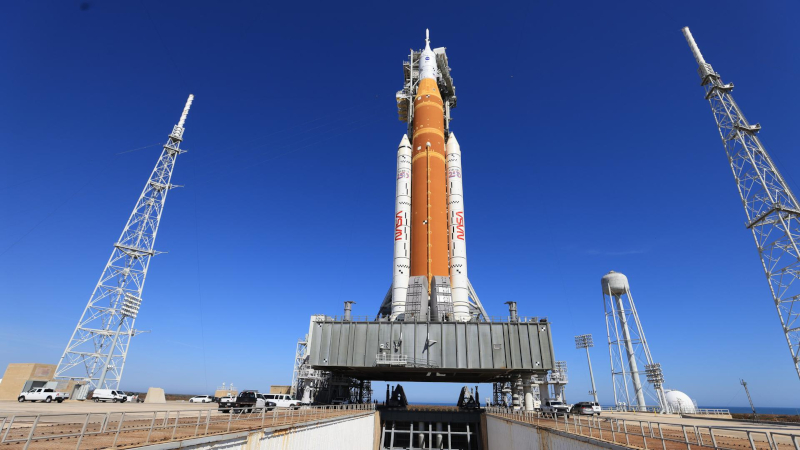
The Space Launch System (SLS) is an American super heavy-lift expendable launch vehicle used by NASA. As the primary launch vehicle of the Artemis Moon landing program, SLS is designed to launch the crewed Orion spacecraft on a trans-lunar trajectory. The first (and so far only) SLS launch was the uncrewed Artemis I, which took place on 16 November 2022.

Development of SLS began in 2011 as a replacement for the retiring Space Shuttle as well as the canceled Ares I and Ares V launch vehicles. SLS was built using existing Shuttle technology, including solid rocket boosters and RS-25 engines. The rocket has been criticized for its political motivations, seen as a way to preserve jobs and contracts for aerospace companies involved in the Shuttle program at great expense to NASA. The project has faced significant challenges, including mismanagement, substantial budget overruns, and significant delays. The first Congressionally mandated launch in late 2016 was delayed by nearly six years.

All Space Launch System flights are to be launched from Launch Complex 39B at the Kennedy Space Center in Florida. The first three SLS flights are expected to use the Block 1 configuration, comprising a core stage, extended Space Shuttle boosters developed for Ares I and the Interim Cryogenic Propulsion Stage (ICPS) upper stage. The improved Block 1B configuration, with the powerful and purpose-built Exploration Upper Stage (EUS), is planned to be introduced on the fourth flight; a further improved Block 2 configuration with new solid rocket boosters is planned for the ninth flight. After the launch of Artemis IV, NASA plans to transfer production and launch operations of SLS to Deep Space Transport LLC, a joint venture between Boeing and Northrop Grumman.

Video credit: NASA


  • Facebook
  • Google
  • Slashdot
  • Reddit
  • Live
  • TwitThis
07-26-24

SLS Core Stage

Posted by


Wikipedia dicit:

The Space Launch System core stage, or simply core stage, is the main stage of the American Space Launch System (SLS) rocket, built by The Boeing Company in the NASA Michoud Assembly Facility. At 65 m (212 ft) tall and 8.4 m (27.6 ft) in diameter, the core stage contains approximately 987 t (2,177,000 lb) of its liquid hydrogen and liquid oxygen cryogenic propellants. Propelled by 4 RS-25 engines, the stage generates approximately 7.44 MN (1,670,000 lbf) of thrust, about 25% of the Space Launch System’s thrust at liftoff, for approximately 500 seconds, propelling the stage alone for the last 375 seconds of flight. The stage lifts the rocket to an altitude of approximately 162 km (531,380 ft) before separating, reentering the atmosphere over the Pacific Ocean.

The core stage originated in 2011, when the architecture of the Space Launch System as a whole was defined. In the aftermath of the end of the Space Shuttle program and the cancellation of its prospective replacement the Constellation program, the SLS emerged, a super-heavy lift launch vehicle intended for human spaceflight to the Moon. The core stage is the first newly-developed stage of the SLS; the ICPS (Interim Cryogenic Propulsion Stage) and five-segment boosters are adaptations of existing hardware, to be replaced by the Exploration Upper Stage and BOLE boosters respectively.

Production of core stages began by 2014, but was beset by numerous difficulties in production and testing which delayed the readiness of the first core stage by several years. The core stage first flew on November 16, 2022, on the Artemis 1 mission, in which it performed successfully. As of 2024, the second core stage is completed, with the third and fourth core stages in production and while work has begun for the fifth and sixth, their production pending the transfer of SLS operations to Deep Space Transport, the vehicle’s future operator.

Video credit: NASA’s Marshall Space Flight Center


  • Facebook
  • Google
  • Slashdot
  • Reddit
  • Live
  • TwitThis


Wikipedia dicit:

The Space Launch System (SLS) is an American super heavy-lift expendable launch vehicle used by NASA. As the primary launch vehicle of the Artemis Moon landing program, SLS is designed to launch the crewed Orion spacecraft on a trans-lunar trajectory. The first SLS launch was the uncrewed Artemis 1, which took place on 16 November 2022.

Development of SLS began in 2011, as a replacement for the retired Space Shuttle as well as the cancelled Ares I and Ares V launch vehicles. As a Shuttle-derived vehicle, the SLS reuses hardware from the Shuttle program, including the solid rocket boosters and RS-25 first stage engines. A Congressionally mandated late 2016 launch was delayed by nearly 6 years.

All Space Launch System flights are launched from Launch Complex 39B at the Kennedy Space Center in Florida. The first three SLS flights use the Block 1 configuration, comprising a core stage, extended Space Shuttle boosters developed for Ares I and the ICPS upper stage. An improved Block 1B configuration, with the Exploration Upper Stage, is planned to debut on the fourth flight; a further improved Block 2 configuration featuring new solid rocket boosters is planned to debut on the ninth flight. After the launch of Artemis 4, NASA plans to transfer production and launch operations of SLS to Deep Space Transport LLC, a joint venture between Boeing and Northrop Grumman.

Video credit: NASA’s Marshall Space Flight Center


  • Facebook
  • Google
  • Slashdot
  • Reddit
  • Live
  • TwitThis
06-27-23

Foam Insulation on Artemis III

Posted by


NASA dicit:

Teams at NASA’s Marshall Space Flight Center in Huntsville, Alabama, have completed applying a spray-on foam insulation to the launch vehicle stage adapter (LVSA) for the Artemis III mission. The LVSA is a cone-shaped piece of hardware that connects the SLS (Space Launch System) rocket’s upper and lower stages and partially encloses the engine of the interim cryogenic propulsion stage. The spray-on foam insulation is a type of thermal protection system that is used to protect the Moon rocket’s hardware from the extreme temperatures, forces, and sounds it’ll experience during launch and ascent. Unlike other parts of the mega rocket, the thermal protection system for the LVSA is applied entirely by hand using a tool similar to a spray gun. It is the largest piece of SLS hardware to be hand sprayed.

Video credit: NASA’s Marshall Space Flight Center


  • Facebook
  • Google
  • Slashdot
  • Reddit
  • Live
  • TwitThis