OrbitalHub

The place where space exploration, science, and engineering meet

Domain is for sale. $50,000,000.00 USD. Direct any inquiries to contact@orbitalhub.com.


Mea AI adiutor dicit:

Sentinel-6B represents the next leap in monitoring our planet’s oceans, a critical mission driven by a collaboration between NASA, NOAA, ESA (the European Space Agency), EUMETSAT, and France’s CNES. Slated for launch in November 2025 aboard a SpaceX Falcon 9 from Vandenberg Space Force Base, this satellite continues a decades-long legacy of radar altimetry measurements that trace back to the TOPEX/Poseidon era.

The heart of Sentinel-6B lies in its mission to precisely measure sea surface height across roughly 90% of the world’s oceans. This is not just a climate mission: the data will feed into operational ocean models, improve weather forecasts, and play a critical role in coastal planning — informing everything from flood risk to shipping routes. Moreover, because sea level is one of the most direct indicators of climate-driven change, Sentinel-6B helps maintain the continuity of a vital long-term dataset.

Beyond ocean heights, Sentinel-6B will also monitor the atmosphere. Using a technique called GNSS radio occultation, it will capture vertical profiles of temperature and humidity in Earth’s atmosphere, enhancing the accuracy of weather prediction models. This atmospheric data even supports NASA’s Engineering Safety Center, helping plan safer reentry paths for future Artemis missions.

The satellite is outfitted with a sophisticated suite of instruments. Its Poseidon-4 altimeter will send radar pulses to the ocean surface and measure their return time to derive sea level measurements. A microwave radiometer (AMR-C) will correct for atmospheric water vapor, which affects radar accuracy. Its GNSS-RO receiver gathers data for the radio occultation measurements, while a DORIS system and a GNSS precise orbit determination package help pin down the satellite’s position with extreme precision. A laser retroreflector array (LRA) further enhances orbit tracking.

The Sentinel-6B mission carries profound implications for climate science, public safety, and operational forecasting. By extending the sea-level record well into the 2030s, it enables scientists and policymakers to track ocean trends with greater fidelity than ever before. This continuity is vital: without it, we risk losing sight of how fast sea levels are changing and which regions are most vulnerable.

As Sentinel-6B prepares for launch, it promises not only to safeguard critical infrastructure but also to deepen our understanding of Earth’s changing climate system. Through robust international collaboration and cutting-edge technology, this mission underscores how satellites remain our most powerful tools in charting the future of our oceans.

Video credit: NASA


  • Facebook
  • Google
  • Slashdot
  • Reddit
  • Live
  • TwitThis
11-24-20

Sentinel-6 Liftoff

Posted by


NASA dicit:

The Sentinel-6 Michael Freilich satellite, carried atop a SpaceX Falcon 9 rocket, lifts off from Space Launch Complex 4 at Vandenberg Air Force Base in California on November 21, 2020. Launch occurred at 9:17 a.m. PST (12:17 p.m. EST). The mission is an international collaboration between NASA and several partners, and it will collect the most accurate data yet on global sea level and how our oceans are rising in response to climate change. NASA’s Launch Services Program based at Kennedy Space Center was responsible for launch management.

Video credit: NASA’s Kennedy Space Center


  • Facebook
  • Google
  • Slashdot
  • Reddit
  • Live
  • TwitThis
05-31-18

Sentinel-3B

Posted by


ESA dixit:

“See in this time-lapse how the Sentinel-3B satellite was prepared for its liftoff on 25 April 2018 from Plesetsk in Russia.

Sentinel-3B joined its twin, Sentinel-3A, in orbit. The pairing of identical satellites provides the best coverage and data delivery for Europe’s Copernicus programme – the largest environmental monitoring programme in the world. The satellites carry the same suite of cutting-edge instruments to measure oceans, land, ice and atmosphere.”

Credits Video: ESA/Stephane Corvaja/Zetapress/Manuel Pedoussaut/Hubrid-Rockot


  • Facebook
  • Google
  • Slashdot
  • Reddit
  • Live
  • TwitThis
10-16-17

Sentinel-5P Liftoff

Posted by


ESA dixit:

“Replay of the Sentinel-5P liftoff on a Rockot from the Plesetsk Cosmodrome in northern Russia at 09:27 GMT (11:27 CEST) on 13 October 2017.

Sentinel-5P – the ‘P’ standing for ‘Precursor’ – is the first Copernicus mission dedicated to monitoring our atmosphere. The satellite carries the state-of-the-art Tropomi instrument to map a multitude of trace gases such as nitrogen dioxide, ozone, formaldehyde, sulphur dioxide, methane, carbon monoxide and aerosols – all of which affect the air we breathe and therefore our health, and our climate.”

Video credit: ESA


  • Facebook
  • Google
  • Slashdot
  • Reddit
  • Live
  • TwitThis
01-16-16

Sentinel-3

Posted by


ESA dixit:

“The Sentinels are a fleet of satellites designed to deliver the wealth of data and imagery that are central to the European Commission’s Copernicus programme.

This unique environmental monitoring programme is making a step change in the way we view and manage our environment, understand and tackle the effects of climate change and safeguard everyday lives. It serves European citizens, both directly through its products and applications, and indirectly through social, economic and environmental benefits.

Carrying a suite of cutting-edge instruments, Sentinel-3 will measure systematically Earth’s oceans, land, ice and atmosphere to monitor and understand large-scale global dynamics. It will provide essential information in near-real time for ocean and weather forecasting.

The mission is based on a two identical satellites orbiting in constellation for optimum global coverage and data delivery. For example, with a swath width of 1270 km, the ocean and land colour instrument will provide global coverage every two days.

With a focus towards our oceans, Sentinel-3 measures the temperature, colour and height of the sea surface as well as the thickness of sea ice. These measurements will be used, for example, to monitor changes in sea level, marine pollution and biological productivity.

Over land, this innovative mission will provide a bigger picture by monitoring wildfires, mapping the way land is used, provide indices of vegetation state and measure the height of rivers and lakes – complementing the high-resolution measurements of its sister mission Sentinel-2.

While Sentinel-3 will provide enhanced continuity of satellites such as Envisat and Spot, the sheer breadth of data from this new mission means that it is set to be the workhorse for Copernicus.

The mission is the result of close collaboration between ESA, the European Commission, Eumetsat, France’s CNES space agency, industry, service providers and data users.

As a prime example of Europe’s technological excellence, the two Sentinel-3 satellites have been designed and built by a consortium of around 100 companies under the leadership of Thales Alenia Space, France.

Once commissioned in orbit, ESA and Eumetsat will manage the mission jointly, where ESA processes land products and Eumetsat the marine products for application through the Copernicus services. Data are free of charge and open to users worldwide.”

Video credit: ESA


  • Facebook
  • Google
  • Slashdot
  • Reddit
  • Live
  • TwitThis
01-17-10

Sentinel

Posted by


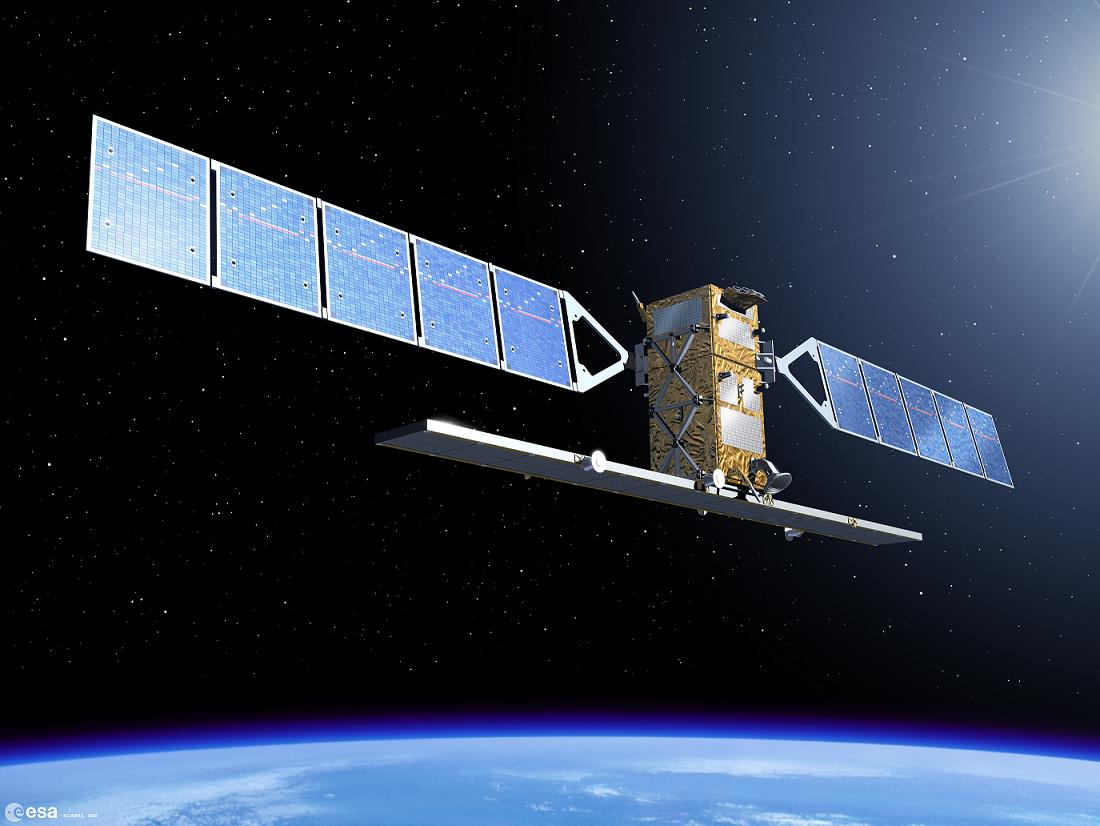
Credits: ESA – P.Carril


The European Union’s Global Monitoring for Environment and Security (GMES) initiative was born as the result of a growing need for accurate and accessible information about the environment, the effects of climate change, and civil security. GMES uses as its main information feed the data collected by satellites developed by ESA. Data is also collected by instruments carried by aircraft, floating in the ocean, or located on the ground.


GMES provides services that can be grouped into five main categories: land management, marine environment, atmosphere, aid emergency response, and security.


There are five Sentinel missions designed as components of the GMES initiative. These missions will complement the national initiatives of the EU members involved. The missions will collect data for land and ocean monitoring, and atmospheric composition monitoring, making use of all-weather radar and optical imaging. Each of the Sentinel missions is based on a constellation of two satellites.


Sentinel-1 is an all-weather radar-imaging mission. The satellites will have polar orbits and collect data for the GMES land and ocean services. The first satellite is scheduled for launch in 2012. Sentinel-1 will ensure the continuity of Synthetic Aperture Radar (SAR) applications, taking over from systems carried by ERS-1, ERS-2, Envisat, and Radarsat. Sentinel-1 satellites will be carried to orbit by Soyuz launch vehicles lifting off from Kourou.


Sentinel-2 will provide high-resolution multi-spectral imagery of vegetation, soil, and water, and will cover inland waterways and coastal areas. Sentinel-2 is designed for the data continuity of missions like Landsat or SPOT (Satellite Pour l’Observation de la Terre). Each satellite will carry a Multi-Spectral Imager (MSI) that can ‘see’ in thirteen spectral bands spanning from the visible and near infrared (VNIR) to the shortwave infrared (SWIR). The first Sentinel-2 is planned to launch in 2013. Vega will provide launch services for Sentinel-2 missions.


Credits: ESA – P.Carril


Sentinel-3 will determine parameters such as sea-surface topography and sea and land surface temperature. It will also determine ocean and land colour with high accuracy. The first Sentinel-3 satellite is expected to reach orbit in 2013. The spacecraft bus has a three-meter accuracy real-time orbit determination capability based on GPS and Kalman filtering.


Sentinel-4 is devoted to atmospheric monitoring and it will consist of payloads carried by Meteosat Third Generation (MTG) satellites that are planned to launch in 2017 and 2024. Sentinel-5 will be used for atmospheric monitoring as well. The payload will be carried by a post-EUMETSAT Polar System (EPS) spacecraft, planned to launch in 2020. A Sentinel-5 precursor will ensure that no data gap will exist between the Envisat missions and Sentinel-5.


You can find out more about the GMES initiative and the Sentinel missions on a dedicated page on ESA’s website.


  • Facebook
  • Google
  • Slashdot
  • Reddit
  • Live
  • TwitThis