
OrbitalHub

The place where space exploration, science, and engineering meet

Domain is for sale. $50,000,000.00 USD. Direct any inquiries to contact@orbitalhub.com.


Asteroid (52246) Donaldjohanson is a small but significant body located in the main asteroid belt between Mars and Jupiter. Though it may not have the fame of larger or more compositionally unique asteroids, Donaldjohanson stepped into the scientific spotlight thanks to its pivotal role in NASA’s ambitious Lucy mission — a 12-year journey to explore the Trojan asteroids that share Jupiter’s orbit. Before Lucy reaches its primary Trojan targets, it first encountered Donaldjohanson, making it a key object of study in humanity’s effort to understand the solar system’s early history.

Discovery

Asteroid Donaldjohanson was discovered on March 2, 1981, by astronomer Schelte “Bobby” Bus at the Siding Spring Observatory in Australia. Initially designated 1981 EQ5, the asteroid was later named in honor of Dr. Donald Johanson, the paleoanthropologist best known for co-discovering the fossilized remains of Australopithecus afarensis, famously known as Lucy, in Ethiopia in 1974.

This naming decision was particularly meaningful to NASA, as their Lucy spacecraft, launched in 2021, carries a similar goal: to uncover the fossils of the solar system—namely, the Trojan asteroids, which are thought to be leftover building blocks from planetary formation. Naming the asteroid after Johanson creates a poetic link between the exploration of human origins and the origins of our solar system.

Location and Characteristics

Donaldjohanson resides in the inner region of the main asteroid belt, at a semi-major axis of approximately 2.39 astronomical units (AU) from the Sun. Its orbit is relatively circular and stable, with a low eccentricity and inclination, placing it within the Erigone asteroid family, a large group of stony asteroids in the inner main belt.

Though smaller and less well-studied than some of its larger neighbors, Donaldjohanson’s value lies in its convenience and timing—it is perfectly positioned to serve as a flyby target for the Lucy spacecraft en route to the outer solar system.

The Lucy Mission Flyby

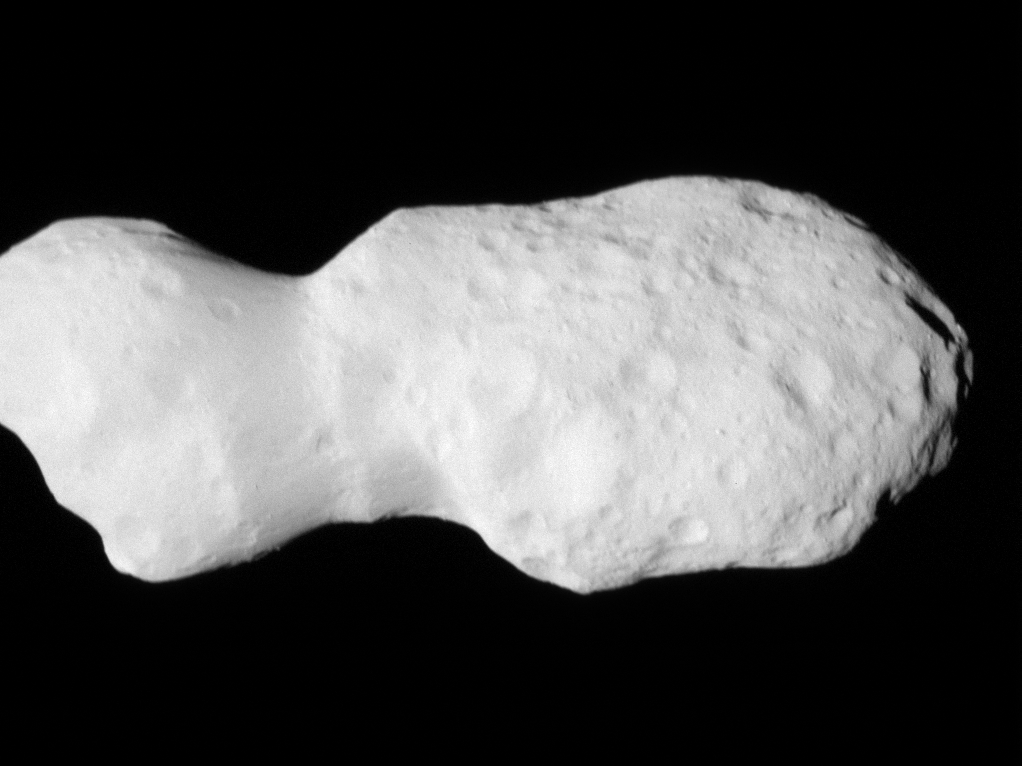
NASA’s Lucy spacecraft has successfully completed a flyby of asteroid Donaldjohanson, providing unprecedented insights into this intriguing celestial body. Lucy performed a close flyby at a distance of approximately 600 miles (960 kilometers), capturing detailed images and data.

The flyby is particularly exciting because very few main belt asteroids have been visited by spacecraft, and each one offers a new data point in understanding the diversity and history of these primitive bodies. By studying Donaldjohanson, Lucy will help bridge the scientific gap between the inner and outer asteroid populations.

During the flyby, Lucy used its three onboard science instruments — L’LORRI (a long-range imager), L’Ralph (a visible and infrared spectrometer), and L’TES (a thermal emission spectrometer) — to examine Donaldjohanson’s surface geology, composition, and thermal properties. In addition to gathering scientific data, the flyby allowed engineers to practice operating the spacecraft’s pointing, tracking, and data-gathering systems ahead of the more complex Trojan encounters.

The flyby revealed that Donaldjohanson is a contact binary asteroid, characterized by two lobes connected by a narrow neck, resembling a peanut or a barbell. This structure suggests a history of two separate bodies gently colliding and merging. The asteroid measures about 8 kilometers in length and 3.5 kilometers at its widest point, larger than previously estimated.

Donaldjohanson’s surface exhibits a complex geology with varying crater densities between its lobes, indicating a diverse collisional history. These observations provide valuable data on the processes that shaped such bodies and, by extension, the early solar system. The successful flyby serves as a critical rehearsal for Lucy’s upcoming encounters with Trojan asteroids near Jupiter, scheduled between 2027 and 2033.

Looking Ahead

While Donaldjohanson is not the primary target of Lucy’s mission, the asteroid plays an essential role in validating the mission’s capabilities and providing early science returns. Its proximity and well-known orbit make it an ideal testbed. Moreover, the data collected during the flyby will contribute to our broader understanding of asteroid families, space weathering, and solar system evolution.

After the 2025 encounter, Lucy will go on to visit eight Trojan asteroids, including Eurybates, Polymele, Leucus, Orus, and the binary pair Patroclus and Menoetius. These objects are expected to reveal new insights into the formation of the gas giants and the migration of planets during the early stages of solar system development.

In this grand journey, asteroid Donaldjohanson acts as the first stepping stone—a humble but crucial waypoint on the path to uncovering our solar system’s ancient past. As such, it not only honors the legacy of scientific discovery associated with its namesake but also propels forward the exploration of space’s most enduring mysteries.


  • Facebook
  • Google
  • Slashdot
  • Reddit
  • Live
  • TwitThis
04-24-25

Lucy Mission Update

Posted by


Mea AI adiutor dicit:

NASA’s Lucy mission, launched on October 16, 2021, is the first space mission specifically designed to study the Trojan asteroids, a unique group of asteroids that orbit the Sun in two large swarms around Jupiter—one leading and one trailing the gas giant. These celestial bodies are believed to be remnants from the early solar system, offering valuable clues about the formation of the planets. Named after the fossilized human ancestor “Lucy,” whose discovery shed light on human evolution, this spacecraft similarly seeks to uncover the ancient history of the solar system.

The Lucy mission has four primary scientific goals:

Surface Geology – Analyze surface features to determine the history of cratering, layering, and possible past activity like volcanism.

Surface Composition – Identify the composition of the asteroids’ surfaces to infer the origins of their materials.

Interior and Bulk Properties – Measure mass, density, and structure of each asteroid to understand their internal makeup.

Satellites and Rings – Search for small moons and ring systems, which may help scientists understand how Trojan asteroids have evolved.

By studying these diverse objects, Lucy is expected to provide insights into planetary formation processes and the dynamics of the early solar system.

Lucy’s mission trajectory is one of the most complex ever attempted. It involves multiple gravity assists and a looping journey through the inner solar system to reach different groups of Trojan asteroids. After launching from Cape Canaveral aboard an Atlas V rocket, Lucy began a 12-year journey involving three Earth gravity assists:

First Earth flyby: October 2022

Second Earth flyby: December 2024

Third Earth flyby: December 2030

These assists help shape Lucy’s path to visit eight asteroids in total—a record for a single NASA mission. These include:

Donaldjohanson (Main Belt asteroid, 2025) – Named after the discoverer of the Lucy hominid fossil.

Eurybates and its satellite Queta (leading Trojan swarm, 2027)

Polymele (2027)

Leucus (2028)

Orus (2028)

Patroclus and Menoetius (binary pair in the trailing Trojan swarm, 2033)

The spacecraft’s ability to fly by both leading and trailing Trojan camps is made possible by its unique and precisely calculated orbit, using Earth’s gravity to slingshot itself across vast distances.

To fulfill its objectives, Lucy is equipped with a suite of three main science instruments:

L’LORRI (Lucy LOng Range Reconnaissance Imager): A high-resolution telescopic camera designed to capture detailed images of the surface features of the Trojan asteroids, similar to what New Horizons used for Pluto.

L’Ralph: This instrument includes both a color visible camera and an infrared spectrometer to analyze surface composition and detect ices, organics, and minerals.

L’TES (Lucy Thermal Emission Spectrometer): Measures the heat emitted from asteroid surfaces, helping scientists estimate the texture and composition of the materials.

In addition to these, Lucy uses a high-gain antenna and radio tracking to precisely measure the gravitational tug of the asteroids during flybys—key for calculating mass and internal structure.

The mission timeline is as follows:

Launch: October 16, 2021

Earth Flyby 1: October 2022 (completed successfully)

Main Belt asteroid Donaldjohanson flyby: April 2025

Trojan flybys (Eurybates, Queta, Polymele, Leucus, Orus): 2027–2028

Return to Earth for gravity assist: December 2030

Patroclus and Menoetius (binary system) flyby: March 2033

End of Primary Mission: Late 2033 (though the spacecraft may continue as an extended mission platform depending on health and power)

NASA’s Lucy mission is a bold and pioneering effort to study some of the oldest and most distant relics of our solar system. Through its ambitious trajectory and carefully selected instruments, Lucy will give scientists an unprecedented look into the origins and evolution of our planetary neighborhood. By exploring a diverse array of Trojan asteroids—each with its own unique story—Lucy stands to revolutionize our understanding of how the planets formed and why our solar system looks the way it does today.

Video credit: NASA Goddard


  • Facebook
  • Google
  • Slashdot
  • Reddit
  • Live
  • TwitThis
10-24-23

Lucy to Finally Meet Dinkinesh

Posted by


Wikipedia dicit:

Lucy is a NASA space probe on a twelve-year journey to eight different asteroids, visiting two main belt asteroids as well as six Jupiter trojans, asteroids which share Jupiter’s orbit around the Sun, orbiting either ahead of or behind the planet. All target encounters will be flyby encounters. The Lucy spacecraft is the centerpiece of a US$981 million mission.

On 4 January 2017, Lucy was chosen, along with the Psyche mission, as NASA’s Discovery Program missions 13 and 14 respectively.

The mission is named after the Lucy hominid fossils, because study of the trojans could reveal the “fossils of planet formation”: materials that clumped together in the early history of the Solar System to form planets and other bodies. The hominid was named after the 1967 Beatles song “Lucy in the Sky with Diamonds”. The spacecraft carries a disc made of lab-grown diamonds for its L’TES instrument.

Video credit: NASA Goddard


  • Facebook
  • Google
  • Slashdot
  • Reddit
  • Live
  • TwitThis
10-25-21

Lucy Launch

Posted by


Wikipedia dicit:

Lucy was launched from Cape Canaveral SLC-41 on 16 October 2021, at 09:34:00.192 UTC on the 401 variant of a United Launch Alliance Atlas V launch vehicle, after which it will gain two gravity assists from Earth; one in 2022, and one in 2024. In 2025, it will fly by the inner main-belt asteroid 52246 Donaldjohanson, which was named after the discoverer of the Lucy hominin fossil. In 2027, it will arrive at the L4 Trojan cloud (the Greek camp of asteroids that orbits about 60° ahead of Jupiter), where it will fly by four Trojans, 3548 Eurybates (with its satellite), 15094 Polymele, 11351 Leucus, and 21900 Orus. After these flybys, Lucy will return to Earth in 2031 for another gravity assist toward the L5 Trojan cloud (the Trojan camp which trails about 60° behind Jupiter), where it will visit the binary Trojan 617 Patroclus with its satellite Menoetius in 2033. The mission may end with the Patroclus–Menoetius flyby, but at that point Lucy will be in a stable, 6-year orbit between the L4 and L5 clouds, and a mission extension will be possible.

Three instruments comprise the payload: a high-resolution visible imager, an optical and near-infrared imaging spectrometer, and a thermal infrared spectrometer. Harold F. Levison of the Southwest Research Institute in Boulder, Colorado is the principal investigator, with Cathy Olkin of Southwest Research Institute as the mission’s deputy principal investigator. NASA’s Goddard Space Flight Center will manage the project.

Exploration of Jupiter Trojans is one of the high-priority goals outlined in the Planetary Science Decadal Survey. Jupiter Trojans have been observed by ground-based telescopes and the Wide-field Infrared Survey Explorer to be “dark with… surfaces that reflect little sunlight”. Jupiter is 5.2 AU (780Ă—106 km; 480Ă—106 mi) from the Sun, or about five times the Earth-Sun distance. The Jupiter Trojans are at a similar distance but can be somewhat farther or closer to the Sun depending on where they are in their orbits. There may be as many Trojans as there are asteroids in the asteroid belt.

Video credit: NASA


  • Facebook
  • Google
  • Slashdot
  • Reddit
  • Live
  • TwitThis
10-13-21

Launching Lucy

Posted by


NASA dicit:

On October 16, 2021, our Lucy spacecraft will begin its journey to visit a record-breaking number of asteroids. The 12-year mission starts from NASA’s Kennedy Space Center where it’ll launch aboard a United Launch Alliance Atlas V 401 rocket. From there, Lucy will be the first spacecraft to visit a record number of destinations in independent orbits around the sun – one main belt asteroid and seven of Jupiter’s Trojan Asteroids.

Like the mission’s namesake – the fossilized human ancestor, “Lucy,” whose skeleton provided unique insight into humanity’s evolution – Lucy will revolutionize our knowledge of planetary origins and the formation of the solar system. Lucy’s first launch attempt in its 21-day launch window is scheduled for 5:34 a.m. EDT on October 16.

Video credit: NASA


  • Facebook
  • Google
  • Slashdot
  • Reddit
  • Live
  • TwitThis
10-12-21

Lucy Overview

Posted by


Wikipedia dicit:

Lucy is a planned NASA space probe that will complete a 12-year journey to eight different asteroids, visiting a main belt asteroid as well as seven Jupiter trojans, asteroids which share Jupiter’s orbit around the Sun, orbiting either ahead of or behind the planet. All target encounters will be fly-by encounters. The Lucy spacecraft is the centerpiece of a US$981 million mission.

On 4 January 2017, Lucy was chosen, along with the Psyche mission, as NASA’s Discovery Program missions 13 and 14 respectively. The mission is named after the Lucy hominid skeleton, because the study of Trojans could reveal the “fossils of planet formation”: materials that clumped together in the early history of the Solar System to form planets and other bodies. The Australopithecus itself was named after the 1967 Beatles song “Lucy in the Sky with Diamonds”.

Lucy is planned to launch in October 2021 on the 401 variant of a United Launch Alliance Atlas V launch vehicle, after which it will gain two gravity assists from Earth; one in 2022, and one in 2024. In 2025, it will fly by the inner main-belt asteroid 52246 Donaldjohanson, which was named after the discoverer of the Lucy hominid fossil. In 2027, it will arrive at the L4 Trojan cloud (the Greek camp of asteroids that orbits about 60° ahead of Jupiter), where it will fly by four Trojans, 3548 Eurybates (with its satellite), 15094 Polymele, 11351 Leucus, and 21900 Orus. After these flybys, Lucy will return to Earth in 2031 whereupon it will receive another slight gravity assist to take it to the L5 Trojan cloud (the Trojan camp which trails about 60° behind Jupiter), where it will visit the binary Trojan 617 Patroclus with its satellite Menoetius in 2033. The mission may end with the Patroclus–Menoetius flyby, but at that point Lucy will be in a stable, 6-year orbit between the L4 and L5 clouds, and a mission extension will be possible.

Three instruments comprise the payload: a high-resolution visible imager, an optical and near-infrared imaging spectrometer and a thermal infrared spectrometer.

Exploration of Jupiter Trojans is one of the high priority goals outlined in the Planetary Science Decadal Survey. Jupiter Trojans have been observed by ground-based telescopes and the Wide-field Infrared Survey Explorer to be “dark with… surfaces that reflect little sunlight”. Jupiter is 5.2 AU (780Ă—106 km; 480Ă—106 mi) from the Sun, or about five times the Earth-Sun distance. The Jupiter Trojans are at a similar distance but can be somewhat farther or closer to the Sun depending on where they are in their orbits. There may be as many Trojans as there are asteroids in the asteroid belt.

Video credit: NASA Goddard


  • Facebook
  • Google
  • Slashdot
  • Reddit
  • Live
  • TwitThis





