


JWST Reveals the Complex Structure of Tc 1 and the Cosmic Origins of Buckyballs
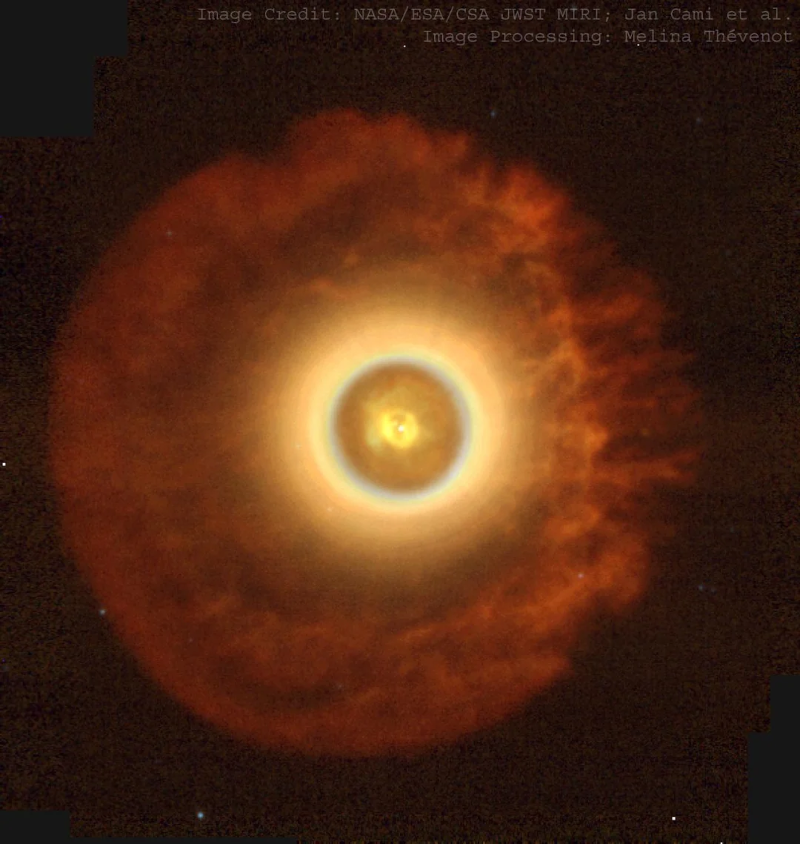
Fifteen years after astronomers first confirmed the existence of buckminsterfullerene molecules in space, new observations from the James Webb Space Telescope are providing the clearest and most detailed view yet of the environment where these carbon structures form and evolve. The planetary nebula Tc 1, located more than 10,000 light-years away in the constellation Ara, has become one of the most important laboratories for studying complex carbon chemistry in space.
The new observations were led by researchers at Western University, including physicist and astronomer Jan Cami, whose team first identified buckyballs in Tc 1 using NASA’s Spitzer Space Telescope in 2010. That discovery confirmed a prediction made decades earlier by chemists studying carbon molecular structures and demonstrated that these molecules could form naturally in astrophysical environments.
Buckminsterfullerene, commonly referred to as a buckyball, is a molecular structure composed of 60 carbon atoms arranged in a hollow spherical geometry. The structure resembles a geodesic dome or a soccer ball, with a repeating pattern of pentagons and hexagons. The molecule was first synthesized in laboratory conditions in 1985 by Sir Harry Kroto and collaborators, work that later earned the 1996 Nobel Prize in Chemistry.
The significance of detecting these molecules in space extends beyond novelty. Carbon chemistry plays a central role in astrophysics because carbon is one of the primary elements involved in the formation of complex molecules. Understanding how carbon-based structures form and survive in harsh interstellar environments contributes to broader models of stellar evolution, dust formation, and the chemical enrichment of galaxies.
Tc 1 itself is a planetary nebula, a phase in stellar evolution that occurs when a low- to intermediate-mass star exhausts its nuclear fuel and sheds its outer layers. The exposed stellar core emits intense ultraviolet radiation that ionizes the surrounding gas, causing it to glow. Planetary nebulae are dynamic chemical environments where high-energy radiation, shock waves, and cooling gas interact to produce a wide range of molecules and dust grains.
The new JWST observations were conducted using the telescope’s Mid-Infrared Instrument, or MIRI. This instrument is optimized for wavelengths between approximately 5 and 28 microns, a spectral region particularly important for studying molecular vibrations and thermal emission from dust. Many carbon-rich molecules, including fullerenes, emit strongly in the mid-infrared, making MIRI an ideal tool for analyzing their distribution and physical properties.
The resulting image of Tc 1 combines observations from nine infrared filters spanning wavelengths from 5.6 to 25.5 microns. Because these wavelengths lie beyond the range of human vision, the image was processed into visible colors representing different thermal regimes. Shorter infrared wavelengths, associated with hotter gas, appear blue, while longer wavelengths tracing cooler material appear red. The processed image reveals a highly structured nebula containing filaments, shells, and radial features extending outward from the central star.
One of the most notable structures visible in the new image is a feature near the nebula’s center resembling an inverted question mark. While its physical origin is not yet understood, it highlights the complexity of the gas dynamics and chemistry occurring within the nebula. The morphology suggests that multiple interacting processes are shaping the environment, potentially including stellar winds, magnetic fields, and asymmetric mass loss from the dying star.
The scientific value of the JWST observations extends well beyond imaging. MIRI also collected spectroscopic data, allowing researchers to analyze the detailed chemical fingerprints of molecules and dust throughout the nebula. Spectroscopy works by separating incoming light into its component wavelengths, revealing characteristic emission and absorption features associated with specific molecules.
Each molecule interacts with electromagnetic radiation in a unique way because molecular bonds vibrate at characteristic frequencies. In the mid-infrared, these vibrational modes produce emission features that can be used to identify molecular species directly. The spectroscopic data from Tc 1 will allow astronomers to map the spatial distribution of buckyballs and investigate how these molecules interact with their surrounding environment.
One of the major scientific questions concerns why the fullerene emission in Tc 1 is unusually strong compared to other nebulae. Understanding this requires detailed modeling of excitation mechanisms, radiation fields, and local physical conditions. Researchers are investigating whether the brightness is driven primarily by ultraviolet excitation from the central star, interactions with dust grains, or specific chemical pathways unique to this environment.
The engineering capabilities of JWST are central to enabling these observations. Unlike previous infrared observatories, JWST combines a large segmented primary mirror with highly sensitive cryogenically cooled instruments. The telescope operates near the Sun-Earth L2 Lagrange point, where its sunshield continuously blocks heat from the Sun, Earth, and Moon. Maintaining extremely low operating temperatures is essential because infrared detectors are sensitive to thermal radiation generated by the telescope itself.
MIRI, in particular, requires active cooling to temperatures below 7 Kelvin. At these temperatures, detector noise is minimized, allowing the instrument to detect faint infrared signals from distant astrophysical sources. The telescope’s pointing stability and optical precision also contribute to the high spatial resolution visible in the Tc 1 observations.
Compared to the earlier Spitzer observations, JWST provides substantially improved sensitivity and angular resolution. Spitzer confirmed the existence of fullerenes in space, but JWST can now resolve the surrounding nebular structure in much greater detail and obtain higher-quality spectra across a broader wavelength range. This transition reflects the broader evolution of infrared astronomy from detection-focused observations toward detailed physical characterization.
The observations of Tc 1 are likely to remain scientifically important for years. The combination of imaging and spectroscopy provides a dataset capable of supporting multiple studies involving molecular chemistry, dust physics, and nebular dynamics. Researchers are currently preparing several scientific papers based on the observations, focusing on both the fullerene molecules themselves and the broader physical structure of the nebula.
More broadly, the work illustrates how astronomical observations connect chemistry, astrophysics, and instrumentation. Molecules first synthesized in terrestrial laboratories have now been observed in complex stellar environments thousands of light-years away. The same physical laws governing molecular vibrations on Earth operate throughout the galaxy, and increasingly sophisticated observatories are allowing those processes to be measured directly.
The new JWST observations of Tc 1 therefore represent more than a visually striking image. They provide a detailed view into the chemical and dynamical processes occurring around dying stars and expand understanding of how complex carbon molecules form and persist in space.


 Subscribe to blog posts using RSS












