OrbitalHub

The place where space exploration, science, and engineering meet

Domain is for sale. $50,000,000.00 USD. Direct any inquiries to contact@orbitalhub.com.

05-22-18

GRACE

Posted by


NASA dixit:

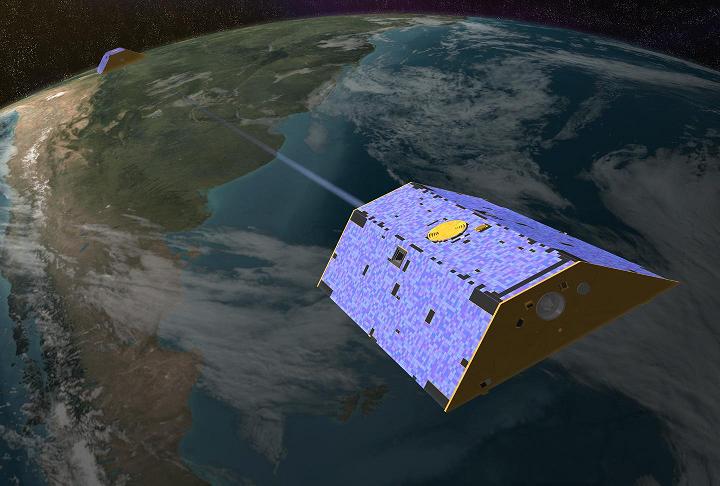
“Between 2002 and 2016, the Gravity Recovery and Climate Experiment (GRACE) tracked the movement of freshwater around the planet. NASA scientists used GRACE data to identify regional trends of freshwater movement, and combined that information with data from other satellites, climate models and precipitation measurements to determine the causes of major regional trends in freshwater storage.”

Credits Music: Iron Throne by Anthony Giordano [SACEM]

Credits Video: NASA’s Goddard Space Flight Center/Kathryn Mersmann


  • Facebook
  • Google
  • Slashdot
  • Reddit
  • Live
  • TwitThis


Credits: NASA


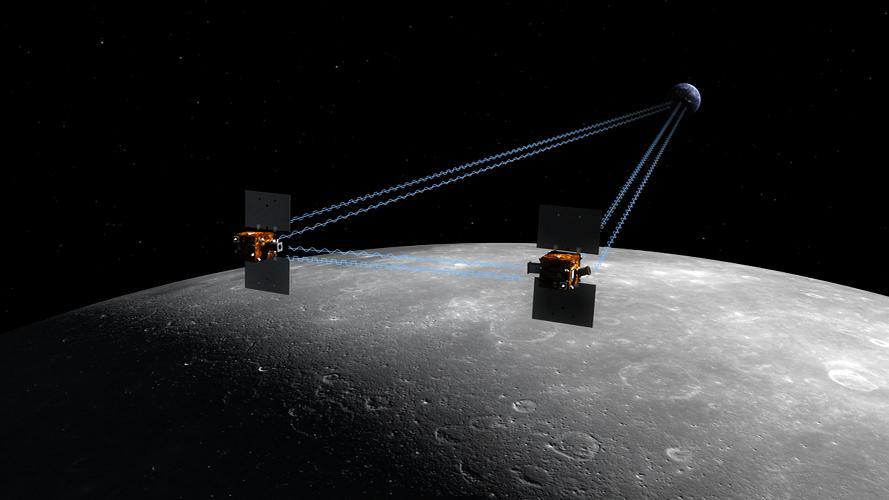
The Gravity Recovery And Interior Laboratory (GRAIL) is a mission that will measure the lunar gravity field in unprecedented detail. The twin spacecraft will orbit the Moon in tandem and collect scientific data for several months.


The GRAIL mission will cost $375 million and launch in 2011 as part of NASA’s Discovery Program. The window for the launch is 26 days long and opens on September 8, 2011.


After a dual launch aboard a Delta II 2920-10, the spacecraft will spend three to four months cruising on a low-energy trans-lunar trajectory. The two spacecraft will orbit the moon on 50 km, near-circular polar orbits, with a spacecraft separation of 175 – 225 km. The science phase of the mission will take 90 days, and it will be followed by a 12-month science data analysis.


The technique used by GRAIL for collecting scientific data was also used for the Gravity Recovery And Climate Experiment (GRACE) mission, launched in 2002. Small changes in the distance that separates the two spacecraft are translated in variations of the lunar gravity field.


The GRAIL spacecraft are based on the Lockheed Martin XSS-11 bus. The XSS-11 (Experimental Small Satellite 11) is the result of research done at Lockheed Martin Space Systems in the field of agile and affordable micro-satellites. Interesting to mention here is that there were speculations that XSS-11 could also be used as the base for the development of a kinetic anti-satellite weapon (ASAT).


The spacecraft is a rectangular composite structure. Two non-articulated solar arrays and lithium ion battery provides power. The attitude control system, the power management system, and the telecommunications system are also inherited from the XSS-11 bus.


The payload consists of a Ka-band Lunar Gravity Ranging System (LGRS), which is derived from the instrument carried by the GRACE spacecraft.


The spacecraft flight operations will be conducted from Lockheed Martin’s Denver facility. Science Level 0 and 1 data processing will be done at Jet Propulsion Laboratory (JPL), Level 2 data processing at JPL, the Goddard Space Flight Center (GSFC) and the Massachusetts Institute of Technology (MIT). The final scientific data will be delivered by MIT.


While missions like the Lunar Reconnaissance Orbiter (LRO) will find safe landing sites, locate potential resources, and take measurements of the radiation environment of the lunar surface, GRAIL will explore the moon from crust to core, and determine the moon’s internal structure and evolution.


More information about GRAIL is available on the GRAIL mission page on MIT’s web site.


  • Facebook
  • Google
  • Slashdot
  • Reddit
  • Live
  • TwitThis


Credits: NASA-JPL


While the preparations for ESA’s GOCE mission are under way, NASA already has its own gravity mapping mission called GRACE, which was launched in March 2002.


NASA teamed up with the German Space Agency to launch GRACE (Gravity Recovery And Climate Experiment).


GRACE currently provides detailed measurements of the Earth’s gravity field, and these measurements help scientists better understand the effects of gravity on global climate change, oceans, and land masses. This will lead to better predictions about changes in water supply, weather forecasts, and natural hazards.


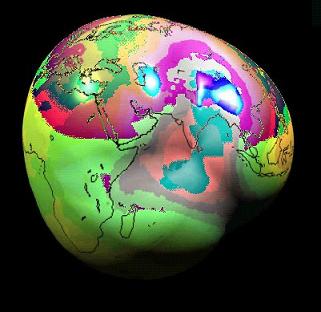
The data gathered by GRACE has been used to create the best map to date of Earth’s gravitational field. While common sense and introductory physics textbooks tell us that the weight of an object should not have different values at different locations on the surface of the Earth, measurements taken indicate that there are areas where gravity is slightly stronger or weaker than the average. Many of the peaks or valley on the maps put together by scientists can be attributed to surface features, like ridges or mountains. However, there are cases when the variations cannot be explained, and they might be related to high or low sub-surface densities.


The maps compiled from the scientific data returned by GRACE are 1,000 times more accurate then maps previously produced.


The GRACE mission consists of two satellites flying one behind another in near circular orbits at an altitude of 460 km and about 220 km apart. The satellites have really neat nicknames: Tom and Jerry. The leading satellite (that would be Jerry) sends a microwave signal to the trailing satellite (Tom) to precisely measure the distance between the two. GRACE can detect very small changes in the distance that separates the two spacecraft, down to one-tenth of the width of a human hair. The Global Positioning System (GPS) onboard Tom and Jerry is used to determine the precise location of the measurement taken.
 

Credits: NASA-JPL


What is the science involved in taking these measurements? When a satellite passes over an area where the gravity is stronger, it will experience a stronger gravitational pull and increase its speed. Conversely, the speed of the satellite will decrease when passing over areas with weaker gravity.


Going back to the satellites, the variations in the gravity field will cause the distance between the two spacecraft to vary slightly. On the ground, the measurements of the distance between the GRACE satellites are translated into variations of the gravity field, and this is how the maps are compiled.


GRACE maps the entire gravity field of Earth every thirty days. The snapshots allow the detection of changes in the polar ice sheets, sea level, ocean currents, the Earth’s water cycle, and even the interior structure of the Earth.


The list of applications is impressive. Measurements over ice sheets can indicate decreases in the ice sheet’s mass. Decreases in gravity can also indicate drying river basins. And not just changes in water above the ground can be measured, but also water stored in aquifers beneath the surface.


For more information about GRACE check out NASA’s web site or the dedicated web page at the University of Texas at Austin.

 

  • Facebook
  • Google
  • Slashdot
  • Reddit
  • Live
  • TwitThis