OrbitalHub

The place where space exploration, science, and engineering meet

Domain is for sale. $50,000,000.00 USD. Direct any inquiries to contact@orbitalhub.com.


After more than a decade of delays, geopolitical shifts, and mission redesigns, ESA’s Rosalind Franklin rover finally has a confirmed launch provider. NASA announced on April 16, 2026, that SpaceX’s Falcon Heavy will launch the European Mars rover from Kennedy Space Center’s Launch Complex 39A in late 2028, with arrival on the Red Planet expected around late 2030. The contract, worth approximately $176 million through NASA’s Launch Services program, marks SpaceX’s first interplanetary mission to Mars and the culmination of an arduous journey for Europe’s first Mars rover.

The mission’s history reads like a geopolitical drama spanning multiple continents and two decades. Originally conceived in 2001 as part of ESA’s Aurora Programme, the rover was designed to search for biosignatures of past or present life on Mars through the most ambitious subsurface drilling attempt ever attempted on another world. The original plan called for a Russian-provided launch vehicle and landing platform through a partnership with Roscosmos, the Russian space agency. That partnership dissolved following Russia’s invasion of Ukraine in 2022, when ESA member states voted to suspend cooperation with Russia.

The rover’s scientific payload centers on a 2-meter drilling system, nearly double the depth achieved by any previous Mars rover. NASA’s Perseverance, for comparison, drills to 7 centimeters, while the Soviet-era Lunokhod rovers never attempted subsurface sampling on another world. The drill retrieves core samples that have been shielded from the harsh Martian surface radiation and oxidation that destroys organic compounds near the top layer of regolith. Once collected, the samples enter the Analytical Laboratory Drawer, where nine instruments including the Panoramic Camera and mass spectrometer characterize the composition.

The landing site, Oxia Planum, was selected after years of debate among planetary scientists. This region shows evidence of ancient clay mineral formation, which requires liquid water to create. Clay minerals serve as excellent preservers of organic compounds, as they can trap and shield complex molecules from degradation. The choice reflects the mission’s core hypothesis: if life ever arose on Mars, the chemical traces would be most likely to survive in protected subsurface environments.

NASA’s role extends beyond launch services. The agency is providing radioisotope heater units, tiny devices that use the decay heat of plutonium-238 to keep electronics warm during the frigid Martian nights. Without these units, the rover would not survive the temperature swings that plunge to minus 100 degrees Celsius. The Trump administration’s FY2027 budget proposed cutting approximately $100 million from NASA’s ROSA program that funds these contributions, but NASA proceeded with the SpaceX contract regardless, signaling continued commitment to international science partnerships despite broader budget pressures.

The selection of Falcon Heavy from Launch Complex 39A places the mission alongside NASA’s own heavy-lift ambitions. LC-39A has hosted Apollo missions, space shuttles, and Falcon Heavy launches including the historic Tesla Roadster flight in 2018. The capacity to lift approximately 3.5 tonnes to trans-Mars injection provides the delta-v needed for the eight-month journey. The backup launch windows in 2030 avoid the Mars dust storm season that historically has disrupted landing operations.

Drilling into bedrock on Mars presents challenges that exceed any previous subsurface expedition. The 2-meter drill must operate in temperatures ranging from minus 80 degrees to plus 20 degrees Celsius, with the mechanical systems enduring thermal cycling that weakens metals through repeated expansion and contraction. The drill string uses a percussive mechanism similar to rotary hammers, powered by electric motors that must produce sufficient torque while drawing minimal current from the solar panels.

The sample retrieval mechanism seals the cores in containers that maintain the terrestrial context of each sample. On Earth, contamination from drilling fluids and equipment can obscure the scientific signal, so the rover’s sample handling system was designed to minimize terrestrial organic contact. Each core breaks into fragments that fit into the analytical instruments, where the mass spectrometer detects organic compounds through vaporization and ion separation.

Solar power at Mars delivers approximately 40 percent of the energy available at Earth, requiring the largest solar array ever deployed on a planetary rover. The 1,200-watt-hour daily capacity must power movement, drilling operations, instrument analysis, and communications while maintaining survival systems through the Martian night. During dust storms, the array may produce only a fraction of rated power, limiting operations until conditions improve.


  • Facebook
  • Google
  • Slashdot
  • Reddit
  • Live
  • TwitThis
05-28-18

ExoMars

Posted by


Wikipedia dixit:

“The ExoMars rover is a planned robotic Mars rover, part of the international ExoMars programme led by the European Space Agency and the Russian Roscosmos State Corporation.

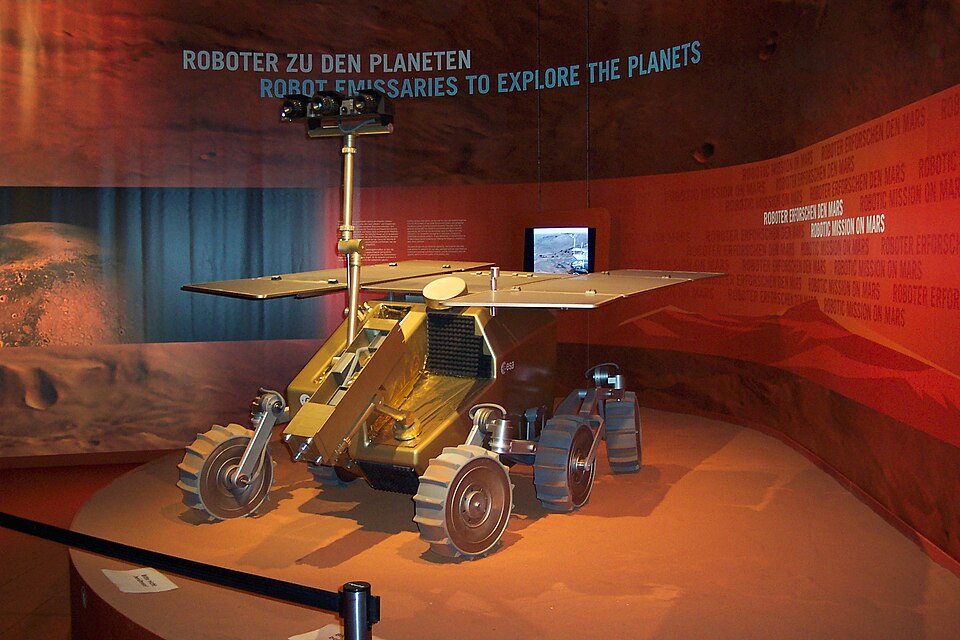
The rover is an autonomous six-wheeled terrain vehicle once designed to weigh up to 295 kg (650 lb), approximately 60% more than NASA’s 2004 Mars Exploration Rovers Spirit and Opportunity, but about one third that of NASA’s Curiosity rover launched in 2011.

In February 2012, following NASA’s withdrawal, the ESA went back to previous designs for a smaller rover, once calculated to be 207 kg (456 lb). Instrumentation will consist of the exobiology laboratory suite, known as Pasteur analytical laboratory to look for signs of biomolecules or biosignatures from past life. Among other instruments, the rover will also carry a 2-metre (6 ft 7 in) sub-surface drill to pull up samples for its on-board laboratory.

The lead builder of the ExoMars rover, the British division of Airbus Defence and Space, began procuring critical components in March 2014. In December 2014, ESA member states approved the funding for the rover, to be sent on the second launch in 2018, but insufficient funds had already started to threaten a launch delay until 2020. The wheels and suspension system are paid by the Canadian Space Agency and are being manufactured by MDA Corporation in Canada.

By March 2013, the spacecraft was scheduled to launch in 2018 with a Mars landing in early 2019. However, delays in European and Russian industrial activities and deliveries of scientific payloads, forced the launch to be pushed back. In May 2016, ESA announced that the mission had been moved to the next available launch window of July 2020. An ESA ministerial meeting in December 2016 will consider mission issues including €300 million in ExoMars funding and lessons learned from the ExoMars 2016 Schiaparelli mission. One concern is that the Schiaparelli module crashed during its Mars atmospheric entry, and this landing system is being produced in near duplication for the ExoMars lander.”

Credits Video: ESA/NASA Goddard


  • Facebook
  • Google
  • Slashdot
  • Reddit
  • Live
  • TwitThis
05-9-18

Mars Sample Return

Posted by


ESA dixit:

“Spacecraft in orbit and on Mars’s surface have made many exciting discoveries, transforming our understanding of the planet and unveiling clues to the formation of our Solar System, as well as helping us understand our home planet. The next step is to bring samples to Earth for detailed analysis in sophisticated laboratories where results can be verified independently and samples can be reanalysed as laboratory techniques continue to improve.

Bringing Mars to Earth is no simple undertaking—it would require at least three missions from Earth and one never-been-done-before rocket launch from Mars.

A first mission, NASA’s 2020 Mars Rover, is set to collect surface samples in pen-sized canisters as it explores the Red Planet. Up to 31 canisters will be filled and readied for a later pickup – geocaching gone interplanetary.

In the same period, ESA’s ExoMars rover, which is also set to land on Mars in 2021, will be drilling up to two meters below the surface to search for evidence of life.

A second mission with a small fetch rover would land nearby and retrieve the samples in a Martian search-and-rescue operation. This rover would bring the samples back to its lander and place them in a Mars Ascent Vehicle – a small rocket to launch the football-sized container into Mars orbit.

A third launch from Earth would provide a spacecraft sent to orbit Mars and rendezvous with the sample containers. Once the samples are safely collected and loaded into an Earth entry vehicle, the spacecraft would return to Earth, release the vehicle to land in the United States, where the samples will be retrieved and placed in quarantine for detailed analysis by a team of international scientists.”

Video Credit: NASA/ESA


  • Facebook
  • Google
  • Slashdot
  • Reddit
  • Live
  • TwitThis


ESA dixit:

“Since arriving at Mars in October 2016, the ExoMars Trace Gas Orbiter has been aerobraking its way into a close orbit of the Red Planet by using the top of the atmosphere to create drag and slow down. It is almost in the right orbit to begin observations – only a few hundred kilometres to go! With aerobraking complete, additional manoeuvres will bring the craft into a near-circular two-hour orbit, about 400 km above the plane, by the end of April. The mission’s main goal is to take a detailed inventory of the atmosphere, sniffing out gases like methane, which may be an indicator of active geological or biological activity. The camera will help to identify surface features that may be related to gas emissions. The spacecraft will also look for water-ice hidden below the surface, which could influence the choice of landing sites for future exploration. It will also relay large volumes of science data from NASA’s rovers on the surface back to Earth and from the ESA–Roscosmos ExoMars rover, which is planned for launch in 2020.”

Video credit: ESA


  • Facebook
  • Google
  • Slashdot
  • Reddit
  • Live
  • TwitThis
05-21-17

ExoMars Rover

Posted by


ESA dixit:

“The ExoMars Rover, developed by ESA, provides key mission capabilities: surface mobility, subsurface drilling and automatic sample collection, processing, and distribution to instruments. It hosts a suite of analytical instruments dedicated to exobiology and geochemistry research: this is the Pasteur payload.

The Rover uses solar panels to generate the required electrical power, and is designed to survive the cold Martian nights with the help of novel batteries and heater units. Due to the infrequent communication opportunities, only 1 or 2 short sessions per sol (Martian day), the ExoMars Rover is highly autonomous. Scientists on Earth will designate target destinations on the basis of compressed stereo images acquired by the cameras mounted on the Rover mast.

The Rover must then calculate navigation solutions and safely travel approximately 100 m per sol. To achieve this, it creates digital maps from navigation stereo cameras and computes a suitable trajectory. Close-up collision avoidance cameras are used to ensure safety.

The locomotion is achieved through six wheels. Each wheel pair is suspended on an independently pivoted bogie (the articulated assembly holding the wheel drives), and each wheel can be independently steered and driven. All wheels can be individually pivoted to adjust the Rover height and angle with respect to the local surface, and to create a sort of walking ability, particularly useful in soft, non-cohesive soils like dunes. In addition, inclinometers and gyroscopes are used to enhance the motion control robustness. Finally, Sun sensors are utilised to determine the Rover’s absolute attitude on the Martian surface and the direction to Earth.

The camera system’s images, combined with ground penetrating radar data collected while travelling, will allow scientists on-ground to define suitable drilling locations.The Rover subsurface sampling device will then autonomously drill to the required depth (maximum 2 m) while investigating the borehole wall mineralogy, and collect a small sample. This sample will be delivered to the analytical laboratory in the heart of the vehicle. The laboratory hosts four different instruments and several support mechanisms. The sample will be crushed into a fine powder. By means of a dosing station the powder will then be presented to other instruments for performing a detailed chemistry, physical, and spectral analyses.”

Video credit: ESA


  • Facebook
  • Google
  • Slashdot
  • Reddit
  • Live
  • TwitThis
12-30-16

ExoMars First Year in Orbit

Posted by


Wikipedia dixit:

“ExoMars (Exobiology on Mars) is a two-part Martian astrobiology project to search for evidence of life on Mars, a joint mission of the European Space Agency (ESA) and the Russian space agency Roscosmos. The first part, launched in 2016, placed a trace gas research and communication satellite into Mars orbit and released a stationary experimental lander (which crashed). The second part is planned to launch in 2020, and to land a rover on the surface, supporting a science mission that is expected to last into 2022 or beyond.

ExoMars goals are to search for signs of past and present life on Mars, investigate how the Martian water and geochemical environment varies, investigate atmospheric trace gases and their sources and by doing so demonstrate the technologies for a future Mars sample return mission. The mission will search for biosignatures of Martian life, past or present, employing several spacecraft elements to be sent to Mars on two launches.

The ExoMars Trace Gas Orbiter (TGO) and a test stationary lander called Schiaparelli were launched on 14 March 2016. TGO entered Mars orbit on 19 October 2016 and will proceed to map the sources of methane (CH4) and other trace gases present in the Martian atmosphere that could be evidence for possible biological or geological activity. The Schiaparelli experimental lander separated from TGO on 16 October and was maneuvered to land in Meridiani Planum. As of 19 October 2016, ESA had not received a signal that the landing was successful. On 21 October 2016, NASA released a Mars Reconnaissance Orbiter image showing what appears to be the lander crash site. The landing was designed to test new key technologies to safely deliver the 2020 rover mission. The TGO features four instruments and will also act as a communications relay satellite.

In 2020, a Roscosmos-built lander (ExoMars 2020 surface platform) is to deliver the ESA-built ExoMars Rover to the Martian surface. The rover will also include some Roscosmos built instruments. The second mission operations and communications will be led by ALTEC’s Rover Control Centre in Italy.”

Video credit: ESA


  • Facebook
  • Google
  • Slashdot
  • Reddit
  • Live
  • TwitThis