


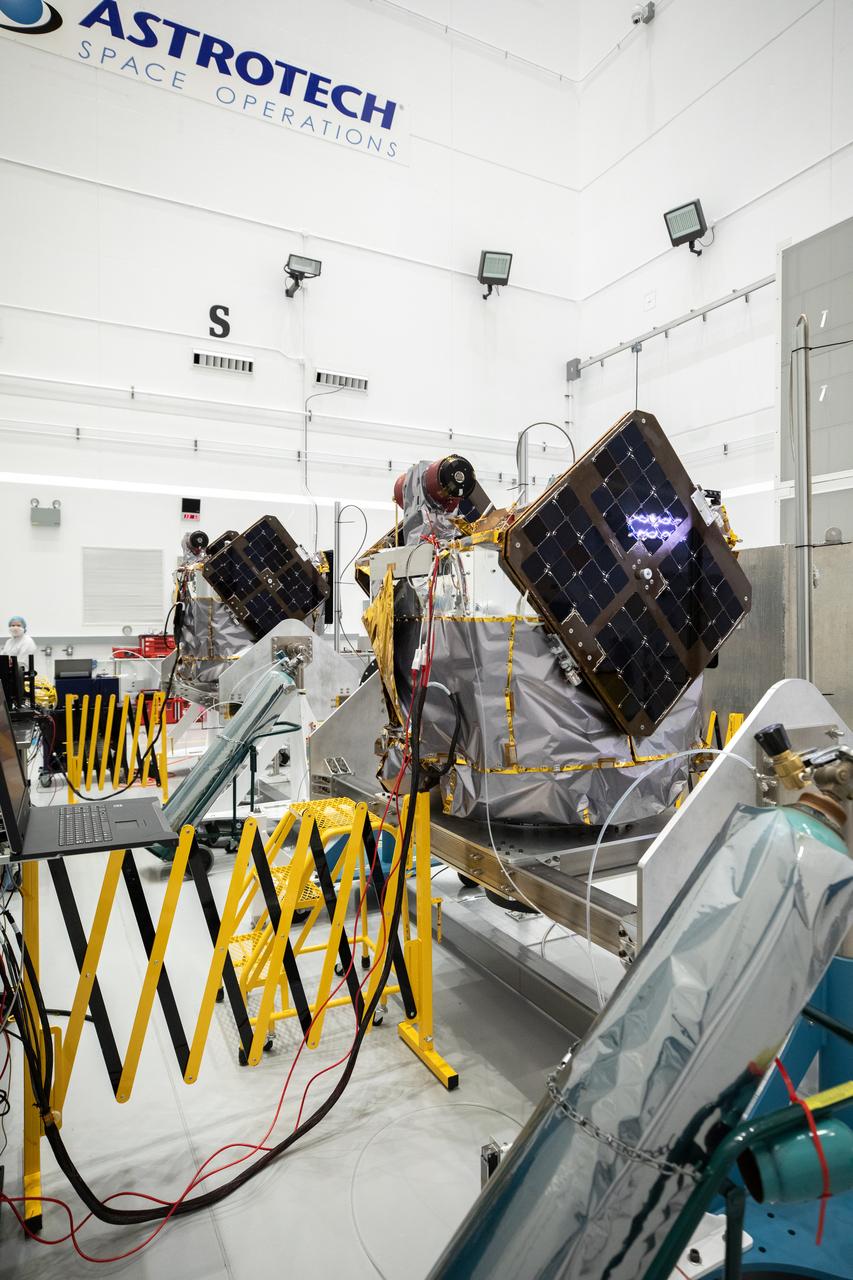
Two small spacecraft currently traversing the void between Earth and Mars are rewriting the playbook for how robotic missions reach the Red Planet. NASA’s ESCAPADE mission, comprising twin spacecraft nicknamed Blue and Gold, launched aboard a Blue Origin New Glenn rocket in November 2025, but they will not arrive at Mars until September 2027. This unusual trajectory represents a deliberate choice to wait for optimal planetary alignment, demonstrating how small spacecraft can offer flexibility that larger missions cannot match.
The ESCAPADE twins carry instruments designed to investigate one of Mars’ most enduring mysteries: how the planet lost the thick atmosphere that scientists believe once permitted flowing water on its surface. Researchers have long suspected the solar wind, a constant stream of charged particles emanating from the Sun, played a central role in stripping away the Martian air over billions of years. The ESCAPADE spacecraft will observe this process directly, measuring how solar wind interacts with Mars’ magnetic field and causes atmospheric gases to escape into space.
What makes the current phase of the mission particularly intriguing is the bonus science the spacecraft are conducting while awaiting their Mars arrival. As of February 2026, both spacecraft have activated their science instruments and are collecting data on Earth’s distant magnetotail, the region of our planet’s magnetic environment that extends away from the Sun. This region has never been studied at such distances, giving scientists their first opportunity to observe how Earth’s magnetic field behaves in the outer reaches of its influence.
The twin spacecraft approach represents a first for Mars exploration. Previous missions to the Red Planet have relied on single spacecraft, limiting observations to one location at any given time. ESCAPADE will provide what mission scientists describe as a stereo perspective, allowing them to observe cause and effect relationships in the Martian magnetosphere from two different vantage points simultaneously. When one spacecraft measures the incoming solar wind while the other measures the planet’s response, researchers can connect these observations to understand the fundamental processes governing atmospheric loss.
The mission’s principal investigator, Rob Lillis of the University of California, Berkeley, has emphasized how the dual-spacecraft configuration enables measurements impossible for single platforms. By observing identical regions at slightly different times, the spacecraft can detect how the Martian magnetosphere changes on timescales as short as two minutes. This temporal resolution will reveal dynamics that previous Mars missions could never capture, potentially answering questions that have puzzled scientists for decades.
Once the spacecraft arrive at Mars in 2027, they will spend approximately six months in complementary orbits before beginning their primary science mission in spring 2028. One spacecraft will remain closer to the planet while the other travels farther away, allowing simultaneous measurement of both the upstream solar wind and the planet’s magnetospheric response. This configuration mirrors the approach used by missions studying Earth’s space weather but represents a first at Mars.
Understanding Mars’ lost atmosphere requires grasp of several interconnected physical processes. The solar wind consists primarily of protons and electrons traveling at speeds typically between 300 and 800 kilometers per second, carrying the Sun’s magnetic field outward through interplanetary space. When this magnetized plasma encounters Mars, it interacts with the planet’s weak magnetic environment, transferring energy and momentum to charged particles in the upper atmosphere.
Mars lacks Earth’s global magnetic field, which shields our planet by deflecting solar wind around the planet like a stone diverting a stream. Instead, Mars possesses scattered regions of remnant magnetization in its crust, along with a dynamically generated magnetic field created when solar wind interacts with charged particles in the ionosphere. This hybrid magnetosphere provides only partial protection, allowing solar wind to directly impact the upper atmosphere in many regions.
The process of atmospheric escape takes multiple forms. Ion pickup involves charged particles from the ionosphere being accelerated by the solar wind and thrown away from the planet. Sputtering occurs when incoming solar wind particles strike atmospheric molecules with enough energy to eject them into space. The most dramatic form, sometimes called atmospheric stripping, happens when solar wind pressure physically pushes atmosphere off the planet, particularly from regions where magnetic protection is weakest.
Measuring these processes requires precise instrumentation capable of detecting low-energy ions and electrons in the tenuous Martian atmosphere. ESCAPADE carries multiple instruments designed specifically for this purpose, allowing scientists to quantify exactly how much atmosphere Mars loses each second and how that loss rate varies with solar wind conditions. This data will not only explain Mars’ past but also inform planning for future human missions, which will need to understand the radiation environment astronauts will encounter.


 Subscribe to blog posts using RSS












