
OrbitalHub

The place where space exploration, science, and engineering meet

Domain is for sale. $50,000,000.00 USD. Direct any inquiries to contact@orbitalhub.com.


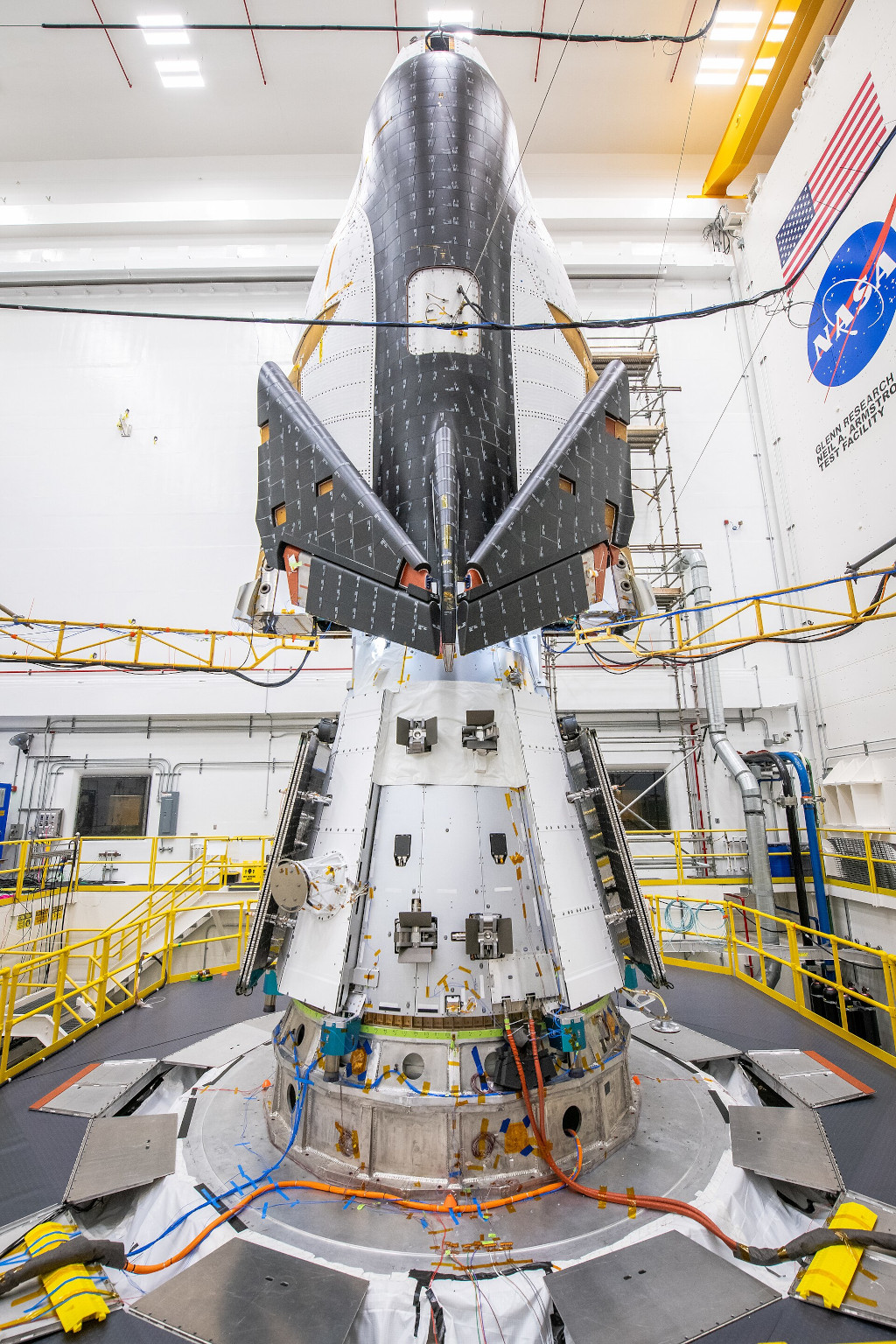
Sierra Space’s Dream Chaser cargo spaceplane continues its path toward first flight, with the demonstration mission currently targeted for late 2026. The spacecraft recently completed important pre-flight milestones at NASA’s Neil Armstrong Test Facility in Ohio, where it underwent vibration testing to simulate launch and re-entry conditions.

The Dream Chaser system consists of two main components: the reusable lifting-body spacecraft and the disposable Shooting Star cargo module. Together, the stack stands approximately 55 feet tall. Testing confirmed the vehicle’s structural integrity under the dynamic conditions experienced during launch and atmospheric re-entry.

Recent updates to the mission profile have changed the original plan. The demonstration flight will no longer dock with the International Space Station as originally planned. Instead, the mission will launch to low Earth orbit and return to Earth with a runway landing at Vandenberg Space Force Base in California. The change allows the mission to proceed without some of the complex docking systems that required additional development time.

NASA announced the modification in September 2025, noting that propulsion system and software certification remained in progress. The revised plan demonstrates the flexibility required in developing new spacecraft systems. The demonstration mission will still validate the vehicle’s core capabilities including launch, orbital flight, re-entry, and landing.

The CRS-2 contract with NASA tasks Dream Chaser with resupplying the International Space Station. Once operational, the spacecraft will be able to return sensitive cargo to Earth rather than disposing of it in the atmosphere as other cargo vehicles do. This capability addresses a longstanding gap in commercial resupply services.

The lifting-body design provides significant advantages during re-entry. Unlike capsule vehicles that splash down in the ocean, Dream Chaser can land on conventional runways. This approach enables faster payload recovery and eliminates the complexity of ocean recovery operations. The design also allows the vehicle to perform a controlled approach with greater maneuverability than capsule-shaped vehicles.

Testing at NASA’s facilities has included comprehensive evaluations of the integrated system. The vibration testing simulated the mechanical stresses of launch, orbital flight, and re-entry. Additional tests will evaluate thermal protection performance and systems integration before the vehicle is cleared for flight.

Sierra Space has invested heavily in developing manufacturing capabilities for the spacecraft. Production facilities in Colorado and Wisconsin support the build process for the reusable vehicle structure and the disposable cargo module. The company has established supplier relationships for specialized components including the heat shield tiles and propulsion systems.

If the demonstration mission succeeds, operational cargo flights could begin in 2027. The Dream Chaser will join SpaceX’s Dragon capsule and Northrop Grumman’s Cygnus vehicle in NASA’s commercial resupply portfolio. The addition of a runway-landable vehicle provides redundancy and expanded capabilities for station resupply operations.

The late 2026 launch window provides adequate time to complete remaining certification activities. Mission planners will select a specific date based on orbital mechanics and station logistics. The demonstration flight will carry a combination of NASA cargo and partner payloads to validate the vehicle’s performance in representative mission scenarios.


  • Facebook
  • Google
  • Slashdot
  • Reddit
  • Live
  • TwitThis
07-24-24

Dream Chaser Tenacity

Posted by


Wikipedia dicit:

Dream Chaser Tenacity (DC101) is the first Dream Chaser spacecraft expected to fly in space. Manufactured by the Sierra Nevada Corporation, it will first fly to the International Space Station as part of the SNC Demo-1 mission in 2025, under the CRS-2 contract.

The Sierra Nevada Corporation was awarded a CRS-2 contract for by NASA for six operational resupply spaceflights to the International Space Station. SNC Demo-1 is a demo flight that will precede the operational resupply flights if the mission is successful.

Tenacity and other Dream Chasers will be mated with a Shooting Star module, which will provide an additional 10,000 lb (4,500 kg) of payload capacity, in addition to the 2,000 lb (910 kg) carried by the space plane. The module will be separated from the Dream Chaser prior to reentry and burn up in the atmosphere, while the Dream Chaser vehicle will perform a runway landing to be reused.

Dream Chaser is an American reusable lifting-body space plane developed by Sierra Space. Originally intended as a crewed vehicle, the Dream Chaser Space System is set to be produced after the Dream Chaser Cargo System cargo variant is operational. The crewed variant is planned to carry up to seven people and cargo to and from low Earth orbit. Sierra plans to manufacture a fleet of the space plane.

The Dream Chaser was originally started in 2004 as a project of SpaceDev, a company that was later acquired by the Sierra Nevada Corporation (SNC) in 2008. In April 2021 the project was taken over by the Sierra Space Corporation (SSC), which at that time was spun off from the Sierra Nevada Corporation as its own fully independent company.

The cargo Dream Chaser is designed to resupply the International Space Station with both pressurized and unpressurized cargo. It is intended to be launched vertically on the Vulcan Centaur rocket and autonomously land horizontally on conventional runways. A proposed version to be operated by European Space Agency (ESA) would launch on an Arianespace vehicle.

The Dream Chaser space plane is designed to be launched on the top of a typical rocket and land like an airplane on a runway. The design has heritage going back decades. Currently, the Dream Chaser will resupply the ISS with cargo.

On-orbit propulsion of the Dream Chaser was originally proposed to be provided by twin hybrid rocket engines capable of repeated starts and throttling. At the time, the SSC’s predecessor, the SNC was also developing a similar hybrid rocket for Virgin Galactic’s SpaceShipTwo. In May 2014, SNC involvement in the SpaceShipTwo program ended.

After the acquisition of Orbitec LLC in July 2014, Sierra Nevada Corporation announced a major change to the propulsion system. The hybrid rocket engine design was dropped in favor of a cluster of Orbitec’s Vortex engines. The new unit would be a pressure-fed three-mode engine. At low- and mid-power regimes it uses monopropellant fuel – hydrogen peroxide – and in high-power demand, the engine adds injection of RP-1 fuel. This increased thrust will be useful to shorten the de-orbit burn duration of the Dream Chaser.

Its thermal protection system (TPS) is made up of silica-based tiles (for most of the belly and upper portion of the heat shield), and a new composite material called Toughened Unipiece Fibrous Reusable Oxidation Resistant Ceramic (TUFROC) to cover the nose and leading edges.

In 2019, it was announced that an expendable Shooting Star cargo module would be part of the Dream Chaser cargo system for CRS-2 flights. The module is a 15-foot-long (4.6 m) attachment to Dream Chaser that will allow the spacecraft to carry an additional 10,000 pounds (4,500 kg) of pressurized and unpressurized cargo to ISS. The module supports disposal of unwanted cargo by burning up upon re-entry.

In addition to carrying cargo, the Shooting Star module includes solar panels that supply up to 6 kW of electrical power. It also supplies active and passive thermal management; provides Dream Chaser translation and rotation capability via six mounted thrusters; and supports berthing or docking (in different configurations) to the ISS. Access from ISS to Dream Chaser will involve crew passing through Shooting Star (which supports a shirt-sleeve environment) and through a hatch that separates Shooting Star from Dream Chaser. Sierra Nevada says the module is capable of additional types of missions in LEO or to cis-lunar destinations; they have developed a free-flying variant with additional capabilities.

Video credit: Sierra Space


  • Facebook
  • Google
  • Slashdot
  • Reddit
  • Live
  • TwitThis
02-26-24

Dream Chaser

Posted by


Wikipedia dicit:

Dream Chaser is an American reusable lifting-body spaceplane being developed by Sierra Space. Originally intended as a crewed vehicle, the Dream Chaser Space System is set to be produced after the Dream Chaser Cargo System cargo variant is operational. The crewed variant is planned to carry up to seven people and cargo to and from low Earth orbit.

The cargo Dream Chaser is designed to resupply the International Space Station with both pressurized and unpressurized cargo. It is intended to launch vertically on the Vulcan Centaur rocket and autonomously land horizontally on conventional runways. A proposed version to be operated by ESA would launch on an Arianespace vehicle.

Video credit: Sierra Space


  • Facebook
  • Google
  • Slashdot
  • Reddit
  • Live
  • TwitThis





