OrbitalHub

The place where space exploration, science, and engineering meet

Domain is for sale. $50,000,000.00 USD. Direct any inquiries to contact@orbitalhub.com.

08-10-20

Atlas V Mars 2020 Launch

Posted by


Wikipedia dicit:

Atlas V is the fifth major version in the Atlas rocket family. It is an expendable launch system originally designed by Lockheed Martin, now being operated by United Launch Alliance (ULA), a joint venture between Lockheed and Boeing.

Each Atlas V rocket consists of two main stages. The first stage is powered by a Russian RD-180 engine manufactured by RD Amross and burning kerosene and liquid oxygen. The Centaur upper stage is powered by one or two US RL10 engine(s) manufactured by Aerojet Rocketdyne and burning liquid hydrogen and liquid oxygen. AJ-60A strap-on solid rocket boosters (SRBs) are used in some configurations and will be replaced by GEM-63 SRBs in the near future. The standard payload fairings are 4 or 5 meters in diameter with various lengths.

Video credit: ULA


  • Facebook
  • Google
  • Slashdot
  • Reddit
  • Live
  • TwitThis
11-11-19

Atlas V LVOS

Posted by


Wikipedia dicit:

Atlas V is the fifth major version in the Atlas rocket family. It is an expendable launch system originally designed by Lockheed Martin, now being operated by United Launch Alliance (ULA), a joint venture between Lockheed and Boeing.

Each Atlas V rocket consists of two main stages. The first stage is powered by a Russian RD-180 engine manufactured by RD Amross and burning kerosene and liquid oxygen. The Centaur upper stage is powered by one or two US RL10 engine(s) manufactured by Aerojet Rocketdyne and burning liquid hydrogen and liquid oxygen. AJ-60A strap-on solid rocket boosters (SRBs) are used in some configurations and will be replaced by GEM-63 SRBs in the near future. The standard payload fairings are 4 or 5 meters in diameter with various lengths.

Video Credit: ULA


  • Facebook
  • Google
  • Slashdot
  • Reddit
  • Live
  • TwitThis
10-2-19

Parkour Atlas

Posted by


Boston Dynamics dicit:

Atlas uses its whole body — legs, arms, torso — to perform a sequence of dynamic maneuvers that form a gymnastic routine. We created the maneuvers using new techniques that streamline the development process. First, an optimization algorithm transforms high-level descriptions of each maneuver into dynamically-feasible reference motions. Then Atlas tracks the motions using a model predictive controller that smoothly blends from one maneuver to the next. Using this approach, we developed the routine significantly faster than previous Atlas routines, with a performance success rate of about 80%.

Video Credit: Boston Dynamics


  • Facebook
  • Google
  • Slashdot
  • Reddit
  • Live
  • TwitThis
09-4-19

Atlas V AEHF-5 Rocket Cam

Posted by


Wikipedia dicit:

Advanced Extremely High Frequency (AEHF) is a series of communications satellites operated by the United States Air Force Space Command. They will be used to relay secure communications for the Armed Forces of the United States, the British Armed Forces, the Canadian Armed Forces, the Royal Netherlands Armed Forces and the Australian Defence Force. The system will consist of six satellites in geostationary orbits, five of which have been launched. AEHF is backward compatible with, and will replace, the older Milstar system and will operate at 44 GHz Uplink (EHF band) and 20 GHz Downlink (SHF band). AEHF systems is a joint service communications system that will provide survivable, global, secure, protected, and jam-resistant communications for high-priority military ground, sea and air assets. It is the follow-on to the Milstar system. AEHF systems’ uplinks and crosslinks will operate in the extremely high frequency (EHF) range and downlinks in the super high frequency (SHF) range.

AEHF satellites use a large number of narrow spot beams directed towards the Earth to relay communications to and from users. Crosslinks between the satellites allow them to relay communications directly rather than via a ground station. The satellites are designed to provide jam-resistant communications with a low probability of interception. They incorporate frequency-hopping radio technology, as well as phased array antennas that can adapt their radiation patterns in order to block out potential sources of jamming.

Video Credit: ULA


  • Facebook
  • Google
  • Slashdot
  • Reddit
  • Live
  • TwitThis
09-30-17

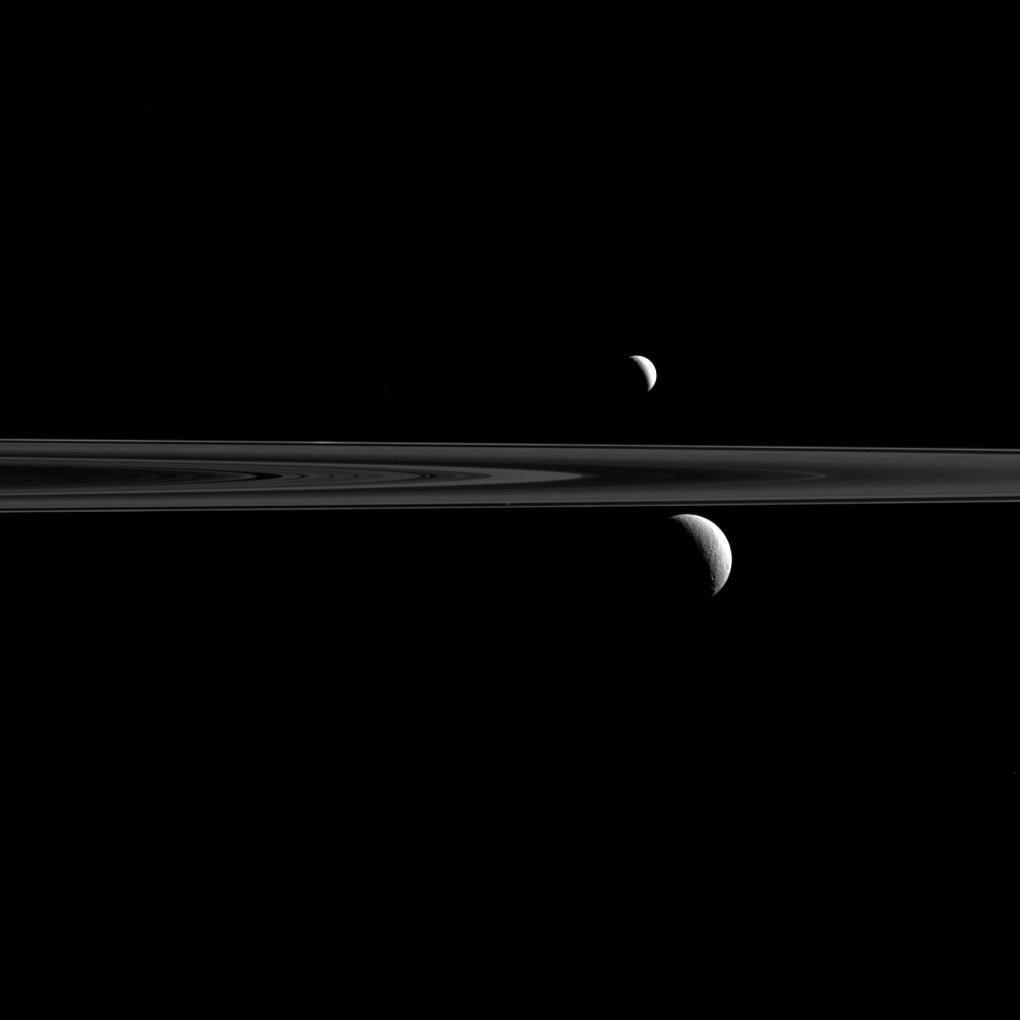
Triple Play

Posted by


NASA dixit:

“September 24, 2015. What looks like a pair of Saturnian satellites is actually a trio upon close inspection. Here, Cassini has captured Enceladus (313 miles or 504 kilometers across) above the rings and Rhea (949 miles or 1,527 kilometers across) below. The comparatively tiny speck of Atlas (19 miles or 30 kilometers across) can also be seen just above and to the left of Rhea, and just above the thin line of Saturn’s F ring. This view looks toward the unilluminated side of the rings from about 0.34 degrees below the ring plane.

The image was taken in visible light with the Cassini spacecraft narrow-angle camera. The view was obtained at a distance of approximately 1.8 million miles (2.8 million kilometers) from Rhea. Image scale on Rhea is 10 miles (16 kilometers) per pixel. The distance to Enceladus was 1.3 million miles (2.1 million kilometers) for a scale of 5 miles (8 kilometers) per pixel. The distance to Atlas was 1.5 million miles (2.4 million) kilometers) for an image scale at Atlas of 9 miles (14 kilometers) per pixel.”

Image credit: NASA/JPL-Caltech/Space Science Institute


  • Facebook
  • Google
  • Slashdot
  • Reddit
  • Live
  • TwitThis
09-22-17

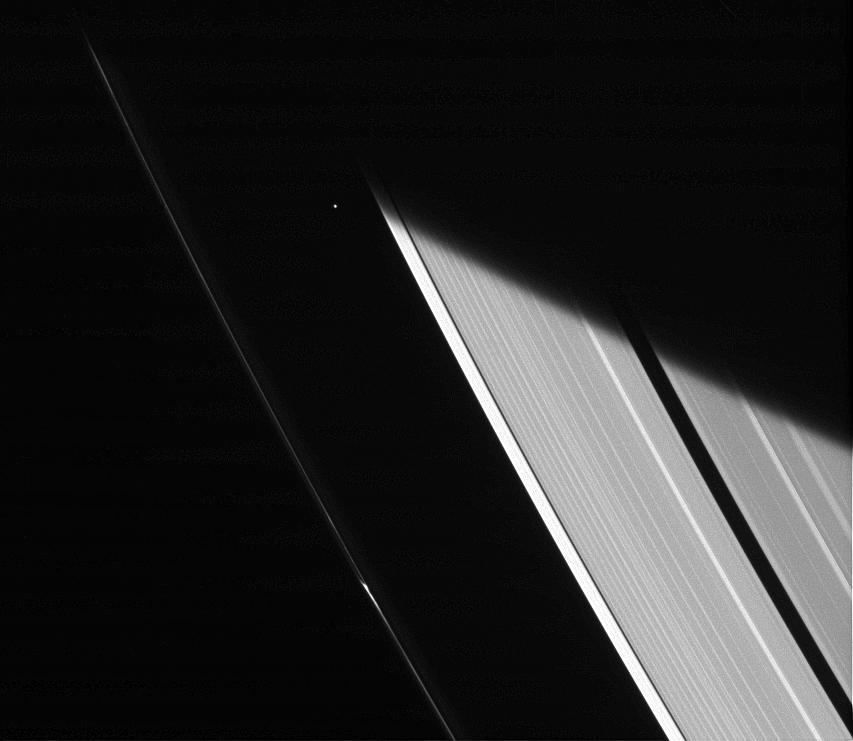
Emerging from Darkness

Posted by


NASA dixit:

“January 23, 2014. The Cassini spacecraft captures a glimpse of the moon Atlas shortly after emerging from Saturn’s shadow. Although the sunlight at Saturn’s distance is feeble compared to that at the Earth, objects cut off from the Sun within Saturn’s shadow cool off considerably. Scientists study how the moons around Saturn cool and warm as they enter and leave Saturn’s shadow to better understand the physical properties of Saturn’s moons.

This view looks toward the sunlit side of the rings from about 44 degrees above the ringplane. The image was taken in visible light with the Cassini spacecraft narrow-angle camera. The view was acquired at a distance of approximately 1.6 million miles (2.6 million kilometers) from Atlas and at a Sun-Atlas-spacecraft, or phase, angle of 93 degrees. Image scale is 10 miles (16 kilometers) per pixel.”

Image credit: NASA/JPL-Caltech/Space Science Institute


  • Facebook
  • Google
  • Slashdot
  • Reddit
  • Live
  • TwitThis