


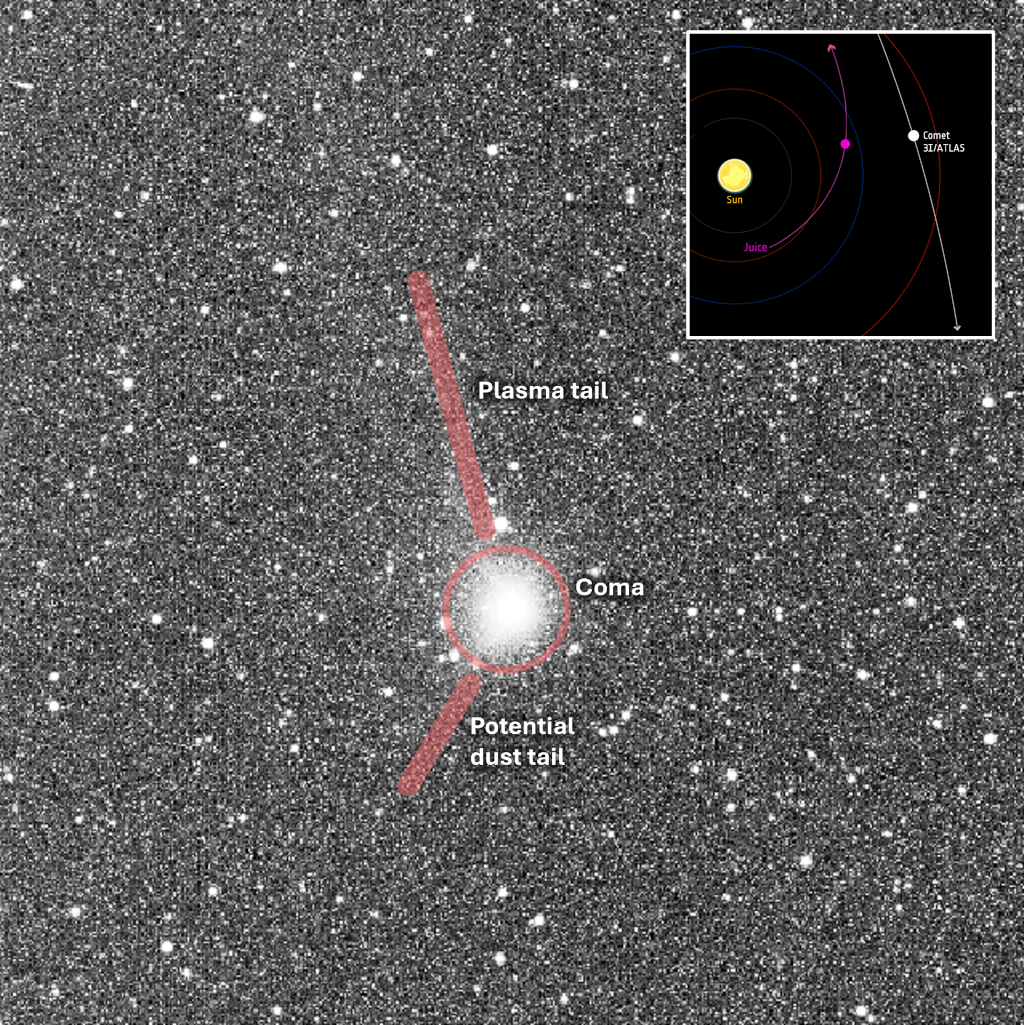
In December 2025, a comet discovered less than six months earlier passed close enough to Earth for astronomers to train their sharpest instruments on it. What they found was a surprise buried in ice: the water aboard 3I/ATLAS, the third confirmed interstellar comet to visit our solar system, carries a chemical fingerprint radically different from anything in our own planetary neighborhood. The finding, published in Nature Astronomy on April 23, 2026, has forced researchers to reconsider the assumption that our solar system’s water chemistry is representative of the galaxy at large.
The comet, formally designated C/2025 N1 (ATLAS), was first spotted by the Asteroid Terrestrial-impact Last Alert System in Chile on July 1, 2025. It reached perihelion on October 30, 2025, at a distance of 1.4 astronomical units from the Sun, and made its closest approach to Earth on December 19, 2025. Since then, outbound at roughly 210,000 kilometers per hour, it has been the subject of one of the most detailed compositional studies ever conducted on an interstellar object.
The work centered on the deuterium-to-hydrogen ratio in the comet’s water — a ratio that acts as a kind of chemical birth certificate. Deuterium, the heavy isotope of hydrogen with an extra neutron, becomes incorporated into water molecules under specific temperature and radiation conditions. Cold, undisturbed environments produce water with high D/H ratios. Warm, irradiated environments produce lower ratios. The ratio in Earth’s oceans, approximately 1.56 times 10 to the minus 4, has long served as a reference point for comparing planetary systems.
Using the Atacama Large Millimeter/submillimeter Array in Chile, a team led by Luis E. Salazar Manzano and Teresa Paneque-Carreño of Stockholm University observed the comet near perihelion and detected the signature of semi-heavy water, HDO. Normal water, Hâ‚‚O, fell below detection thresholds. The researchers derived a conservative lower limit for the D/H ratio in the comet’s water of greater than 6.6 times 10 to the minus 3. This is more than 40 times the value found in Earth’s oceans and more than 30 times the typical value measured in Solar System comets.
The implication is stark. Either the protoplanetary disk that gave rise to our solar system was unusual in its water chemistry, or 3I/ATLAS formed in an environment far colder and more chemically pristine than the region where our comets were born. The most likely explanation is that the comet originated in the outer reaches of a planetary system where temperatures never rose above 10 to 20 Kelvin and radiation levels were minimal — conditions consistent with formation in a distant molecular cloud or the outer reaches of another star’s protoplanetary disk, perhaps billions of years ago.
The finding complicates the search for life beyond our solar system in ways that reach beyond cometary science. Water is considered essential for life as we understand it, and astronomers have long used the D/H ratio as a tracer for understanding where and how planets form. If our solar system’s water chemistry turns out to be an outlier rather than a norm, it means the conditions that gave rise to Earth’s oceans may be rarer than expected — and that the building blocks of life are distributed across the galaxy in more diverse configurations than models have historically assumed.
The distinction matters because it shifts the probability landscape for habitability. If most stellar systems form water with high D/H ratios like 3I/ATLAS, then the path from ice to ocean to life involves chemistry that our own system did not follow. If, instead, our system is typical and 3I/ATLAS is an outlier, then the conditions for water retention and planetary habitability may be common. The truth likely falls somewhere in between, but the current data cannot yet say where.
What is clear is that interstellar comets offer something no Solar System object can: a direct sample of material from another planetary system’s formation zone, unmodified by the gravitational and thermal processing that has reshaped everything in our own neighborhood. Each new interstellar visitor that astronomers can study adds another data point to a distribution we are only beginning to map. 3I/ATLAS is the third confirmed interstellar comet. The next one may tell us something different. The story of where water comes from in the galaxy is far from settled.


 Subscribe to blog posts using RSS












