OrbitalHub

The place where space exploration, science, and engineering meet

Domain is for sale. $50,000,000.00 USD. Direct any inquiries to contact@orbitalhub.com.


Credits: NASA/CSA


Canadian astronaut Chris Hadfield will take command of the station during the second half of his third space mission. Hadfield will launch aboard a Soyuz rocket in December 2012, and spend six months on the station as part of the crew of Expedition 34/35. He will return to Earth in a Soyuz capsule in June 2013.


Hadfield is the only Canadian to board the Russian Mir space station, in 1995, during his first space flight, while he served as Mission Specialist 1 on STS-74. He is also the first Canadian mission specialist and the first Canadian to operate the Canadarm in orbit.


His second space flight was onboard STS-100, where he served as Mission Specialist 1. STS-100 was the International Space Station assembly flight 6A, which delivered and installed the Canadarm-2 on the station. During this mission, Hadfield performed two spacewalks.


Chris Hadfield also served as Director of Operations for NASA at the Yuri Gagarin Cosmonaut Training Centre in Star City, Russia; as Chief of Robotics for the NASA Astronaut Office at the Johnson Space Center in Houston, Texas; as Chief of International Space Station Operations; and as the Commander of NEEMO 14, a NASA undersea mission to test exploration concepts living in an underwater facility off the Florida coast.


The official announcement was made by the Canadian Space Agency. Chris Hadfield’s biography is also available here.


  • Facebook
  • Google
  • Slashdot
  • Reddit
  • Live
  • TwitThis
01-10-10

Arianespace 30th Anniversary

Posted by


Credits: ESA/CNES/Arianespace – Optique vidéo du CSG, L. Boyer


Arianespace was founded in 1980. With twenty-four shareholders from ten European countries (among which CNES holds 34% and EADS 30%), Arianespace is the world’s first commercial space transportation company.


The workhorse of Arianespace has been the Ariane launch vehicle.


Five versions of Ariane have served the company so far: Ariane 1, with the first successful launch on December 24, 1979, Ariane 2, launched for the first time on November 20, 1987, Ariane 3, starting its service on August 4, 1984, Ariane 4, launched on June 15, 1988, and Ariane 5, with the first successful flight on October 30, 1997.


The first launch of Ariane 5, a.k.a. Flight 501, ended with the vehicle being destroyed by its automated self-destruct system, after the high accelerations caused the inertial guidance system to crash. The crash was caused by, I quote, one of the most infamous computer bugs in history. If you like, you can take a look at the Ada code that caused the malfunction. But enough with the dark memories, this is an anniversary after all…


Since its inception, Arianespace has signed over 300 contracts that resulted in more than 277 satellite launches. According to Arianespace, Ariane launchers have delivered more than half of all commercial satellites now in service. The year 2009 was a very successful year for Ariane 5. The launcher orbited nine commercial satellites, the Herschel space telescope, the Planck scientific observatory, and the Helios 2B observation satellite. Ariane 5 has proven to be a versatile launch vehicle, capable of handling a wide range of missions.


The challenges for 2010 are many, as Arianespace is planning up to seven Ariane 5 launches. Two new launch vehicles will join Ariane 5 as part of the Arianespace family of launchers: the Vega small launcher and the Soyuz medium launcher.


You can read more about Arianespace, its mission, and the solutions provided to customers around the world on the Arianespace website.


  • Facebook
  • Google
  • Slashdot
  • Reddit
  • Live
  • TwitThis
11-19-09

Soyuz Update

Posted by


Credits: ESA – S. Corvaja, 2009


Arianespace is getting closer to the first Soyuz launch from Kourou, in French Guyana.


On November 7, 2009, two Soyuz launchers were loaded on MN Colibri, which transports them from Russia to French Guyana. The journey of the two Soyuz 2-1A launchers from St. Petersburg to Kourou takes two weeks.


Each launch vehicle is loaded in ten containers, which hold the four first-stage strap-on boosters, the Block A core stage, the Block I third stage, the Fregat upper stage, and the Soyuz 2-1A ST-type payload fairing. MN Colibri is also carrying the refined kerosene propellant used by the boosters, the Block A and Block I stages, as well as the unsymmetrical dimethylhydrazine (UDMH) and the nitrogen peroxide (N2O4) needed to fuel the Fregat upper stage.


The Soyuz launch site at Kourou is in its final stage of construction. While sharing common features with the cosmodromes at Baikonur in Kazakhstan and Plesetsk in Russia, the launch site at Kourou will have a fifty-two meter tall mobile gantry, which will be used for vertical payload integration and final pre-liftoff processing.


If you ask yourself how safe is Soyuz, it has been in production since 1957, continuously upgraded, and has more than 1,740 successful launches on record to date. Soyuz will become the medium-size launcher in the Arianespace family of launch vehicles. Taking advantage of the low latitude of the European spaceport, Soyuz will be able to deliver three-ton payloads to geostationary orbits.


  • Facebook
  • Google
  • Slashdot
  • Reddit
  • Live
  • TwitThis


Credits: Arianespace


An updated version of the Soyuz launch vehicle will liftoff at the end of the year from the European Spaceport at Kourou in French Guyana.


Soyuz will complete the range of launchers operated by Arianespace, which already includes the Ariane 5, with the Vega small launcher soon to come.


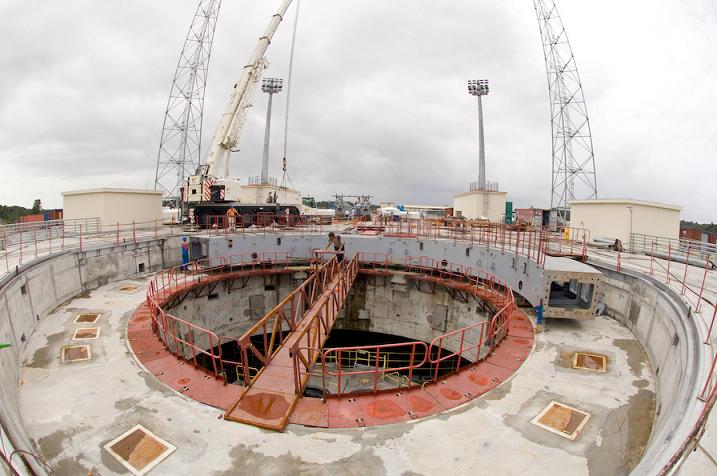
The construction of the Soyuz site in Guyana has reached a major milestone: the construction of the launch system has begun. The launch system supports and services the launch vehicle when it is erected for liftoff.


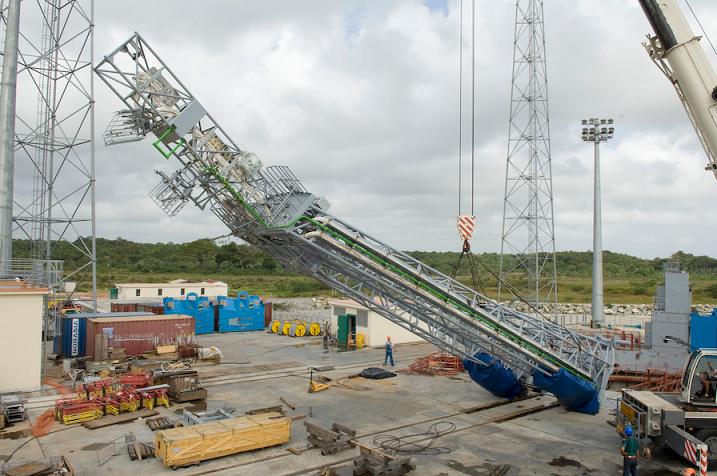
The concrete launch pad supports a multi-segment steel ring inset (known as the support crown). Two umbilical masts have also been positioned on top of the support crown. The masts, together with four support booms, will keep the launch vehicle in position on the launch pad. The two towers visible at the launch site will protect the Soyuz vehicle from lightning strikes.


Credits: Arianespace


One interesting detail about the launch site is that the support crown is fixed on the launch pad, in contrast to the launch pads built for Soyuz in Russia and Kazakhstan, as the updated Soyuz operated from Kourou is able to manage the launch azimuth during ascent.


You can read more about the Kourou Spaceport on the Arianespace website.


  • Facebook
  • Google
  • Slashdot
  • Reddit
  • Live
  • TwitThis


Credits: NASA/RASA


The Alpha Magnetic Spectrometer (AMS) is a high-energy particle detector. AMS will detect electrons, positrons, protons, antiprotons, and nuclei in cosmic radiation.


AMS is a cooperative project that involved more than 200 scientists from 31 institutions and 15 countries. The data gathered by AMS during its three-year mission will help scientists answer important questions about antimatter and invisible mass in the Universe. AMS could detect many types of particles predicted by theorists and determine their astrophysical sources.


AMS could reveal to scientists unusual astrophysical objects like antimatter galaxies, dark matter, strangelets, microquasars, and primordial black holes.


AMS actually refers to two particle experiments: AMS-01 and AMS-02. AMS-01 flew in low Earth orbit (LEO) with Space Shuttle Discovery STS-91 in June 1998. AMS-01 was an AMS prototype (a simplified version of the spectrometer) and was used to test particle physics technology in LEO. AMS-02 is the Alpha Magnetic Spectrometer designed to be mounted and operated on the ISS.
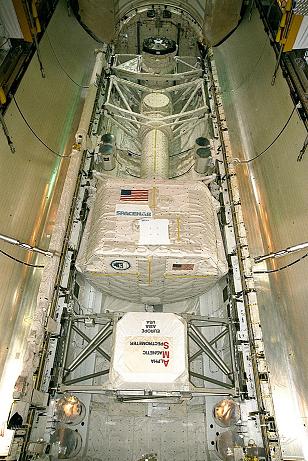
 

Credits: NASA


AMS-02 is a cube-shaped structure with a mass of 6,731 kg. The spectrometer consists of a huge superconducting magnet and six specialized detectors, and requires 2,000 watts of power.


The experiment has a 10Gb/sec internal data pipeline and will have a dedicated 2MB/sec connection to ground stations. AMS-02 will gather approximately 200 TB of scientific data during its mission. Four 750 MHz PowerPC computers running Linux will provide the computing power.


The spectrometer also contains two star tracker cameras, which detect the orientation in space, and a thermal control system that will control the temperature of the whole experiment. The thermal control system is quite complex. Heat is collected from the detectors and the magnet, and then pushed through conductors to the radiators mounted on the outside of the AMS and radiated into space.


AMS-02 has a little bit of history associated with it … due to the Space Shuttle accidents, which reduced the number of orbiters available, and the decision to retire the Space Shuttle fleet, AMS-02 faced cancellation (a long list of elements meant to be part of the ISS were cancelled for the same reasons). Because an additional shuttle flight was added to the launch manifest, most likely AMS-02 will make it to the space station.


The plan for AMS-02 is that it will be attached to the zenith side of the S3 section of the Integrated Truss Structure on the ISS. A Payload Attachment System will be used to keep the spectrometer in place on the truss segment.
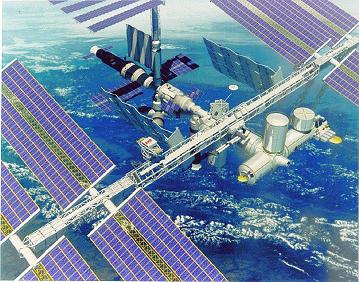
 

Credits: NASA


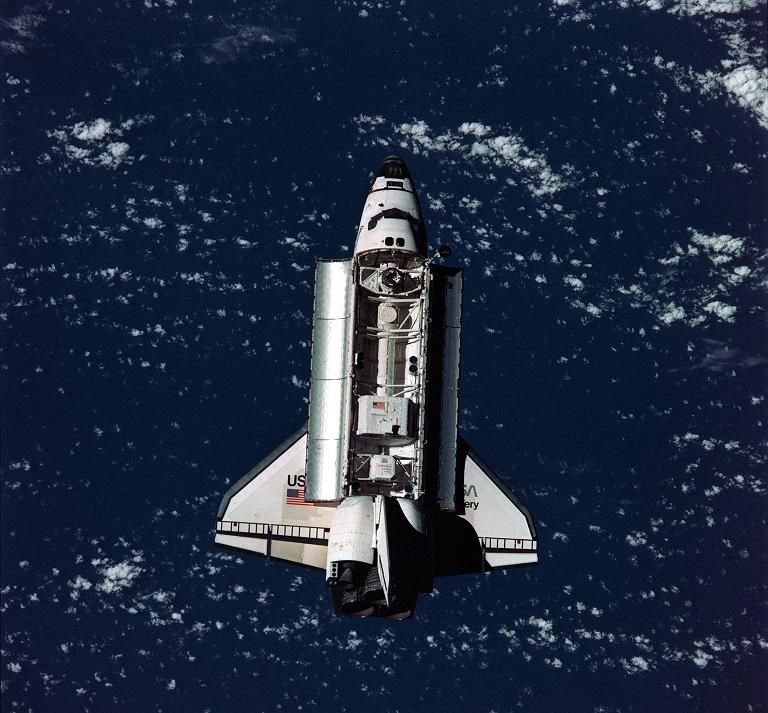
According to the missions schedule, AMS-02 will be installed on ISS as part of the Space Shuttle Discovery STS-134 mission, together with the last ExPRESS Logistics Carrier (ELC-4), in late 2010.


STS-134 will be the last Space Shuttle flight before the deadline set to end Space Shuttle operations on September 30, 2010.


To make things more interesting (and Space Shuttle operations cheaper), it has been proposed that the last mission should end through a destructive re-entry. In this scenario, the reduced crew of three will remain on the space station and return to Earth onboard Soyuz spacecraft.


You can read more about AMS-02 on a dedicated web page at MIT. There is also a web page dedicated to AMS-02 at CERN.

 

  • Facebook
  • Google
  • Slashdot
  • Reddit
  • Live
  • TwitThis
01-24-09

Carnival of Space #87

Posted by


Credits: NASA


Carnival of Space #87 is hosted at The Martian Chronicles by Ryan Anderson.


This week, you can read about methane on Mars, NASA’s lunar rover, the ten space trends for 2009, building lunar outposts, space solar power, and much more.


OrbitalHub presents the Soyuz 4 and 5 missions. Soyuz 4 and 5 successfully carried out the first docking and crew transfer between two spacecraft on January 16, 1969.


  • Facebook
  • Google
  • Slashdot
  • Reddit
  • Live
  • TwitThis