OrbitalHub

The place where space exploration, science, and engineering meet

Domain is for sale. $50,000,000.00 USD. Direct any inquiries to contact@orbitalhub.com.

07-26-11

Interplanetary Internet

Posted by


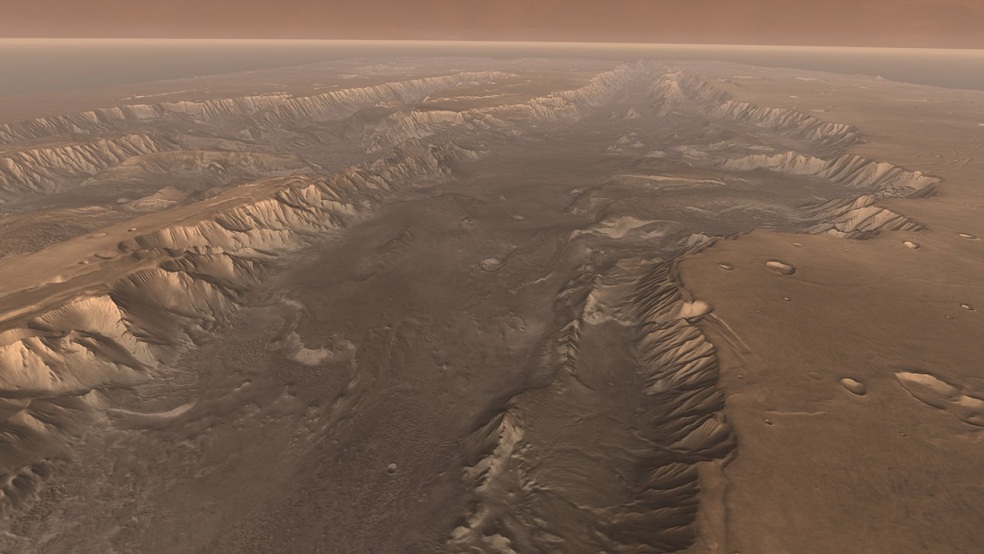
Credits: NASA/JPL/Arizona State University


You know the frustration you experience when the new hit of your favorite band takes too long to download on your iPhone? Imagine 30 years from now (an optimistic estimate)… you are one of the happy colonists who work around the clock to build one of the first outposts on Mars.


At the end of your shift in the hydroponics, you head back to your luxurious 20mx10m quarters (the shoebox, as your relatives back on Earth like to call it), have a hot shower, and a delicious vegetarian dinner while enjoying the view over the Valles Marineris (the $100 million view, as you like to call it). You receive an email with a link to the new hit of your favorite Earth band, and after clicking on the link in your favorite Internet browser, you download the song in less than one second.


What’s wrong with this scenario? It describes what software engineers would call a wonderful user experience, but something is wrong with this picture… what is it?


One short story might give you a hint. In January 2004, when the two Mars Exploration Rovers, Spirit and Opportunity, landed on Mars, you could watch videos of the scientists in the mission control room at JPL cheering when receiving confirmations of successful landings. The detail that might have escaped you is that those confirmation messages traveled around 20 minutes through interplanetary space before reaching the room at JPL. The scientists were cheering at JPL 20 minutes after the landings happened. If anything went wrong, the bad news would have reached Earth too late to do anything about it. This kind of explains why the engineers that designed and built the rovers had to make sure that the rovers themselves were capable of making some decisions on their own.


To go back to our sci-fi novel attempt in the first paragraph, the little detail that is misplaced in our story is that the time delay is not present. Our colonist clicks on the link to a server which is somewhere on Earth and the download is performed in no time.


For someone who has a basic understanding of protocol stacks (i.e. HTTP/TCP/IP), it is obvious that it would take quite some time to download a file from a server located on Earth to our Mars colony. All of a sudden, the ACK packets have lost their charm.


No reason to worry. Even if Mars outposts are far in the future, time and effort is spent on finding solutions for such communication problems in the present. The challenges seem overwhelming: very long delays, possible communication disruptions, and significant loss due to big bit error rates. A leap is necessary. The present protocols and architecture on which Internet relays have been designed assuming continuous and bi-directional paths, short round-trip times, and small error-rates.


One architecture that promises to solve the problems inherent to our scenario is the Delay Tolerant Networking (DTN) architecture, proposed in RFC 4838. A physical architecture that could solve the problems mentioned above is also proposed by Takashi Iida (Tokyo Metropolitan University), Yoshinori Arimoto (National Institute of Information and Communications Technology), and Yoshiaki Suzuki (NEC Corporation). The architecture would include clusters of communication satellites in orbit around Earth and Mars and relay satellites located at the Lagrangian points L4 and L5 of the Sun-Earth system. The relay satellites would make communication between Earth and Mars possible even when Mars is behind the Sun. Just a smart placement of relay satellites does not do the trick. In order to increase the responsiveness of the network, mirroring of data is also necessary.


You can find more information about space data systems on The Consultative Committee for Space Data Systems website. Other good resources include The InterPlaNetary Internet Project, and The Delay Tolerant Networking Research Group.


  • Facebook
  • Google
  • Slashdot
  • Reddit
  • Live
  • TwitThis


Credits: NASA


ARES (or the Aerial Regional-scale Environment Survey) is an autonomous powered airplane. ARES will bridge the gap between remote sensing and surface exploration on Mars.


This new class of science will allow magnetic surveys with an improved resolution, geologic diversity coverage, and in-situ atmospheric science.


ARES method of deployment is unique because the robotic aircraft has to travel to Mars folded inside a protective shell. After the atmospheric entry and the parachute deployment, the heat shield that protects the aircraft during entry is released. Once the heat shield is out of the way, the folded aircraft leaves the protective shell. The unfolded tail will stabilize the tumbling aircraft. Finally, the wings will unfold and the aircraft will pull up from the dive.


It is needless to say that reliability is essential. All the mechanical systems of the aircraft that are involved in this maneuver must perform without any flaws, and that has to happen after spending six to eight months in vacuum at (more than) freezing temperatures. It is hard to imagine that ARES would be able to fly with a folded wing.


Credits: NASA


The ARES design is the result of five years of extensive analysis and testing. Testing has included wind tunnel tests, ejection tests, and flight tests. In order to simulate the Mars environment, the flight tests had to be performed at certain Mach and Reynolds numbers. A 50% scale prototype was released from a high-altitude research balloon. The robust design that resulted will handle the uncertainties in the Mars environment.


ARES could be selected as the next Mars Scout Mission. For more details about ARES you can visit NASA’s website. ARES Principal Investigator, Dr. Joel S. Levine, presented ARES at a TEDxNASA event. If you want to build your own paper-made scale model of the ARES Mars Airplane, you can find the model here.


  • Facebook
  • Google
  • Slashdot
  • Reddit
  • Live
  • TwitThis


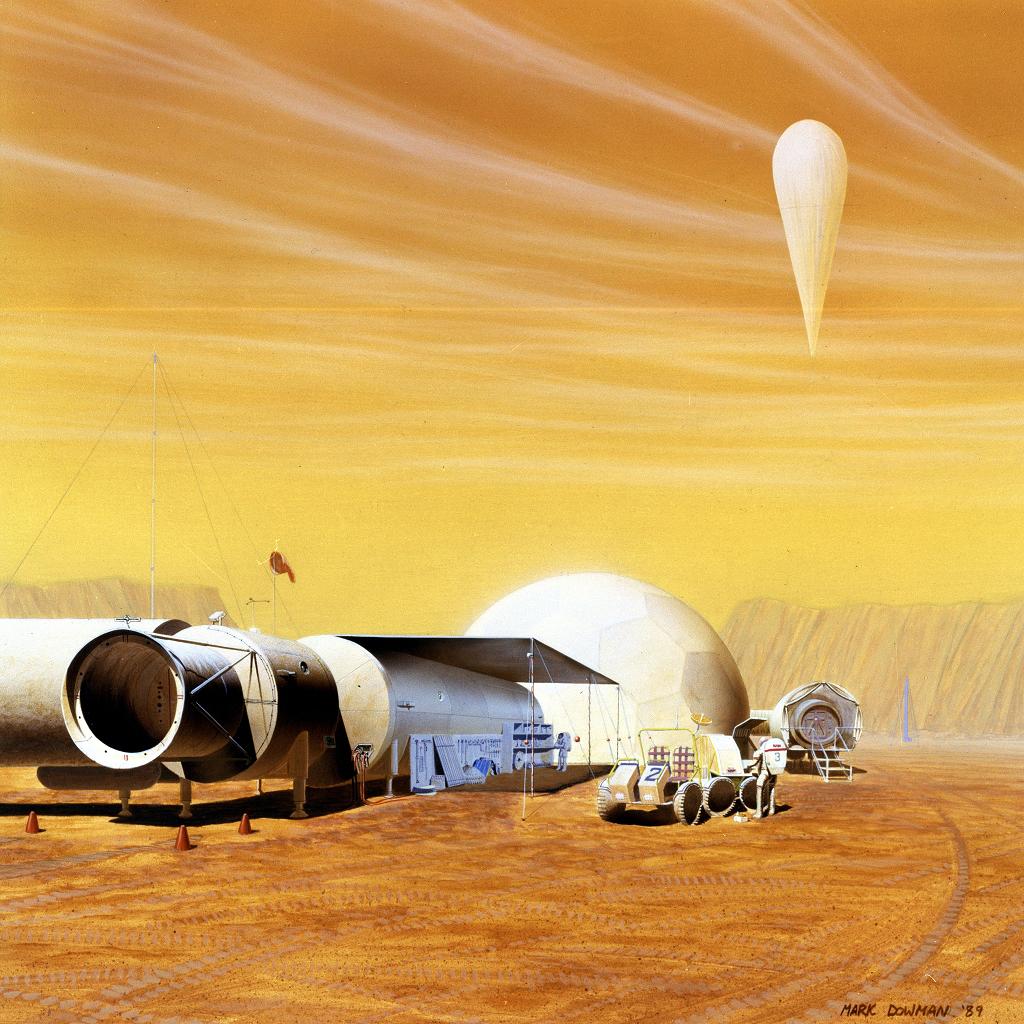
Credits: Mark Dowman


Airships are making a big comeback now as the energy consumption for all modes of transportation is being re-analyzed. Missions with special requirements like surveillance and reconnaissance missions and transportation of heavy payloads to remote outposts are the main driver for the reinvention of the airship.


But Earth is not the only place where airships can be deployed. There are a number of destinations in the solar system that would make a perfect environment for deployment and operation of airships, like Mars, Venus, and Titan – Saturn’s largest moon.


The presence of an atmosphere makes possible the use of vehicles that can fly within atmosphere for planetary exploration. Also, planetary exploration with low-powered vehicles like airships really makes sense considering the fact that energy is always at a premium.


So far, the only extraterrestrial deployment of an airship was performed during the Vega mission to Venus, in 1984. Two balloons were released and they floated 54 km above the planet’s surface for nearly two days.


Lighter-Than-Air (LTA) AERial ROBOTS (AEROBOTS) would present some advantages over their Heavier-Than-Air (HTA) siblings and the traditional planetary scouts, the exploration rovers: they would have long-duration mission and long-distance capabilities, they would not have to deal with obstacle avoidance problems, and they have low-power consumption. However, the environment in which the airship will operate will impose some restrictions on the capabilities of the airship (consider things like atmospheric composition and density, temperature, and the amount of solar radiation available). More on the planetary environments in the solar system and airship evaluations for each one of them can be found here.


NASA has funded a number of projects for solar system exploration that make use of aerobots. The Jet Propulsion Laboratory’s Planetary Aerobot Program is developing balloons to support scientific payloads in the atmosphere of other planets in our solar system. You can find more details about JPL’s Planetary Aerobot Program here.


  • Facebook
  • Google
  • Slashdot
  • Reddit
  • Live
  • TwitThis
06-2-10

Mars 500 Update

Posted by


Credits: ESA – S. Corvaja


After a successful simulated Mars mission that lasted for only 150 days, the Mars 500 experiment will go to the next level: the 520-day mission. The hatch of the facility hosted at the Russian Institute for Biomedical Problems in Moscow will be sealed again tomorrow, on June 3, 2010.


There are six crewmembers selected plus a Russian backup: Diego Urbina, Romain Charles, Sukhrob Kamolov, Alexey Sitev, Alexandr Smoleevskiy, Mikhail Sinelnikov, and Wang Yue. The crew will live and work for 520 days inside the sealed facility in the same way astronauts live and work on the International Space Station (minus the zero-g environment, of course).


You can find more information about the Mars 500 project on the dedicated page on ESA’s website.


  • Facebook
  • Google
  • Slashdot
  • Reddit
  • Live
  • TwitThis
02-17-09

Dawn and the Flyby of Mars

Posted by


Credits: NASA/JPL


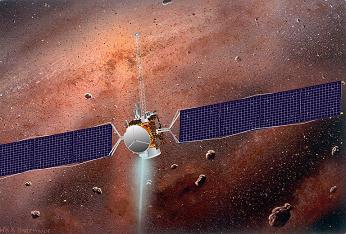
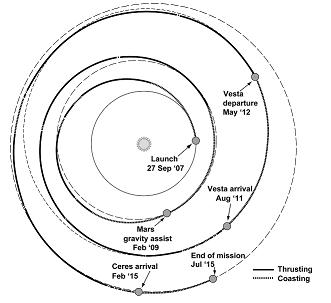
The Dawn spacecraft is currently performing the Mars flyby phase of its mission. The purpose of the Mars flyby is to alter the trajectory of the spacecraft in order to rendezvous with its first scientific target in the main asteroid belt.


The spacecraft will come within 549 km of the surface of Mars on February 17, 2009, at 4:28 PST.


The flyby is a gravity assist maneuver used in orbital mechanics to alter the trajectory of a spacecraft. The gravity assist is also known as a gravitational slingshot. The first ever gravity assist maneuver was performed by Mariner 10 in February 1974, and most of the interplanetary missions have made use of it since then.


The scientific objective of the Dawn mission is to answer important questions about the origin and the evolution of our solar system. The currently accepted theory about the formation of our solar system states that Jupiter’s gravity interfered with the accretion process, thereby preventing a planet from forming in the region between Jupiter and Mars. This led to the formation of the asteroid belt.


The asteroids chosen as scientific targets for the Dawn mission are Vesta and Ceres. Due to their size, they have survived the collisional phase, and it is believed that they have preserved the physical and chemical conditions of the early solar system. The asteroids have followed different evolutionary paths and have dissimilar characteristics, which makes them perfect research subjects.
 

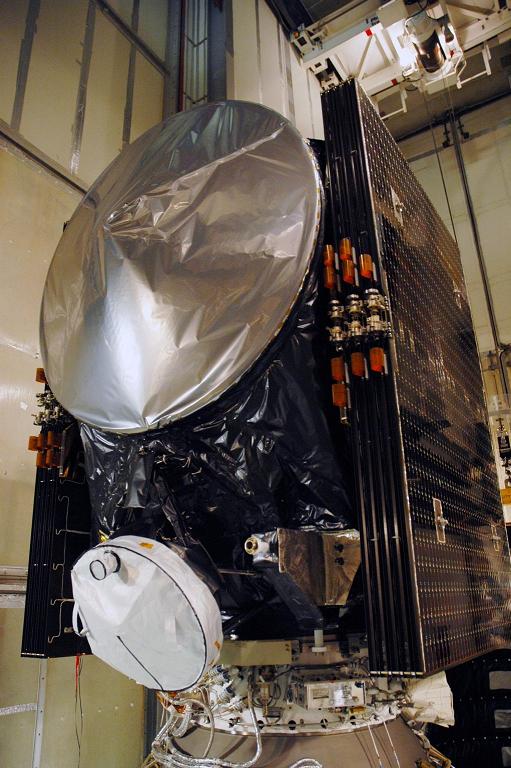
Credits: NASA/JPL


The design of the Dawn spacecraft is based on Orbital’s STAR-2 series, and uses flight-proven components from other Orbital and JPL spacecraft: the propulsion system is based on the design used on Deep Space 1, the attitude control system used on Orbview, a hydrazine-based reaction control system used on the Indostar spacecraft, and command and data handling, as well as flight software, from the Orbview program.


The core structure of the spacecraft is a graphite composite cylinder, while the panels are aluminum core with aluminum/composite face sheets.


The central cylinder hosts the hydrazine and xenon tanks. The hydrazine tank can store 45 kg of fuel, while the xenon tank has a capacity of 450 kg.


The attitude control system (ACS) uses star trackers to estimate attitudes in cruise mode. A coarse Sun sensor (CSS) allows ACS to keep the solar panels normal to the Sun-spacecraft line. ACS also uses the hydrazine-based reaction control system for the control of attitude and for desaturation of the reaction wheels.
 

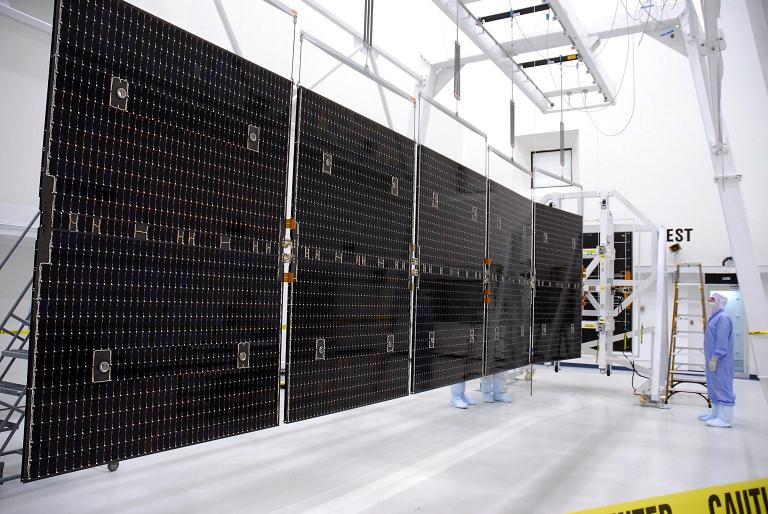
Credits: NASA/George Shelton


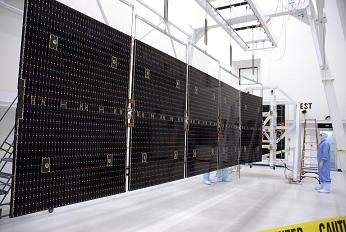
The solar panels are capable of producing more than 10 kW at 1 AU and 1 kW at 3 AU (on Ceres’ orbit).


The command and data handling system (CDHS) is based on a RAD6000 board running VxWorks. The software is written in C. There are 8GB available on the board as storage for engineering and scientific data.


The scientific payload consists of the Framing Camera (FC), the Gamma Ray and Neutron Detector (GRaND), and the visible and infrared (VIR) mapping spectrometer.


The FC will be used for determining the bulk density, the gravity field, for obtaining images of the surface, and for compiling topographic maps of Vesta and Ceres. In addition, the FC will capture images for optical navigation in the proximity of the asteroids. For reliability purposes, the payload includes two identical cameras that can run independently.


GRaND will serve for the determination of the elemental composition of the asteroids. GRaND is the result of the expertise accumulated during the Lunar Prospector and Mars Odyssey programs.


Credits: NASA/Jack Pfaller


VIR will help map the surface mineralogy of the asteroids. The instrument is a modified version of the visible and infrared spectrometer flying on the Rosetta mission.


The Dawn spacecraft uses ion propulsion to make its journey to Vesta and Ceres. Ion propulsion will also be used by Dawn during the low altitude flights over the asteroids.


While the fact that Dawn’s engines have a thrust of only 90 mN can hardly impress a reader, the important detail to mention when discussing propulsion systems is the specific impulse. Dawn’s engines have a specific impulse of 3100 s. For a chemical rocket, the specific impulse ranges from 250 s for solid rockets to 450 s for bipropellant liquid rockets. The only drawback (if this can be regarded as a drawback) is that the ion engines must be fired for much longer in order to achieve an equivalent trajectory.


With such high specific impulse engines, Dawn makes use of the fuel onboard in a very efficient way. The fuel used is xenon, a heavy noble gas placed in group 8A of the periodic table. The power produced by the large solar panels is used to ionize the fuel and then accelerate it with an electric field between two grids. In order to maintain a neutral plasma, electrons are injected into the beam after acceleration.


Credits: NASA/Amanda Diller


Dawn was launched from Cape Canaveral Air Force Station and injected on an interplanetary trajectory by a Delta II launch vehicle.


The main contributors to the Dawn mission are the University of California in Los Angeles (science lead, science operations, data products, archiving, and analysis), the Jet Propulsion Laboratory (project management, systems engineering, mission assurance, payload, navigation, mission operations, level zero data), and the Orbital Sciences Corporation (spacecraft design and fabrication, quality assurance, and payload integration).


The scientific payload was provided by the Los Alamos National Laboratory, the German Aerospace Center, the Max Planck Institute, and the Italian Aerospace Center. The Deep Space Network is responsible for data return from the spacecraft.



For more information about Dawn, you can visit the Dawn Mission Home Page on the JPL web site.


  • Facebook
  • Google
  • Slashdot
  • Reddit
  • Live
  • TwitThis
02-11-09

Mars 500

Posted by


Credits: ESA – S. Corvaja


The Mars500 experiment is a cooperative project between the European Space Agency’s Directorate of Human Spaceflight and the Russian Institute for Biomedical Problems (IBMP).


The experiment will be conducted inside a special facility at the IBMP in Moscow.


Mars500 is essential for the preparation of human missions to Mars, as the data, knowledge, and experience accumulated during the experiment will help scientists investigate the human factors of this type of mission.


Many aspects of long duration spaceflights are targeted by this study: crew composition, the influence of isolation on sleep, mood, and mental health, the impact of different personalities, cultural background, and motivation of the crew members, and the effects of stress on health and the immune system.


There is one 150-day simulation to be conducted (that can be followed by an additional 150-day study) before the full 520-day simulation. The full simulation follows the profile of a real mission to Mars, which contains an exploration phase that has to be performed by the crew of six selected for the experiment.


During the experiments, the crews will have a diet identical to the one that the ISS crews have and communication with the outside world will involve a delay (as in the real conditions of a space mission, when the spacecraft and the mission control are millions of kilometers away from each other).


The crew will be completely isolated, and they will have to handle all of the critical situations for the duration of the experiment. The crew will speak English and Russian, and have experience in medicine, biology, and engineering.


Credits: ESA – S. Corvaja


The facility at IBMP is known as the Ground-based Experimental Complex (GEC or NEK in Russian). Besides the isolation facility (or the mockup of the habitable modules of a spacecraft), the facility also contains technical facilities, offices, and an operations room.


The isolation facility contains four interconnected modules, which are used by the crew for daily activities.


It also contains a module that will simulate the Martian landscape and it will be used for activities on the surface of Mars during the simulated landing.


The four modules are designated as the medical module, the living quarters, the Mars landing module, and the storage module. The medical module will be used for routine medical examinations, and eventually for complex medical investigations in the case of any crew member becoming ill. The living quarters module contains individual compartments for the crew members, and also a living room, and a kitchen. The control room will also be part of this module.


The Mars landing module will accommodate the landing crew during the orbiting of Mars phase of the mission. Three of the crew members will have to live and work inside this module for up to 3 months. The storage module contains a refrigerator for food storage, a storage compartment for non-perishable food, a greenhouse, a gym, a bathroom, and even a sauna.


The start of the full 520-day study is planned for late 2009, when a six-member crew will be sealed behind the entry hatch in order to live and work in the conditions of a complete Mars mission.


For more information about the Mars500 project, check out the dedicated page on the IBMP web site.


  • Facebook
  • Google
  • Slashdot
  • Reddit
  • Live
  • TwitThis