OrbitalHub

The place where space exploration, science, and engineering meet

Domain is for sale. $50,000,000.00 USD. Direct any inquiries to contact@orbitalhub.com.

08-1-11

Juno

Posted by


Credits: NASA/JPL


Juno is a NASA spacecraft scheduled to start its journey to Jupiter in a few days. Juno will help scientists understand the origin and evolution of Jupiter. While the dense cover of clouds helps Jupiter keep its secrets away from Earth observers, Juno will get close enough to Jupiter so that fundamental processes and conditions characteristic to the early solar system will be revealed.


First, Juno will try to determine if Jupiter has a solid planetary core. While this is an important piece of the puzzle, it might also help determine how Jupiter’s magnetic field is generated (by the way, scientists are still unclear how Earth’s magnetic field is generated, and there are several theories trying to explain it). Juno will also map Jupiter’s magnetic field, study the auroras, and determine the amount of water and ammonia in the atmosphere.


The launch vehicle to lift off with Juno is the most powerful Atlas rocket ever built, the United Launch Alliance Atlas V 551. In this configuration, an Atlas V launch vehicle can lift 18,810 kg to Low Earth Orbit (LEO) and 8,900 kg to Geosynchronous Transfer Orbit (GTO). However, the Atlas V 551 is not powerful enough to put Juno on a direct trajectory to Jupiter. In order to get as far as Jupiter’s orbit, Juno has to perform a gravity assist maneuver.


Juno will orbit Jupiter in a polar orbit and get as close as 5,000 km above the planet’s top clouds. This will allow the spacecraft to do science below the radiation belt of the planet and allow for a complete coverage of the planet. The low altitude will allow for a detailed analysis of the planet’s atmosphere. The orbit will also allow Juno to take a very close look at the auroras that are forming at the north and south Jovian poles.


The scientific payload carried by Juno includes a gravity/radio science system, a microwave radiometer, a vector magnetometer, particle detectors, ultraviolet and infrared spectrometers, and a color camera to capture images of the Jovian poles.


One interesting feature of the spacecraft is the electronics vault. Even if Juno’s highly elliptical orbit avoids the deadly radiation belts by approaching the planet at the north pole, skimming the clouds below the radiation belts, and exiting over the south pole, as an additional protection measure the onboard electronics are protected by a radiation shielded vault. This will ensure that the computers will not malfunction due to single events, and that the electronics will meet the requirements for the mission lifespan.


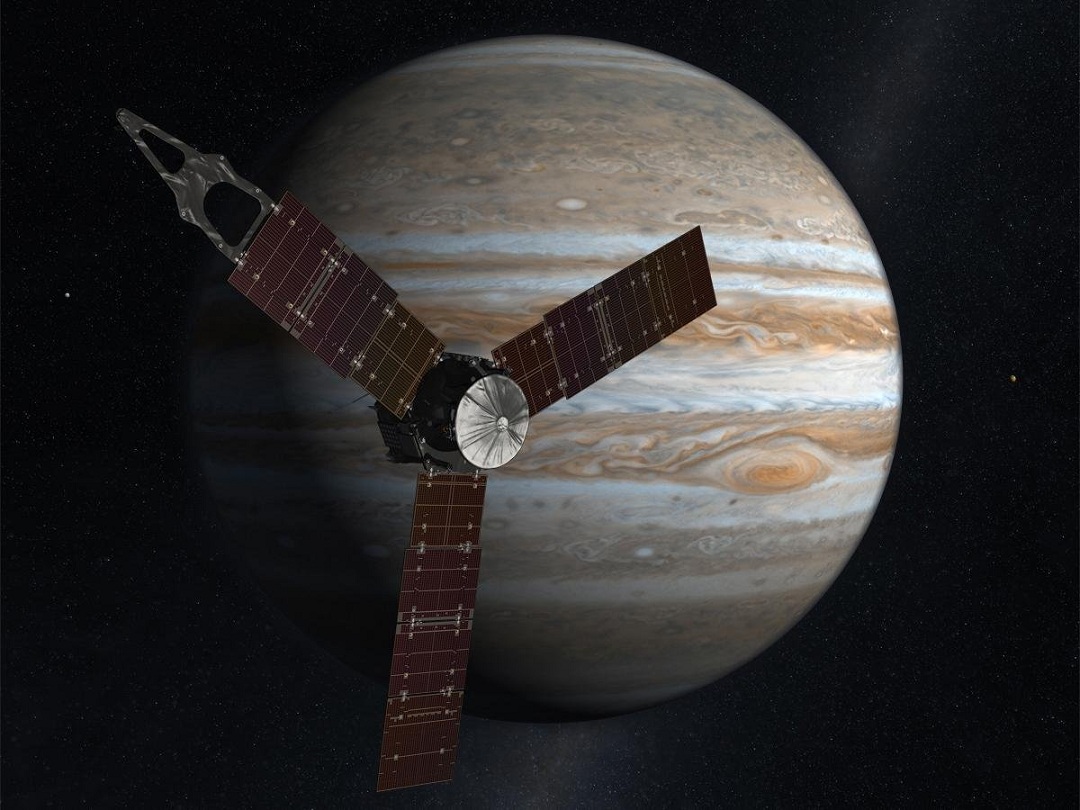
While the previous missions to the Jovian system have been powered by Radio Thermal Generators (RTGs), Juno will benefit from advances in solar power cell design. The cells used for Juno’s solar panels are far more efficient and radiation tolerant than the cells available to space systems engineers decades ago. Three solar panels that extend more than 10 meters from the hexagonal body of the spacecraft will provide the power required by the scientific instruments.


The mission is scheduled for launch on August 5, 2011. After coasting for more than two years, in October 2013, Juno will swing by Earth. The gravity assist maneuver will provide the delta V necessary for the spacecraft to reach Jupiter’s orbit. Juno will arrive at Jupiter in July 2016. After performing the Jupiter Orbital Insertion (JOI) maneuver, the spacecraft will start to collect and send back home scientific data.


Juno will send back science and telemetry data through the Deep Space Network (DSN), a network of powerful antennas located in Madrid, Spain; Barstow, California; and Canberra, Australia.


At the end of the mission, planned for October 2017, and after 33 complete revolutions around Jupiter, Juno will fire up its thrusters and decrease its velocity, enter the upper atmosphere of Jupiter, and get incinerated. Why such a tragic end to the Juno mission? Remember the Prime Directive? While the Prime Directive is known only to Star Trek fans… and it might get serious consideration only from Star Fleet officers, the possibility of having Juno crashing on one of the Jovian satellites (especially Europa) has to be eliminated. NASA scientists take contamination of other worlds very seriously.


You can find out more about the Juno mission on NASA’s dedicated web site. The Juno mission is managed by NASA’s Jet Propulsion Laboratory in Pasadena, California. The Principal Investigator for the Juno mission is Dr. Scott Bolton of Southwest Research Institute in San Antonio, Texas. The spacecraft was designed and built by Lockheed Martin of Denver, Colorado.


  • Facebook
  • Google
  • Slashdot
  • Reddit
  • Live
  • TwitThis
04-17-09

Delta II

Posted by


Credits: NASA/MSFC


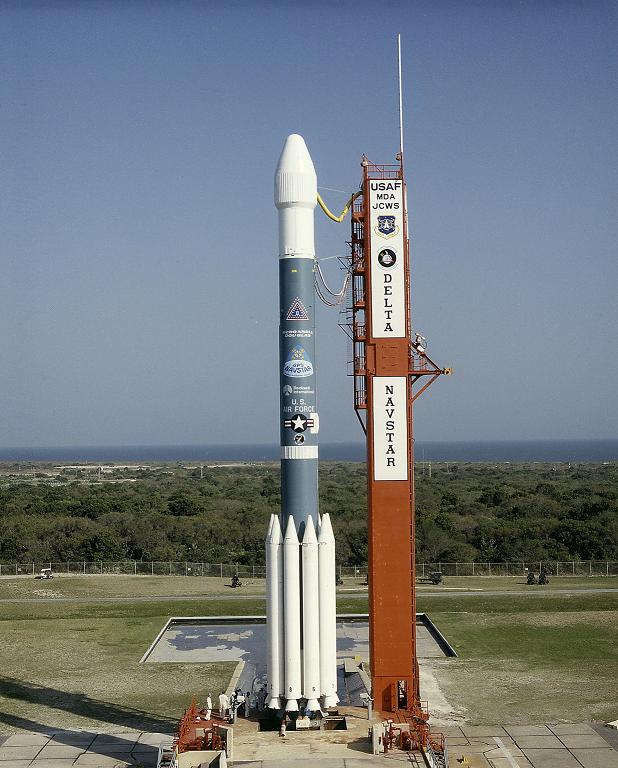
Delta II is a space launch system operated by United Launch Alliance (ULA), which was initially built by McDonnell Douglas, and by Boeing Integrated Defense Systems after McDonnell Douglas merged with Boeing in 1997.


As any other early space launch system, it evolved from a ballistic missile. In the 1960s, the Thor intermediate-range ballistic missile was modified to become the Delta launch vehicle. In 1981, after being operated for 24 years, Delta production was halted due to a change in U.S. space policy. However, in 1986, after the Challenger accident, it was decided that the Space Shuttle fleet would not carry commercial payloads anymore, paving the way for the return of the Delta launch vehicle. Delta II had its maiden flight on February 14, 1989.


Delta II launch vehicle is 38.2 to 39 m long, with a diameter of 2.44 m, and a mass that can range from 151,700 to 231,870 kg, depending on configuration. Delta II can be configured with two or three stages.


Delta II can inject a payload having a mass of 2,700 to 6,100 kg in low Earth orbit (LEO). Payloads deployed to Geosynchronous Transfer Orbit (GTO) can have a mass from 900 to 2,170 kg.


The first stage, Thor/Delta XLT-C, is powered by one Pratt & Whitney Rocketdyne RS-27A liquid fuel engine. The RS-27A engine is fueled by RP-1 and liquid oxygen. The RS-27A engine provides around 1,000 kN of thrust.


Credits: NASA


The solid boosters are used to increase the thrust of the launch vehicle. The first solid boosters used by Delta II 6000 series were Castor 4A motors. The 7000 and 7000 Heavy series use GEM 40 and GEM 46 solid motors respectively. The increase in thrust from Castor 4A to GEM 46 is substantial, from 480 kN to 630 kN.


Stage two, Delta K, is powered by a hypergolic restartable Aerojet AJ10-118K engine that can provide 43 kN. The AJ10-118K can fire more than once in order to insert the payload into LEO. The engine uses dinitrogen tetroxide as oxidizer and aerozine 50 (which is a mix of hydrazine and unsymmetrical dimethylhydrazine) as fuel. Besides having hard to pronounce names, the oxidizer and the fuel are very toxic and corrosive. The second stage contains the flight control system, which is a combined inertial system and guidance system.


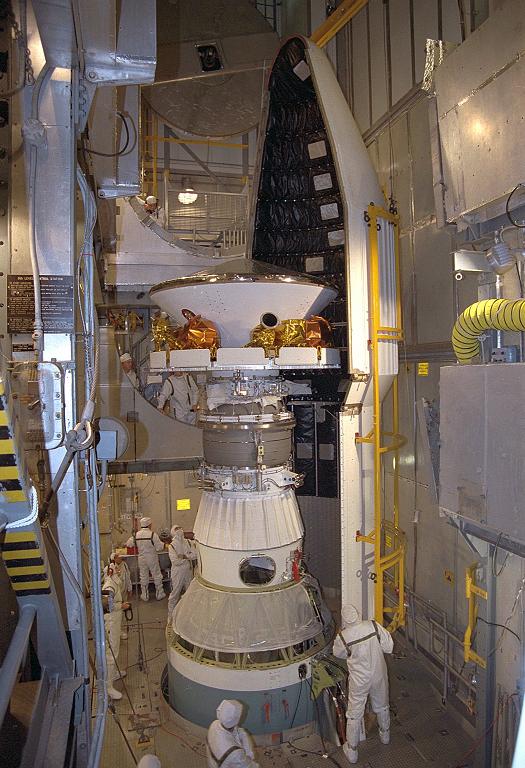
The third stage, if present in the configuration, is a Payload Assist Module (PAM). This stage is powered by an ATK-Thiokol motor, which provides the velocity change needed for missions beyond Earth orbit. The stage has no active guidance control and it is spin-stabilized.


The de-spin mechanism used to slow the spin of the spacecraft after the burn and before the stage separation is a yo-yo de-spin mechanism. This mechanism consists of two cables with weights on the ends. The weights are released and the angular momentum transferred from the stage reduces the spin to a value that can be controlled by the attitude control system of the spacecraft.


Delta II can launch single, dual, or multiple payloads during the same mission. There are three fairing sizes available: composite 3-meter diameter, aluminum 2.9-meter diameter, and stretched composite 3-meter diameter.


Credits: NASA


Delta II is assembled on the launch pad. After hoisting the first stage into position, the solid boosters are hoisted and mated with the first stage. The second stage is then hoisted atop the first stage.


Delta II launch vehicles have a four-digit naming system. The first digit can be either 6 or 7, designating the 6000 or 7000 series. The second digit indicates the number of solid boosters used for the mission. Delta II can have three, four, or nine solid boosters strapped to the first stage. The third digit denotes the engine type used for the second stage. This digit is two for 6000 and 7000 series Delta II, which indicates the Aerojet A10 engine. The last digit designates the type of the third stage. Zero means that no third stage is used, whereas five indicates a third stage powered by a Star 48B solid motor, and 6 marks a third stage powered by a Star 37FM motor. A Delta II 7426 has 4 solid boosters and a third stage powered by a Star 37FM motor.


Delta II proved to be a very reliable Expendable Launch Vehicle (ELV). Some NASA missions that used Delta II as launch vehicle include: Mars Global Surveyor, Mars Pathfinder, Mars Exploration Rovers (MER-A Spirit and MER-B Opportunity), Mars Phoenix Lander, Dawn, STEREO, and Kepler.


After long years of service, Delta II is getting close to retirement. The final mission for Delta II is currently scheduled for 2011.


You can find more information about the Delta launch vehicles on the Delta web page on Boeing’s web site.


  • Facebook
  • Google
  • Slashdot
  • Reddit
  • Live
  • TwitThis