OrbitalHub

The place where space exploration, science, and engineering meet

Domain is for sale. $50,000,000.00 USD. Direct any inquiries to contact@orbitalhub.com.


NASA dixit:

“Orion’s journey to the pad for its first flight test began about two years ago, when the vehicle first arrived at the Neil Armstrong Operations and Checkout Building high bay at NASA’s Kennedy Space Center in Florida. Inside this building, the Orion team of NASA and Lockheed Martin engineers and technicians spent countless hours and days building up the spacecraft, putting it through a series of tests, installing the heat shield, stacking it atop the service module, fueling it and installing the Launch Abort System. Then it made the trek to the Space Launch Complex 37 at Cape Canaveral Air Force Station.”

Credit: NASA


  • Facebook
  • Google
  • Slashdot
  • Reddit
  • Live
  • TwitThis
11-14-14

Orion Flight Test

Posted by


NASA dixit:

“NASA’s Orion spacecraft is built to take humans farther than they’ve ever gone before. Orion will serve as the exploration vehicle that will carry the crew to space, provide emergency abort capability, sustain the crew during the space travel, and provide safe re-entry from deep space return velocities.

On December 4, 2014, Orion will launch atop a Delta IV Heavy rocket from Cape Canaveral Air Force Station’s Space Launch Complex Flight Test on the Orion Flight Test: a two-orbit, four-hour flight that will test many of the systems most critical to safety.

The Orion Flight Test will evaluate launch and high speed re-entry systems such as avionics, attitude control, parachutes and the heat shield. In the future, Orion will launch on NASA’s new heavy-lift rocket, the Space Launch System. More powerful than any rocket ever built, SLS will be capable of sending humans to deep space destinations such as an asteroid and eventually Mars. Exploration Mission-1 will be the first mission to integrate Orion and the Space Launch System.”

Credit: NASA


  • Facebook
  • Google
  • Slashdot
  • Reddit
  • Live
  • TwitThis


Credits: NASA


One of the crucial requirements for a man-rated launch system is a reliable Launch Abort System (LAS). LAS is basically a top-mounted rocket connected to a crew module and it is used to separate the crew module from the rest of the launch vehicle in case of emergency.


An emergency can be anything from an explosion of the launch vehicle on the launch pad to a failed separation of the lower stage during flight.


In the case of the Orion Module, several designs were considered for the LAS: the Multiple External Service Module Abort Motor concept, the Crew Module Strap On Motors concept, and the In-Line Tandem Tractor (Tower) concept. The latter concept was incorporated in the Ares I/Orion design.


The Tandem Tractor (Tower) design of the LAS has three motors: an Attitude Control Motor (eight nozzles), a Jettison Motor (four aft nozzles), and the Abort Motor (four exposed flow nozzles). These motors will make possible the separation of the module and the control of the flight after the separation from the launch vehicle. An important component of the LAS is the Boost Protective Cover (BPC), which protects the crew module from the exhaust of the motors.


Credits: NASA


The LAS is designed to perform on the launch pad as well as during the first 300,000 feet after the launch. There are three possible scenarios for the abort procedure: on the launch pad, on the mid-altitude flight segment (up to an altitude of 150,000 feet), and on the high-altitude flight segment (from 150,000 feet to 300,000 feet, where the LAS is jettisoned on a nominal flight). Tests will have to be performed to cover these scenarios: on the launch pad as well in flight.


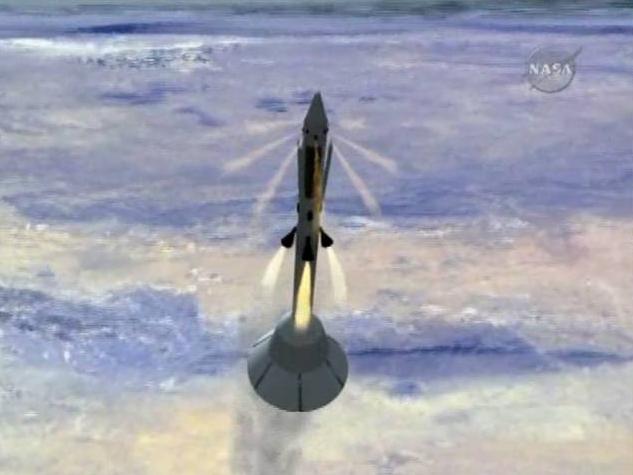
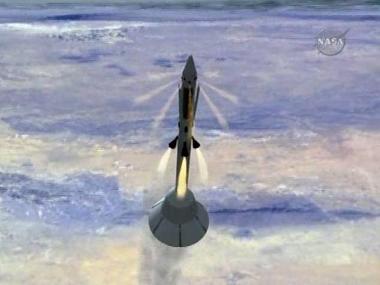
NASA has made available animations of the test flights planned for the LAS. One is the animation of the Orion Module LAS pad abort flight test. The second presents the Orion Module LAS ascent abort flight test.


Credits: NASA


Currently, the Launch Abort System of the Orion Module is under development.


The first full-scale test fire of the motor that powers the LAS was completed on November 20, 2008. This was the first time a LAS test has been conducted since the 1960s, when the LAS for the Apollo Program was tested.

 

  • Facebook
  • Google
  • Slashdot
  • Reddit
  • Live
  • TwitThis