OrbitalHub

The place where space exploration, science, and engineering meet

Domain is for sale. $50,000,000.00 USD. Direct any inquiries to contact@orbitalhub.com.


Credits: NASA/RASA


The Alpha Magnetic Spectrometer (AMS) is a high-energy particle detector. AMS will detect electrons, positrons, protons, antiprotons, and nuclei in cosmic radiation.


AMS is a cooperative project that involved more than 200 scientists from 31 institutions and 15 countries. The data gathered by AMS during its three-year mission will help scientists answer important questions about antimatter and invisible mass in the Universe. AMS could detect many types of particles predicted by theorists and determine their astrophysical sources.


AMS could reveal to scientists unusual astrophysical objects like antimatter galaxies, dark matter, strangelets, microquasars, and primordial black holes.


AMS actually refers to two particle experiments: AMS-01 and AMS-02. AMS-01 flew in low Earth orbit (LEO) with Space Shuttle Discovery STS-91 in June 1998. AMS-01 was an AMS prototype (a simplified version of the spectrometer) and was used to test particle physics technology in LEO. AMS-02 is the Alpha Magnetic Spectrometer designed to be mounted and operated on the ISS.


Credits: NASA


AMS-02 is a cube-shaped structure with a mass of 6,731 kg. The spectrometer consists of a huge superconducting magnet and six specialized detectors, and requires 2,000 watts of power.


The experiment has a 10Gb/sec internal data pipeline and will have a dedicated 2MB/sec connection to ground stations. AMS-02 will gather approximately 200 TB of scientific data during its mission. Four 750 MHz PowerPC computers running Linux will provide the computing power.


The spectrometer also contains two star tracker cameras, which detect the orientation in space, and a thermal control system that will control the temperature of the whole experiment. The thermal control system is quite complex. Heat is collected from the detectors and the magnet, and then pushed through conductors to the radiators mounted on the outside of the AMS and radiated into space.


AMS-02 has a little bit of history associated with it … due to the Space Shuttle accidents, which reduced the number of orbiters available, and the decision to retire the Space Shuttle fleet, AMS-02 faced cancellation (a long list of elements meant to be part of the ISS were cancelled for the same reasons). Because an additional shuttle flight was added to the launch manifest, most likely AMS-02 will make it to the space station.


The plan for AMS-02 is that it will be attached to the zenith side of the S3 section of the Integrated Truss Structure on the ISS. A Payload Attachment System will be used to keep the spectrometer in place on the truss segment.


Credits: NASA


According to the missions schedule, AMS-02 will be installed on ISS as part of the Space Shuttle Discovery STS-134 mission, together with the last ExPRESS Logistics Carrier (ELC-4), in late 2010.


STS-134 will be the last Space Shuttle flight before the deadline set to end Space Shuttle operations on September 30, 2010.


To make things more interesting (and Space Shuttle operations cheaper), it has been proposed that the last mission should end through a destructive re-entry. In this scenario, the reduced crew of three will remain on the space station and return to Earth onboard Soyuz spacecraft.


You can read more about AMS-02 on a dedicated web page at MIT. There is also a web page dedicated to AMS-02 at CERN.


  • Facebook
  • Google
  • Slashdot
  • Reddit
  • Live
  • TwitThis
03-5-09

HTV

Posted by


Credits: JAXA


HTV stands for H-II Transfer Vehicle. HTV is an unmanned spacecraft designed and built in Japan. HTV is designed to deliver supplies to the International Space Station (ISS).


The typical mission for HTV starts at the Tanegashima Space Center (TKSC) near Tsukuba, in Japan.


A H-IIB launch vehicle will inject the HTV on a low Earth orbit (LEO). After the separation from the H-IIB second stage, the transfer vehicle is able to navigate independently.


It will take approximately three days for HTV to reach the proximity of the ISS. During this time, it will maintain contact with the Control Center at TKSC (designated as HTV-CC) through the Tracking and Data Relay Satellite System (TDRSS). TDRSS is a network of satellites that allow a spacecraft in LEO to maintain permanent contact with the control center on the ground. HTV will use GPS to position itself at 7 km behind the ISS.


At this point, the berthing phase of the mission starts. HTV will approach the ISS within 500 m and use the Rendezvous Sensor (RVS) to move closer to the ISS. Reflectors that are installed on Kibo will allow HTV to maintain a distance of 10 m below the ISS.


Credits: JAXA


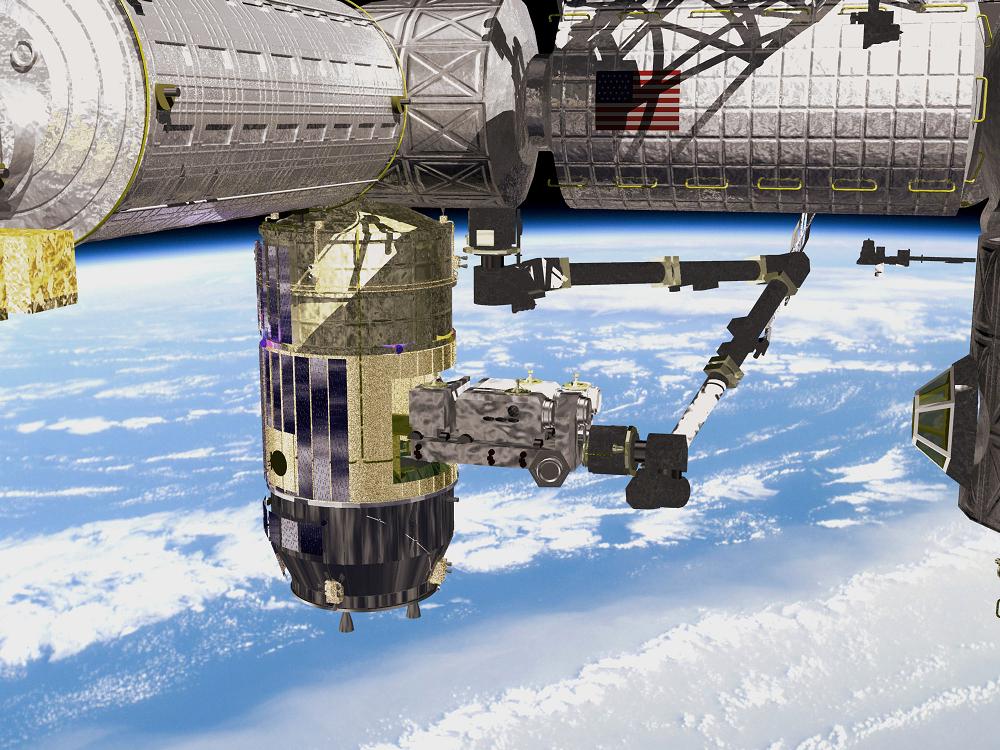
HTV does not have the capability to dock on its own to the ISS (as opposed to the European ATV), so the Canadarm2 robotic arm will be used to grab the transfer vehicle and berth it to the nadir side of the Node 2 module.


While the HTV is berthed to the ISS, supplies from the HTV’s pressurized section are transferred to the space station by the crew, and waste will be loaded from the ISS.


The cargo from the un-pressurized section will be unloaded using the robotic arm and attached either to the Exposed Facility of the Japanese Experiment Module (JEM) or the ISS Mobile Base System.


The HTV mission will end in a similar way to the European ATV: a destructive re-entry above the Pacific Ocean.


Here is some more background information about the HTV. The spacecraft is a cylinder-shaped structure 10 m long and 4.4 m in diameter. It has a total mass of 10,500 kg, of which 6,000 kg is cargo (divided into 4,500 kg pressurized cargo and 1,500 kg un-pressurized cargo). HTV can carry 6,000 kg of waste during the re-entry.


HTV consists of four modules: the Pressurized Logistics Carrier (PLC), the Unpressurized Logistics Carrier (UPLC), the Avionics Module, and the Propulsion Module. The UPLC carries the Exposed Pallet (EP), which can accommodate unpressurized payloads.


Credits: JAXA


The PLC is equipped with a Common Berthing Mechanism (CBM). This will allow the crew present on the station to enter the module in order to unload the supplies and load waste material.


The EP carried by the UPLC can be either Type I or Type III Exposed Pallets. The Type I EPs will carry payloads for the Kibo’s Exposed Facility (EF), while the Type III EPs will be used to deliver the Orbital Replacement Units (ORUs) to the ISS.


The systems in the avionics module enable HTV to execute the autonomous flight to the space station. The module also contains communication and power systems. The thirty-two thrusters installed on the propulsion module provide HTV with the capability to execute orbital adjustments and control the attitude during the mission.


HTV will add to the existing fleet of transfer vehicles that includes the Russian Soyuz and Progress spacecraft, as well as the European ATV. The first HTV mission is scheduled for late 2009.


For more information about HTV, you can visit the H-II Transfer Vehicle page on the JAXA web site.


  • Facebook
  • Google
  • Slashdot
  • Reddit
  • Live
  • TwitThis
02-15-09

Carnival of Space #90

Posted by


Credits: NASA


The Valentine’s Day Edition of the Carnival of Space is hosted by Bruce Cordell at 21ST CENTURY WAVES.

The collision of the Iridium 33 and Cosmos 2251 satellites has sent ripples across the space blogosphere and debris into low Earth orbit. At this Carnival you can read about shielding interstellar spaceships, saving the Space Shuttle, Pluto, visualizing constellations, lakes on Titan, type III Kardashev civilizations, and much more.


OrbitalHub has submitted a post about the Japan Experiment Module a.k.a. Kibo. The Japanese Experiment Module (JEM) is the first contribution of the Japan Aerospace Exploration Agency (JAXA) to the International Space Station (ISS) program.


  • Facebook
  • Google
  • Slashdot
  • Reddit
  • Live
  • TwitThis
02-12-09

KIBO

Posted by


Credits: NASA


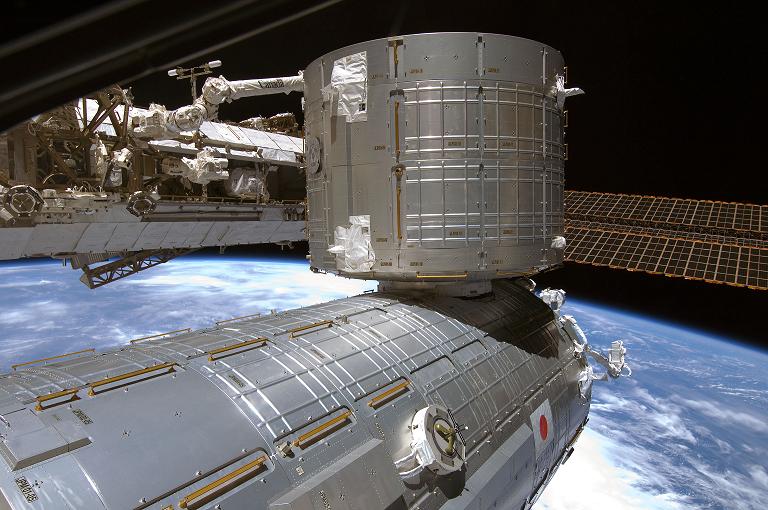
The Japanese Experiment Module (JEM) a.k.a. Kibo is the first contribution of the Japan Aerospace Exploration Agency (JAXA) to the International Space Station (ISS) program.


Kibo improves the research capabilities of the ISS by accommodating a maximum of four astronauts who can conduct scientific research activities and experiments in orbit.


JEM has six major components: the Pressurized Module (PM), the Exposed Facility (EF), the Experiment Logistics Module – Pressurized Section (ELM-PS), the Experiment Logistics Module – Exposed Section (ELM-ES), the Remote Manipulator System (JEMRMS), and the Inter-Orbit Communication System (ICS).


The PM is the largest component of JEM. It has a cylindrical shape, 4.4 m in diameter and 11.2 m in length. A total of twenty-three racks can be installed in the PM, six racks on each of the four walls, except for the zenith wall, which can accommodate a maximum of 5 racks. Some of the visible features are the airlock (which allows access to the EF), the two windows located above the airlock, the berthing mechanism for the EF (EFBM), an Active Common Berthing Mechanism (ACBM) on the zenith side for berthing the ELM-PS, and a Passive Common Berthing Mechanism (PCBM) used to connect with the port side ACBM of the Harmony module.


Credits: NASDA


The EF is a box-shaped structure, which is 5.0 m wide, has a length of 5.2 m, and a height of 3.8 m. The EF has 12 payload attachment locations. Each payload location can accommodate a science experiment that must be conducted in the exposed environment.


Kibo’s robotic arm (JEMRMS) is used for attaching and removing the payloads.


The ELM-PS is a cylindrical structure 4.4 m in diameter and 4.2 m in length. The ELM-PS contains a total of eight rack locations. ELM-PS can be used as storage space for experiments, samples, and spare items.


The ELM-ES provides storage space for up to three payloads. ELM-ES will be attached to the end of the EF. Besides the function of in-orbit exposed storage facility, the ELM-ES can also be used to return scientific payloads to Earth. The ELM-ES is a frame structure 4.9 m wide, with a length of 4.1 m, and a height of 2.2 m.


Credits: NASDA


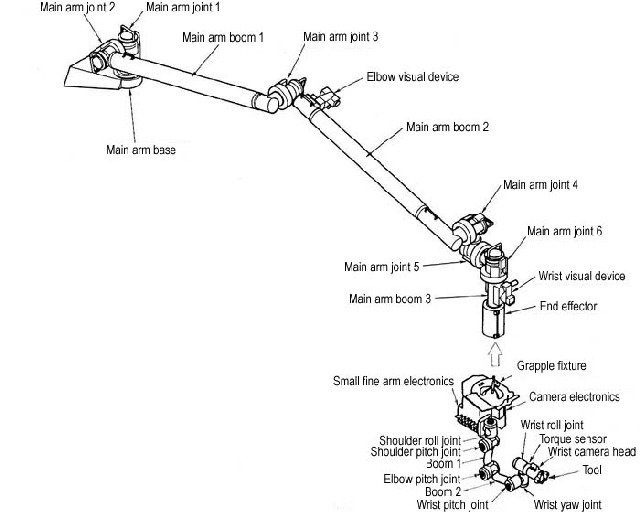
The JEMRMS is a robotic manipulator system. JEMRMS will have two roles: supporting the experiments conducted on Kibo, and assisting with Kibo’s maintenance tasks.


A 10 m long Main Arm (MA), a 2.2 m long Small Fine Arm (SFA), and a robotic control workstation are the components of the robotic manipulator system.


The ICS has two subsystems: a Pressurized Module (ICS-PM) and an Exposed Facility (ICS-EF). The ICS-PM occupies a rack inside the PM, and provides command and data handling functions. The ICS-EF is basically the antenna used for communication.


Kibo is a large structure and more Space Shuttle missions are required to complete the deployment of all the components.


STS-123 Space Shuttle Endeavour delivered the ELM-PS component and ICS-PS to the ISS. JAXA astronaut Takao Doi was part of the STS-123 crew as mission specialist. During the mission, the ELM-PS was berthed to the zenith port of the Node 2 (Harmony) module. The ELM-PS carried the system racks and the experiment racks that are operated in the PM.


Credits: NASA


STS-124 Space Shuttle Discovery delivered the PM and the JEMRMS components to the ISS. The JAXA astronaut assigned to STS-124 as mission specialist was Akihiko Hoshide. STS-124 had to perform a number of operations in order to activate and assemble the pressurized components of JEM: installation and activation of PM, rack deployment, installation of JEMRMS, and the relocation of the ELM-PS from the zenith port of Node 2 to the zenith side of the PM.


The EF is the last major component of Kibo that has to be hauled to the ISS. The STS-127 mission will carry the EF, together with the ELM-ES and the ICS-EF components. The completion of Kibo will be done in two steps: the EF will be attached to the PM through the EFBM, and the ELM-ES will be attached to the EF as the last step. JAXA astronaut Koichi Wakata will be on board the ISS to supervise the operation as mission specialist.


The Japan Aerospace Exploration Agency has a web page dedicated to Kibo.


  • Facebook
  • Google
  • Slashdot
  • Reddit
  • Live
  • TwitThis


Credits: NASA


Forty years ago, on January 16, 1969, two Russian spacecraft (Soyuz 4 and Soyuz 5) carried out the first docking between two manned spacecraft and transfer of crew between the craft.


The Soyuz 4/5 mission was a critical milestone for the future of manned space missions, the rendezvous and docking of manned spacecraft being essential for the development of space stations.


Soyuz 4 was launched on January 14, 1969, with cosmonaut Vladimir Shatalov on board. Soyuz 5 was launched one day later. Soyuz 5 had three cosmonauts on board: Boris Volynov, Alexei Yeliseyev, and Yevgeny Khrunov. During the mission, Soyuz 5 acted as the passive ship, while Soyuz 4 was the active chaser craft.


The two spacecraft docked at 0820 UT over the Soviet territory. The docking mechanism did not connect the pressurized modules of the Soyuz spacecraft and two of the cosmonauts on board Soyuz 5, Yevgeny Khrunov and Alexei Yeliseyev, performed EVAs in order to transfer to Soyuz 4.


Credits: NASA/R.F.Gibbons


Soyuz 4 and 5 undocked after three hours and thirty-five minutes.


Soyuz 4 fired its retro-rockets on January 17 and landed somewhere near Karaganda, in Kazakhstan.


Soyuz 5 had an eventful landing. After the retro-fire, the instrument module failed to separate from the descent module, and the landing could have been catastrophic due to the fact that the heat shield was not oriented properly.


However, the re-entry heat caused the propellant tanks in the instrument module to explode and the two modules eventually separated. The parachute had problems deploying properly and a failure of the soft-landing rockets occurred, so the landing was much harder than usual. Apparently, the landing shock was so great that Boris Volynov was thrown across the cabin and broke some of his front teeth.


Volynov landed far off course, in the Ural Mountains near Orenburg, in Russia. The event was kept secret and it eventually came to light in 1997, when an official history book mentioned the incident.


Forty years later, the Soyuz spacecraft is still the workhorse of the Russian space program, and continues to this day to serve as a transfer vehicle to and from the International Space Station (ISS), performing rendezvous and docking maneuvers on each mission.


  • Facebook
  • Google
  • Slashdot
  • Reddit
  • Live
  • TwitThis
01-8-09

Taurus II and Cygnus

Posted by


Credits: NASA


Orbital will employ its Taurus II medium-lift launch vehicle and the Cygnus spacecraft in order to service the International Space Station (ISS) under the Commercial Resupply Services (CRS) contract.


Orbital is one of the two companies awarded CRS contracts under the Commercial Orbital Transportation Services Project (COTS).


NASA announced the COTS project on January 18, 2006. The purpose of the program is to stimulate the development of access to low Earth orbit (LEO) in the private sector. At the time, with the imminent retirement of the Space Shuttle fleet, NASA was faced with the option of buying orbital transportation services on foreign launch systems: the Russian Soyuz / Progress, the European Ariane 5 / ATV, or the Japanese H-II / HTV.


Another factor taken into consideration by NASA was that competition in the free market could lead to the development of more efficient and affordable launch systems compared to launch systems that a government agency could build and operate.


Credits: Orbital


Orbital relies on proven experience in launch vehicle technology. Taurus II is designed to provide low-cost and reliable access to space, and it uses systems from other members of Orbital’s family of successful launchers: Pegasus, Taurus, and Minotaur.


Taurus II is a two-stage launch vehicle that can use an additional third stage for achieving higher orbits. The payloads handled by Taurus II can have a mass of up to 5,400 kg.


Orbital is responsible for overall development and integration of the first stage. The two AJ26-62, designed and produced by Aerojet and Orbital, are powered by liquid oxygen and kerosene. The core design is driven by NPO Yuzhnoye, the designer of the Zenit launchers.


The AJ26-62 engines are basically the NK-33 engines designed by the Kuznetsov Design Bureau for the Russian N-1 launch vehicle, and remarketed by Aerojet under a new designation.


The second stage uses an ATK Castor-30 solid motor with thrust vectoring. This stage evolved from the Castor-120 solid stage.


The optional third stage is developed by Orbital. The stage was dubbed the Orbit Raising Kit (ORK) and it uses a helium pressure regulated bi-propellant propulsion system powered by nitrogen tetroxide and hydrazine. ORK evolved from the Orbital STAR Bus. Because it is a hypergolic stage, it allows several burns to be performed in orbit, and can be used for high-precision injections using various orbital profiles.


Credits: Orbital


Cygnus will only have cargo capability and will be able to deliver up to 2,300 kg of pressurized or un-pressurized cargo to the ISS. The spacecraft will also be able to return up to 1,200 kg of cargo from ISS to Earth.


The two components of the Cygnus spacecraft will be the service module and the cargo module.


The service module is based on the Orbital STAR bus (like the ORK stage), and will use two solar arrays for producing electrical power for the navigation systems onboard.


The pressurized cargo module is based on the Italian-built Multi-Purpose Logistics Module (MPLM). The un-pressurized cargo module is based on NASA’s ExPRESS Logistics Carrier.


Cygnus will not dock to the ISS in the same manner as the European ATV, but it will be able to maneuver close to the ISS where the Canadarm 2 robotic arm will be used to capture it and berth it to the Node 2 module, similar to the Japanese HTV or SpaceX’s Dragon spacecraft.


The Mid-Atlantic Regional Spaceport (MARS), located at NASA’s Wallops Island Flight Facility on Virginia’s Eastern shore, was chosen by Orbital to serve as the base of operations for the Taurus II launch vehicle.


MARS has two FAA licensed launch pads for LEO access. MARS also offers access to suborbital launchers, vehicle and payload storage, and processing and launch facilities.


Credits: NASA


Due to the location of the spaceport, latitude 37.8 degrees N, longitude 75.5 degrees W, optimal orbital inclinations for the launches performed at MARS are between 38 and 60 degrees. Polar and retrograde orbits can also be serviced with additional in-flight maneuvering.


The first flight of Orbital’s new Taurus II / Cygnus launch system under COTS is scheduled for late 2010.


  • Facebook
  • Google
  • Slashdot
  • Reddit
  • Live
  • TwitThis