OrbitalHub

The place where space exploration, science, and engineering meet

Domain is for sale. $50,000,000.00 USD. Direct any inquiries to contact@orbitalhub.com.

07-10-17

Big and Small Before Rings

Posted by


NASA dixit:

“March 24, 2010. Saturn’s moon Rhea looms “over” a smaller and more distant Epimetheus against a striking background of planet and rings. The two moons aren’t actually close to each other. The view was obtained at a distance of approximately 1.2 million kilometers (746,000 miles) from Rhea and 1.6 million kilometers (994,000 miles) from Epimetheus.

Lit terrain seen here is in the area between the trailing hemisphere and anti-Saturn side of Rhea (1,528 kilometers, or 949 miles across). Lit terrain seen on Epimetheus (113 kilometers, or 70 miles across) is mostly on the Saturn-facing side. This view looks toward the sunlit side of the rings from just above the ringplane.

The image was taken in visible green light with the Cassini spacecraft narrow-angle camera. Image scale is 7 kilometers (4 miles) per pixel on Rhea and 10 kilometers (6 miles) per pixel on Epimetheus.”

“After almost 20 years in space, NASA’s Cassini spacecraft begins the final chapter of its remarkable story of exploration: its Grand Finale. Between April and September 2017, Cassini will undertake a daring set of orbits that is, in many ways, like a whole new mission. Following a final close flyby of Saturn’s moon Titan, Cassini will leap over the planet’s icy rings and begin a series of 22 weekly dives between the planet and the rings.

No other mission has ever explored this unique region. What we learn from these final orbits will help to improve our understanding of how giant planets – and planetary systems everywhere – form and evolve.

On the final orbit, Cassini will plunge into Saturn’s atmosphere, sending back new and unique science to the very end. After losing contact with Earth, the spacecraft will burn up like a meteor, becoming part of the planet itself.

Cassini’s Grand Finale is about so much more than the spacecraft’s final dive into Saturn. That dramatic event is the capstone of six months of daring exploration and scientific discovery. And those six months are the thrilling final chapter in a historic 20-year journey.”

Image credit: NASA


  • Facebook
  • Google
  • Slashdot
  • Reddit
  • Live
  • TwitThis
05-14-17

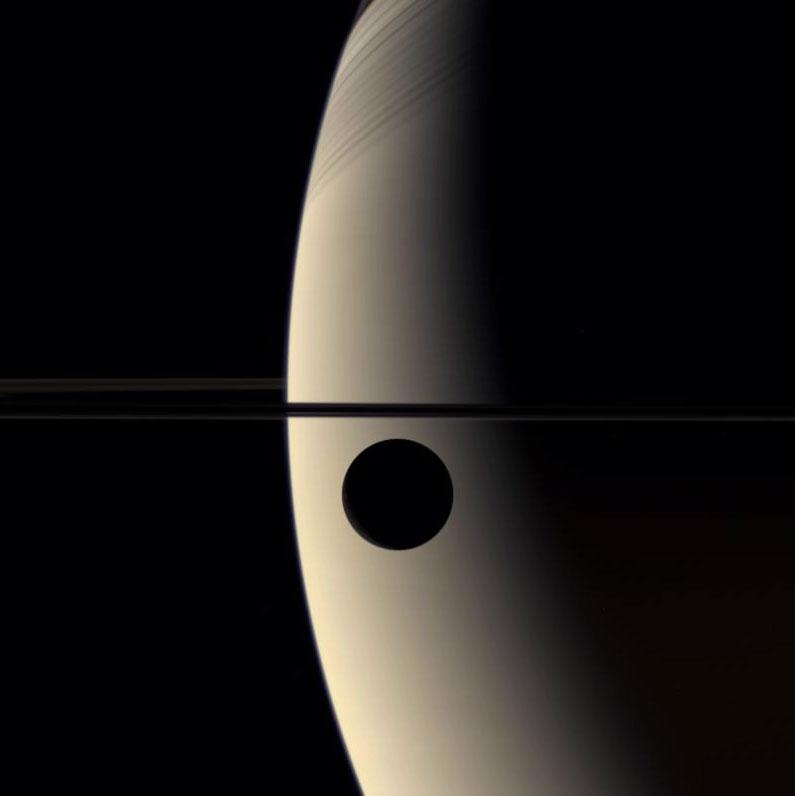
Rhea Transits Saturn

Posted by


NASA dixit:

“June 21, 2006. The slim crescent of the moon Rhea glides silently onto the featureless, golden face of Saturn in this mesmerizing color image. In an interplay of contrast and shadow, the moon goes dark against the planet, and then its crescent suddenly brightens as it slips in front of Saturn’s night side. This view looks down onto the unlit side of Saturn’s rings, which cast soft, linear shadows onto the planet’s northern hemisphere. The images were acquired by the Cassini spacecraft wide-angle camera on March 21, 2006, at a distance of approximately 221,000 kilometers (137,000 miles) from Rhea. The image scale is approximately 13 kilometers (8 miles) per pixel.”

“After almost 20 years in space, NASA’s Cassini spacecraft begins the final chapter of its remarkable story of exploration: its Grand Finale. Between April and September 2017, Cassini will undertake a daring set of orbits that is, in many ways, like a whole new mission. Following a final close flyby of Saturn’s moon Titan, Cassini will leap over the planet’s icy rings and begin a series of 22 weekly dives between the planet and the rings.

No other mission has ever explored this unique region. What we learn from these final orbits will help to improve our understanding of how giant planets – and planetary systems everywhere – form and evolve.

On the final orbit, Cassini will plunge into Saturn’s atmosphere, sending back new and unique science to the very end. After losing contact with Earth, the spacecraft will burn up like a meteor, becoming part of the planet itself.

Cassini’s Grand Finale is about so much more than the spacecraft’s final dive into Saturn. That dramatic event is the capstone of six months of daring exploration and scientific discovery. And those six months are the thrilling final chapter in a historic 20-year journey.”

Image credit: NASA


  • Facebook
  • Google
  • Slashdot
  • Reddit
  • Live
  • TwitThis