OrbitalHub

The place where space exploration, science, and engineering meet

Domain is for sale. $50,000,000.00 USD. Direct any inquiries to contact@orbitalhub.com.

04-13-18

Tour of the Moon in 4K

Posted by


NASA dixit:

“Take a virtual tour of the Moon in all-new 4K resolution, thanks to data provided by NASA’s Lunar Reconnaissance Orbiter spacecraft. As the visualization moves around the near side, far side, north and south poles, we highlight interesting features, sites, and information gathered on the lunar terrain.”

Music Provided By Killer Tracks: “Never Looking Back” – Frederick Wiedmann. “Flying over Turmoil” – Benjamin Krause & Scott Goodman.

Video Credit: NASA’s Goddard Space Flight Center/David Ladd


  • Facebook
  • Google
  • Slashdot
  • Reddit
  • Live
  • TwitThis


NASA dixit:

“In October 2017, The Lunar Reconnaissance Orbiter celebrates 100 lunar days of being at the Moon. Part 1 of this video series helps explain what a “lunar day” is, and what it means for the spacecraft’s mission to have been at the Moon for this period of time.”

Music provided by Killer Tracks: “Time is Running” – Dirk Ehlert, Guillermo De La Barreda; “Buckaroo Instrumental” – Alan Gold & Fiona Hamilton.

Video credit: NASA Goddard


  • Facebook
  • Google
  • Slashdot
  • Reddit
  • Live
  • TwitThis
09-13-17

The Moon May Have Frost

Posted by


NASA dixit:

“Scientists using data from NASA’s Lunar Reconnaissance Orbiter, or LRO, have identified bright areas in craters near the moon’s south pole that are cold enough to have frost present on the surface. The new evidence comes from an analysis that combined surface temperatures with information about how much light is reflected off the moon’s surface.

“We found that the coldest places near the moon’s south pole are also the brightest places—brighter than we would expect from soil alone—and that might indicate the presence of surface frost,” said Elizabeth Fisher, the lead author of the study, published in Icarus. Fisher carried out the data analysis while doing research at the University of Hawai‘i at Manoa after earning her undergraduate degree. She is now a graduate student at Brown University.

The icy deposits appear to be patchy and thin, and it’s possible that they are mixed in with the surface layer of soil, dust and small rocks called the regolith. The researchers say they are not seeing expanses of ice similar to a frozen pond or skating rink. Instead, they are seeing signs of surface frost. The frost was found in cold traps close to the moon’s south pole. Cold traps are permanently dark areas—located either on the floor of a deep crater or along a section of crater wall that doesn’t receive direct sunlight—where temperatures remain below minus 260 degrees Fahrenheit (minus 163 degrees Celsius). Under these conditions, water ice can persist for millions or billions of years.

More than a half-century ago, scientists suggested that lunar cold traps could store water ice, but confirming that hypothesis turned out to be challenging. Observations made by NASA’s Lunar Prospector orbiter in the late 1990s identified hydrogen-rich areas near the moon’s poles but could not determine whether that hydrogen was bound up in water or was present in some other form. Understanding the nature of these deposits has been one of the driving goals of LRO, which has been orbiting the moon since 2009.

Fisher and her colleagues found evidence of lunar frost by comparing temperature readings from LRO’s Diviner instrument with brightness measurements from the spacecraft’s Lunar Orbiter Laser Altimeter, or LOLA. In these comparisons, the coldest areas near the south pole also were very bright, indicating the presence of ice or other highly reflective materials. The researchers looked at the peak surface temperatures, because water ice won’t last if the temperature creeps above the crucial threshold.”

Video credit: NASA Goddard


  • Facebook
  • Google
  • Slashdot
  • Reddit
  • Live
  • TwitThis


Credits: NASA


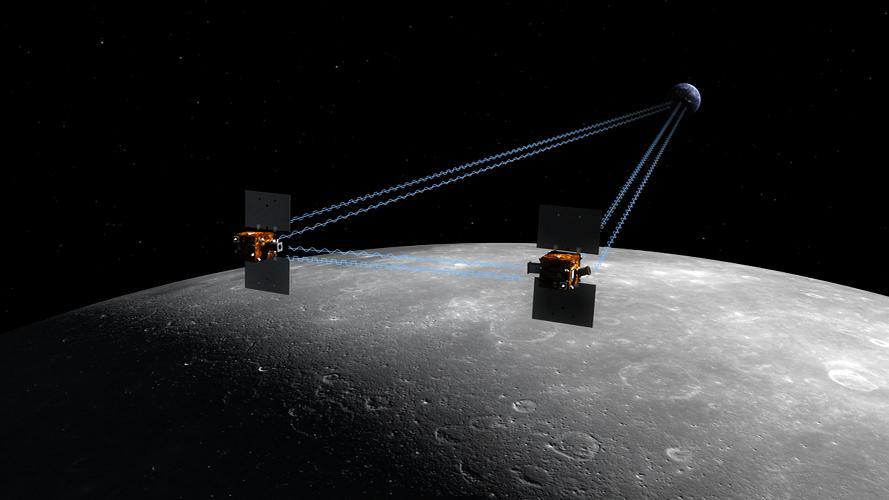
The Gravity Recovery And Interior Laboratory (GRAIL) is a mission that will measure the lunar gravity field in unprecedented detail. The twin spacecraft will orbit the Moon in tandem and collect scientific data for several months.


The GRAIL mission will cost $375 million and launch in 2011 as part of NASA’s Discovery Program. The window for the launch is 26 days long and opens on September 8, 2011.


After a dual launch aboard a Delta II 2920-10, the spacecraft will spend three to four months cruising on a low-energy trans-lunar trajectory. The two spacecraft will orbit the moon on 50 km, near-circular polar orbits, with a spacecraft separation of 175 – 225 km. The science phase of the mission will take 90 days, and it will be followed by a 12-month science data analysis.


The technique used by GRAIL for collecting scientific data was also used for the Gravity Recovery And Climate Experiment (GRACE) mission, launched in 2002. Small changes in the distance that separates the two spacecraft are translated in variations of the lunar gravity field.


The GRAIL spacecraft are based on the Lockheed Martin XSS-11 bus. The XSS-11 (Experimental Small Satellite 11) is the result of research done at Lockheed Martin Space Systems in the field of agile and affordable micro-satellites. Interesting to mention here is that there were speculations that XSS-11 could also be used as the base for the development of a kinetic anti-satellite weapon (ASAT).


The spacecraft is a rectangular composite structure. Two non-articulated solar arrays and lithium ion battery provides power. The attitude control system, the power management system, and the telecommunications system are also inherited from the XSS-11 bus.


The payload consists of a Ka-band Lunar Gravity Ranging System (LGRS), which is derived from the instrument carried by the GRACE spacecraft.


The spacecraft flight operations will be conducted from Lockheed Martin’s Denver facility. Science Level 0 and 1 data processing will be done at Jet Propulsion Laboratory (JPL), Level 2 data processing at JPL, the Goddard Space Flight Center (GSFC) and the Massachusetts Institute of Technology (MIT). The final scientific data will be delivered by MIT.


While missions like the Lunar Reconnaissance Orbiter (LRO) will find safe landing sites, locate potential resources, and take measurements of the radiation environment of the lunar surface, GRAIL will explore the moon from crust to core, and determine the moon’s internal structure and evolution.


More information about GRAIL is available on the GRAIL mission page on MIT’s web site.

 

  • Facebook
  • Google
  • Slashdot
  • Reddit
  • Live
  • TwitThis





