OrbitalHub

The place where space exploration, science, and engineering meet

Domain is for sale. $50,000,000.00 USD. Direct any inquiries to contact@orbitalhub.com.

02-12-17

Ariane 6

Posted by


ESA dixit:

“ESA and European industry are currently developing a new-generation launcher: Ariane 6. This follows the decision taken at the ESA Council meeting at Ministerial level in December 2014, to maintain Europe’s leadership in the fast-changing commercial launch service market while responding to the needs of European institutional missions.

This move is associated with a change in the governance of the European launcher sector, based on a sharing of responsibility, cost and risk by ESA and industry. The participating states are: Austria, Belgium, Czech Republic, France, Germany, Ireland, Italy, Netherlands, Norway, Romania, Spain, Sweden and Switzerland.

The overarching aim of Ariane 6 is to provide guaranteed access to space for Europe at a competitive price without requiring public sector support for exploitation. Different concepts have been examined for Ariane 6 such as single- and dual-payloads, solid or cryogenic propulsion for the main stage, and the number of stages (three or more), all to cover a wide range of missions: GEO, either directly or through intermediate orbits, in particular GTO and LEO, Polar/SSO, MEO or MTO.

The targeted payload performance of Ariane 6 is over 4.5 t for polar/Sun-synchronous orbit missions at 800 km altitude and the injection of two first-generation Galileo satellites. Ariane 6 can loft a payload mass of 4.5–10.5 tonnes in equivalent geostationary transfer orbit.

The exploitation cost of the Ariane 6 launch system is its key driver. Launch service costs will be halved, while maintaining reliability by reusing the trusted engines of Ariane 5. The first flight is scheduled for 2020.

Ariane 6 has a ‘PHH’ configuration, indicating the sequence of stages: a first stage using strap-on boosters based on solid propulsion (P) and a second and third stage using cryogenic liquid oxygen and hydrogen propulsion (H).

Ariane 6 provides a modular architecture using either two boosters (Ariane 62) or four boosters (Ariane 64), depending on the required performance. Two or four P120 solid-propellant boosters will be common with Vega C, an evolution of the current Vega launcher.

The main stage containing liquid oxygen and hydrogen is based around the Vulcain 2 engine of Ariane 5.

The upper stage of Ariane 6 builds on developments for the Adapted Ariane 5 ME, and cryogenic propulsion using the Vinci engine. It will be restartable and have direct deorbiting features to mitigate space debris.

Flexibility is a design characteristic for A64 and A62. The launcher responds to different market needs by varying the number of boosters in the configuration.

The A62, with two P120 solid boosters, will be used mainly in single-launch configurations, while the A64 – with four P120 solids – will enable double launch of medium-class satellites over 4.5–5 t, mainly for commercial market needs.

The main characteristics of the Ariane 6 concept are: the total length of the vehicle is about 62 m; the cryogenic main stage holds about 150 t of propellants, the upper stage holds about 30 t; the external diameter of the cryogenic main stage and upper stages including the part that connects the fairing is about 5.4 m.”

Video credit: ESA/David Ducros


  • Facebook
  • Google
  • Slashdot
  • Reddit
  • Live
  • TwitThis
11-28-15

Ariane 5 VA227 Liftoff

Posted by


Arianespace dixit:

“Arianespace successfully launched two satellites [on November 10]: Arabsat-6B (BADR-7) for the operator Arabsat, and GSAT-15 for ISRO (Indian Space Research Organisation). The company’s tenth launch of the year from the Guiana Space Center (CSG), and sixth with the Ariane 5 heavy launcher, took place on November 10 at 6:34 pm local time in Kourou, French Guiana. Through this mission, the 69th successful launch in a row by Ariane 5, Arianespace is proud to deliver reliable, sustainable solutions to Arabsat and ISRO, two loyal customers for over 30 years.

Arabsat is the leading regional satellite telecommunications operator in the Middle East and Africa. Arabsat-6B (BADR 7) is the ninth satellite orbited by Arianespace for this operator since the launch of Arabsat-1A in 1985. This satellite is the first of the sixth generation of satellites in the Arabsat fleet. It will provide telecommunications and direct- to-home (DTH) TV broadcast services for the Middle East, Africa and Central Asia. In 2012 Arabsat also confirmed its goal of bolstering its position in the Europe-Middle East-Africa (EMEA) zone by acquiring the company Hellasat. Arianespace will be launching another Arabsat satellite, Hellasat-4.

GSAT-15 is the 19th satellite to be launched by Arianespace for ISRO (Indian Space Research Organisation). It will provide telecommunications services for the country, along with dedicated navigation-aid and emergency services. Arianespace has launched 91% of ISRO’s geostationary satellites that used non-Indian launch systems, dating back to the launch of the country’s experimental satellite APPLE on Flight L03 in 1981. The favored relationship between Arianespace and ISRO reflects the exemplary collaboration in the space sector between France and India, a partnership that will help ISRO realize its aim of using space to foster the development of the Indian sub-continent through a full range of satellite applications, for Earth observation, telecommunications, science and navigation.”

Video credit: ESA


  • Facebook
  • Google
  • Slashdot
  • Reddit
  • Live
  • TwitThis
10-24-15

Ariane 5 VA226 Liftoff

Posted by


Arianespace dixit:

“Two telecommunications satellites that will provide expanded relay capacity for Australia and Argentina were orbited today on Arianespace’s ninth mission in 2015 – putting the company on track to perform a record 12 flights this year using its three-member launch vehicle family, which consists of the heavy-lift Ariane 5, medium-lift Soyuz and lightweight Vega. Lifting off exactly on time during a daylight departure from the Spaceport in French Guiana, the heavy-lift Ariane 5 utilized for today’s mission deployed its Sky Muster and ARSAT-2 satellite passengers during a 32-minute flight sequence. It marked the 82nd mission overall using Arianespace’s workhorse launcher, as well as the 68th consecutive Ariane 5 success. In post-launch comments, Chairman and CEO Stéphane Israël confirmed that Arianespace was on pace for a record-setting operational performance this year (12 flights from the Spaceport in 12 months), and also highlighted the company’s continued commitment to quality. The Ariane 5 ascends from the Spaceport in French Guiana with a dual-satellite payload of Sky Muster and ARSAT-2.

Further extending Ariane 5’s track record of highly accurate payload delivery, the estimated orbital parameters at injection of its cryogenic upper stage for Flight VA226 were:

– Perigee: 249.2 km. for a target of 249.5 km.

– Apogee: 35,911 km. for a target of 35,927 km.

– Inclination: 5.99 deg. for a target of 6.00 deg.

The first-released passenger on today’s mission was Sky Muster, which is the initial satellite to be operated by nbnâ„¢ – a service provider owned by the Commonwealth of Australia. This company’s objective is to ensure all Australians have access to fast broadband as soon as possible, at affordable prices and at the least cost to taxpayers. Built by Palo Alto-based SSL (Space Systems Loral), Sky Muster is scheduled to operate from geostationary orbit. It is designed to deliver broadband services to more than 200,000 rural and remote Australians, providing coverage to the entire country – including the Norfolk, Christmas, Macquarie and Cocos islands. Launch of nbn’s second spacecraft also has been entrusted to Arianespace. […]

Completing today’s mission was the deployment of ARSAT-2, which is the second of three geostationary satellites that will increase Argentina’s telecommunications capacity and guarantee the same level of connectivity quality across the country’s regions. Arianespace successfully orbited the first of these relay platforms – ARSAT-1 – on an Ariane 5 flight in October 2014. Built under the responsibility Argentina’s INVAP, ARSAT-2 will be operated by the state-owned Argentinian operator ARSAT (Empresa Argentina de Soluciones Satelitales Sociedad Anónima) to provide direct-to-home (DTH) television, Internet access services for reception on VSAT antennas, along with data transmission and IP telephony.”

Video credit: ESA / Arianespace


  • Facebook
  • Google
  • Slashdot
  • Reddit
  • Live
  • TwitThis
12-8-14

Ariane 6

Posted by


ESA dixit:

“Decided upon in Luxembourg by the European Space Agency Council Meeting at Ministerial Level, Ariane 6 is a modular three-stage launcher (solid–cryogenic–cryogenic) with two configurations using: four boosters (A64) or two boosters (A62).”

Credit: ESA


  • Facebook
  • Google
  • Slashdot
  • Reddit
  • Live
  • TwitThis
01-10-10

Arianespace 30th Anniversary

Posted by


Credits: ESA/CNES/Arianespace – Optique vidéo du CSG, L. Boyer


Arianespace was founded in 1980. With twenty-four shareholders from ten European countries (among which CNES holds 34% and EADS 30%), Arianespace is the world’s first commercial space transportation company.


The workhorse of Arianespace has been the Ariane launch vehicle.


Five versions of Ariane have served the company so far: Ariane 1, with the first successful launch on December 24, 1979, Ariane 2, launched for the first time on November 20, 1987, Ariane 3, starting its service on August 4, 1984, Ariane 4, launched on June 15, 1988, and Ariane 5, with the first successful flight on October 30, 1997.


The first launch of Ariane 5, a.k.a. Flight 501, ended with the vehicle being destroyed by its automated self-destruct system, after the high accelerations caused the inertial guidance system to crash. The crash was caused by, I quote, one of the most infamous computer bugs in history. If you like, you can take a look at the Ada code that caused the malfunction. But enough with the dark memories, this is an anniversary after all…


Since its inception, Arianespace has signed over 300 contracts that resulted in more than 277 satellite launches. According to Arianespace, Ariane launchers have delivered more than half of all commercial satellites now in service. The year 2009 was a very successful year for Ariane 5. The launcher orbited nine commercial satellites, the Herschel space telescope, the Planck scientific observatory, and the Helios 2B observation satellite. Ariane 5 has proven to be a versatile launch vehicle, capable of handling a wide range of missions.


The challenges for 2010 are many, as Arianespace is planning up to seven Ariane 5 launches. Two new launch vehicles will join Ariane 5 as part of the Arianespace family of launchers: the Vega small launcher and the Soyuz medium launcher.


You can read more about Arianespace, its mission, and the solutions provided to customers around the world on the Arianespace website.


  • Facebook
  • Google
  • Slashdot
  • Reddit
  • Live
  • TwitThis


Credits: NASA


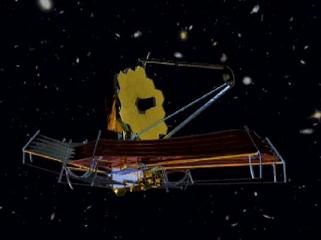
The James Webb Space Telescope (JWST) is the successor of the Hubble Space Telescope (HST). While Hubble looks at the sky in the visible and ultraviolet light, JWST will operate in the infrared.


JWST is a joint mission of NASA, ESA, and the Canadian Space Agency.


The project started in 1996 and was initially known as the Next Generation Space Telescope (NGST). In 2002, the project was renamed the James Webb Space Telescope in honor of NASA administrator James E. Webb, who led the agency from February 1961 to October 1968.


The JWST will use a large deployable sunshade to keep the temperature of the telescope to about 35K. Operating at this temperature gives the telescope exceptional performance in near-infrared and mid-infrared wavebands. The JWST observatory will have a five to ten year lifetime and it will not be serviceable by astronauts.


JWST will be able to see the first galaxies that formed in the early Universe, and how the young stars formed planetary systems.
 

Credits: NASA


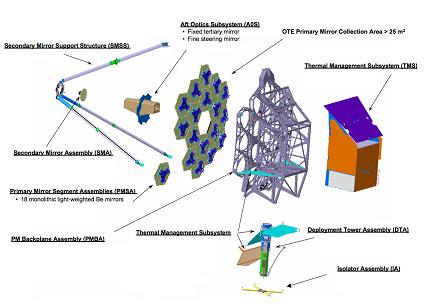
The JWST observatory includes the Integrated Science Instrument Module (ISIM), the Optical Telescope Element (OTE), and the Spacecraft Element containing a spacecraft bus (which offers the support functions for the observatory) and the sunshield.


I will say a few words about each one of them.


The Optical Telescope Element (OTE) collects the light coming from space. Thanks to a 6.5 meter primary mirror, JWST will be able to see the galaxies from the beginning of the Universe. The OTE is also composed of the Fine Steering Mirror (FSM), the secondary mirror support structure (SMSS), and the primary mirror backplane assembly (PMBA). Other subsystems of the OTE are the tertiary mirror and the fine steering mirror. The PMBA contains the Integrated Instrument Module (IIM).


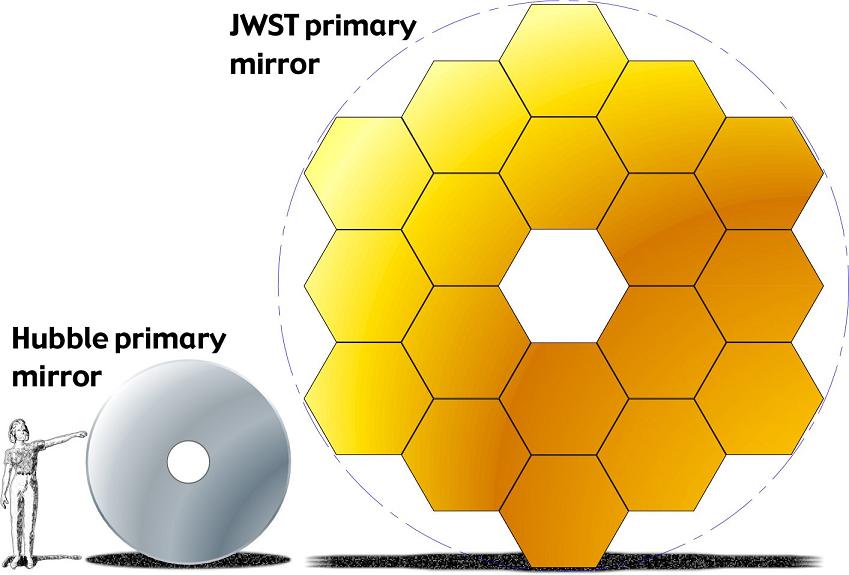
Because the primary mirror is too large to fit inside any available payload fairing, it had to be made out of eighteen hexagonal segments. Some of the elements will be folded before the launch and unfolded during the commissioning phase at the L2 point. NASA made available some neat animations showing how the observatory will be folded in order to fit into the launcher payload, and how the sun shields and the primary mirror will unfold before the observatory becomes operational.
 

Credits: NASA


The sunshield will keep the scientific payload of the observatory away from any light from the Sun, the Earth, or the Moon. Because JWST will observe primarily the infrared light from very distant objects, the temperature of the scientific payload must be maintained at very low values (under 50K). This requirement is so important that even a part of the observatory (the spacecraft bus) had to be placed on the warm side of the sunshield.


The sunshield not only protects the scientific instruments from the heat of the Sun, the Earth, the Moon, and the warm spacecraft bus electronics, but it also provides a stable thermal environment. This is necessary in order to maintain the alignment of the eighteen hexagonal components of the mirror while the observatory changes its orientation relative to the Sun.


The primary mirror is the essential component of a telescope. The design of the primary mirror was driven by a number of important requirements: the size, the mass, and the temperature at which the mirror will operate.


Credits: NASA


In order to be able to see galaxies from thirteen billion light-years away, scientists determined that the mirror must have a diameter of at least 6.5 meters.


The weight of the primary mirror has only one tenth of the mass of Hubble’s mirror per unit area. Considering the size of the mirror, this made the task of launching the telescope into space achievable.


Due to the fact that the telescope will observe the light in the infrared spectrum, the temperature of the mirror has to be as low as –220 degrees Celsius. If operating at the same temperature as the ground telescopes do, the infrared glow of the mirror would interfere with the light received from distant galaxies. Basically, these distant galaxies would disappear in the noise generated by the telescope.


The engineering challenge that scientists faced was to build a lightweight mirror that would preserve its optical and geometric properties when cooled to –220 degrees Celsius. Using beryllium was the solution. Beryllium is lightweight (it is widely used in the aerospace industry) and it is very good at holding its shape across a range of temperatures.


As we mentioned above, the PMBA contains the Integrated Instrument Module (IIM), which is the scientific payload onboard the observatory. The scientific payload includes the following scientific instruments: the Mid-Infrared Instrument (MIRI), the Near-Infrared Spectrograph (NIRSpec), the Near-Infrared Camera (NIRCam), and the Fine Guidance Sensor (FGS).


The MIRI is an imager/spectrograph that covers the wavelength range from 5 to 27 micrometers. The nominal operating temperature for the MIRI is 7K. The NIRSpec covers two wavelength ranges: from 1 to 5 micrometers (medium-resolution spectroscopy) and from 0.6 to 5 micrometers (lower-resolution spectroscopy). The NIRCam was provided by the University of Arizona. NIRCam covers the spectrum from 0.6 to 5 micrometers. The FGS is a broadband guide camera that is used for guide star acquisition and fine pointing.
 

Credits: ESA


The spacecraft bus is composed of every subsystem of the observatory minus the sunshield and the scientific payload, and it provides the necessary support functions for the operations of the observatory. The spacecraft bus contains the Electrical Power Subsystem (EPS), the Attitude Control Subsystem (ACS), the Communication Subsystem (CS), the Command and Data Handling Subsystem (C&DHS), the Propulsion Subsystem (PS), and the Thermal Control Subsystem (TCS).


One interesting thing I would like to mention here is that the C&DH subsystem is using a solid-state recorder as memory/data storage for the observatory. I cannot envision a hard disk drive taking all of the vibrations during the launch and running for ten years without any flaws, so the choice of using radiation hardened solid-state memory units on long-term space mission spacecrafts seems to be the optimal choice.


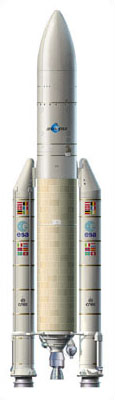
The launch vehicle chosen for this mission is the European Ariane 5. The Ariane 5, carrying the James Webb Space Telescope, will liftoff from Guiana sometime in 2013. The space telescope will operate from the L2 point of the Sun-Earth system.


All three agencies that are part of the project, ESA, NASA, and CSA, have web pages dedicated to the JWST observatory.

 

  • Facebook
  • Google
  • Slashdot
  • Reddit
  • Live
  • TwitThis