OrbitalHub

The place where space exploration, science, and engineering meet

Domain is for sale. $50,000,000.00 USD. Direct any inquiries to contact@orbitalhub.com.


Credits: ESA


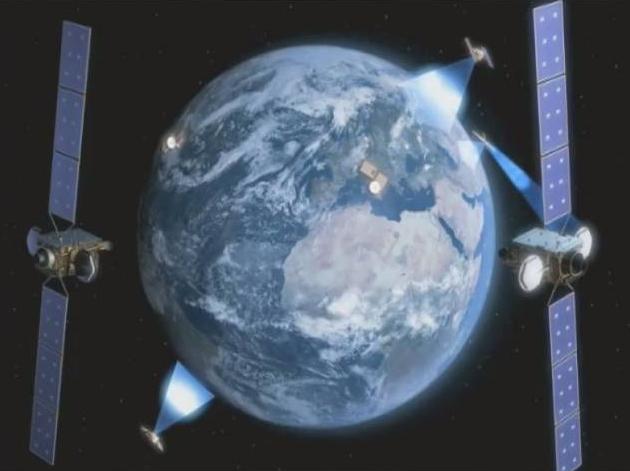
ESA is developing a new satellite communication system that will revolutionize the way Europe gets its information from space. This new communication system is called EDRSS – the European Data Relay Satellite System.


EDRSS will use geostationary satellites to communicate with both ground stations and satellites that are operating in low Earth orbits.


EDRSS will allow low Earth orbit satellites to deliver data continuously, instead of storing it on board and sending it to Earth while flying over a ground station. EDRSS will consist of a network of satellites that will communicate between themselves as well as with the ground stations. This new infrastructure will increase the speed at which ground stations receive data from satellites, thereby improving global communication, navigation, and Earth observation.


EDRSS will serve as a communication infrastructure and it will improve many key services: monitoring earthquakes, forest fires, floods, and aircraft navigation, just to name a few.


You can watch an ESA video cast for more details.


  • Facebook
  • Google
  • Slashdot
  • Reddit
  • Live
  • TwitThis


Credits: ESA – J. Huart


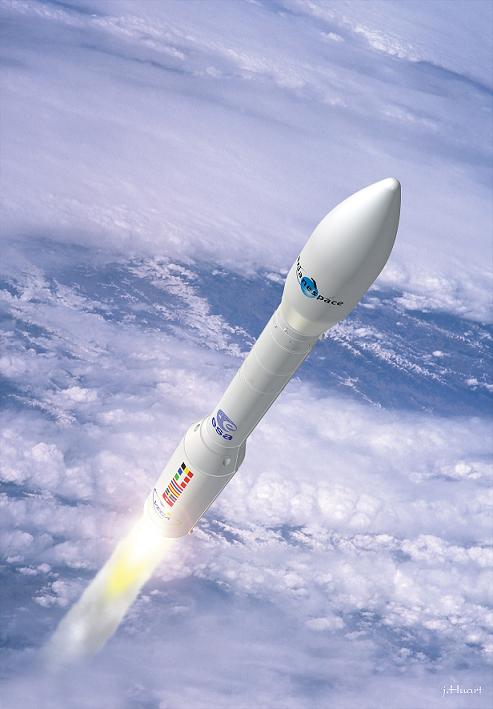
The small-payload market is rapidly expanding. Institutional programs (mostly Earth observation and scientific missions) drive this emerging market. In order to meet the demands of the small-payload market, ESA has transformed the small launcher program initiated by the Italian Space Agency (ASI) in the 1990s into Vega, a co-operative project with other Member States within the ESA framework.


The small-payload market consists of satellites up to 3,000 kg and it stands at around five missions per year. There are many classifications for the satellites in this market, so we will present just one classification for informational purposes. The satellites in this class are divided into three categories: micro-satellites (up to 300 kg), mini-satellites (from 300 kg to 1,000 kg), and small satellites (from 1,000 kg to 3,000 kg).


The orbits required for the deployment of these satellites are mainly Sun Synchronous Orbits (SSO) and Low Earth Orbits (LEO). Vega’s in-orbit launch capability benchmark is 1,500 kg into a 700 km altitude polar orbit. Being designed to cope with a wide range of missions, Vega will address the various market requirements for this class of satellites.


Credits: ESA


Vega is a single-body launcher composed of four stages. The first three stages are solid propellant stages, while the fourth stage has a liquid propellant engine. Vega is 30 meters high, has a maximum diameter of three meters and a total of 137 tons at lift-off.


There are three main sections: the Lower Composite, the Restartable Upper Module and the Payload Composite.


The Lower Composite section consists of the first three stages (the solid propellant stages). The first stage is equipped with a P80-FW motor containing 88 tons of propellant. The second stage contains a Zefiro 23 motor with 23 tons of propellant. The third stage consists of a Zefiro 9 motor with 10 tons of propellant and the stage-interfacing structures.


The technology for the three solid-propellant stages (P80, Z23, Z9) is derived from the Zefiro 16 rocket motor. These motors benefit from the experience acquired by Europe in the field of solid propulsion. Each motor is composed of a thermal-insulated carbon-epoxy monolithic case, the solid propellant HTPB 1912, a nozzle, a thrust vector control system driven by two electro-actuators that operate the movable nozzle, and a control unit that provides pitch and yaw control during the flight. Each stage also includes an ignition subsystem, a safety subsystem, and the interfaces to the other stages.


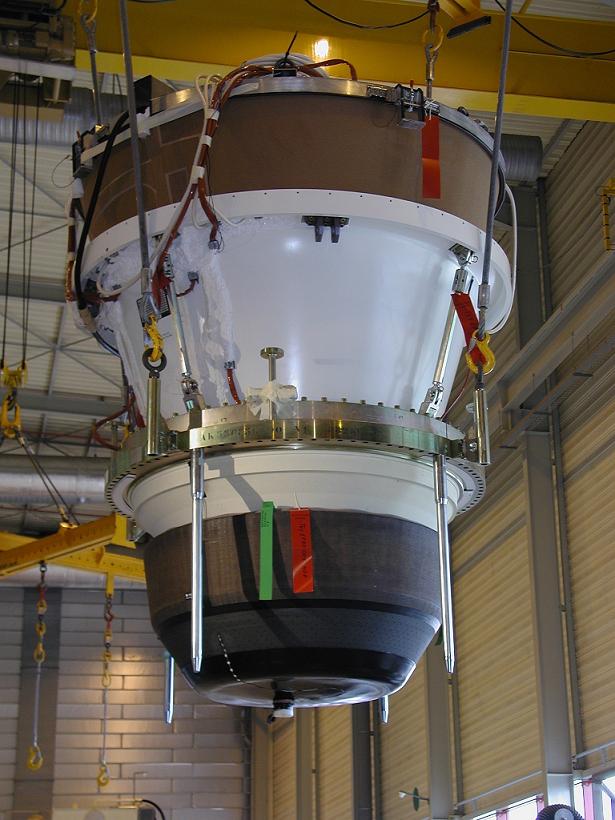
Credits: ESA/CNES-SOV


The P80 engine was designed for the Vega small launcher, and it helps validate technologies applicable to a new generation of solid boosters for the Ariane 5 launch vehicle. This new design was driven by the goal of minimizing recurring costs, a significant reduction being made with respect to the current metal case boosters.


The Restartable Upper Module is the fourth stage of the launcher. It is also known as the Altitude and Vernier Upper Module (AVUM). The AVUM consists of two modules: the AVUM Propulsion Module and the AVUM Avionics Module.


The propulsion system uses NTO (Nitrogen Tetroxide) and UDMH (Unsymmetrical dimethyl hydrazine) as propellants. The propellants are stored in two identical titanium tanks pressurized by helium. Depending on the mission, the propellant load can be between 250 kg and 500 kg.


The avionics system is largely adapted from existing hardware and/or components already under development (namely subsystems already in use by the Ariane 5 launch vehicle).


The Payload Composite section is composed of the fairing and the payload/launcher interface structure. The fairing is composed of two shells that are jettisoned during flight after the separation of the second stage. The payload/launcher interface is an Adaptor 937, which is a standard interface used on the European launchers. Additional payload adapters can be added for multi-payload missions.


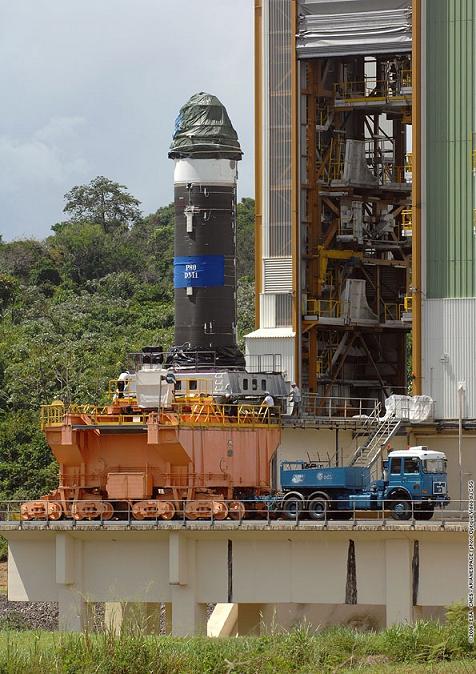
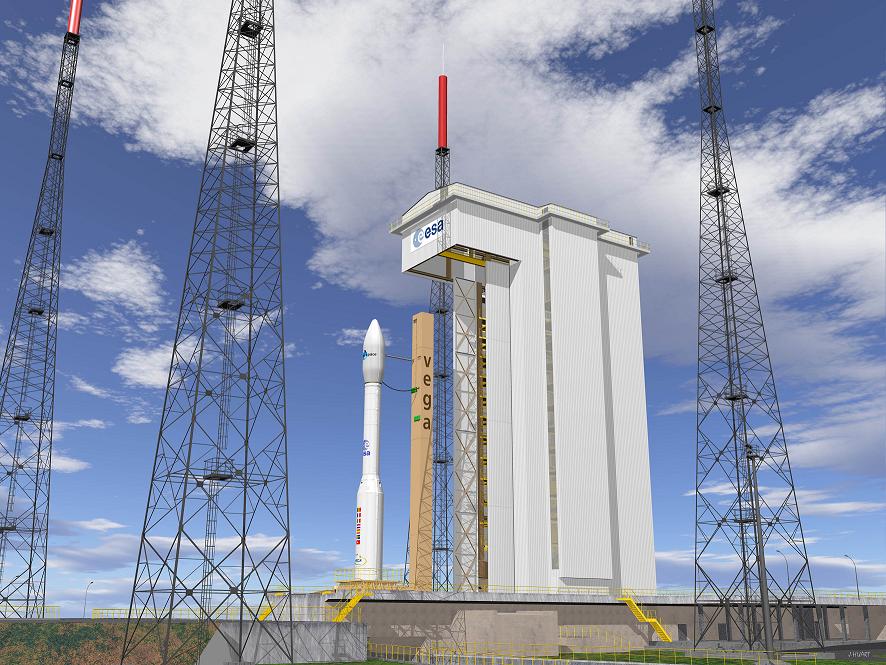
Credits: ESA – J. Huart


The dedicated Ground Segment for the Vega launcher comprises of the Launch Zone (ZLV – Zone de Lancement Vega) and the Operational Control Center, all located at the European Spaceport at Kourou, in French Guiana. ESA also built a Payload Preparation Complex that will be used for satellite and equipment unpacking, mechanical inspections, the checkout of the payloads, and the final integration of the payload composite before mounting it on top of the launcher.


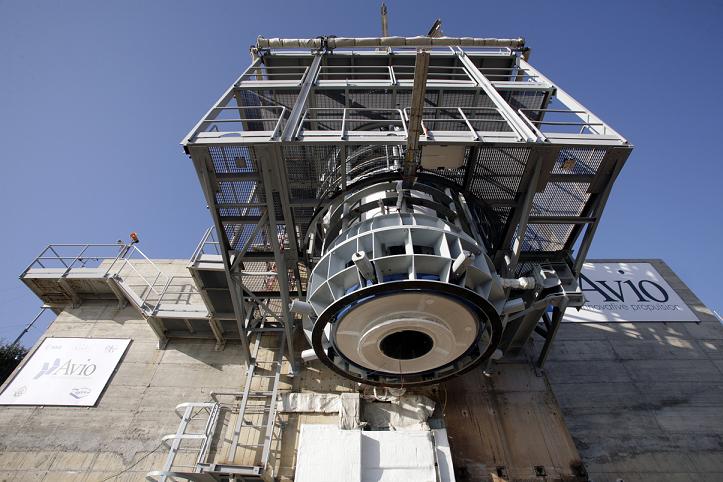
On October 24, 2008, the Zefiro 9 rocket engine passed the first qualification test. There is one additional firing test left for the engine. The Vega launcher’s qualification flight is scheduled to take place by the end of 2009.


Credits: Avio SpA (Italy)


ESA is responsible for the qualification of the launch service and also for sustaining the qualification status during the exploitation phase. Ariane Space will be responsible for Vega’s commercialization and launch operations. The expected launch rate for Vega will be up to four launches per year.


Please stay tuned on the OrbitalHub frequency. We will keep you posted!


  • Facebook
  • Google
  • Slashdot
  • Reddit
  • Live
  • TwitThis


Credits: ESA/AOES Medialab


In a previous post, we presented the Planck spacecraft. We would like to dedicate this post to Planck’s big brother, Herschel. Why b(r)other? Because Planck and Herschel will be launched into space by the same Ariane 5 launcher and they will share the fairing section during the launch phase of the mission. Why big? Well, because Herschel is a larger spacecraft than Planck… actually Herschel is the largest space telescope ever built.


Just to have an idea about the size of the infrared telescope onboard the Herschel spacecraft, the primary mirror has a diameter of 3.5 m and a mass of only 350 kg. In comparison, the mirror of the Hubble space telescope has a diameter of 2.4 m and a mass of 1.5 tons. Obviously, a great deal of effort has been put into minimizing the mass of the telescope, an advance made possible by present-day technology.


The infrared telescope will become operational four months after its launch and will have a nominal mission lifetime of three years. The objectives that ESA set for the Herschel Space Observatory are ambitious: the study of the galaxies in the early universe, the investigation of the creation of stars, the observation of the chemical composition of the atmosphere and surfaces of comets, planets and satellites, as well as examining the molecular chemistry of the universe.


Like Planck, Herschel will observe the sky from the second Lagrangean Point (L2) of the Sun-Earth system. The instruments onboard Herschel will collect long-wavelength infrared radiation. Herschel will be the only space observatory to cover the spectral range from the far infrared to sub-millimeter, which is the reason why the initial name of the space observatory was Far Infrared and Sub-millimeter Telescope (FIRST).


Credits: ESA


The Herschel spacecraft will have 3.3 tons at launch, with a length of 7.5 m and a cross section of 4×4 m. The spacecraft comprises of two modules: the service module and the payload module. While the service module contains the systems for power conditioning, attitude control, data handling and communications, and the warm parts of the scientific instruments, the payload module contains the telescope, the optical bench, the cold parts of the scientific instruments and the cooling system. A sunshield protects the telescope and the cryostat from solar radiation. The sunshield also carries solar cells for power generation.


In order to make accurate observations of the infrared spectrum, parts of the scientific instruments onboard have to be cooled to temperatures close to absolute zero. Two thousand liters of liquid helium will be used for primary cooling during the mission. In addition, each detector onboard is equipped with additional cooling systems.


Credits: ESA/Guarniero


Herschel will not be the first infrared telescope launched into space. There are three predecessors that we would like to mention here: IRAS, the US-Dutch-British satellite launched in 1983, ISO – launched by ESA in 1995, and the NASA’s Spitzer Space Telescope – launched in 2003. However, these three infrared space telescopes were operated on Earth orbits. As we mentioned, Herschel will operate in the L2 point, away from any interference that would affect the scientific instruments onboard. Operating in the L2 point will also help with regard to thermal stability because the spacecraft will not move in and out of eclipse regions.


The launch date is set for early 2009. The journey to the final operational position will take around four months. The European Space Operations Control Center (ESOC) in Darmstadt will coordinate the mission.


  • Facebook
  • Google
  • Slashdot
  • Reddit
  • Live
  • TwitThis
10-25-08

Starquakes Detected By COROT

Posted by


Credits: CNES / D. Ducros


Stellar seismology is a relatively new field of study. Since 1995, the ESA/NASA mission SOHO (SOlar Heliospheric Observatory) has pioneered the study of stellar seismology through observations of our own star, the Sun. Despite its name, stellar seismology is the study of stellar pressure waves and not stellar seismic activity (There is no such thing as seismic activity inside a star).


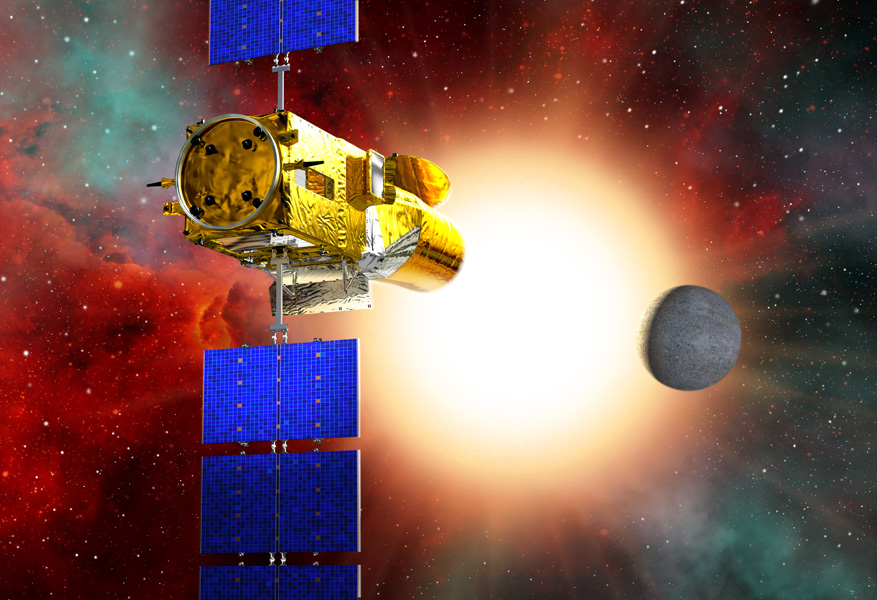
The COROT mission uses a similar approach to study other stars. Three stars similar to the Sun – known as HD499933, HD181420, and HD181906 – have been probed and starquakes have been detected.


Credits: CNES


Starquakes, or oscillations of distant stars, can be detected through variation in the light emitted by the star as sound waves hit the star’s surface.


This method reveals the internal structure of the star, and the patterns that the energy follows when transported from the core to the surface. These observations also allow astronomers to calculate the star’s mass, age, and chemical composition.


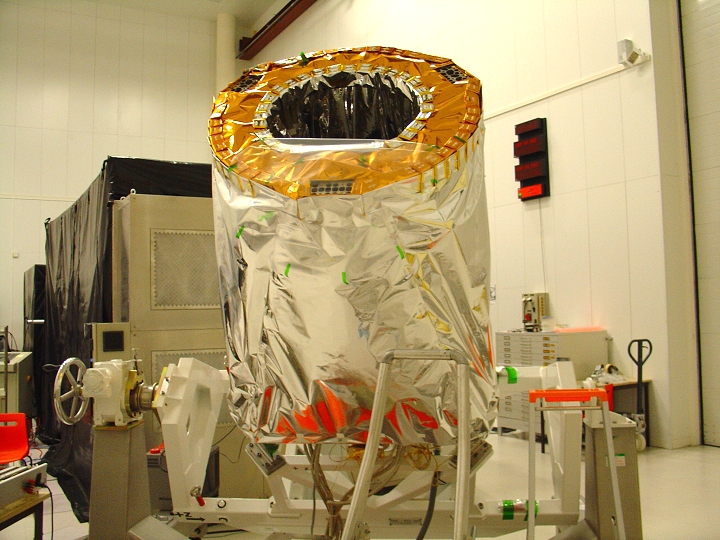
The COROT satellite, carrying a 27 cm diameter telescope, was launched in December 2006 by a Soyuz rocket from the Baikonur Cosmodrome. COROT is a 360 kg satellite and operates on a polar orbit at an altitude of 896 km. COROT is a mission lead by the French Space Agency (CNES); ESA, Austria, Belgium, Germany, Spain, and Brazil also contributed to the mission. The main objectives of the mission are to search for exoplanets and to study stellar interiors.


Credits: CNES


The telescope onboard COROT cannot see exoplanets directly. The method employed by COROT to discover exoplanets is to measure variations in the luminosity of stars. Planets cause such variations as they pass in front of their parent stars. These celestial alignments are called planetary transits. Obviously, the smaller the planet, the higher the telescope’s sensitivity must be in order to detect it.


Ground telescopes have detected more than 200 exoplanets to date (all of them gas giants). COROT continues the search for new worlds outside of our solar system from above the Earth’s atmosphere. Without the distorting effects of the atmosphere, COROT is able to find planets that are made out of rock and are smaller than the gas giants. COROT marks the first step in understanding other solar systems, how planets are formed, and how life can develop on these planets.


From February 2 to February 5, 2009, the first COROT International Symposium will be held in Paris, France.


  • Facebook
  • Google
  • Slashdot
  • Reddit
  • Live
  • TwitThis
10-22-08

Newton Phone Home

Posted by


Credits: ESA


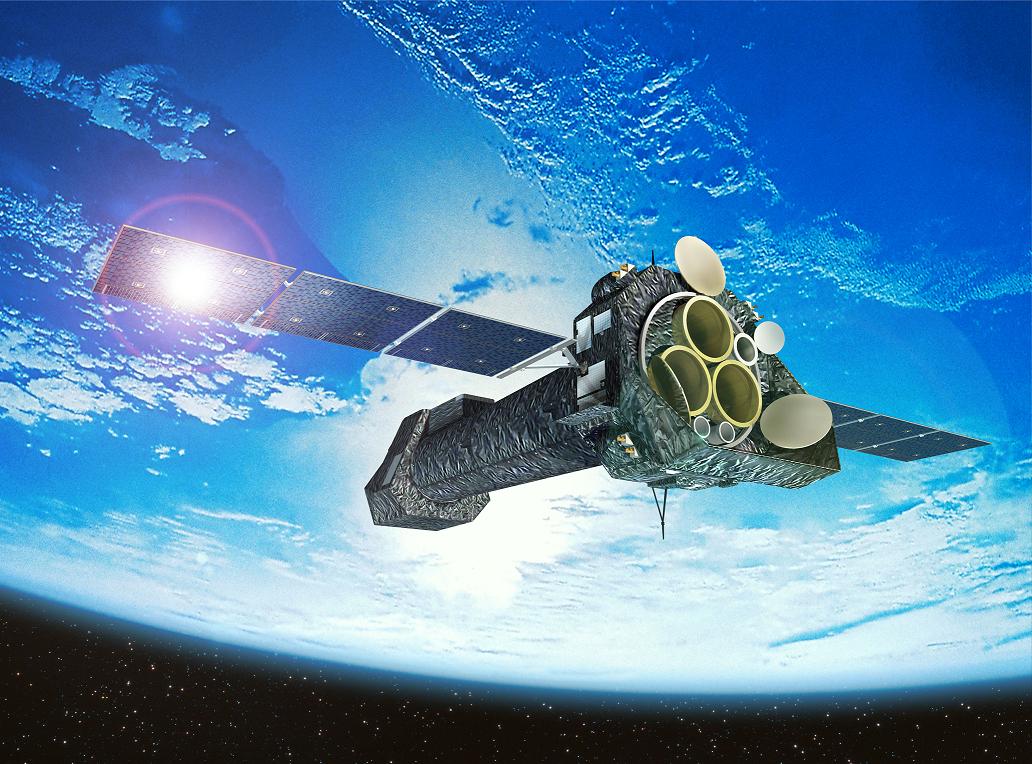
After operating flawlessly in orbit for almost nine years, the XMM-Newton X-ray observatory lost contact with the ESA’s ground stations.


In the case of a space mission, losing contact with a spacecraft can mean anything from a technical problem onboard to a collision with space debris or even a meteorite.


The contact was lost when the satellite switched from one ground station to another. The satellite must perform such operations in orbit in order to maintain radio contact with the ground control center of the mission. The ESA’s ground station in Villafranca, Spain, reported that it was not able to re-establish radio contact with the satellite.


Several astronomic observatories have managed to take images of the satellite in orbit. By now it is clear to the ground investigators that the satellite is intact and it is maintaining a constant altitude on the expected orbit. By using a more powerful ground antenna (the 35m diameter antenna at New Norcia in Australia), a weak radio transmission was received from XMM-Newton, proving that the satellite is still alive. Engineers hope to re-establish nominal radio contact with the satellite.


Credits: NASA/ESA/R. Massey (Caltech)


ESA launched the X-ray Multi-Mirror Mission (XMM-Newton) on December 10th, 1999. The mission has an operational lifetime of ten years. XMM-Newton has a large collecting area due to its three X-ray telescopes. In addition, the high altitude orbit offers the ability to make long uninterrupted exposures.


X-rays are absorbed by the Earth’s atmosphere, so only a space telescope like XMM-Newton can detect and study celestial X-ray sources.


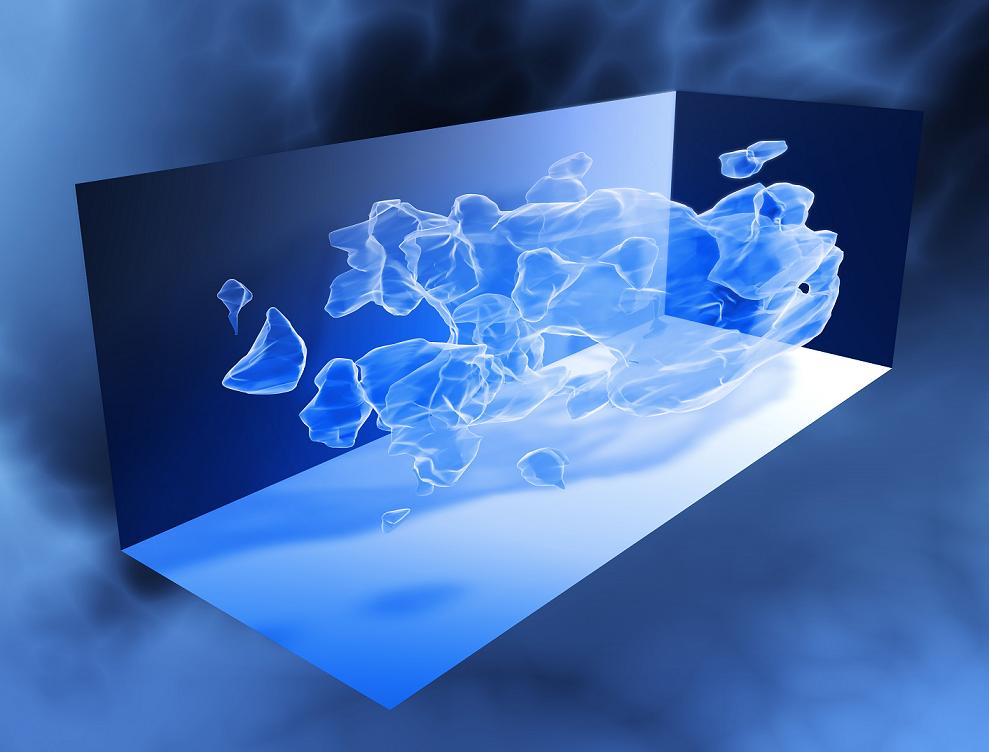
Data collected by the XMM-Newton was used to compile a three-dimensional large-scale map of the dark matter for the first time. The dark matter is an invisible form of matter that accounts for most of the mass of the Universe.


ESA has an entire website dedicated to the XMM-Newton mission. For more details about XMM-Newton you can visit the XMM-Newton Science Operations Center (XMM-Newton SOC) page.


  • Facebook
  • Google
  • Slashdot
  • Reddit
  • Live
  • TwitThis


Credits: ESA


ESA is about to launch a satellite capable of measuring very small variations in the Earth’s gravitational field. Even if it is a common-sense assumption that the force of gravity on the surface of the Earth has a constant value, there are subtle variations caused by the rotation of the Earth, the position of the mountains and ocean trenches, and by the variations of the Earth’s inner density. Determining the variations in the Earth’s gravitational field will improve our knowledge of ocean circulation, and will also help to make advances in geodesy and surveying.


The Gravity field and steady-state Ocean Circulation Explorer (GOCE) satellite will measure the small variations of the gravitational field. GOCE is the most advanced gravity space mission to date. Scientists will build a detailed map of Earth’s gravity using data collected by GOCE.


Credits: ESA


In order to make accurate measurements, the GOCE satellite will orbit in a low altitude orbit, around 250 km above the surface of the Earth.


An elongated shape has been chosen for the satellite design to minimize the atmospheric drag. GOCE is five meters long, one meter in diameter, and has a mass of roughly 1050 kg.


The heart of the GOCE satellite is a scientific instrument called gradiometer. The gradiometer consists of three pairs of accelerometers, and it measures acceleration variations over short distances between proof masses inside the satellite. One important thing to mention here is that the calibration of the gradiometer takes place after launch. The reason? The instrument cannot be calibrated on the ground, under the force of gravity.


Credits: ESA


You can find out more about the calibration of the GOCE instrument by reading an interesting article on ESA’s website.


Daniel Lamarre, a Canadian national working at ESA’s European Space Research and Technology Centre (ESTEC), is the inventor and the developer of the method used for the calibration of the instrument. He won an ESA award for developing the calibration method.


The GOCE satellite will be launched from the Plesetsk Cosmodrome in northern Russia. Eurockot Launch Services GmbH, a company that provides commercial launch services with the Rockot launch system, will be the launch provider for the GOCE mission. Eurockot was formed in 1993. EADS Astrium, located in Bremen, Germany, holds 51 percent of the company. The Khrunichev State Research and Production Space Center in Moscow, Russia, owns the remaining 49 percent.


Credits: ESA


The Rockot launcher is based on the SS-19 Intercontinental Ballistic Missiles. The upper stage of the launch system, Breeze KM, extends the performance capabilities of the Rockot lower stages. The system is capable of injecting a 1950 kg payload into Low Earth Orbit (LEO). The re-ignitable main engine of the Breeze KM allows various injection schemes for the payload. The length of the launch vehicle is 29 meters, with a launch mass of 107 tons. The external diameter of the three stages is 2.5 meters, while the payload fairing has an external diameter of 2.6 meters and a height of 6.7 meters.


The initial launch date was postponed due to an anomaly identified in the guidance and navigation subsystem of the Breeze KM upper stage. The new launch date has been scheduled for Monday, October 27th, 2008.


  • Facebook
  • Google
  • Slashdot
  • Reddit
  • Live
  • TwitThis