OrbitalHub

The place where space exploration, science, and engineering meet

Domain is for sale. $50,000,000.00 USD. Direct any inquiries to contact@orbitalhub.com.

02-11-09

Mars 500

Posted by


Credits: ESA – S. Corvaja


The Mars500 experiment is a cooperative project between the European Space Agency’s Directorate of Human Spaceflight and the Russian Institute for Biomedical Problems (IBMP).


The experiment will be conducted inside a special facility at the IBMP in Moscow.


Mars500 is essential for the preparation of human missions to Mars, as the data, knowledge, and experience accumulated during the experiment will help scientists investigate the human factors of this type of mission.


Many aspects of long duration spaceflights are targeted by this study: crew composition, the influence of isolation on sleep, mood, and mental health, the impact of different personalities, cultural background, and motivation of the crew members, and the effects of stress on health and the immune system.


There is one 150-day simulation to be conducted (that can be followed by an additional 150-day study) before the full 520-day simulation. The full simulation follows the profile of a real mission to Mars, which contains an exploration phase that has to be performed by the crew of six selected for the experiment.


During the experiments, the crews will have a diet identical to the one that the ISS crews have and communication with the outside world will involve a delay (as in the real conditions of a space mission, when the spacecraft and the mission control are millions of kilometers away from each other).


The crew will be completely isolated, and they will have to handle all of the critical situations for the duration of the experiment. The crew will speak English and Russian, and have experience in medicine, biology, and engineering.


Credits: ESA – S. Corvaja


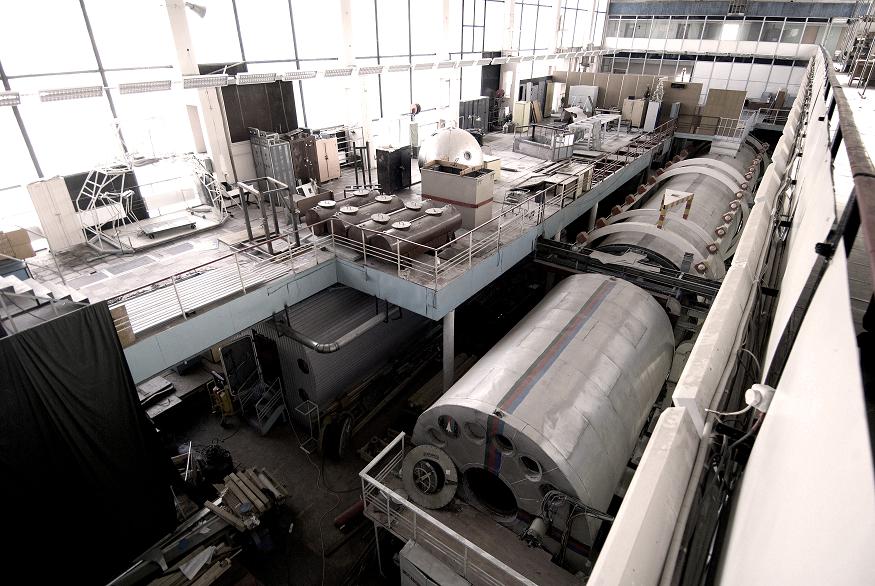
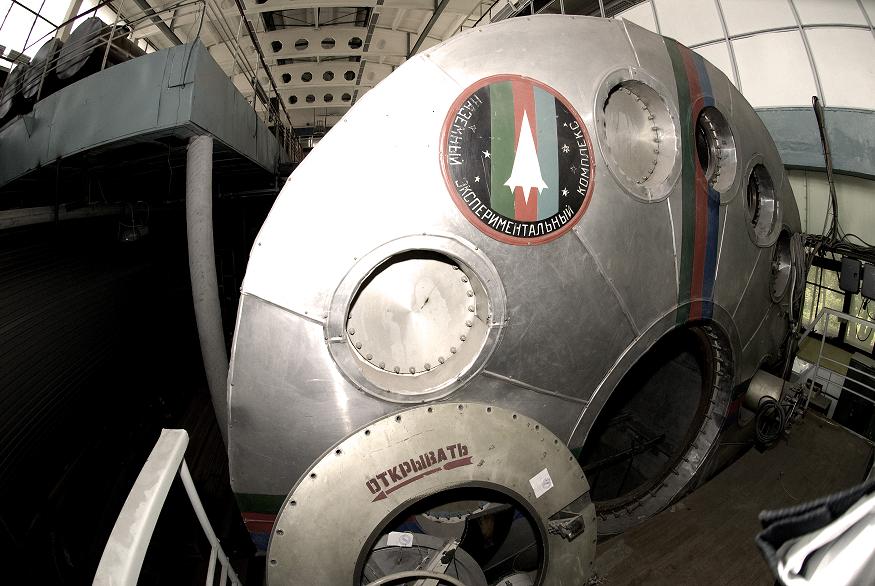
The facility at IBMP is known as the Ground-based Experimental Complex (GEC or NEK in Russian). Besides the isolation facility (or the mockup of the habitable modules of a spacecraft), the facility also contains technical facilities, offices, and an operations room.


The isolation facility contains four interconnected modules, which are used by the crew for daily activities.


It also contains a module that will simulate the Martian landscape and it will be used for activities on the surface of Mars during the simulated landing.


The four modules are designated as the medical module, the living quarters, the Mars landing module, and the storage module. The medical module will be used for routine medical examinations, and eventually for complex medical investigations in the case of any crew member becoming ill. The living quarters module contains individual compartments for the crew members, and also a living room, and a kitchen. The control room will also be part of this module.


The Mars landing module will accommodate the landing crew during the orbiting of Mars phase of the mission. Three of the crew members will have to live and work inside this module for up to 3 months. The storage module contains a refrigerator for food storage, a storage compartment for non-perishable food, a greenhouse, a gym, a bathroom, and even a sauna.


The start of the full 520-day study is planned for late 2009, when a six-member crew will be sealed behind the entry hatch in order to live and work in the conditions of a complete Mars mission.


For more information about the Mars500 project, check out the dedicated page on the IBMP web site.


  • Facebook
  • Google
  • Slashdot
  • Reddit
  • Live
  • TwitThis


Credits: CNES


In 2005, ESA’s Advanced Concepts Team held its first Global Trajectory Optimization Competition (GTOC). The purpose of the competition is to stimulate research of techniques for finding the optimal trajectory for different space missions.


What is interesting about this competition is how it has been taken up by the community after its first edition. The winners of the competition become the hosts for the next edition.


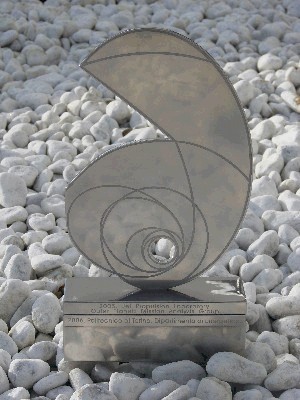
The first edition of the competition was won by the Outer Planets Mission Analysis Group of JPL. The second edition was won by the Department of Energetic in the Polytechnic of Turin, and the third edition was won by CNES (Centre National d’Etudes Spatiales).


CNES has announced the 4th Edition of the GTOC. We quote this year’s announcers of the competition, Regis Bertrand, Richard Epenoy, and Benoit Meyssignac:


“Mission designers generally solve trajectory optimisation problems by means of local optimisation methods together with their own experience of the problem. Even if this way is known to provide good results, it never guarantees to yield the global optimum. On the other hand, global optimisation techniques can offer significant assistance in finding an acceptable solution to a given problem, even though convergence to the global optimum is still not guaranteed. By focusing on a problem with a very large number of locally optimal solutions, the Global Trajectory Optimisation Competition promotes the development of methods that most thoroughly and most quickly search through a large and unconventional design space for optima.”


The deadline for registration is February 27, 2009. On March 2, 2009, the competition problem will be disclosed, and March 30, 2009, is the deadline for return of solutions. In September 2009, during a one-day workshop held in Toulouse, France, the teams selected will present their methods and solutions.


  • Facebook
  • Google
  • Slashdot
  • Reddit
  • Live
  • TwitThis
12-12-08

Columbus

Posted by


Credits: ESA/NASA


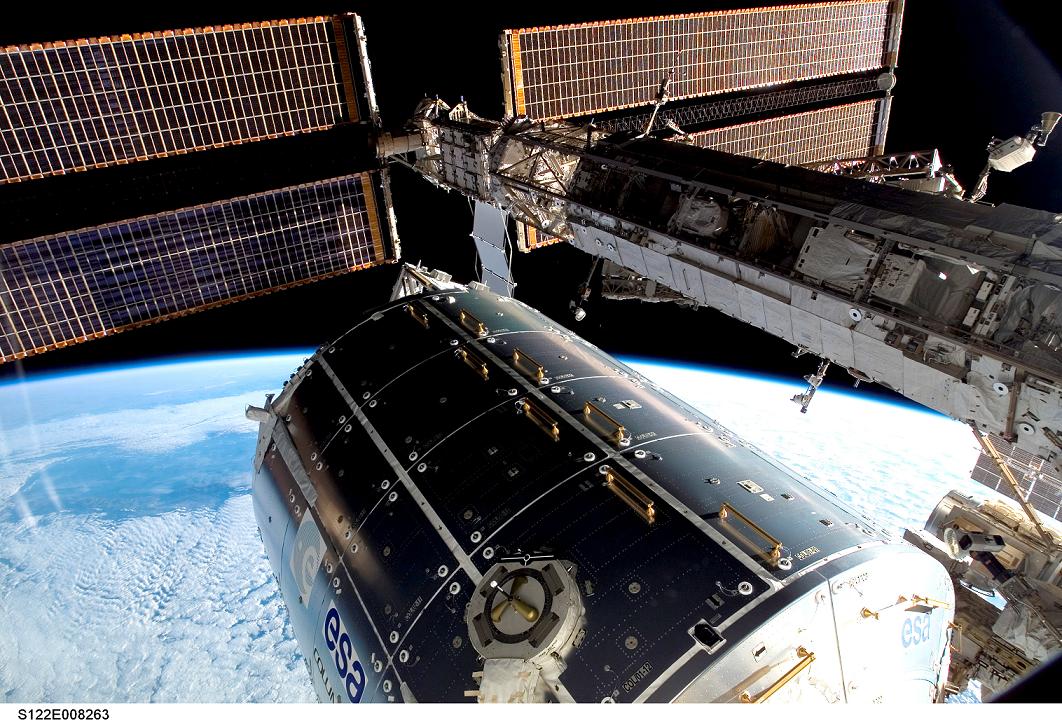
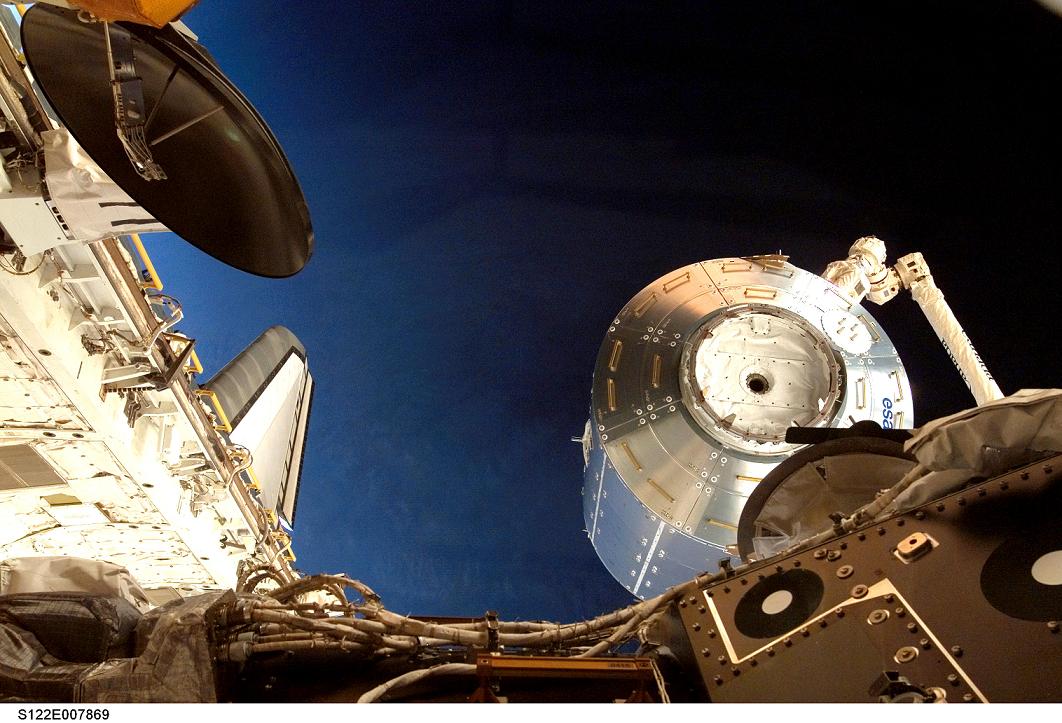
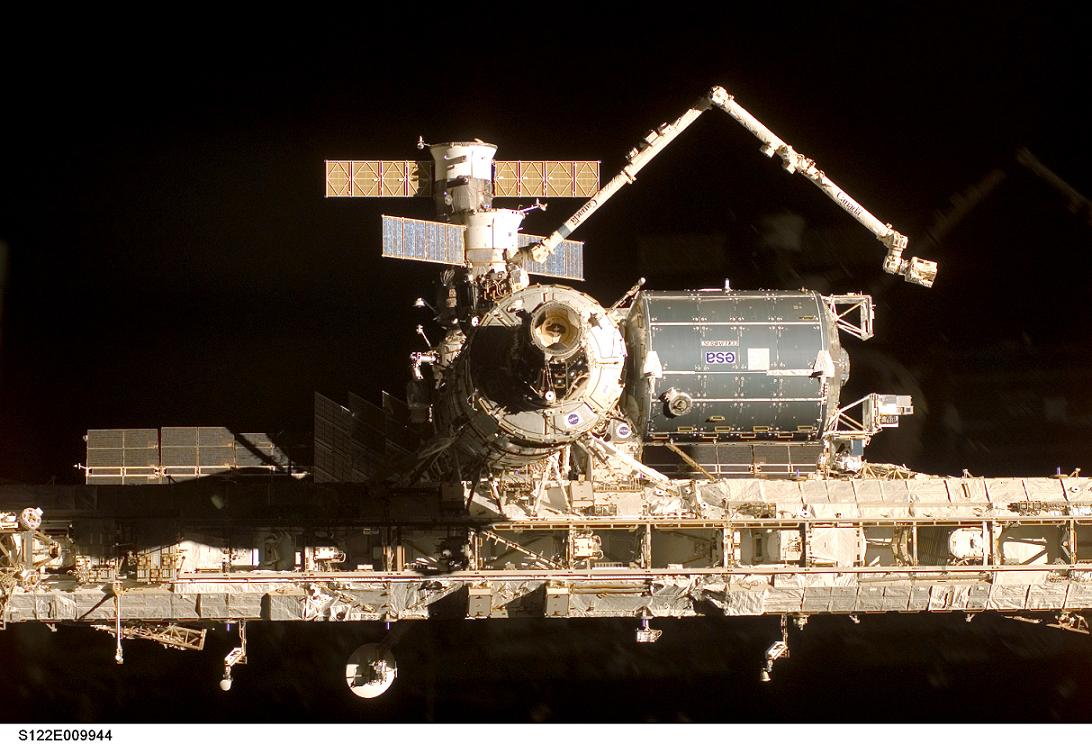
Columbus is an integral part of the International Space Station (ISS), and it is the first European laboratory dedicated to long-term experimentation in zero-g conditions. The projected lifetime of the laboratory is ten years.


The laboratory is named after the famous Italian navigator and explorer Christoforo Columbus, who discovered the Americas in 1492.


The Columbus Laboratory is a large, pressurized aluminum cylinder measuring 4.5 meters in diameter and 6.9 meters in length. Its side walls contain eight research racks, with another two in the ceiling. Each one of these racks contains its own power and cooling systems. Video and data links systems feed information back to researchers and control centers on the Earth.


Columbus is the smallest ISS laboratory, but it has the same scientific, power, and data handling capacity as the other laboratories owned by Russia, USA, and Japan.


Credits: ESA/NASA


Scientific experiments started immediately on the Columbus because the laboratory arrived at the station with four scientific facilities pre-installed.


Columbus is used to carry out experiments in many different disciplines, including biology, biotechnology, fluid and material science, medicine, and human physiology.


The key element in these experiments is the micro gravity. In micro gravity, with gravitational forces much weaker than on the ground, processes that are obscured by gravity become noticeable. The research racks onboard Columbus are designed to investigate how micro gravity affects materials, biological specimens, and people.


Columbus contains the European Physiology Module Facility, the Fluid Science Laboratory, the BioLab, the Material Science Laboratory, and the European Drawer Rack, which can house a variety of small experiments.


Credits: ESA/NASA


Problems that are investigated on Columbus include the loss of bone cells by astronauts, plant growth in micro gravity, fluids behavior, and combustion of materials.


Experiments are also conducted outside of Columbus. These experiments are used to study the Earth or to expose materials to the harsh radiation, temperature, and the vacuum of space.


The mission that delivered the Columbus Laboratory to the ISS was STS-122. On February 7, 2008, the Space Shuttle Atlantis lifted off from Cape Canaveral, with Columbus docked into its cargo bay.


A vital part of the ISS and a prerequisite for the STS-122 mission, the Italian-built Node2 module (a.k.a. Harmony) was delivered to the ISS by the STS-120 mission in October 2007. The node is used as a connecting component for the Columbus Laboratory and the Kibo Laboratory. Node2 is also a docking port for the Space Shuttle.


Credits: ESA/NASA


Prior to the STS-122 mission , there were two spacewalks performed by the ISS Expedition 16 crew to prepare Node2 in order to receive the Columbus Laboratory.


ESA astronauts Léopold Eyharts from France and Hans Schlegel from Germany were members of the STS-122 mission. With five other NASA astronauts, they were part of the Columbus assembly and commissioning mission.


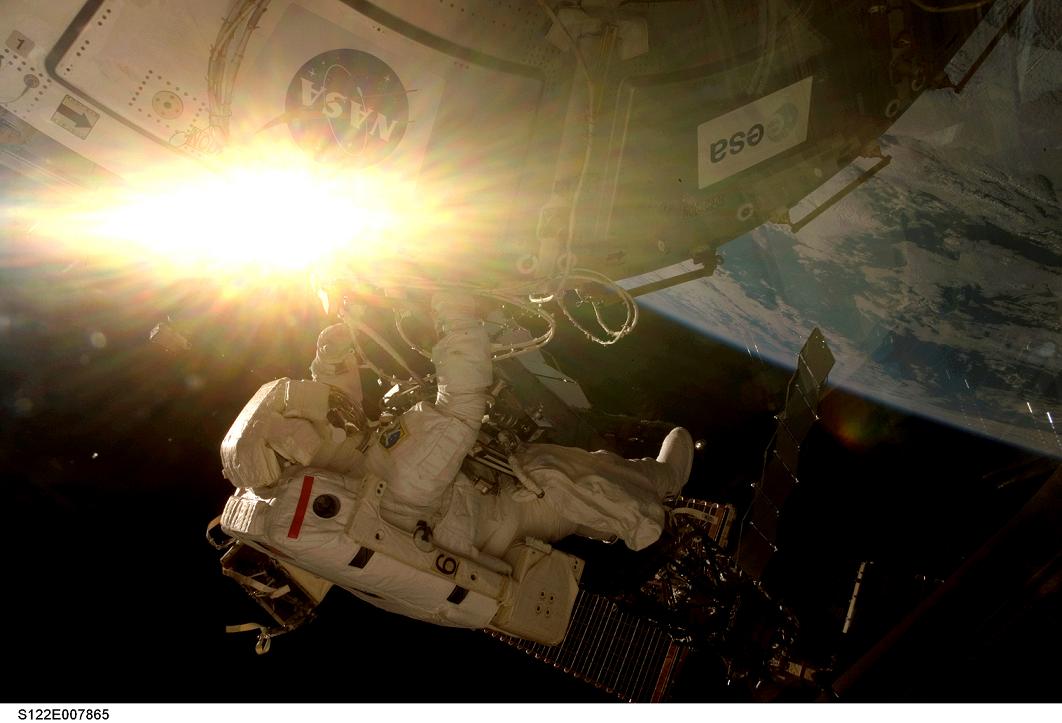
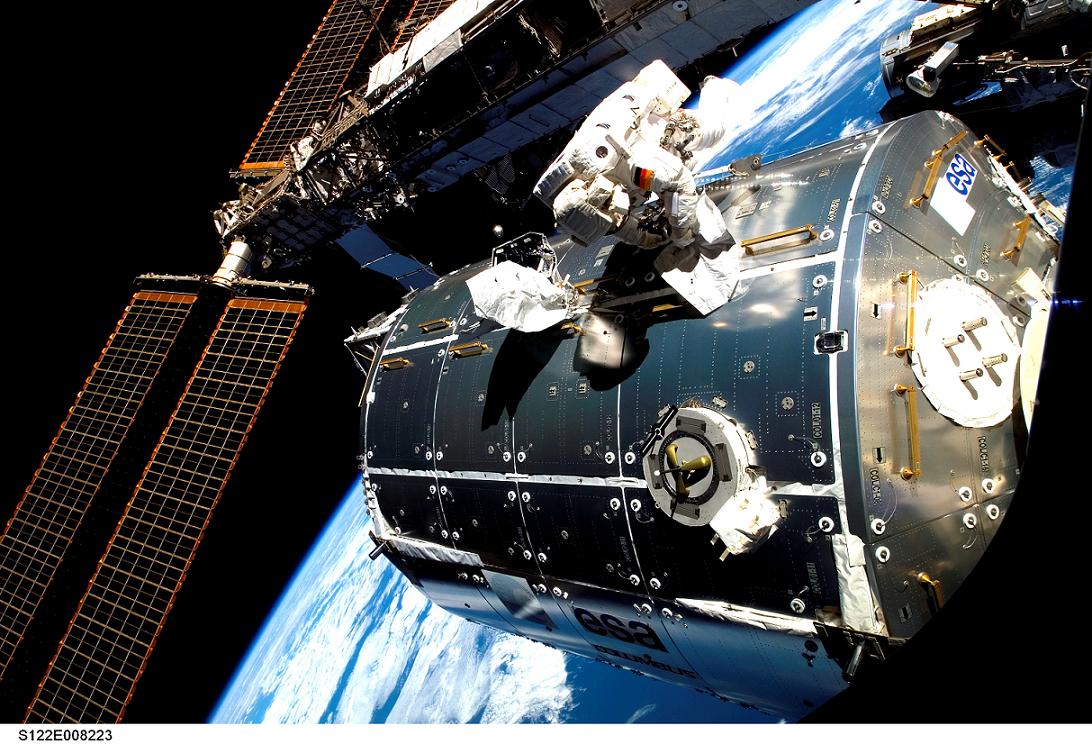
Schlegel spent twelve days in space and undertook two spacewalks to install the laboratory. Eyharts oversaw the installation and the start-up of the laboratory during a longer mission spent onboard the ISS.


Columbus was attached to the Harmony module on February 11, 2008, during the first spacewalk of the STS-122 mission. During this spacewalk, NASA astronauts Stanley Love and Rex Walheim spent nearly eight hours outside the ISS. The ISS robotic arm, Canadarm2, was used to move the laboratory from the cargo bay of the Space Shuttle to the starboard side of the Harmony module.


Credits: ESA/NASA


The second spacewalk of the mission lasted six hours and forty-five minutes. Schlegel and Walheim performed a regular station maintenance operation: they replaced the nitrogen tank that is used to pressurize the ammonia cooling system that runs on the ISS.


ESA was quite inspired to name the laboratory Columbus because it will open the world of micro gravity to a multitude of discoveries, in the same way that Christoforo Columbus opened up the New World to European explorers.


  • Facebook
  • Google
  • Slashdot
  • Reddit
  • Live
  • TwitThis


Credits: NASA


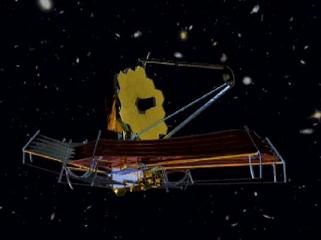
The James Webb Space Telescope (JWST) is the successor of the Hubble Space Telescope (HST). While Hubble looks at the sky in the visible and ultraviolet light, JWST will operate in the infrared.


JWST is a joint mission of NASA, ESA, and the Canadian Space Agency.


The project started in 1996 and was initially known as the Next Generation Space Telescope (NGST). In 2002, the project was renamed the James Webb Space Telescope in honor of NASA administrator James E. Webb, who led the agency from February 1961 to October 1968.


The JWST will use a large deployable sunshade to keep the temperature of the telescope to about 35K. Operating at this temperature gives the telescope exceptional performance in near-infrared and mid-infrared wavebands. The JWST observatory will have a five to ten year lifetime and it will not be serviceable by astronauts.


JWST will be able to see the first galaxies that formed in the early Universe, and how the young stars formed planetary systems.
 

Credits: NASA


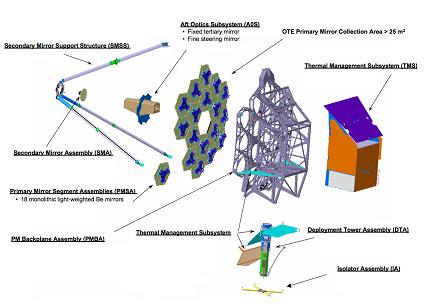
The JWST observatory includes the Integrated Science Instrument Module (ISIM), the Optical Telescope Element (OTE), and the Spacecraft Element containing a spacecraft bus (which offers the support functions for the observatory) and the sunshield.


I will say a few words about each one of them.


The Optical Telescope Element (OTE) collects the light coming from space. Thanks to a 6.5 meter primary mirror, JWST will be able to see the galaxies from the beginning of the Universe. The OTE is also composed of the Fine Steering Mirror (FSM), the secondary mirror support structure (SMSS), and the primary mirror backplane assembly (PMBA). Other subsystems of the OTE are the tertiary mirror and the fine steering mirror. The PMBA contains the Integrated Instrument Module (IIM).


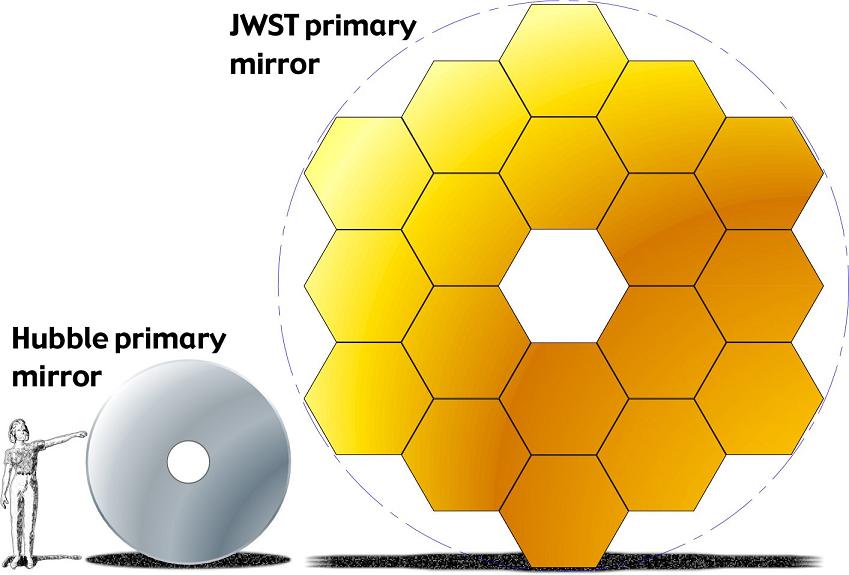
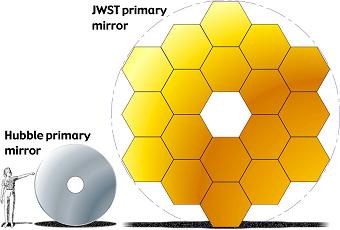
Because the primary mirror is too large to fit inside any available payload fairing, it had to be made out of eighteen hexagonal segments. Some of the elements will be folded before the launch and unfolded during the commissioning phase at the L2 point. NASA made available some neat animations showing how the observatory will be folded in order to fit into the launcher payload, and how the sun shields and the primary mirror will unfold before the observatory becomes operational.
 

Credits: NASA


The sunshield will keep the scientific payload of the observatory away from any light from the Sun, the Earth, or the Moon. Because JWST will observe primarily the infrared light from very distant objects, the temperature of the scientific payload must be maintained at very low values (under 50K). This requirement is so important that even a part of the observatory (the spacecraft bus) had to be placed on the warm side of the sunshield.


The sunshield not only protects the scientific instruments from the heat of the Sun, the Earth, the Moon, and the warm spacecraft bus electronics, but it also provides a stable thermal environment. This is necessary in order to maintain the alignment of the eighteen hexagonal components of the mirror while the observatory changes its orientation relative to the Sun.


The primary mirror is the essential component of a telescope. The design of the primary mirror was driven by a number of important requirements: the size, the mass, and the temperature at which the mirror will operate.


Credits: NASA


In order to be able to see galaxies from thirteen billion light-years away, scientists determined that the mirror must have a diameter of at least 6.5 meters.


The weight of the primary mirror has only one tenth of the mass of Hubble’s mirror per unit area. Considering the size of the mirror, this made the task of launching the telescope into space achievable.


Due to the fact that the telescope will observe the light in the infrared spectrum, the temperature of the mirror has to be as low as –220 degrees Celsius. If operating at the same temperature as the ground telescopes do, the infrared glow of the mirror would interfere with the light received from distant galaxies. Basically, these distant galaxies would disappear in the noise generated by the telescope.


The engineering challenge that scientists faced was to build a lightweight mirror that would preserve its optical and geometric properties when cooled to –220 degrees Celsius. Using beryllium was the solution. Beryllium is lightweight (it is widely used in the aerospace industry) and it is very good at holding its shape across a range of temperatures.


As we mentioned above, the PMBA contains the Integrated Instrument Module (IIM), which is the scientific payload onboard the observatory. The scientific payload includes the following scientific instruments: the Mid-Infrared Instrument (MIRI), the Near-Infrared Spectrograph (NIRSpec), the Near-Infrared Camera (NIRCam), and the Fine Guidance Sensor (FGS).


The MIRI is an imager/spectrograph that covers the wavelength range from 5 to 27 micrometers. The nominal operating temperature for the MIRI is 7K. The NIRSpec covers two wavelength ranges: from 1 to 5 micrometers (medium-resolution spectroscopy) and from 0.6 to 5 micrometers (lower-resolution spectroscopy). The NIRCam was provided by the University of Arizona. NIRCam covers the spectrum from 0.6 to 5 micrometers. The FGS is a broadband guide camera that is used for guide star acquisition and fine pointing.
 

Credits: ESA


The spacecraft bus is composed of every subsystem of the observatory minus the sunshield and the scientific payload, and it provides the necessary support functions for the operations of the observatory. The spacecraft bus contains the Electrical Power Subsystem (EPS), the Attitude Control Subsystem (ACS), the Communication Subsystem (CS), the Command and Data Handling Subsystem (C&DHS), the Propulsion Subsystem (PS), and the Thermal Control Subsystem (TCS).


One interesting thing I would like to mention here is that the C&DH subsystem is using a solid-state recorder as memory/data storage for the observatory. I cannot envision a hard disk drive taking all of the vibrations during the launch and running for ten years without any flaws, so the choice of using radiation hardened solid-state memory units on long-term space mission spacecrafts seems to be the optimal choice.


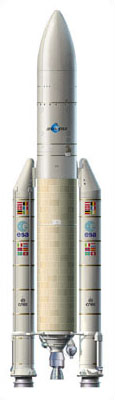
The launch vehicle chosen for this mission is the European Ariane 5. The Ariane 5, carrying the James Webb Space Telescope, will liftoff from Guiana sometime in 2013. The space telescope will operate from the L2 point of the Sun-Earth system.


All three agencies that are part of the project, ESA, NASA, and CSA, have web pages dedicated to the JWST observatory.

 

  • Facebook
  • Google
  • Slashdot
  • Reddit
  • Live
  • TwitThis
11-22-08

ESA Prepares For The Next Step

Posted by


Credits: ESA


The European presence in space has become more prominent over the years. The development of the Columbus Laboratory and the introduction of the Automated Transport Vehicle (ATV) are two major milestones that have opened a new era for Europe’s presence in space.


Europe now aspires to consolidate its independence with the Large Cargo Return (LCR) and the Crew Transport Vehicle (CTV).


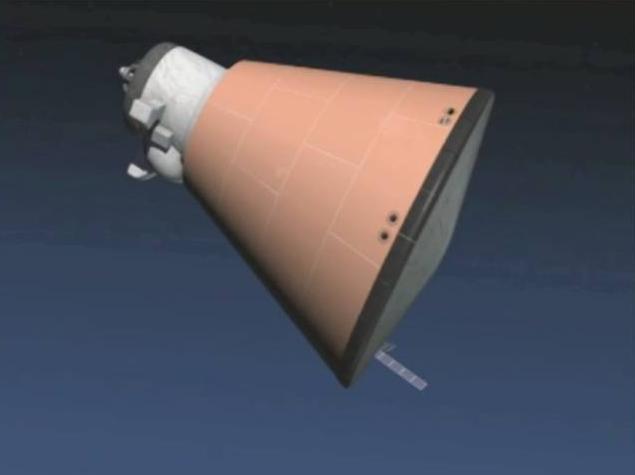
The LCR and the CTV are the new versions of the ATV that are now being considered by ESA’s Human Spaceflight Directorate. These versions of the ATV reuse the service module of the ATV configuration. A capsule with re-entry capability will replace the integrated cargo carrier. In the first phase, the capsule will bring cargo from the ISS down to Earth. The ultimate goal is to be able to carry a full crew up to the ISS and bring the crew back to Earth.


Credits: ESA


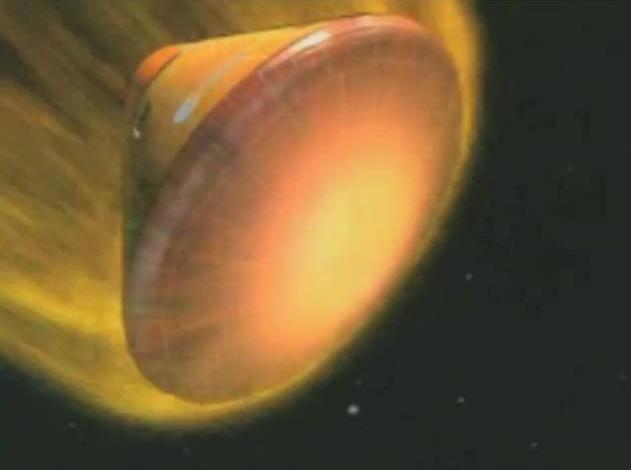
Atmospheric re-entry is not a new challenge for ESA engineers.


Past programs – like the Atmospheric Re-entry Demonstrator – and future programs – like the Intermediate Experimental Vehicle (IXV) – will help validate models used for the simulation of the re-entry phase and also provide a solid base in designing materials for the thermal protection system.


However, one challenge that needs to be addressed is the ejection system for the CTV/Ariane V configuration. The safety of the crew has to be ensured in the case of an anomaly on the launch pad or during the ascent phase of the flight. ESA will have to develop new technologies to satisfy this crucial requirement.


Credits: ESA


ESA has already proposed the LCR and the CTV versions of the ATV as the next step in the evolution of the ATV. However, the decision to go forward lies with the Council of the European Space Ministers. If ESA proposals are approved, the first flight of the LCR is expected in 2015, and the CTV could be docking to the ISS by 2020.


Check out ESA’s podcast about the new proposed programs that are based on the ATV.


  • Facebook
  • Google
  • Slashdot
  • Reddit
  • Live
  • TwitThis


Credits: ESA – S. Corvaja 2007


CNES and ESA signed the development contract to build the launch facilities for Soyuz at the Guiana Space Centre on July 19, 2005. The Soyuz launcher will give Europe medium-lift capability and will complete the range of launchers operated by Arianespace, which includes the Ariane 5 heavy-lift launcher and the Vega small launcher.


The Soyuz launchers that will liftoff from Kourou have a number of improvements: an updated digital flight control system, an increased-performance third stage, and the larger Soyuz ST payload fairing.


The launcher has a length of 46.2 meters, a diameter of 10.3 meters, and a liftoff mass of 308 tons. Due to the position of the launch site, close to the equator, the payload capacity of the launcher has increased significantly: 3,150 kg to a geostationary orbit, and 4,900 kg to a sun-synchronous orbit, with a circular altitude of 820 km.


Soyuz is a reliable, four-stage launch vehicle, which has been in production since 1957 and has accounted for more than 1,700 missions to date.


The first stage is composed of the four boosters that are assembled around the central core of the launcher. The RD-107A engines installed on the boosters use liquid oxygen and kerosene as propellant combination. Each engine has four combustion chambers and four nozzles. One aerofin and two movable vernier thrusters per engine are used for the three-axis flight control.


Credits: ESA – S. Corvaja 2008


The second stage consists of the central core surrounded by the boosters. It uses the same propellant combination for powering the RD-108A engine with four combustion chambers and nozzles.


Four vernier thrusters are used for three-axis flight control, after the boosters of the first stage are jettisoned during flight.


The engines of the first two stages are ignited 20 seconds before liftoff. The reason for this is that the launch procedures include monitoring the engine health parameters just before liftoff, while the engines are operating at an intermediate level of thrust. This reminds me of the SpaceX Falcon 1 booster launch procedures. SpaceX engineers perform a similar monitoring procedure for the Merlin engine just before the Falcon 1 liftoff.


The third stage utilizes a RD-0124 engine, also powered by liquid oxygen and kerosene. The liquid oxygen and kerosene tanks are pressurized using helium stored in vessels located in the liquid oxygen tank. The avionics module of the launcher is carried by this stage. The new flight control system improves the accuracy and the control capability for the launcher, as additional flight control authority is needed for the enlarged payload fairing.


Credits: ESA – S. Corvaja 2008


The upper stage of the Soyuz launcher is called Fregat. Fregat is an autonomous and flexible upper stage with its own guidance, navigation, control, tracking, and telemetry systems. It was designed to operate as an orbital vehicle, and it extends the launch capabilities of the Soyuz launcher to medium-Earth orbits, Sun-synchronous orbits, geostationary transfer orbits, and Earth escape trajectories.


The Fregat stage can be restarted up to 20 times in flight, it can provide three-axis stabilization, and perform a spin-up of the spacecraft payload. Fregat uses a bi-propellant propulsion system: UDMH (unsymmetrical dimethylhydrazine) and NTO (nitrogen tetroxide).


The payload fairing is the most visible change to the Soyuz launcher. The new Soyuz fairing has a diameter of 4.11 meters and a length of 11.4 meters. The fairing is based on the configuration used for Ariane 4 vehicles.


The construction of the Soyuz launch base in French Guiana started in early 2007. At the groundbreaking ceremony on February 26, 2007, a number of European space industry officials were present: Jean-Jacques Dordain – ESA Director General, Yannick d’Escatha – President of CNES, Jean-Yves Le Gall – Director General of Arianespace, and Anatoly Perminov – Head of Roscosmos.


In 2007, Arianespace ordered four Soyuz launchers for the early launch missions that are scheduled for the second half of 2009. A contract was also signed in September 2008 for 10 more Soyuz launch vehicles.


The Soyuz launch missions that are scheduled for 2009 signal the beginning of a new chapter in ESA-Russian relations. Stay tuned for more information about the Soyuz launches from French Guiana!


  • Facebook
  • Google
  • Slashdot
  • Reddit
  • Live
  • TwitThis