OrbitalHub

The place where space exploration, science, and engineering meet

Domain is for sale. $50,000,000.00 USD. Direct any inquiries to contact@orbitalhub.com.

February 5, 2009

GRACE Or Why Tom Is Chasing Jerry In Orbit

Posted by


Credits: NASA-JPL


While the preparations for ESA’s GOCE mission are under way, NASA already has its own gravity mapping mission called GRACE, which was launched in March 2002.


NASA teamed up with the German Space Agency to launch GRACE (Gravity Recovery And Climate Experiment).


GRACE currently provides detailed measurements of the Earth’s gravity field, and these measurements help scientists better understand the effects of gravity on global climate change, oceans, and land masses. This will lead to better predictions about changes in water supply, weather forecasts, and natural hazards.


The data gathered by GRACE has been used to create the best map to date of Earth’s gravitational field. While common sense and introductory physics textbooks tell us that the weight of an object should not have different values at different locations on the surface of the Earth, measurements taken indicate that there are areas where gravity is slightly stronger or weaker than the average. Many of the peaks or valley on the maps put together by scientists can be attributed to surface features, like ridges or mountains. However, there are cases when the variations cannot be explained, and they might be related to high or low sub-surface densities.


The maps compiled from the scientific data returned by GRACE are 1,000 times more accurate then maps previously produced.


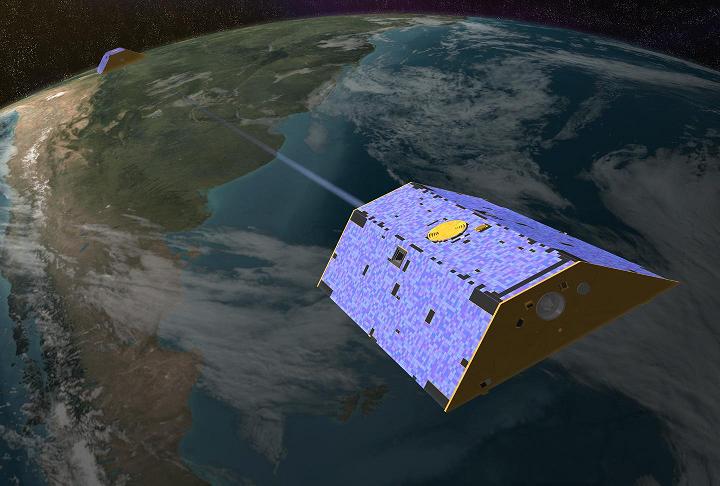
The GRACE mission consists of two satellites flying one behind another in near circular orbits at an altitude of 460 km and about 220 km apart. The satellites have really neat nicknames: Tom and Jerry. The leading satellite (that would be Jerry) sends a microwave signal to the trailing satellite (Tom) to precisely measure the distance between the two. GRACE can detect very small changes in the distance that separates the two spacecraft, down to one-tenth of the width of a human hair. The Global Positioning System (GPS) onboard Tom and Jerry is used to determine the precise location of the measurement taken.


Credits: NASA-JPL


What is the science involved in taking these measurements? When a satellite passes over an area where the gravity is stronger, it will experience a stronger gravitational pull and increase its speed. Conversely, the speed of the satellite will decrease when passing over areas with weaker gravity.


Going back to the satellites, the variations in the gravity field will cause the distance between the two spacecraft to vary slightly. On the ground, the measurements of the distance between the GRACE satellites are translated into variations of the gravity field, and this is how the maps are compiled.


GRACE maps the entire gravity field of Earth every thirty days. The snapshots allow the detection of changes in the polar ice sheets, sea level, ocean currents, the Earth’s water cycle, and even the interior structure of the Earth.


The list of applications is impressive. Measurements over ice sheets can indicate decreases in the ice sheet’s mass. Decreases in gravity can also indicate drying river basins. And not just changes in water above the ground can be measured, but also water stored in aquifers beneath the surface.


For more information about GRACE check out NASA’s web site or the dedicated web page at the University of Texas at Austin.


  • Facebook
  • Google
  • Slashdot
  • Reddit
  • Live
  • TwitThis


ESA plans to design and build an autonomous lifting and aerodynamically controlled re-entry system. Critical technologies are being tested: instrumentation for aerodynamics and aerothermodynamics, thermal protection and hot-structure solutions, guidance, navigation, and flight control using a combination of jets and aerodynamic flaps. The Intermediate Experimental Vehicle (IXV) will be the European platform for in-flight testing of re-entry technologies.

The mission is planned to launch from the European spaceport at Kourou, French Guiana. In 2012, a new launch vehicle, Vega, will inject IXV into a low Earth orbit. The small spacecraft will perform a controlled re-entry, its descent slowed by a parachute, and will land in the Pacific Ocean.


  • Facebook
  • Google
  • Slashdot
  • Reddit
  • Live
  • TwitThis
February 1, 2009

Carnival of Space #88

Posted by


Credits: NASA/Ball Aerospace


Carnival of Space #88 is hosted at The Spacewriter’s Ramblings.


This week you can read about stargazing, past tragedies in space exploration, humanity’s future in space and a nod to our past efforts, lunar robotic exploration, astronomy news, and much more.


Kepler, an exo-planet discovery mission, is covered by OrbitalHub at this edition of the Carnival.


  • Facebook
  • Google
  • Slashdot
  • Reddit
  • Live
  • TwitThis


Credits: NASA

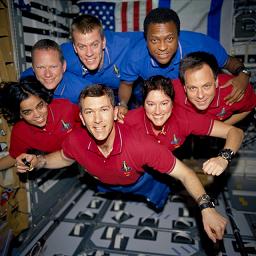
The STS-107 crew members in the SPACEHAB Research Double Module (RDM) aboard the Space Shuttle Columbia. From the left (bottom row): Kalpana Chawla (mission specialist), Rick D. Husband (mission commander), Laurel B. Clark (mission specialist), and Ilan Ramon (payload specialist). From the left (top row): David M. Brown (mission specialist), William C. McCool (pilot), and Michael P. Anderson (payload commander).

The picture was recovered from a roll of unprocessed film found among the debris.


  • Facebook
  • Google
  • Slashdot
  • Reddit
  • Live
  • TwitThis
January 29, 2009

Kepler – The Exo-Planet Hunter

Posted by


Credits: NASA


Kepler is the first NASA mission capable of finding terrestrial exo-planets. Of particular interest are the planets orbiting in the so-called habitable zone, where conditions are met so that liquid water can exist on the surface of the planet.


The observations made so far have brought clear evidence that planets orbiting around other stars are a common thing, rather than the exception to the rule. Due to the limitations of present technology, only gas giants, hot-super Earths in short period orbits, and ice giants have been discovered.


The Kepler mission, part of NASA’s Discovery Program, is designed to survey a portion of our region of the Milky Way. Kepler will survey a large number of stars, and explore the structure and diversity of many planetary systems.


The scientific objectives of the mission are very ambitious: determine the fraction of terrestrial planets in or near the habitable zone, determine the distribution of sizes and the orbits of exo-planets in the surveyed planetary systems, determine reflectivity, size, and density of short-period giant planets, estimate how many planets are in multiple-star systems, and determine the characteristics of the stars that have planets orbiting around them. Scientists hope to discover additional members of the planetary systems surveyed using other indirect techniques.


Credits: NASA/Ball Aerospace


The duration of the mission must be selected to allow the detection and confirm the periodic nature of the planet transits in or near the habitable zone. Due to the characteristics of orbits of such planets, a lifetime of three and a half years (as currently envisioned) would allow a four-transit detection of most orbits up to one year in length and a three-transit detection of orbits of length up to 1.75 years.


The mission lifetime will be extendible to at least six years. The extension will permit the detection of planets smaller than Earth with two-year orbits.


Kepler will be inserted in an Earth-trailing heliocentric orbit, then the spacecraft will slowly drift away from Earth. The selected orbit offers a very stable pointing attitude, and it avoids the high radiation dosage associated with an Earth orbit. However, Kepler will be exposed occasionally to solar flares.


The communication protocol with the spacecraft includes establishing contact twice a week for commanding, health, and status, and science data downlink contact once a month.


Credits: Jon Lomberg


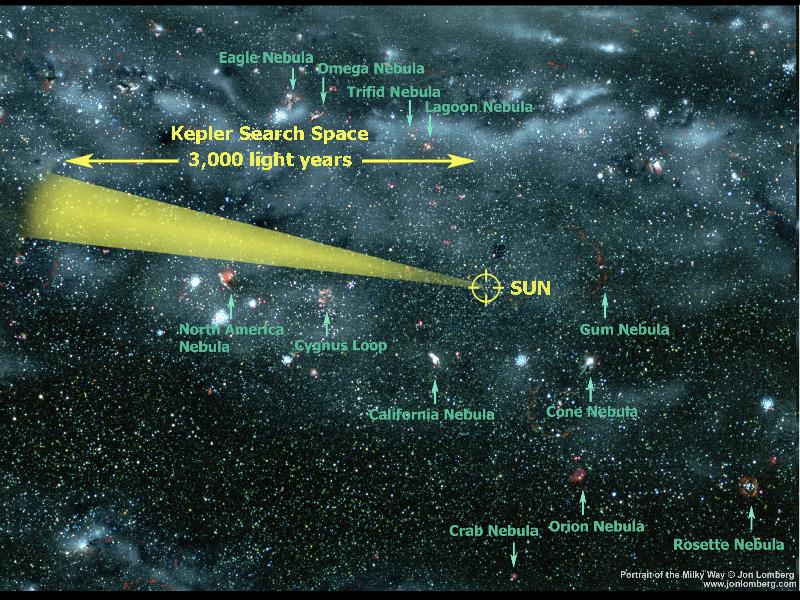
There are two requirements that dictated the selection of the target field. The first requirement is the ability to monitor continuously the stars surveyed because transits last only a fraction of a day. This can be achieved by having the field of view out of the ecliptic plane, so the Sun will not interfere with the observations at any time during the year. The second requirement is to have the largest possible number of stars in the field of view.


To meet both requirements, a region in the Cygnus and Lyra constellations of our galaxy has been selected as the field of view.


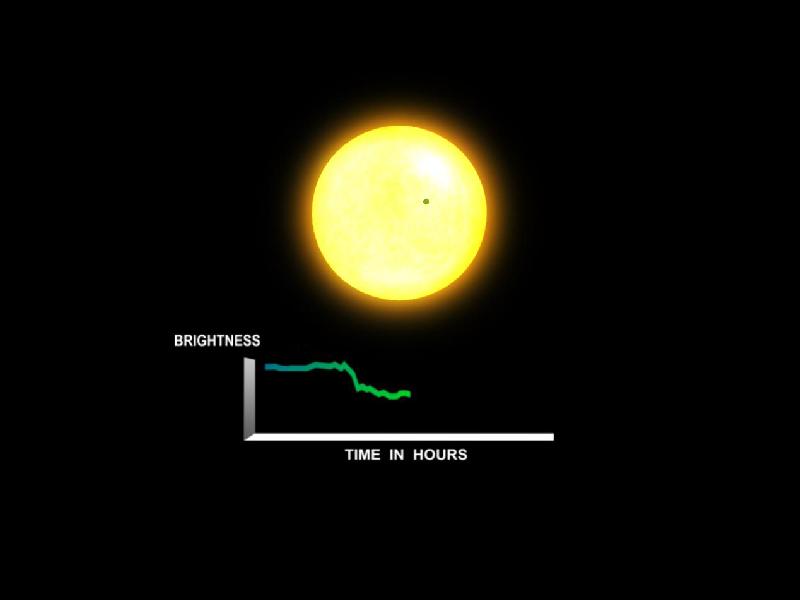
Kepler will use the transit method for detecting exo-planets. The sensitivity of the photometer will allow the discovery of terrestrial exo-planets (planets comparable in size and composition to Earth that are orbiting other stars).


The transit occurs when a planet passes in front of its star as viewed by an observer. Depending on the size of the planet, the change in the brightness of the star has different amplitudes. Transits of terrestrial planets cause a change in the star’s brightness of about 1/10,000, and they last from two to sixteen hours.


Credits: NASA


Changes in star brightness that are produced by a planet transit must be periodic, and all transits produced by the same planet must cause the same variation of brightness and last the same amount of time.


Of course, the case when two or more planets are in transit at the same time must be considered, and this can make the detection method a little bit more complicated.


The method allows for the calculation of the orbit, the mass, and the characteristic temperature of the exo-planet. Once we know the characteristic temperature of an exo-planet, the question of whether or not the planet is habitable (by our standards) can be answered.


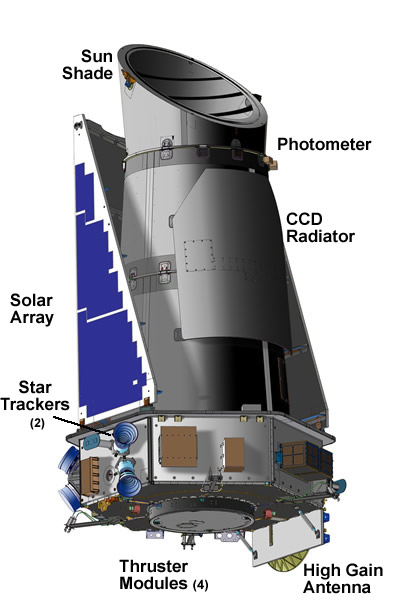
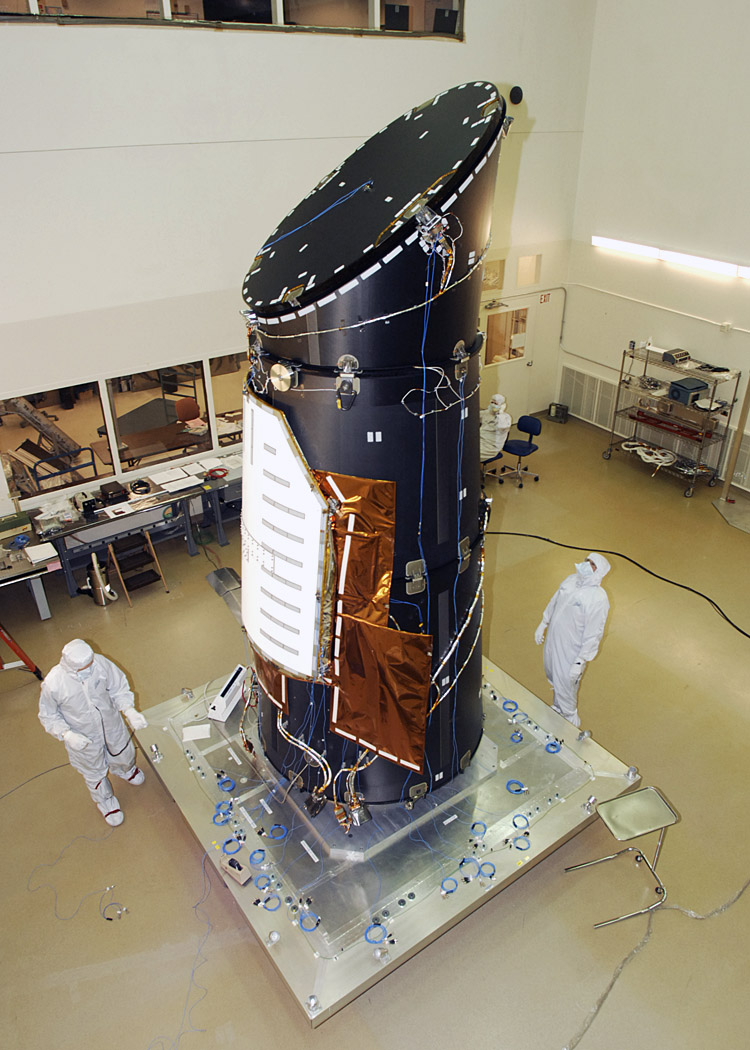
The Kepler instrument is a special telescope called photometer or light meter. The telescope has a very large field of view for an astronomical telescope, 105 square degrees. The primary mirror of the telescope is 0.95 m in diameter. The telescope needs a large field of view because it has to continuously monitor the brightness of more than 100,000 stars for the duration of the mission.


Credits: Ball Aerospace


The photometer is composed of one instrument, which is an array of charge-coupled devices (CCD), 42 in total. Each CCD is 50mm x 25mm and has 2200 x 1024 pixels. Data from the individual pixels that make up each star are recorded continuously and simultaneously.


The primary mirror of the photometer was coated with enhanced silver, which allows more light to reach the telescope’s detectors.


The spacecraft provides power, attitude control, and telemetry for the photometer. The mission requirements contributed to the simple design of the spacecraft. The only moving parts are the reaction wheels used to control the attitude of the spacecraft.


The launcher selected for the mission is Delta II. Delta II is a versatile launcher, and can be configured in two or three-stage vehicles in order to accommodate a variety of requirements.


Ball Aerospace is the prime contractor for the Kepler mission, building the photometer and the spacecraft, as well as managing the system integration and testing of the spacecraft. The Jet Propulsion Laboratory is managing mission development, while NASA Ames Research Center is responsible for ground system development, mission operations, and science data analysis.


Once the first observation results are downloaded from Kepler and made available to scientists, we will be able to place our solar system within the context of planetary systems in our galaxy.


The launch of Kepler is planned for March 5, 2009. For more information about the Kepler mission, you can visit the Kepler mission web page.


  • Facebook
  • Google
  • Slashdot
  • Reddit
  • Live
  • TwitThis
January 28, 2009

The Space Shuttle Challenger Explosion

Posted by


On January 28, 1986, the Space Shuttle Challenger broke apart seventy-three seconds into its flight. The disintegration of the space shuttle occurred after an O-ring seal in one of its solid rocket boosters (SRB) failed. The O-ring failure caused a breach in the SRB, and a flare from within the solid rocket motor reached outside. This led to the separation of the SRB aft attachment and the structural failure of the external tank.

The Space Shuttle program was halted for 32 months. A special commission was appointed by President Ronald Reagan to investigate the accident. The commission offered NASA nine recommendations that were to be implemented as a condition to have the space shuttle flights resumed.

The crew of Space Shuttle Challenger was composed of Francis R. Scobee, Michael J. Smith, Judith A. Resnik, Ellison S. Onizuka, Ronald E. McNair, Gregory B. Jarvis, and Sharon Christa McAuliffe.

The area where M.E.R. Opportunity landed in the Meridiani Planum on Mars is called Challenger Memorial Station, in memory of the last crew of the Space Shuttle Challenger.


  • Facebook
  • Google
  • Slashdot
  • Reddit
  • Live
  • TwitThis