


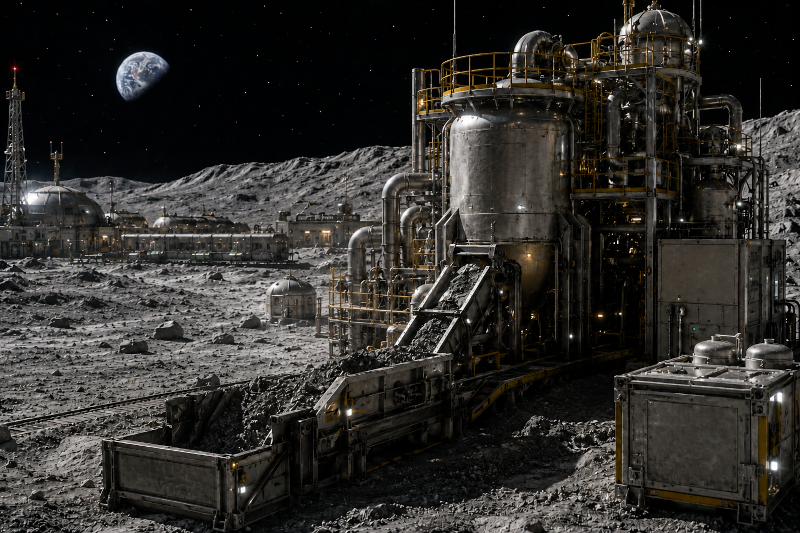
On May 4, 2026, a Seattle-based startup called Interlune announced it had won a $6.9 million Small Business Innovation Research Phase 3 contract from NASA to develop a payload designed to extract helium-3 from lunar regolith. The award, from NASA’s Space Technology Mission Directorate’s Game Changing Development program, funds a mission called Prospect Moon that represents the first attempt to extract solar wind volatiles directly from lunar soil in situ. If the technology works as designed, it could establish the foundation for a commercial helium-3 industry that its proponents argue will eventually support both quantum computing applications on Earth and a sustainable economic presence on the Moon.
Helium-3 is a light isotope of helium with two protons and one neutron, as opposed to the far more common helium-4, which has two of each. The isotope is scarce on Earth, where natural concentrations in the atmosphere measure in the parts per billion, but it accumulates on the lunar surface over billions of years as the solar wind embeds helium-3 ions directly into regolith grains. The Moon lacks both a substantial atmosphere and a strong magnetic field, so its surface receives the full intensity of the solar wind, making the isotope roughly 1,000 times more abundant in lunar soil than in Earth’s crust. Interlune estimates that concentrations in certain lunar regions reach 20 to 30 parts per billion, a trace amount that requires industrial-scale processing to extract economically.
The Prospect Moon payload consists of a robotic arm that scoops regolith into an instrument chamber where samples are heated to release volatile gases, including helium-3, hydrogen, and other elements implanted by the solar wind. The system also performs mechanical processing, including size sorting, agitation, and crushing, to evaluate the efficiency of different extraction approaches. The data collected during the mission will calibrate the processes Interlune intends to use at scale on the Moon, building toward a full commercial operation that the company projects could begin within the early 2030s.
The payload is designed to fly on a lunar lander mission launching in 2028, with integration targeted for the fall of 2027. Interlune is evaluating several lander options and has stated a preference for equatorial landing sites, which differ from the south polar region where NASA’s Artemis program and the proposed lunar base are concentrated. This distinction matters because helium-3 distribution on the Moon is not uniform. Equatorial regolith, subject to higher temperatures and longer exposure to the solar wind over lunar geological history, may contain different concentrations than regolith in permanently shadowed polar regions where water ice also accumulates.
Interlune is not entirely new to lunar hardware. The company previously announced an agreement to fly a camera called Crescent Moon on Astrolab’s FLIP rover, which is scheduled to launch later in 2026 aboard Astrobotic’s Griffin-1 lander. That camera is designed to identify concentrations of ilmenite, an iron-titanium oxide mineral that Interlune considers a geological proxy for helium-3. The camera was delivered to Astrolab for integration in early 2026, making it the company’s first piece of hardware on the lunar surface before Prospect Moon flies.
The commercial rationale for helium-3 rests on applications in quantum computing and quantum sensors, where the isotope serves as a cooling medium and a resource for certain types of quantum bit architectures. Interlune has signed contracts with the Department of Energy and with quantum computing companies Maybell Quantum and Bluefors, collectively worth approximately $500 million, with letters of intent for additional volume. Some of these contracts have delivery timelines as early as 2028, which means Interlune is simultaneously developing Earth-based helium-3 extraction technology from industrial-grade helium supplies to bridge the gap before lunar production becomes viable. The trace amounts of helium-3 present in commercial helium make this terrestrial approach technically feasible, though yield per unit processed is far lower than what lunar mining would eventually produce.
Rob Meyerson, Interlune’s chief executive, has acknowledged that the transition from a demonstration payload to a full extraction operation will take years, and that commercial lunar helium-3 production is not expected before the early 2030s even if the 2028 mission succeeds. The relationship between Interlune’s business and NASA’s lunar base plans remains an open question. Meyerson has stated that the company does not expect its operations to be located within the Artemis base’s south polar footprint, which is not a preferred region for helium-3 extraction. However, he argues that the infrastructure built for the base, including landing facilities and surface power systems, would benefit commercial lunar operations generally, and that Interlune’s technologies would in turn provide economic justification for that infrastructure.
The solar wind is a continuous stream of charged particles, predominantly protons and electrons, emanating from the Sun’s upper atmosphere at velocities between 400 and 800 kilometers per second. When these particles reach the Moon, they penetrate the regolith surface and come to rest at depths determined by their energy, typically within the top few hundred micrometers of grain surfaces. Over geological time, this implanted inventory builds up as a function of the solar wind flux, which varies with the Sun’s activity cycle, and the regolith’s exposure history, which is governed by the overturn and transport of surface material by micrometeorite impacts.
Helium-3 accumulation on the Moon follows a predictable pattern driven by exposure age. Regolith grains that have resided at or near the surface for hundreds of millions of years accumulate more helium-3 than material that has been recently buried or overturned. The concentration per unit mass depends on the mineral composition of the regolith, because different minerals have different capacities to retain implanted helium without losing it to diffusion. Ilmenite, an iron-titanium oxide found in lunar mare basalt, has received particular attention for its retention properties, which is why Interlune uses it as a geological indicator for high helium-3 zones.
Extracting helium-3 from regolith involves heating the material to temperatures between 600 and 800 degrees Celsius, at which point the implanted volatiles diffuse out of the mineral matrix and can be captured and separated. The process is thermally intensive and must be conducted in a controlled atmosphere to prevent oxidation or loss of the collected gases. A full-scale lunar operation would require substantial power, typically provided by solar arrays during the lunar day, with energy storage to maintain operations through the two-week lunar night, making power availability a primary constraint on mining rates.
The isotopic ratio of helium-3 to helium-4 in lunar regolith provides information about the long-term average composition of the solar wind. Measurements from Apollo samples indicate a helium-3 to helium-4 ratio of approximately 1 to 2,000 in the solar wind, compared to approximately 1 to 1,000,000 in Earth’s atmospheric helium, reflecting the preferential loss of the lighter isotope from Earth’s gravity well over geological time. This difference is what makes lunar helium-3 economically interesting relative to terrestrial sources, where the isotope is present but at concentrations millions of times lower.


 Subscribe to our RSS feed













There are no comments.
Add A Comment