


For as long as humans have imagined traveling between worlds, one limitation has remained stubbornly in place: time. Even the most powerful rockets ever built still rely on chemical reactions, releasing energy stored in molecular bonds. These reactions are violent, effective, and well understood, but they are ultimately constrained. They push spacecraft away from Earth with immense force, yet once the fuel is spent, the journey continues in silence, governed by inertia alone. To truly shorten the distances between planets, something more powerful is required—something that does not merely burn fuel, but transforms matter itself into energy.
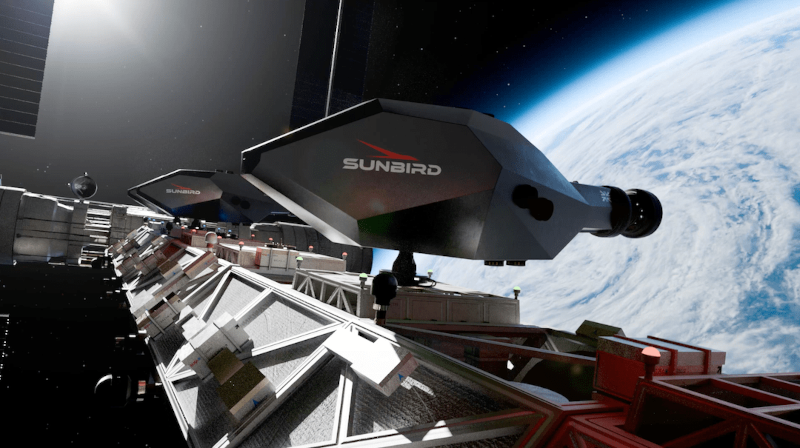
This is the promise behind the Sunbird spacecraft concept, developed by Pulsar Fusion. Sunbird is not designed as a traditional spacecraft, nor even as a standalone mission vehicle. Instead, it is envisioned as a space tug, operating in orbit and attaching to other spacecraft to accelerate them across the Solar System. At its core lies a propulsion system that has long been considered the ultimate prize in aerospace engineering: a nuclear fusion engine.
Fusion is the process that powers the stars. It occurs when light atomic nuclei combine under extreme conditions, releasing vast amounts of energy. Unlike chemical reactions, which rearrange electrons in atoms, fusion rearranges the nuclei themselves, tapping into the fundamental forces that bind matter together. The energy density of fusion is orders of magnitude greater than that of chemical fuels. In principle, it offers the ability to sustain thrust over long durations while achieving velocities far beyond what conventional propulsion can deliver.
Sunbird’s propulsion system is based on what Pulsar Fusion calls a Dual Direct Fusion Drive. The concept is both elegant and demanding. Instead of using fusion merely as a heat source to generate electricity or drive a conventional engine, the system aims to convert fusion energy directly into thrust. In this approach, charged particles produced by fusion reactions are guided and accelerated by magnetic fields, forming an exhaust stream that produces propulsion without the need for traditional propellant expulsion in the chemical sense.
The choice of fuel is critical. Sunbird is designed to use a mixture of deuterium and helium-3, isotopes that offer a pathway toward cleaner fusion reactions. When these nuclei fuse, they produce high-energy charged particles with relatively low neutron output compared to other fusion reactions. This is significant because neutrons, lacking an electric charge, are difficult to control and can damage reactor materials over time. By favoring reactions that produce charged particles, the engine can more effectively channel energy into directed thrust using magnetic confinement.
The engineering challenges behind such a system are immense. Fusion requires extreme conditions—temperatures of millions of degrees and precise control of plasma behavior. On Earth, experimental fusion reactors rely on large, complex facilities such as tokamaks and stellarators to confine plasma using powerful magnetic fields. Translating this technology into a compact, space-based system demands innovation at every level.
Magnetic confinement becomes the central mechanism. Superconducting magnets generate intense magnetic fields that hold the plasma in place, preventing it from contacting the reactor walls. These fields must be stable and precisely controlled, as even small instabilities can lead to energy losses or disruptions. At the same time, the system must allow for the extraction of energy in a controlled manner, directing charged particles out of the reactor to produce thrust.
Thermal management presents another critical challenge. Even with aneutronic fusion reactions, significant heat is generated within the system. In the vacuum of space, there is no atmosphere to carry heat away, so the spacecraft must rely on radiative cooling. Large radiators may be required to dissipate excess heat, adding complexity to the design and influencing the overall architecture of the vehicle.
The concept of Sunbird as a space tug introduces an additional layer of strategic thinking. Rather than equipping every spacecraft with its own fusion engine, Sunbird would operate as an orbital asset. Spacecraft launched from Earth using conventional rockets would rendezvous with the tug in low Earth orbit. Once attached, Sunbird would provide sustained acceleration, gradually increasing velocity over time. This approach leverages the strengths of both chemical and fusion propulsion, combining the high thrust of rockets for launch with the high efficiency of fusion for deep-space travel.
The physics of continuous acceleration opens new possibilities for mission design. Instead of following purely ballistic trajectories, spacecraft could maintain thrust for extended periods, reducing travel times significantly. Missions to Mars, which currently take months, could potentially be shortened. Journeys to the outer planets could become more practical, enabling more ambitious exploration and even the transport of larger payloads.
Yet Sunbird remains, for now, a concept in development. The transition from theoretical design to operational system requires rigorous testing and validation. Plasma behavior must be understood under the specific conditions of the engine. Materials must be developed that can withstand the harsh environment inside the reactor. Control systems must be capable of maintaining stability over long durations. Each of these challenges represents a frontier in its own right.
What makes Sunbird compelling is not just its potential speed, but what that speed represents. It is a step toward a future where the Solar System is not defined by distance in the same way it is today. If fusion propulsion can be made practical, it could transform how we think about space travel, shifting the focus from isolated missions to sustained movement between worlds.
There is a certain symmetry in this vision. The same process that powers the Sun—fusion—becomes the engine that carries humanity outward. The energy that has shaped the cosmos becomes a tool for exploring it. In this sense, Sunbird is not just a spacecraft concept. It is an attempt to harness the most fundamental source of energy in the universe and turn it into motion.
Whether Sunbird ultimately achieves its goals remains to be seen. But the effort itself reflects a broader trend in space exploration: the search for propulsion systems that go beyond the limits of chemistry, reaching into the realm of fundamental physics. It is a reminder that the journey to other worlds is not just about where we go, but about how we get there.
And if that journey is ever powered by fusion, it may mark the moment when the distances between planets begin to feel, at last, a little smaller.


 Subscribe to our RSS feed













There are no comments.
Add A Comment