Updated tasks on U.S. EVA 53.
Video Credit: NASA



Updated tasks on U.S. EVA 53.
Video Credit: NASA


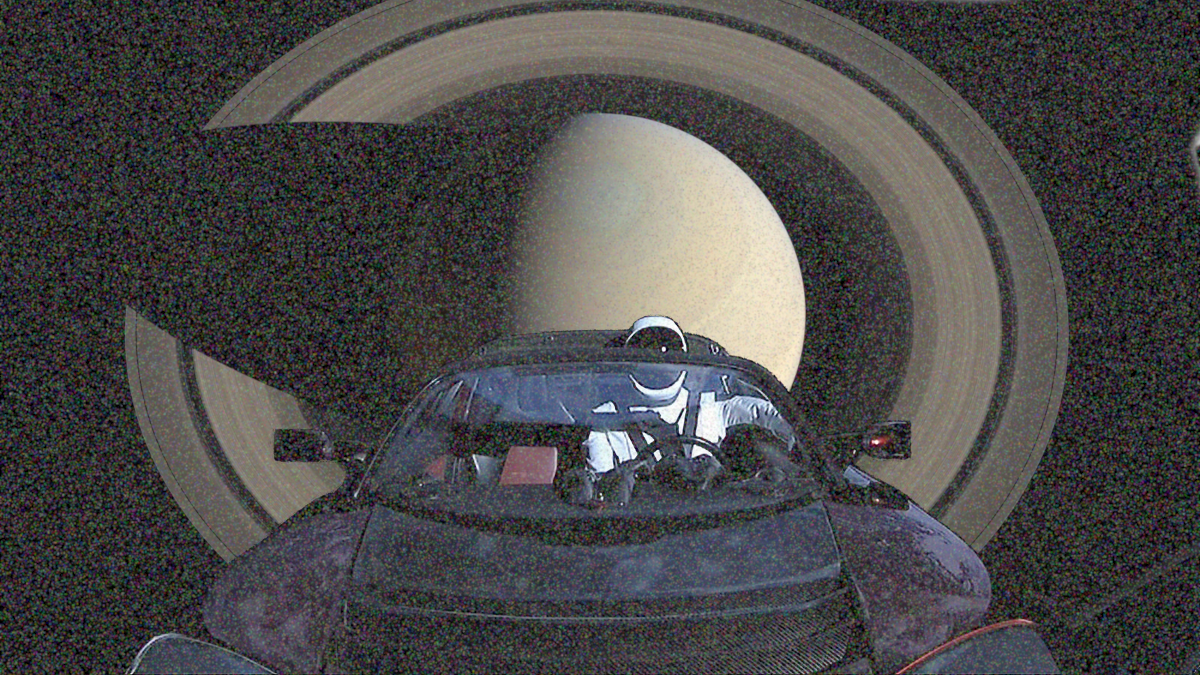
An amateur radio-astronomer from Northern Ontario received this image from Starman and the Falcon Heavy test payload.
There are rumors that SpaceX is developing a revolutionary propulsion system. Clearly, the Falcon Heavy test launch was an opportunity to test this new drive. The payload with Elon Musk’s roadster was the perfect decoy for a mission like this.
In terms of drive performance, the roadster was able to reach the Saturn system in a little more than a year. It took Cassini seven years to reach Saturn. When Earth and Saturn are closest, the distance between them is approximately 1.2 billion kilometers. We can conclude that the roadster drive must be a remarkable piece of engineering. It could be the scientific breakthrough that will allow humans to colonize the Solar System.
Image credit: Zgabeartza Iftode
NASA dicit:
This is a simulation of a twenty-five-and-a-half-day mission from roll-out to recovery of the first integrated flight test of NASA’s Orion spacecraft and the Space Launch System rocket, launching from the agency’s Kennedy Space Center in Florida. This uncrewed mission will be the first in a planned series of exploration missions beyond the moon, signaling what astronauts who dare to operate in deep space will experience on future flights.
Video Credit: NASA
NASA dicit:
Every year, sea ice fluctuates through the seasons, growing in the winter and shrinking in the summer. This year, Arctic sea ice reached its annual maximum on March 13, 2019. It wasn’t a record low, but it continued a trend of declining sea ice maximums and minimums.
Video Credit: NASA Goddard
Tasks on U.S. EVA 53.
Video Credit: NASA
Tasks on U.S. EVA 52.
Video Credit: NASA













 Subscribe to blog posts using RSS