OrbitalHub

The place where space exploration, science, and engineering meet

Domain is for sale. $50,000,000.00 USD. Direct any inquiries to contact@orbitalhub.com.

Archive for 2017

October 17, 2017

Soyuz Progress MS-07 Launch and Docking

Posted by


NASA dixit:

“The unpiloted Russian ISS Progress 68 cargo craft arrived at the International Space Station October 16 on a resupply mission following a two day journey following its launch from the Baikonur Cosmodrome in Kazakhstan. The Progress delivered almost three tons of food, fuel and supplies for the Expedition 53 crew. The Progress automatically linked up to the Pirs Docking Compartment, where it will remain until next March.”

Video credit: NASA / Roscosmos


  • Facebook
  • Google
  • Slashdot
  • Reddit
  • Live
  • TwitThis
October 16, 2017

Daphnis Up Close

Posted by


NASA dixit:

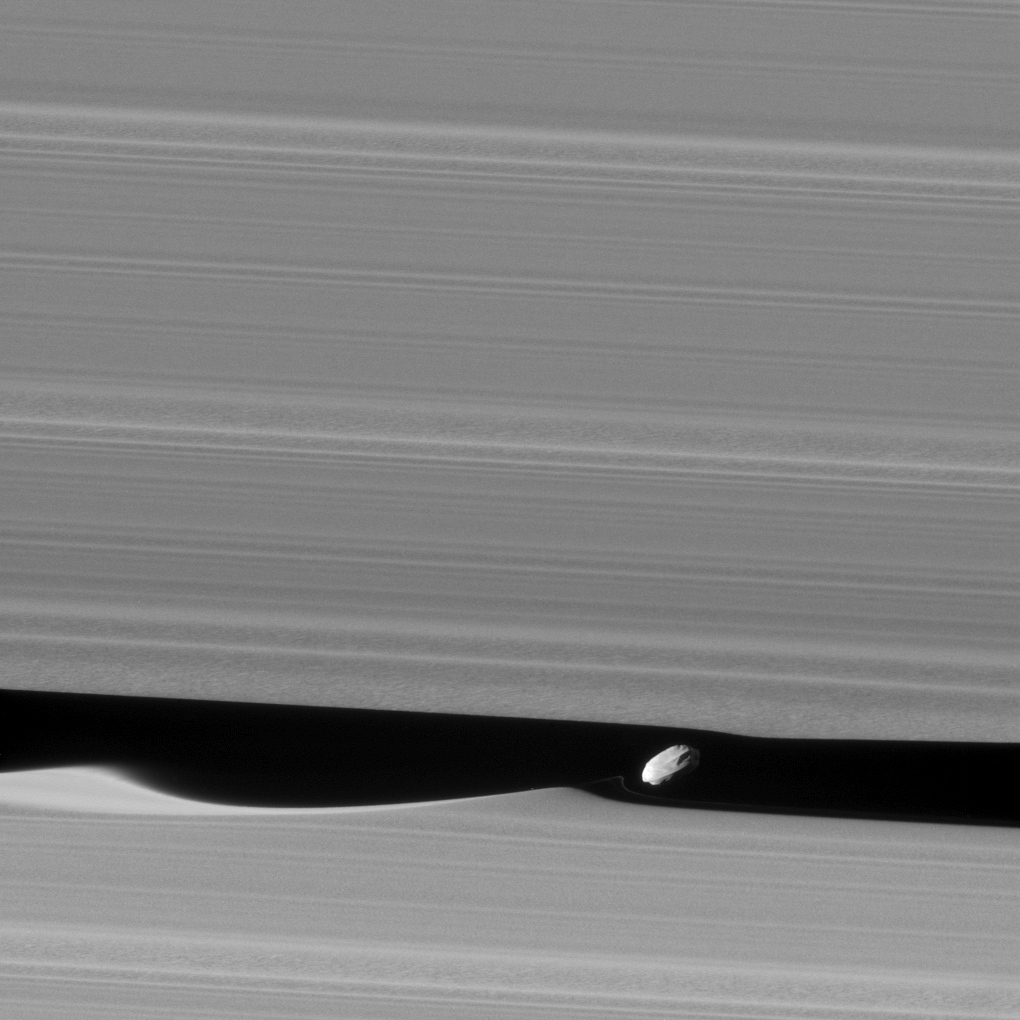
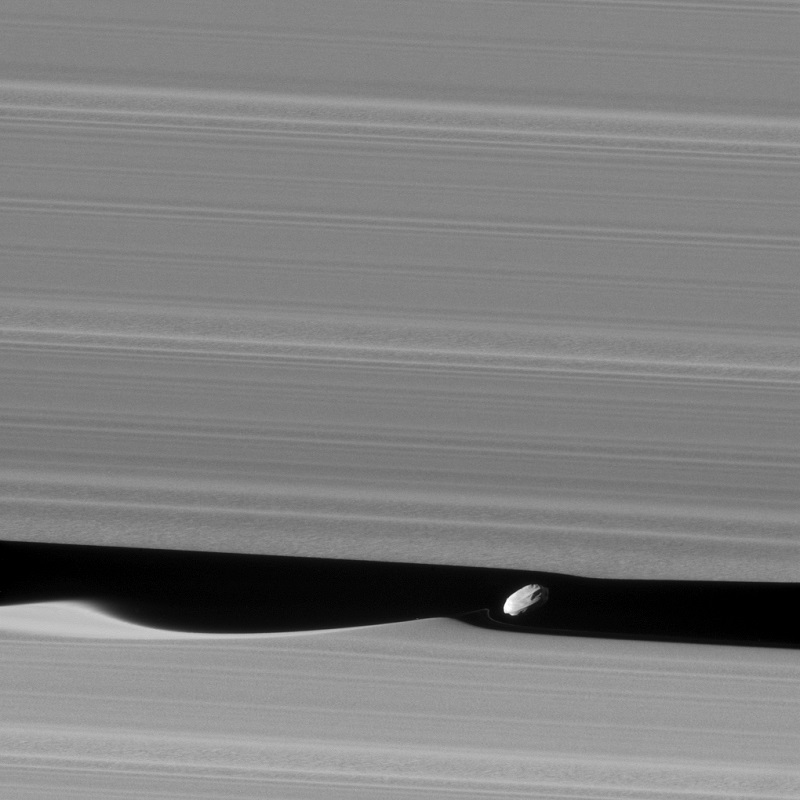
“January 16, 2017. The wavemaker moon, Daphnis, is featured in this view, taken as NASA’s Cassini spacecraft made one of its ring-grazing passes over the outer edges of Saturn’s rings. This is the closest view of the small moon obtained yet. Daphnis (5 miles or 8 kilometers across) orbits within the 42-kilometer (26-mile) wide Keeler Gap. Cassini’s viewing angle causes the gap to appear narrower than it actually is, due to foreshorteneing.

The little moon’s gravity raises waves in the edges of the gap in both the horizontal and vertical directions. Cassini was able to observe the vertical structures in 2009, around the time of Saturn’s equinox. Like a couple of Saturn’s other small ring moons, Atlas and Pan, Daphnis appears to have a narrow ridge around its equator and a fairly smooth mantle of material on its surface — likely an accumulation of fine particles from the rings. A few craters are obvious at this resolution. An additional ridge can be seen further north that runs parallel to the equatorial band.

Fine details in the rings are also on display in this image. In particular, a grainy texture is seen in several wide lanes which hints at structures where particles are clumping together. In comparison to the otherwise sharp edges of the Keeler Gap, the wave peak in the gap edge at left has a softened appearance. This is possibly due to the movement of fine ring particles being spread out into the gap following Daphnis’ last close approach to that edge on a previous orbit. A faint, narrow tendril of ring material follows just behind Daphnis (to its left). This may have resulted from a moment when Daphnis drew a packet of material out of the ring, and now that packet is spreading itself out.

The image was taken in visible (green) light with the Cassini spacecraft narrow-angle camera. The view was acquired at a distance of approximately 17,000 miles (28,000 kilometers) from Daphnis and at a Sun-Daphnis-spacecraft, or phase, angle of 71 degrees. Image scale is 551 feet (168 meters) per pixel.”

Image credit: NASA/JPL-Caltech/Space Science Institute

 

  • Facebook
  • Google
  • Slashdot
  • Reddit
  • Live
  • TwitThis
October 16, 2017

Sentinel-5P Liftoff

Posted by


ESA dixit:

“Replay of the Sentinel-5P liftoff on a Rockot from the Plesetsk Cosmodrome in northern Russia at 09:27 GMT (11:27 CEST) on 13 October 2017.

Sentinel-5P – the ‘P’ standing for ‘Precursor’ – is the first Copernicus mission dedicated to monitoring our atmosphere. The satellite carries the state-of-the-art Tropomi instrument to map a multitude of trace gases such as nitrogen dioxide, ozone, formaldehyde, sulphur dioxide, methane, carbon monoxide and aerosols – all of which affect the air we breathe and therefore our health, and our climate.”

Video credit: ESA


  • Facebook
  • Google
  • Slashdot
  • Reddit
  • Live
  • TwitThis
October 14, 2017

Pandora Up Close

Posted by


NASA dixit:

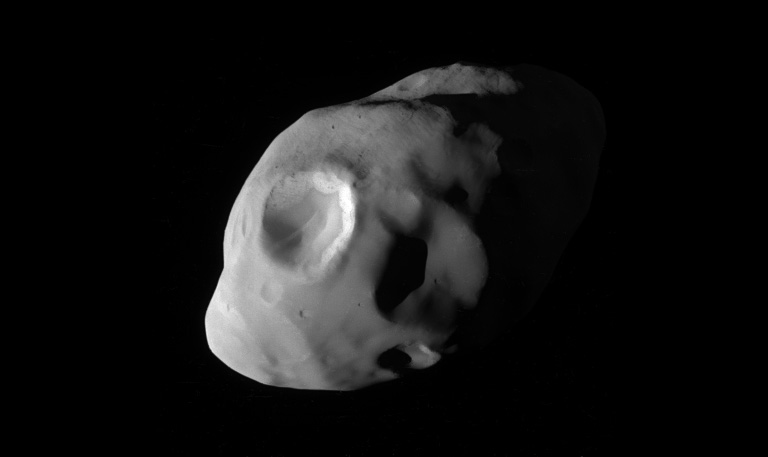
“December 18, 2016. This image from NASA’s Cassini spacecraft is one of the highest-resolution views ever taken of Saturn’s moon Pandora. Pandora (52 miles, 84 kilometers) across orbits Saturn just outside the narrow F ring. The spacecraft captured the image during its closest-ever flyby of Pandora, during the third of its grazing passes by the outer edges of Saturn’s main rings.

The image was taken in green light with the Cassini spacecraft narrow-angle camera at a distance of approximately 25,200 miles (40,500 kilometers) from Pandora. Image scale is 787 feet (240 meters) per pixel.”

Image credit: NASA/JPL-Caltech/Space Science Institute


  • Facebook
  • Google
  • Slashdot
  • Reddit
  • Live
  • TwitThis
October 14, 2017

Atlas V NROL-52 Mission Profile

Posted by


ULA dixit:

“An Atlas V 421 rocket will launch the NROL-52 mission for the National Reconnaissance Office.”

Video credit: ULA


  • Facebook
  • Google
  • Slashdot
  • Reddit
  • Live
  • TwitThis
October 13, 2017

Enceladus

Posted by


NASA dixit:

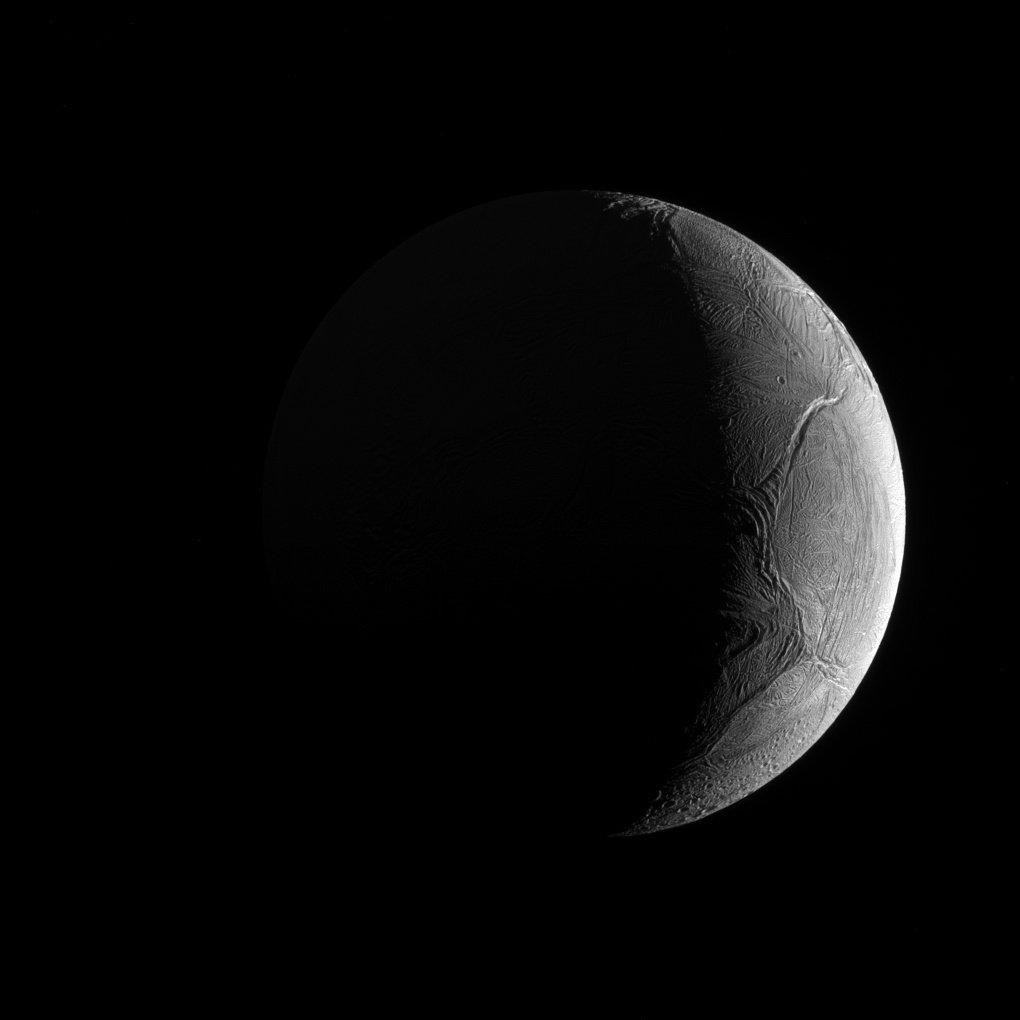
“November 27, 2016. Seen from outside, Enceladus appears to be like most of its sibling moons: cold, icy and inhospitable. But under that forbidding exterior may exist the very conditions needed for life. Over the course of the Cassini mission, observations have shown that Enceladus (313 miles or 504 kilometers across) not only has watery jets sending icy grains into space; under its icy crust it also has a global ocean, and may have hydrothermal activity as well. Since scientists believe liquid water is a key ingredient for life, the implications for future missions searching for life elsewhere in our solar system could be significant.

This view looks toward the Saturn-facing hemisphere of Enceladus. North on Enceladus is up and rotated 6 degrees to the right. The image was taken in green light with the Cassini spacecraft narrow-angle camera. The view was obtained at a distance of approximately 81,000 miles (130,000 kilometers) from Enceladus. Image scale is 2,566 feet (782 meters) per pixel.”

Image credit: NASA/JPL-Caltech/Space Science Institute


  • Facebook
  • Google
  • Slashdot
  • Reddit
  • Live
  • TwitThis