United Launch Alliance Atlas V 551 is the launch vehicle that will place Juno on its trajectory to Jupiter. Atlas V 551 is the most powerful Atlas rocket ever built.



United Launch Alliance Atlas V 551 is the launch vehicle that will place Juno on its trajectory to Jupiter. Atlas V 551 is the most powerful Atlas rocket ever built.


Juno leaves Earth in August 2011. After two years it will swing by Earth and get the boost in velocity required to travel all the way to Jupiter.
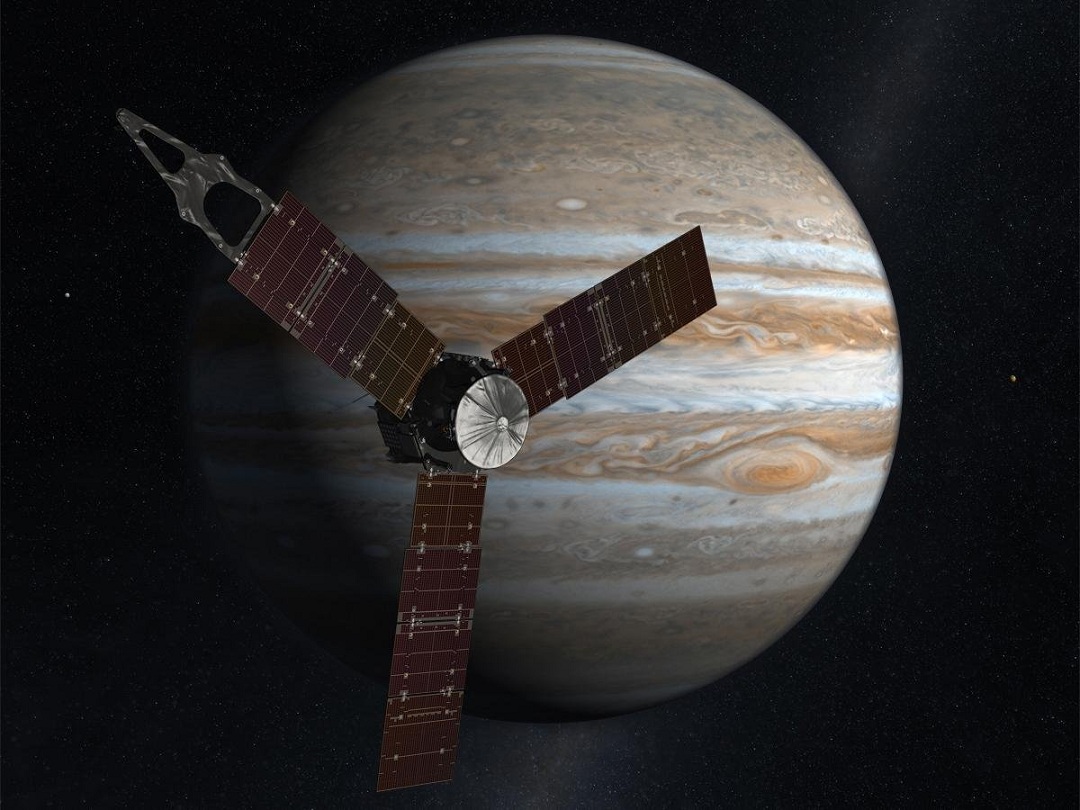
Juno spacecraft is not powered by a RTG, but takes advantage of the advances in the solar power cell technology. Juno is powered by three solar panels that extend more than ten meters from the body of the spacecraft.
 |
| Credits: NASA/JPL |
Juno is a NASA spacecraft scheduled to start its journey to Jupiter in a few days. Juno will help scientists understand the origin and evolution of Jupiter. While the dense cover of clouds helps Jupiter keep its secrets away from Earth observers, Juno will get close enough to Jupiter so that fundamental processes and conditions characteristic to the early solar system will be revealed.
First, Juno will try to determine if Jupiter has a solid planetary core. While this is an important piece of the puzzle, it might also help determine how Jupiter’s magnetic field is generated (by the way, scientists are still unclear how Earth’s magnetic field is generated, and there are several theories trying to explain it). Juno will also map Jupiter’s magnetic field, study the auroras, and determine the amount of water and ammonia in the atmosphere.
The launch vehicle to lift off with Juno is the most powerful Atlas rocket ever built, the United Launch Alliance Atlas V 551. In this configuration, an Atlas V launch vehicle can lift 18,810 kg to Low Earth Orbit (LEO) and 8,900 kg to Geosynchronous Transfer Orbit (GTO). However, the Atlas V 551 is not powerful enough to put Juno on a direct trajectory to Jupiter. In order to get as far as Jupiter’s orbit, Juno has to perform a gravity assist maneuver.
Juno will orbit Jupiter in a polar orbit and get as close as 5,000 km above the planet’s top clouds. This will allow the spacecraft to do science below the radiation belt of the planet and allow for a complete coverage of the planet. The low altitude will allow for a detailed analysis of the planet’s atmosphere. The orbit will also allow Juno to take a very close look at the auroras that are forming at the north and south Jovian poles.
The scientific payload carried by Juno includes a gravity/radio science system, a microwave radiometer, a vector magnetometer, particle detectors, ultraviolet and infrared spectrometers, and a color camera to capture images of the Jovian poles.
One interesting feature of the spacecraft is the electronics vault. Even if Juno’s highly elliptical orbit avoids the deadly radiation belts by approaching the planet at the north pole, skimming the clouds below the radiation belts, and exiting over the south pole, as an additional protection measure the onboard electronics are protected by a radiation shielded vault. This will ensure that the computers will not malfunction due to single events, and that the electronics will meet the requirements for the mission lifespan.
While the previous missions to the Jovian system have been powered by Radio Thermal Generators (RTGs), Juno will benefit from advances in solar power cell design. The cells used for Juno’s solar panels are far more efficient and radiation tolerant than the cells available to space systems engineers decades ago. Three solar panels that extend more than 10 meters from the hexagonal body of the spacecraft will provide the power required by the scientific instruments.
The mission is scheduled for launch on August 5, 2011. After coasting for more than two years, in October 2013, Juno will swing by Earth. The gravity assist maneuver will provide the delta V necessary for the spacecraft to reach Jupiter’s orbit. Juno will arrive at Jupiter in July 2016. After performing the Jupiter Orbital Insertion (JOI) maneuver, the spacecraft will start to collect and send back home scientific data.
Juno will send back science and telemetry data through the Deep Space Network (DSN), a network of powerful antennas located in Madrid, Spain; Barstow, California; and Canberra, Australia.
At the end of the mission, planned for October 2017, and after 33 complete revolutions around Jupiter, Juno will fire up its thrusters and decrease its velocity, enter the upper atmosphere of Jupiter, and get incinerated. Why such a tragic end to the Juno mission? Remember the Prime Directive? While the Prime Directive is known only to Star Trek fans… and it might get serious consideration only from Star Fleet officers, the possibility of having Juno crashing on one of the Jovian satellites (especially Europa) has to be eliminated. NASA scientists take contamination of other worlds very seriously.
You can find out more about the Juno mission on NASA’s dedicated web site. The Juno mission is managed by NASA’s Jet Propulsion Laboratory in Pasadena, California. The Principal Investigator for the Juno mission is Dr. Scott Bolton of Southwest Research Institute in San Antonio, Texas. The spacecraft was designed and built by Lockheed Martin of Denver, Colorado.
 |
| Credits: NASA/JPL/Arizona State University |
You know the frustration you experience when the new hit of your favorite band takes too long to download on your iPhone? Imagine 30 years from now (an optimistic estimate)… you are one of the happy colonists who work around the clock to build one of the first outposts on Mars.
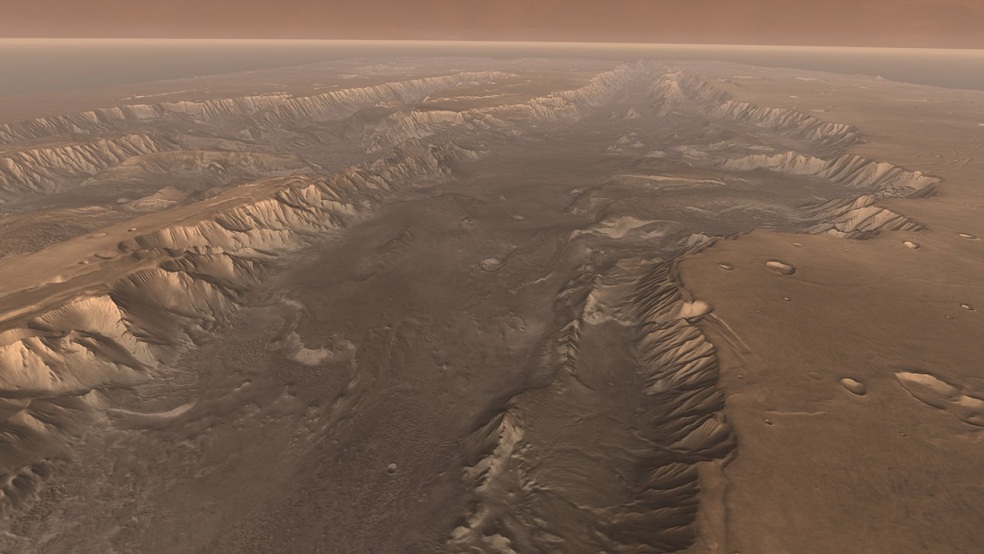
At the end of your shift in the hydroponics, you head back to your luxurious 20mx10m quarters (the shoebox, as your relatives back on Earth like to call it), have a hot shower, and a delicious vegetarian dinner while enjoying the view over the Valles Marineris (the $100 million view, as you like to call it). You receive an email with a link to the new hit of your favorite Earth band, and after clicking on the link in your favorite Internet browser, you download the song in less than one second.
What’s wrong with this scenario? It describes what software engineers would call a wonderful user experience, but something is wrong with this picture… what is it?
One short story might give you a hint. In January 2004, when the two Mars Exploration Rovers, Spirit and Opportunity, landed on Mars, you could watch videos of the scientists in the mission control room at JPL cheering when receiving confirmations of successful landings. The detail that might have escaped you is that those confirmation messages traveled around 20 minutes through interplanetary space before reaching the room at JPL. The scientists were cheering at JPL 20 minutes after the landings happened. If anything went wrong, the bad news would have reached Earth too late to do anything about it. This kind of explains why the engineers that designed and built the rovers had to make sure that the rovers themselves were capable of making some decisions on their own.
To go back to our sci-fi novel attempt in the first paragraph, the little detail that is misplaced in our story is that the time delay is not present. Our colonist clicks on the link to a server which is somewhere on Earth and the download is performed in no time.
For someone who has a basic understanding of protocol stacks (i.e. HTTP/TCP/IP), it is obvious that it would take quite some time to download a file from a server located on Earth to our Mars colony. All of a sudden, the ACK packets have lost their charm.
No reason to worry. Even if Mars outposts are far in the future, time and effort is spent on finding solutions for such communication problems in the present. The challenges seem overwhelming: very long delays, possible communication disruptions, and significant loss due to big bit error rates. A leap is necessary. The present protocols and architecture on which Internet relays have been designed assuming continuous and bi-directional paths, short round-trip times, and small error-rates.
One architecture that promises to solve the problems inherent to our scenario is the Delay Tolerant Networking (DTN) architecture, proposed in RFC 4838. A physical architecture that could solve the problems mentioned above is also proposed by Takashi Iida (Tokyo Metropolitan University), Yoshinori Arimoto (National Institute of Information and Communications Technology), and Yoshiaki Suzuki (NEC Corporation). The architecture would include clusters of communication satellites in orbit around Earth and Mars and relay satellites located at the Lagrangian points L4 and L5 of the Sun-Earth system. The relay satellites would make communication between Earth and Mars possible even when Mars is behind the Sun. Just a smart placement of relay satellites does not do the trick. In order to increase the responsiveness of the network, mirroring of data is also necessary.
You can find more information about space data systems on The Consultative Committee for Space Data Systems website. Other good resources include The InterPlaNetary Internet Project, and The Delay Tolerant Networking Research Group.
Mars Science Laboratory (a.k.a. Curiosity) will land inside the Gale Crater. The Mars explorer is scheduled to launch late this year and land in August 2012. The crater is named for Australian astronomer Walter F. Gale.
Read more about Mars Science Laboratory…













 Subscribe to blog posts using RSS