OrbitalHub

The place where space exploration, science, and engineering meet

Domain is for sale. $50,000,000.00 USD. Direct any inquiries to contact@orbitalhub.com.

Archive for 2010

April 11, 2010

Apollo 13 and UTIAS

Posted by


Credits: NASA


During the Apollo 13 mission, after the explosion of an oxygen tank crippled the Service Module, the astronauts had to abandon the third Moon landing. The Apollo 13 crew used the Lunar Module as a lifeboat. The Lunar Module was jettisoned by the Command Module just prior to re-entry.


A team of engineers from the University of Toronto Institute for Aerospace Studies (UTIAS) played a key role in the separation of the Lunar Module and the Command Module. As the tunnel connecting the two modules was pressurized, the UTIAS team had to determine how much pressure was necessary to safely separate the modules. Not an easy task considering the fact that if there was too much air in the tunnel, the explosion that triggered the separation would have damaged the hatch of the Command Module, and the astronauts would not have survived the re-entry.


The Apollo 13 astronauts, Commander James A. Lovell, Command Module Pilot John L. Swigert, and Lunar Module Pilot Fred W. Haise, were recovered by the U.S.S. Iwo Jima in the South Pacific after splashing down on April 17, 1970.


If you are in Toronto next Tuesday, on April 13, 2010, you can meet some of the members of the UTIAS team at the Canadian Air and Space Museum. They will receive the Pioneer Award for their role in the Apollo 13 rescue.


  • Facebook
  • Google
  • Slashdot
  • Reddit
  • Live
  • TwitThis
April 9, 2010

Cryosat 2 Launch

Posted by


Cryosat 2 launched on April 8, 2010, from the Baikonur Cosmodrome. Cryosat 2 was placed in orbit by a Dnepr launch vehicle. Cryosat has been designed to measure the ice thickness on land and also at sea, and will provide enough data so that a precise rate of change of the ice thickness can be determined.

Read more about Cryosat 2…


  • Facebook
  • Google
  • Slashdot
  • Reddit
  • Live
  • TwitThis
April 7, 2010

STS-131 Space Shuttle Discovery Launch

Posted by


Space Shuttle Discovery lifted off successfully on April 5, 2010, from Kennedy Space Center\’s Launch Pad 39A. The primary payload of the mission is the Multi-Purpose Logistics Module Leonardo, which is filled with food and science supplies for the International Space Station. The STS-131 crew consists of Commander Alan Poindexter, Pilot James Dutton, Mission Specialists Richard Mastracchio, Dorothy M. Metcalf-Lindenburger, Stephanie Wilson, JAXA\’s Naoko Yamazaki, and Clayton Anderson.

Read more about the International Space Station…


  • Facebook
  • Google
  • Slashdot
  • Reddit
  • Live
  • TwitThis
April 2, 2010

Soyuz TMA-18 Launch

Posted by


Soyuz TMA-18 launched from the Baikonur Cosmodrome on April 2, 2010. Three members of the Expedition 23 crew are heading to the International Space Station: Commander Aleksandr Skvortsov, Flight Engineer Mikhail Korniyenko, and Flight Engineer Tracy Caldwell Dyson.

Read more about the International Space Station…


  • Facebook
  • Google
  • Slashdot
  • Reddit
  • Live
  • TwitThis
April 2, 2010

IKAROS

Posted by


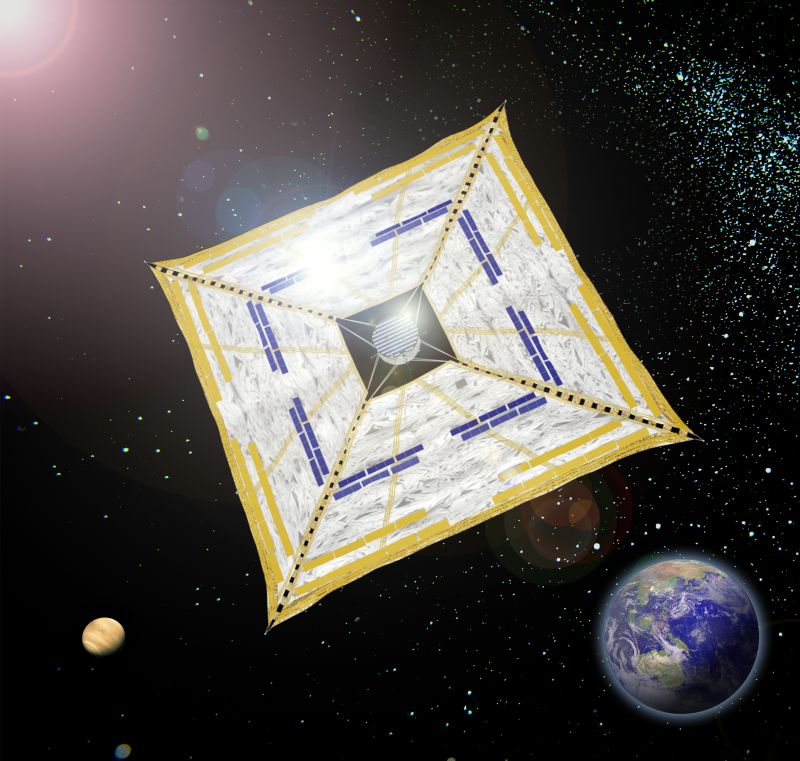
Credits: JAXA


While solar sail projects around the world are starving for funding, in Japan things are different. The Japan Aerospace Exploration Agency (JAXA) is developing a small solar power sail demonstrator, IKAROS (Interplanetary Kite-craft Accelerated by Radiation Of the Sun). IKAROS is equipped with a square sail made of polyimide resin and 0.0075 mm thick. Long-term plans of the agency include a medium-sized solar power sail with a diameter of 50 m and ion-propulsion engines that will explore the Trojan asteroids and Jupiter.


The solar power sail is a slightly different concept than the traditional solar sail. In addition to the solar sail, the solar power sail has a thin film of solar cells deployed on the membrane. The solar cells generate electricity that can be used to power ion-propulsion engines onboard the spacecraft. Fuel-effective mission profiles are made possible by such hybrids.


IKAROS will be launched from the Tanegashima Space Center on top of a H-II launch vehicle. It will share the ride with the Venus Climate Orbiter “AKATSUKIâ€.


JAXA is committed to leading the research and the development of solar sails:
“JAXA will lead future solar system exploration using solar power sails. Our missions will lead to lower cost in the solar cells market, whose growth is a key factor for global warming prevention. Those low-cost solar cells are also the foundation of future solar power satellite systems.â€


Centauri Dreams presents the comments of Osamu Mori, the project leader for the sail mission, on the solar-powered attitude control system of the spacecraft and the deployment method of the sail. You can find more information about IKAROS on JAXA’s web site.


  • Facebook
  • Google
  • Slashdot
  • Reddit
  • Live
  • TwitThis
March 22, 2010

Soyuz TMA-16 Landing

Posted by


The Soyuz TMA-16 spacecraft returned to Earth with only a crew of two: cosmonaut Maksim Surayev and Expedition 22 Commander Jefferey Williams.

Read more about the International Space Station…


  • Facebook
  • Google
  • Slashdot
  • Reddit
  • Live
  • TwitThis