OrbitalHub

The place where space exploration, science, and engineering meet

Domain is for sale. $50,000,000.00 USD. Direct any inquiries to contact@orbitalhub.com.

Archive for 2009

August 13, 2009

Carnival of Space #115

Posted by


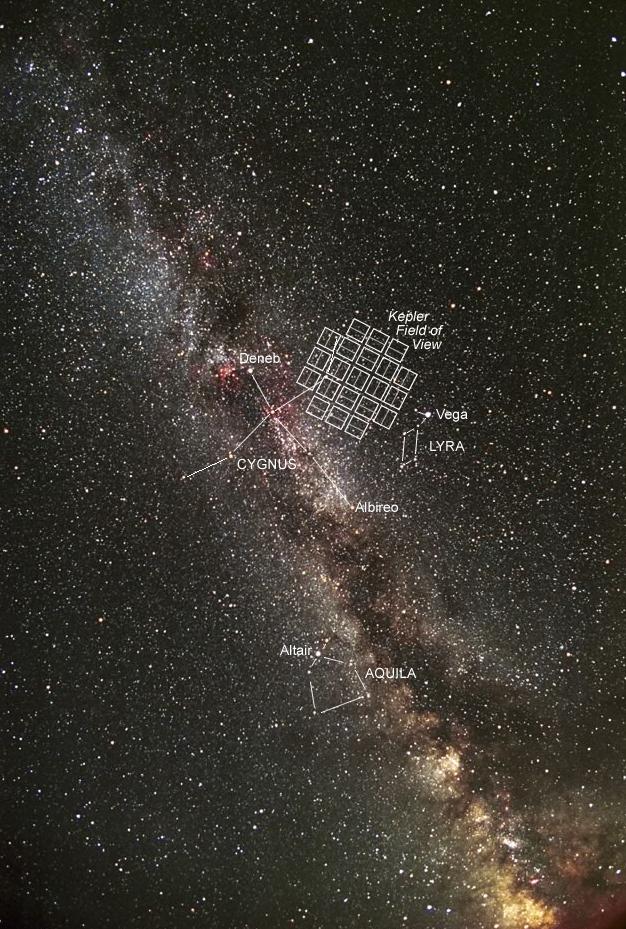
Credits: Carter Roberts/NASA


Carnival of Space #115 is hosted by Mike Davey at New Frontier News.


This week you can read about the calibration and testing of Kepler telescope, the International Astronomical Union meeting and the politics around Pluto, Despina – one of Neptune’s moons, anomalous findings in the Solar System and their uses, photonic propulsion, Mars sample return missions, suborbital missions from Wallops, the annual CubeSat Developer’s Workshop, and much more.


  • Facebook
  • Google
  • Slashdot
  • Reddit
  • Live
  • TwitThis
August 13, 2009

MRO Launch Anniversary

Posted by


The Mars Reconnaissance Orbiter (MRO) was launched on August 12, 2005. MRO reached Martian orbit on March 10, 2006, and, after five months of aerobraking, it entered its final science orbit and began its primary science phase.

Read more about MRO…


  • Facebook
  • Google
  • Slashdot
  • Reddit
  • Live
  • TwitThis
August 10, 2009

The Advanced Re-entry Vehicle

Posted by


One important variation of the typical ATV mission is the Advanced Re-entry Vehicle (ARV). The ARV configuration will consist of a large cargo capsule capable of bringing back on Earth hundreds of kilograms of cargo and valuable experiment results. ARV would be able to dock to the US side of the ISS that has larger docking ports and would make possible the transfer of complete payload racks.

Atmospheric re-entry is not a new challenge for ESA engineers. Past programs – like the Atmospheric Re-entry Demonstrator – and future programs – like the Intermediate Experimental Vehicle (IXV) – will help validate models used for the simulation of the re-entry phase and also provide a solid base in designing materials for the thermal protection system.


  • Facebook
  • Google
  • Slashdot
  • Reddit
  • Live
  • TwitThis
August 5, 2009

Carnival of Space #114

Posted by


Credits: James Gitlin


Carnival of Space #114 is hosted at CHEAP ASTRONOMY.


This week you can read about doomsday scenarios of 2012, solar oscillations in some red giants in NGC 6397, the celebration of the first ten years of discovery by the Chandra Space Telescope, the space elevator games, and much more.


  • Facebook
  • Google
  • Slashdot
  • Reddit
  • Live
  • TwitThis


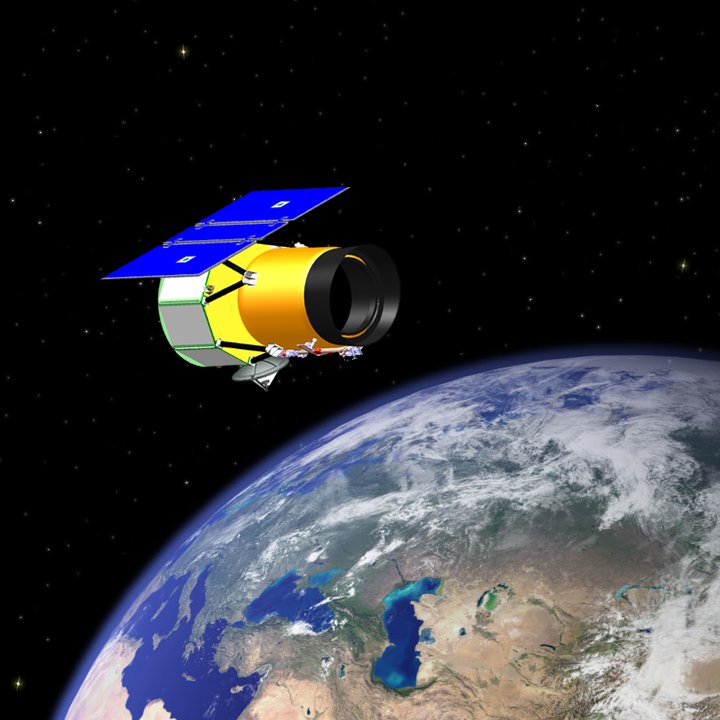
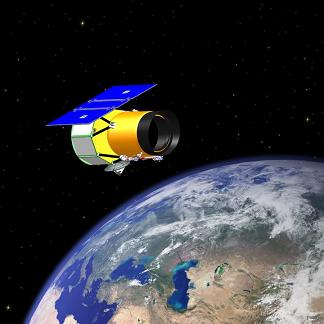
Credits: NASA/JPL


Wide-field Infrared Survey Explorer or WISE is a NASA-funded scientific research project that will provide an all-sky survey in the mid-infrared wavelength range.


WISE will collect data that will allow scientists to compile an all-sky infrared image atlas and catalogue of over 300 million infrared sources. WISE will be able to measure the diameters of more than 100,000 asteroids that glow in the mid-infrared, and make observations of the coldest and nearest stars, regions of new star and planet formation, and the structure of our own galaxy.


WISE will only operate for seven to thirteen months. WISE will explore the entire Universe from a 523×523 km, 97.4-inclined orbit above the ground. The spacecraft will orbit in a Sun-synchronous orbit, so the solar panel will always be pointed at the Sun.


The cryostat will run for thirteen months. After a one-month in-orbit checkout period, the telescope will operate for six months. An additional pass of the sky (that would take another six months) is possible, if funded to do so by NASA.
 

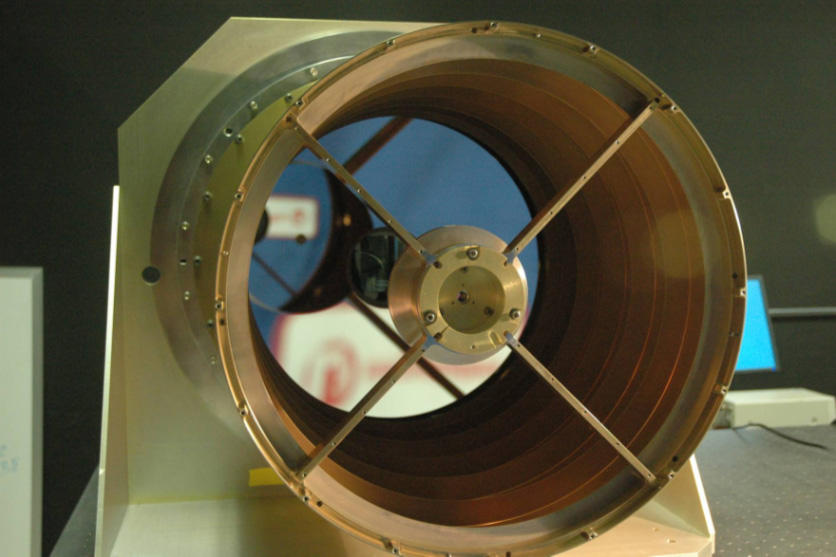
Credits: UCLA/JPL


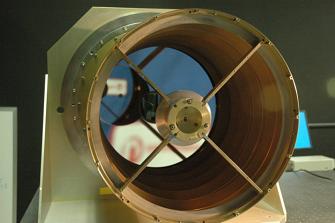
The spacecraft is 2.85 m long, 2.0 m wide, and 1.73 m deep. The spacecraft does not carry propellant. The telescope will make all pointing adjustments using reaction wheels and torque rods. Star trackers, sun sensors, a magnetometer, and gyroscopes will be the sensors used by the attitude control subsystem. The TDRSS (Tracking and Data Relay Satellite System) satellites will relay commands and data with ground stations.


The field of view is 47 arc minutes and it comes from a small telescope diameter (only 40 cm) and large detector arrays. The telescope has four infrared sensitive detector arrays, 1024×1024 pixels each. For the near-infrared bands, there are Mercury-Cadmium-Telluride (MCT) detectors, while for the mid-infrared bands, Arsenic-doped Silicon (Si:As) detectors are used.
 

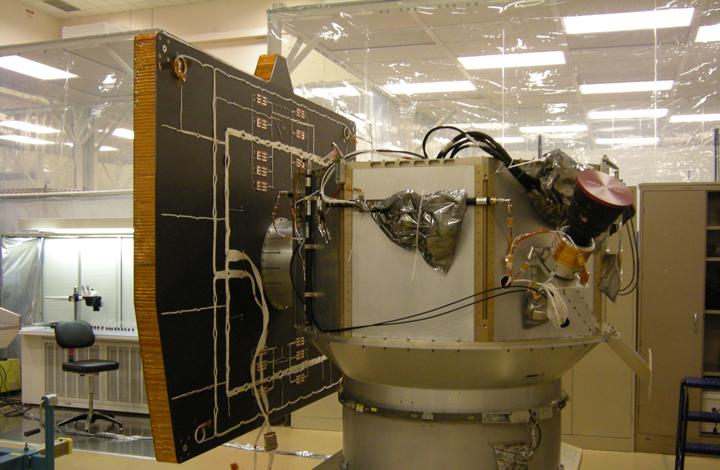
Credits: UCLA/JPL


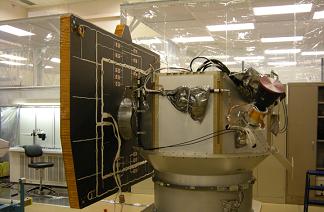
The optics instruments have to be cooled to very low temperatures in order to lower noise detection. The MCT detectors operate at 32 K, while the Si:As detectors will be cooled to less than 8 K.


The WISE launch is scheduled for November 2009. WISE will launch aboard a Delta II launch vehicle from Vandenberg Air Force Base, in California.


The WISE team consists of UCLA (University of California at Los Angeles), JPL (Jet Propulsion Laboratory), SDL (Space Dynamics Labs in Utah), BATC (Ball Aerospace & Technology Corporation), IPAC (Infrared Processing and Analysis Center), and UCB (University of California at Berkeley).


For more information about the WISE mission, you can visit the WISE mission homepage at the Space Science Laboratory, University of California, Berkeley, website.

 

  • Facebook
  • Google
  • Slashdot
  • Reddit
  • Live
  • TwitThis
August 5, 2009

Dniepr Launch

Posted by


On July 29, 2009, a Russian Dniepr launch vehicle placed in orbit six small satellites. The satellites weigh from 12 kg to 200 kg. Three of the six satellites are European: Deimos-1 and UK-DMC2 built by SSTL, and NanoSat-1B, which is a Spanish experimental satellite. The Dniepr launch vehicle is based on the SS-18 ballistic missile.


  • Facebook
  • Google
  • Slashdot
  • Reddit
  • Live
  • TwitThis