OrbitalHub

The place where space exploration, science, and engineering meet

Domain is for sale. $50,000,000.00 USD. Direct any inquiries to contact@orbitalhub.com.

Archive for the Launchers category


Credits: NASA


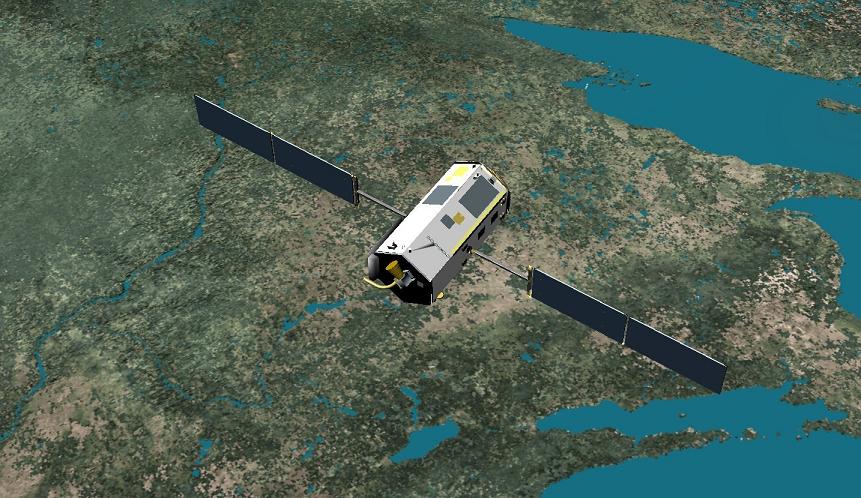
Last week we presented GOSAT a.k.a. Ibuki, a mission that has as its objective the mapping of carbon dioxide and methane in the Earth’s atmosphere. A similar mission is getting ready to launch on the other side of the Pacific: the Orbiting Carbon Observatory (OCO). OCO is a NASA Earth System Science Pathfinder (ESSP) Program mission.


The mission team includes the Orbital Sciences Corporation, the Jet Propulsion Laboratory, and Hamilton Sundstrand Sensor Systems.


The atmospheric carbon dioxide (CO2) is an important greenhouse gas. CO2 absorbs and traps infrared radiation emitted by the Earth’s surface, preventing it from escaping to space. OCO will provide global CO2 measurements from space. The data collected during the mission will help scientists understand the global carbon cycle. This understanding is essential to improve the predictions of future atmospheric CO2 increases and its impact on the climate.


The OCO has a mass of 407 kg. The two GaAs solar arrays will provide 324 W orbit average for the scientific payload onboard. The satellite will use hydrazine thrusters for stabilization while on orbit. The estimated life span for the mission is 24 months.


The scientific payload includes three spectrometers. The spectrometers can detect what gases are in the Earth’s atmosphere and determine their amounts. The measurements will translate into monthly estimates of atmospheric CO2 over 621-square-mile regions of the Earth’s surface. From its sun-synchronous orbit, OCO will map the globe once every sixteen days. These maps will help locate CO2 sources and sinks.


Credits: NASA / Orbital


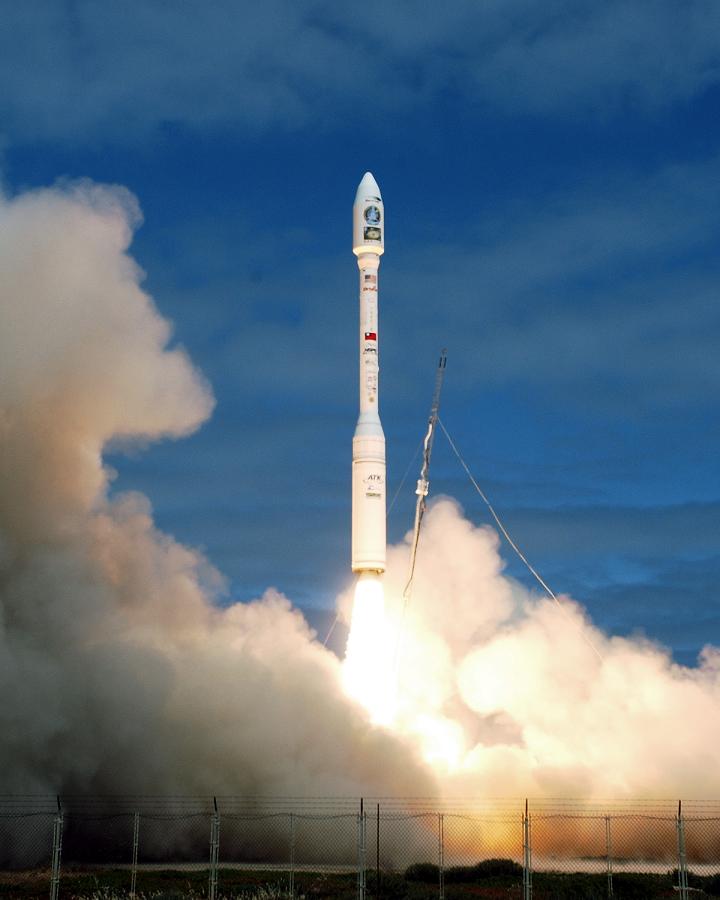
OCO will be placed on orbit by a Taurus XL launch vehicle. Taurus XL is a solid fuel launch vehicle built by the Orbital Sciences Corporation. According to the Taurus fact sheet, it provides launch capability for satellites weighing up to 1,590 kg. The range of launch missions supported by Taurus include low inclination low Earth orbit (LEO), polar LEO, sun-synchronous LEO, geo-transfer orbit, and interplanetary trajectory.


Depending on the configuration, Taurus can have a mass from 69,000 to 77,000 kg and can have a length from 27 to 32 m.


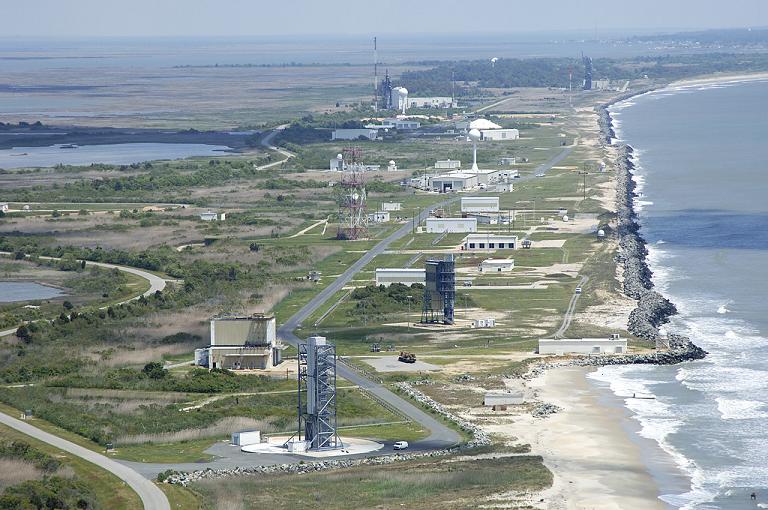
The mission launch is scheduled for early 2009. The Taurus XL launch vehicle will lift off from Vandenberg Air Force Base, California.


  • Facebook
  • Google
  • Slashdot
  • Reddit
  • Live
  • TwitThis
November 27, 2008

The Orion Module Launch Abort System

Posted by


Credits: NASA


One of the crucial requirements for a man-rated launch system is a reliable Launch Abort System (LAS). LAS is basically a top-mounted rocket connected to a crew module and it is used to separate the crew module from the rest of the launch vehicle in case of emergency.


An emergency can be anything from an explosion of the launch vehicle on the launch pad to a failed separation of the lower stage during flight.


In the case of the Orion Module, several designs were considered for the LAS: the Multiple External Service Module Abort Motor concept, the Crew Module Strap On Motors concept, and the In-Line Tandem Tractor (Tower) concept. The latter concept was incorporated in the Ares I/Orion design.


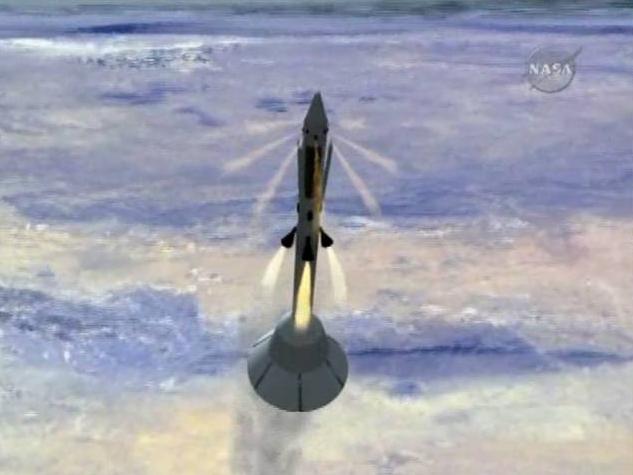
The Tandem Tractor (Tower) design of the LAS has three motors: an Attitude Control Motor (eight nozzles), a Jettison Motor (four aft nozzles), and the Abort Motor (four exposed flow nozzles). These motors will make possible the separation of the module and the control of the flight after the separation from the launch vehicle. An important component of the LAS is the Boost Protective Cover (BPC), which protects the crew module from the exhaust of the motors.


Credits: NASA


The LAS is designed to perform on the launch pad as well as during the first 300,000 feet after the launch. There are three possible scenarios for the abort procedure: on the launch pad, on the mid-altitude flight segment (up to an altitude of 150,000 feet), and on the high-altitude flight segment (from 150,000 feet to 300,000 feet, where the LAS is jettisoned on a nominal flight). Tests will have to be performed to cover these scenarios: on the launch pad as well in flight.


NASA has made available animations of the test flights planned for the LAS. One is the animation of the Orion Module LAS pad abort flight test. The second presents the Orion Module LAS ascent abort flight test.


Credits: NASA


Currently, the Launch Abort System of the Orion Module is under development.


The first full-scale test fire of the motor that powers the LAS was completed on November 20, 2008. This was the first time a LAS test has been conducted since the 1960s, when the LAS for the Apollo Program was tested.


  • Facebook
  • Google
  • Slashdot
  • Reddit
  • Live
  • TwitThis


Credits: SpaceX


The nine Merlin engines that power the first stage of the Falcon 9 launcher have been successfully tested. At the McGregor Test Facility in Texas, a full mission-length firing test of the first stage of the launcher was conducted on November 22, 2008. The engines, fired for 178 seconds, consumed over half a million pounds of propellant.


During the last eighteen seconds of the test, two of the engines were shut down in order to test the ability of the first stage to complete a mission in the event of an engine being lost during flight.


According to SpaceX CEO, Elon Musk, the first liftoff of a Falcon 9 launcher from Cape Canaveral will occur in 2009.


Falcon 9 is a two-stage launch vehicle. It is powered by liquid oxygen and rocket grade kerosene. Nine Merlin engines power the first stage of the launcher. The second stage of the Falcon 9 launcher is powered by one Merlin engine.


Falcon 9 has a length of 54.9 m, a diameter of 3.6 m, and can have a mass of 333,400 kg for a low Earth orbit (LEO) mission, and 332,800 kg for a geosynchronous transfer orbit (GTO) mission. It can inject 12,500 kg payloads into LEO (200 km) and 4,640 kg payloads into GTO (185×35,788 km). SpaceX will charge $36.75M for a LEO mission, and $46.75M for a trans-lunar injection (TLI) mission. For GTO missions, the price ranges from $36.75M to $57.75M.


For more details about the Falcon 9 launcher, you can visit the Falcon 9 overview web page on the SpaceX web site.


Check out the video with the 3 minute test of the Merlin engines on the SpaceX web site.


  • Facebook
  • Google
  • Slashdot
  • Reddit
  • Live
  • TwitThis


Credits: ESA – S. Corvaja 2007


CNES and ESA signed the development contract to build the launch facilities for Soyuz at the Guiana Space Centre on July 19, 2005. The Soyuz launcher will give Europe medium-lift capability and will complete the range of launchers operated by Arianespace, which includes the Ariane 5 heavy-lift launcher and the Vega small launcher.


The Soyuz launchers that will liftoff from Kourou have a number of improvements: an updated digital flight control system, an increased-performance third stage, and the larger Soyuz ST payload fairing.


The launcher has a length of 46.2 meters, a diameter of 10.3 meters, and a liftoff mass of 308 tons. Due to the position of the launch site, close to the equator, the payload capacity of the launcher has increased significantly: 3,150 kg to a geostationary orbit, and 4,900 kg to a sun-synchronous orbit, with a circular altitude of 820 km.


Soyuz is a reliable, four-stage launch vehicle, which has been in production since 1957 and has accounted for more than 1,700 missions to date.


The first stage is composed of the four boosters that are assembled around the central core of the launcher. The RD-107A engines installed on the boosters use liquid oxygen and kerosene as propellant combination. Each engine has four combustion chambers and four nozzles. One aerofin and two movable vernier thrusters per engine are used for the three-axis flight control.


Credits: ESA – S. Corvaja 2008


The second stage consists of the central core surrounded by the boosters. It uses the same propellant combination for powering the RD-108A engine with four combustion chambers and nozzles.


Four vernier thrusters are used for three-axis flight control, after the boosters of the first stage are jettisoned during flight.


The engines of the first two stages are ignited 20 seconds before liftoff. The reason for this is that the launch procedures include monitoring the engine health parameters just before liftoff, while the engines are operating at an intermediate level of thrust. This reminds me of the SpaceX Falcon 1 booster launch procedures. SpaceX engineers perform a similar monitoring procedure for the Merlin engine just before the Falcon 1 liftoff.


The third stage utilizes a RD-0124 engine, also powered by liquid oxygen and kerosene. The liquid oxygen and kerosene tanks are pressurized using helium stored in vessels located in the liquid oxygen tank. The avionics module of the launcher is carried by this stage. The new flight control system improves the accuracy and the control capability for the launcher, as additional flight control authority is needed for the enlarged payload fairing.


Credits: ESA – S. Corvaja 2008


The upper stage of the Soyuz launcher is called Fregat. Fregat is an autonomous and flexible upper stage with its own guidance, navigation, control, tracking, and telemetry systems. It was designed to operate as an orbital vehicle, and it extends the launch capabilities of the Soyuz launcher to medium-Earth orbits, Sun-synchronous orbits, geostationary transfer orbits, and Earth escape trajectories.


The Fregat stage can be restarted up to 20 times in flight, it can provide three-axis stabilization, and perform a spin-up of the spacecraft payload. Fregat uses a bi-propellant propulsion system: UDMH (unsymmetrical dimethylhydrazine) and NTO (nitrogen tetroxide).


The payload fairing is the most visible change to the Soyuz launcher. The new Soyuz fairing has a diameter of 4.11 meters and a length of 11.4 meters. The fairing is based on the configuration used for Ariane 4 vehicles.


The construction of the Soyuz launch base in French Guiana started in early 2007. At the groundbreaking ceremony on February 26, 2007, a number of European space industry officials were present: Jean-Jacques Dordain – ESA Director General, Yannick d’Escatha – President of CNES, Jean-Yves Le Gall – Director General of Arianespace, and Anatoly Perminov – Head of Roscosmos.


In 2007, Arianespace ordered four Soyuz launchers for the early launch missions that are scheduled for the second half of 2009. A contract was also signed in September 2008 for 10 more Soyuz launch vehicles.


The Soyuz launch missions that are scheduled for 2009 signal the beginning of a new chapter in ESA-Russian relations. Stay tuned for more information about the Soyuz launches from French Guiana!


  • Facebook
  • Google
  • Slashdot
  • Reddit
  • Live
  • TwitThis


Credits: ESA – J. Huart


The small-payload market is rapidly expanding. Institutional programs (mostly Earth observation and scientific missions) drive this emerging market. In order to meet the demands of the small-payload market, ESA has transformed the small launcher program initiated by the Italian Space Agency (ASI) in the 1990s into Vega, a co-operative project with other Member States within the ESA framework.


The small-payload market consists of satellites up to 3,000 kg and it stands at around five missions per year. There are many classifications for the satellites in this market, so we will present just one classification for informational purposes. The satellites in this class are divided into three categories: micro-satellites (up to 300 kg), mini-satellites (from 300 kg to 1,000 kg), and small satellites (from 1,000 kg to 3,000 kg).


The orbits required for the deployment of these satellites are mainly Sun Synchronous Orbits (SSO) and Low Earth Orbits (LEO). Vega’s in-orbit launch capability benchmark is 1,500 kg into a 700 km altitude polar orbit. Being designed to cope with a wide range of missions, Vega will address the various market requirements for this class of satellites.


Credits: ESA


Vega is a single-body launcher composed of four stages. The first three stages are solid propellant stages, while the fourth stage has a liquid propellant engine. Vega is 30 meters high, has a maximum diameter of three meters and a total of 137 tons at lift-off.


There are three main sections: the Lower Composite, the Restartable Upper Module and the Payload Composite.


The Lower Composite section consists of the first three stages (the solid propellant stages). The first stage is equipped with a P80-FW motor containing 88 tons of propellant. The second stage contains a Zefiro 23 motor with 23 tons of propellant. The third stage consists of a Zefiro 9 motor with 10 tons of propellant and the stage-interfacing structures.


The technology for the three solid-propellant stages (P80, Z23, Z9) is derived from the Zefiro 16 rocket motor. These motors benefit from the experience acquired by Europe in the field of solid propulsion. Each motor is composed of a thermal-insulated carbon-epoxy monolithic case, the solid propellant HTPB 1912, a nozzle, a thrust vector control system driven by two electro-actuators that operate the movable nozzle, and a control unit that provides pitch and yaw control during the flight. Each stage also includes an ignition subsystem, a safety subsystem, and the interfaces to the other stages.


Credits: ESA/CNES-SOV


The P80 engine was designed for the Vega small launcher, and it helps validate technologies applicable to a new generation of solid boosters for the Ariane 5 launch vehicle. This new design was driven by the goal of minimizing recurring costs, a significant reduction being made with respect to the current metal case boosters.


The Restartable Upper Module is the fourth stage of the launcher. It is also known as the Altitude and Vernier Upper Module (AVUM). The AVUM consists of two modules: the AVUM Propulsion Module and the AVUM Avionics Module.


The propulsion system uses NTO (Nitrogen Tetroxide) and UDMH (Unsymmetrical dimethyl hydrazine) as propellants. The propellants are stored in two identical titanium tanks pressurized by helium. Depending on the mission, the propellant load can be between 250 kg and 500 kg.


The avionics system is largely adapted from existing hardware and/or components already under development (namely subsystems already in use by the Ariane 5 launch vehicle).


The Payload Composite section is composed of the fairing and the payload/launcher interface structure. The fairing is composed of two shells that are jettisoned during flight after the separation of the second stage. The payload/launcher interface is an Adaptor 937, which is a standard interface used on the European launchers. Additional payload adapters can be added for multi-payload missions.


Credits: ESA – J. Huart


The dedicated Ground Segment for the Vega launcher comprises of the Launch Zone (ZLV – Zone de Lancement Vega) and the Operational Control Center, all located at the European Spaceport at Kourou, in French Guiana. ESA also built a Payload Preparation Complex that will be used for satellite and equipment unpacking, mechanical inspections, the checkout of the payloads, and the final integration of the payload composite before mounting it on top of the launcher.


On October 24, 2008, the Zefiro 9 rocket engine passed the first qualification test. There is one additional firing test left for the engine. The Vega launcher’s qualification flight is scheduled to take place by the end of 2009.


Credits: Avio SpA (Italy)


ESA is responsible for the qualification of the launch service and also for sustaining the qualification status during the exploitation phase. Ariane Space will be responsible for Vega’s commercialization and launch operations. The expected launch rate for Vega will be up to four launches per year.


Please stay tuned on the OrbitalHub frequency. We will keep you posted!


  • Facebook
  • Google
  • Slashdot
  • Reddit
  • Live
  • TwitThis
September 29, 2008

Falcon 1 Takes Flight

Posted by


After six years of tremendous effort and more than $100 million USD spent, SpaceX made a successful launch of Falcon 1. Falcon 1 is the first booster built by a private company to ever reach the Earth’s orbit. This is the fourth Falcon 1 mission.


Credits: SpaceX


The booster lifted off yesterday from the testing site on Omelek Island in the Kwajalein Atoll located in the central Pacific some 2,500 miles southwest of Hawaii.


The previous three missions were not successful, but SpaceX managed to remove all the stumbling blocks out of the way. In less than two months from the previous attempt, on August 2nd 2008, SpaceX had another booster ready for launch.


The payload carried by the Flight 4 mission is a mass simulator that weighs around 165 kg. The payload did not separate but remained attached to the second stage as it orbits the Earth.


Falcon 1 is a two-stage booster. It uses liquid oxygen and rocket grade kerosene as fuel. The booster is 21.3 meters long and 1.7 meters in diameter. It weighs 27, 670 kg when ready to launch. The first stage of the booster is powered by a Merlin 1C engine and the upper stage is powered by a Kestrel engine.


The Merlin 1C engine is a turbo pump fed engine, while the smaller Kestrel engine uses tank pressure to inject the fuel into its combustion chamber. In order to simplify the design, the Merlin engine uses the high-pressure kerosene to cool the combustion chamber and the nozzle. In addition, the engine uses the high-pressure kerosene for the hydraulic actuators, thereby eliminating the need for a separate hydraulic power system.


Credits: SpaceX


Falcon 1 is the first in a family of launch vehicles that SpaceX will build and operate. NASA awarded Commercial Orbital Transportation Services (COTS) funding to SpaceX to demonstrate delivery and return of cargo and potentially a human crew to the International Space Station (ISS). In order to achieve these goals, SpaceX is developing a bigger booster, Falcon 9, and a cargo and crew capsule, Dragon.


SpaceX holds a unique position in the launch vehicle market, being able to take over the delivery of supplies and human crews to the ISS, after the Space Shuttle’s retirement in 2010. For more information about SpaceX and its fleet of launch vehicles, check out their website.


  • Facebook
  • Google
  • Slashdot
  • Reddit
  • Live
  • TwitThis