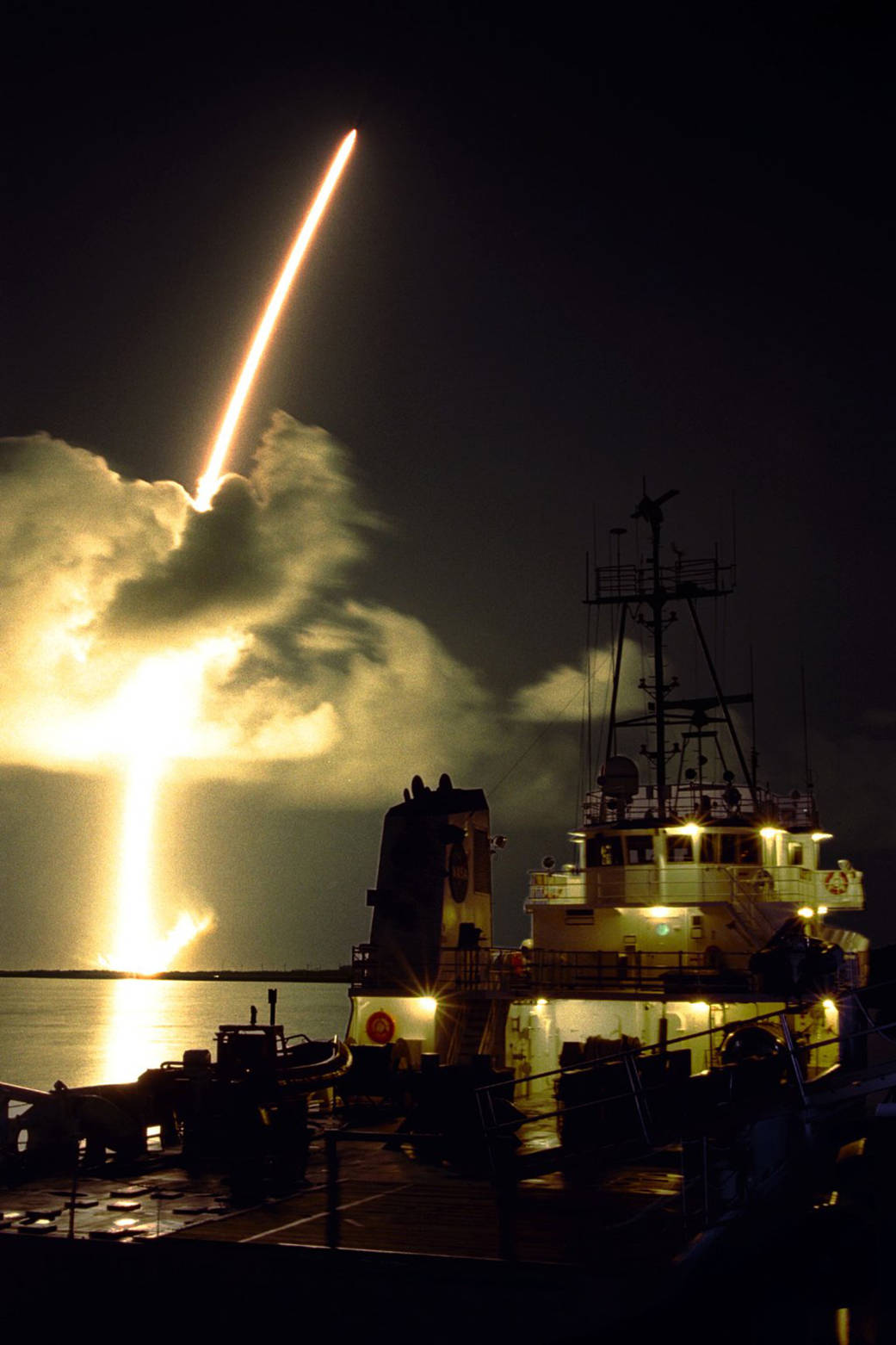
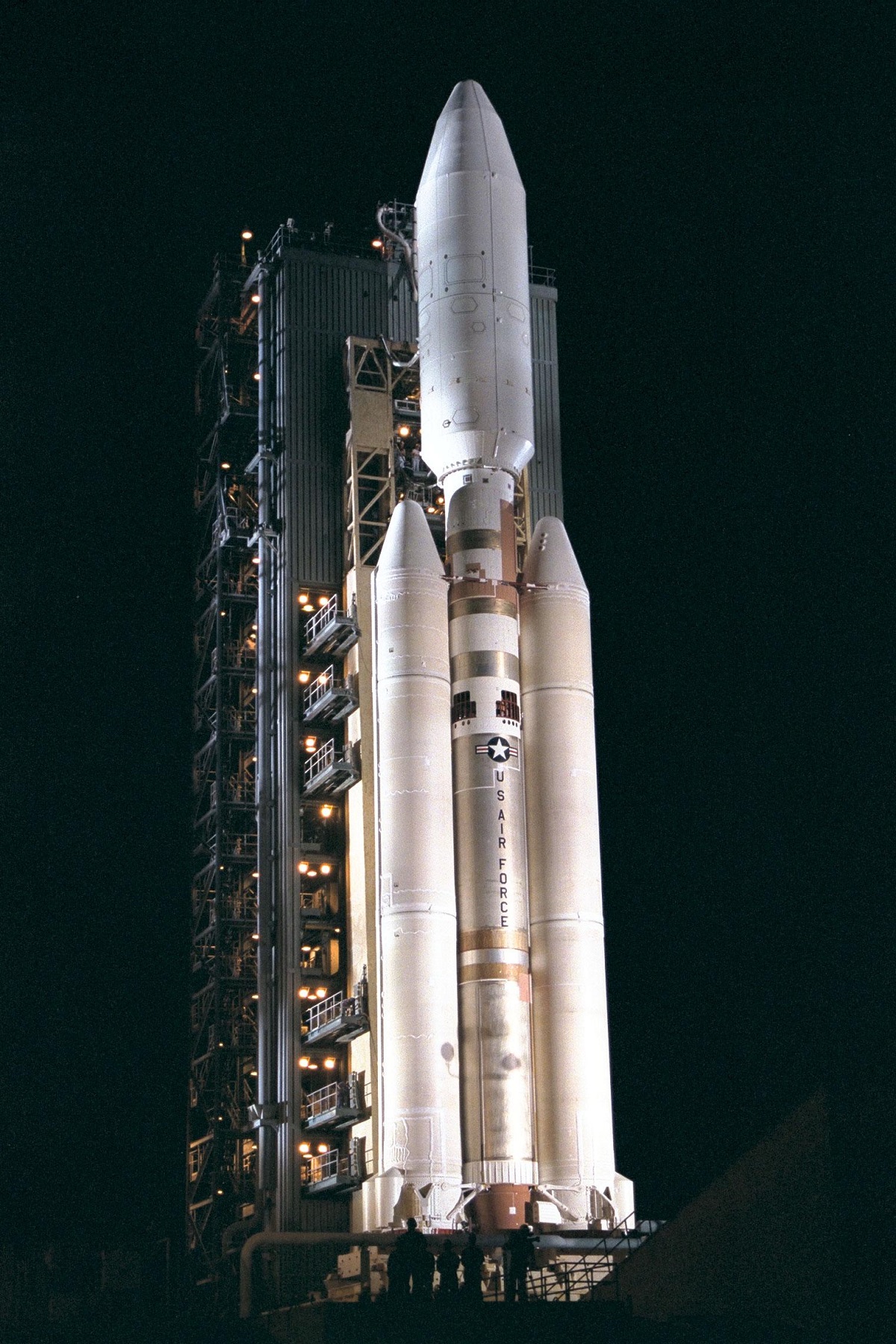
“October 12, 1997. Launch Complex 40: The second Titan IVB/Centaur (Model 401), with Cassini/Huygens on board. At Launch Complex 40 on Cape Canaveral Air Station, the Mobile Service Tower has been retracted away from the Titan IVB/Centaur carrying the Cassini spacecraft, marking a major milestone in the launch countdown sequence. Retraction of the structure began about an hour later than scheduled due to minor problems with ground support equipment. The launch vehicle, Cassini spacecraft and attached Centaur stage encased in a payload fairing, altogether stand about 183 feet tall; mounted at the base of the launch vehicle are two upgraded solid rocket motors. Liftoff of Cassini on the journey to Saturn and its moon Titan is slated to occur during a window opening at 4:55 a.m. EDT, Oct. 13, and extending through 7:15 a.m.”
“After almost 20 years in space, NASA’s Cassini spacecraft begins the final chapter of its remarkable story of exploration: its Grand Finale. Between April and September 2017, Cassini will undertake a daring set of orbits that is, in many ways, like a whole new mission. Following a final close flyby of Saturn’s moon Titan, Cassini will leap over the planet’s icy rings and begin a series of 22 weekly dives between the planet and the rings.
No other mission has ever explored this unique region. What we learn from these final orbits will help to improve our understanding of how giant planets – and planetary systems everywhere – form and evolve.
On the final orbit, Cassini will plunge into Saturn’s atmosphere, sending back new and unique science to the very end. After losing contact with Earth, the spacecraft will burn up like a meteor, becoming part of the planet itself.
Cassini’s Grand Finale is about so much more than the spacecraft’s final dive into Saturn. That dramatic event is the capstone of six months of daring exploration and scientific discovery. (And those six months are the thrilling final chapter in a historic 20-year journey.)”
“After launching earlier in the day in their Soyuz MS-04 spacecraft from the Baikonur Cosmodrome in Kazakhstan, Expedition 51-52 Soyuz Commander Fyodor Yurchikhin of Roscosmos and Flight Engineer Jack Fischer of NASA arrived at the International Space Station April 20 to complete a six-hour journey, docking their vehicle to the Poisk module on the Russian segment of the complex.”
“The H3 Launch Vehicle is a large-size next-generation launch vehicle whose maiden flight is scheduled in Japan Fiscal Year 2020 from the Tanegashima Space Center. H3 is under development to be a successor to the H-IIA Launch Vehicle, the current mainstay launch vehicle, in order to maintain Japan’s autonomous access to space.
Recently, many satellites that are closely related to our lives have been transported to space, thus utilizing space has become part of our daily lives. Under such a progressive society, H3 is aiming to become a launch vehicle that attracts people’s attention not only in Japan but also globally as an easy-to-use space transportation system.
For H3 to succeed, JAXA will modernize the overall launch vehicle based on our experience cultivated through the development and operation of H-IIA. In that sense, we face technological challenges including the development of a new large liquid engine (LE-9) and solid rocket boosters (SRB-3). Technologies developed for H3 will be applied to the Epsilon Launch Vehicle.
JAXA and related companies will make active use of Japanese technologies in various fields to develop the new launch vehicle.”
“The Wideband Global SATCOM system (WGS) is a high capacity satellite communications system planned for use in partnership by the United States Department of Defense (DoD) and the Australian Department of Defence. The system is composed of the Space Segment satellites, the Terminal Segment users and the Control Segment operators.
DoD wideband satellite communication services are currently provided by a combination of the existing Defense Satellite Communications System (DSCS) and Global Broadcast Service (GBS) satellites. According to United Launch Alliance, quoted on Spaceflight Now, “A single WGS spacecraft has as much bandwidth as the entire existing DSCS constellation.”
The constellation of WGS satellites increases the communications capabilities of the militaries of the United States, Canada, and Australia by providing additional bandwidth and communications capabilities for tactical command and control, communications, and computers; intelligence, surveillance, and reconnaissance (C4ISR); battle management; and combat support information. Canada has also signed on to become a partner.
WGS also augments the current Ka-band Global Broadcast Service (on UHF F/O satellites) by providing additional information broadcast capabilities as well as providing new two-way capability on that band. The combination of the Wideband Global Satellites, DSCS satellites, GBS payloads, wideband payload and platform control assets, and earth terminals operating with them has been referred to as the Interim Wideband System (IWS). It provides services to the US DoD and Australian Department of Defence. The IWS System supports continuous 24-hour-per-day wideband satellite services to tactical users and some fixed infrastructure users. Limited protected services will be provided under conditions of stress to selected users employing terrestrial modems capable of providing protection against jamming.
The WGS satellites will complement the DSCS III Service Life Enhancement Program (SLEP) and GBS payloads and will offset the eventual decline in DSCS III capability. WGS will offer 4.875 GHz of instantaneous switchable bandwidth, thus each WGS can supply more than 10 times the capacity of a DSCS III Service Life Enhancement Program (SLEP) satellite. Once the full constellation of 6 WGS satellites is operational, they will replace the DSCS system. WGS-1 with its 2.4 Gbit/s wideband capacity, provided greater capability and bandwidth than all the DSCS satellites combined.
Operation and usage of the system is broken into 3 segments.
The end users of the communication services provided by the WGS are described by the DoD as the terminal segment. Users include the Australian Defence Force and U.S. Army ground mobile terminals, U.S. Navy ships and submarines, national command authorities for the nuclear forces, and various national security/allied national forces. Additionally, the Air Force Satellite Control Network will also use the WGS in a similar manner as the DSCS III constellation is used to route ATM packets through the DISA “cloud” to establish command and control streams with various satellite constellations. One of the emerging applications is SATCOM-ON-The-Move which is now being extensively used on the military tactical vehicles for Blue Force Tracking and C3 missions.
The satellite operators in charge of commanding and monitoring the satellite’s bus and payload systems as well as managing the network operating over the satellite are the control segment. Like the DSCS constellation that WGS will replace, spacecraft bus will be commanded by the 3rd Space Operations Squadron of Schriever AFB, Colorado. Payload commanding and network control will be handled by the Army 53rd Signal Battalion headquartered at nearby Peterson AFB, Colorado with subordinate elements A Co. at Fort Detrick, Maryland, B Co. at Fort Meade, Maryland, E Co. at Fort Buckner, Okinawa Japan, C Co. Landstuhl Germany, and, D Co. Wahiawa, Hawaii.
The primary contractor for the satellites themselves is Boeing Satellite Development Center, which is building them around the Boeing 702 satellite platform. Originally five satellites were planned. On October 3, 2007, Australia’s Department of Defence announced that the country would fund a sixth satellite in the constellation. Once in their orbits at an altitude of 22,300 mi (35,900 km), each will weigh approximately 7,600 lb (3,400 kg). The program intends to use both the Delta IV and the Atlas V as launch vehicles. The Air Force Space Command estimates each satellite will cost approximately US$300 million.”
“The unpiloted Russian ISS Progress 66 cargo craft launched from the Baikonur Cosmodrome in Kazakhstan on February 22 atop a Soyuz booster on a two-day journey to deliver almost three tons of food, fuel and supplies for the residents of the International Space Station. The vehicle is scheduled to automatically dock to the Pirs Docking Compartment on the Russian segment of the complex on February 24. It was the first launch of a Progress resupply craft to the station since a launch failure last December 1 resulted in the loss of the ISS Progress 65 ship.”
“SpaceX CRS-10, also known as SpX-10 or simply CRS-10, is a cargo resupply mission to the International Space Station. The mission was contracted by NASA and was launched by SpaceX aboard a Dragon spacecraft on 19 February 2017. The mission is currently active, with the Dragon spacecraft in orbit adjusting and preparing for docking to the ISS, which is expected between 21 February and 22 February 2017. CRS-10 is part of the original order of twelve missions awarded to SpaceX under the Commercial Resupply Services contract. As of June 2016, a NASA Inspector General report had this mission manifested for November 2016. The launch was put on hold pending investigation of the pad explosion in September 2016, with a tentative date no earlier than January 2017, subsequently set for 18 February.
CRS-10 was launched from Kennedy Space Center Launch Complex 39 Pad A, the first launch from the complex since STS-135 on 8 July 2011, the last flight of the Space Shuttle program; this complex is also where the Apollo missions were launched. On 12 February 2017, SpaceX successfully completed a static fire test of the Falcon 9 engines on Pad 39A. An initial launch attempt on 18 February 2017 was scrubbed 13 seconds before its 15:01 UTC launch due to a thrust vector control system issue, resulting in a 24-hour hold for launch no earlier than 19 February at 14:38:59 UTC.
Following the successful Launch on 19 February, the first stage returned and landed safely in landing Zone 1.
NASA has contracted for the CRS-10 mission from SpaceX and therefore determines the primary payload, date/time of launch, and orbital parameters for the Dragon space capsule. CRS-10 is expected to carry 1,530 kg (3,373.1 lb) of pressurized mass and 960 kg (2,116.4 lb) unpressurized. External payloads on the CRS-10 spacecraft are the SAGE III Earth observation experiment and its Nadir Viewing Platform (NVP), and the U.S. Department of Defense’s Space Test Program H5 (STP-H5) package, including the Raven navigation investigation and the Lightning Imaging Sensor. Some science payloads include ACME, LMM Biophysics, ZBOT, and CIR/Cool Flames.”