OrbitalHub

The place where space exploration, science, and engineering meet

Domain is for sale. $50,000,000.00 USD. Direct any inquiries to contact@orbitalhub.com.

Archive for the Cassini Images category

August 8, 2017

Looming Enceladus

Posted by


NASA dixit:

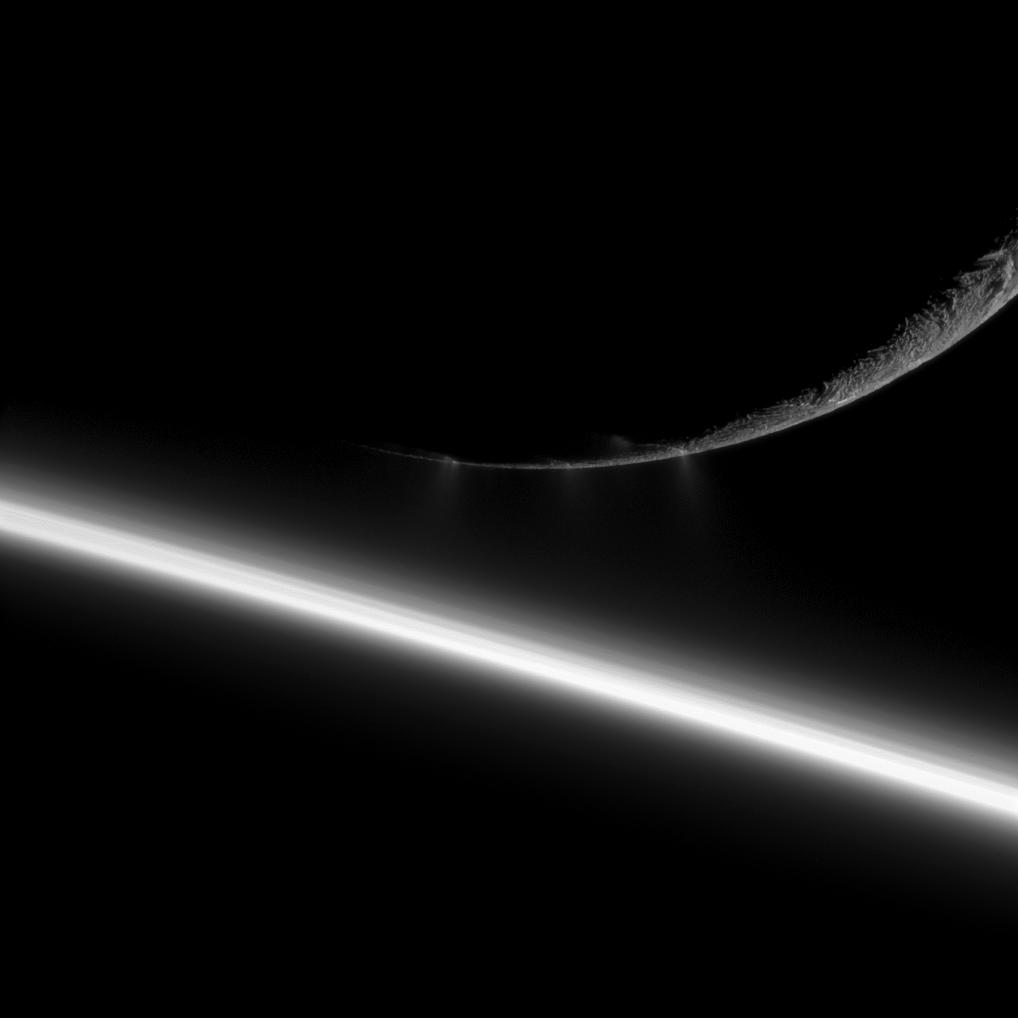
“August 13, 2010. Small water ice particles fly from fissures in the south polar region of Saturn’s moon Enceladus in this image taken during the flyby of the moon by NASA’s Cassini spacecraft. This view looks toward the night side of Saturn, which is in the lower left of the image. Enceladus, in the top right, is closer to the spacecraft than the planet is in this view. Sunlight scatters through the planet’s atmosphere and forms the bright diagonal line running from the left to bottom right of the image. The atmosphere appears layered here. Scientists think the different layers on the limb are real and not an artifact of the camera’s exposure.

The famous jets, imaged by Cassini’s cameras for the first time in 2005, are faintly seen here erupting from the fractures that cross the south polar region of the moon. Illuminated terrain seen on Enceladus is on the leading hemisphere of the moon, or the side facing forward in the moon’s orbit around Saturn. North on Enceladus (504 kilometers, 313 miles across) is up. The jets appear faint here, but can be seen near the center of the image.

The image was taken in visible light with the Cassini spacecraft narrow-angle camera. The view was obtained at a distance of approximately 59,000 kilometers (37,000 miles) from Enceladus and at a sun-Enceladus-spacecraft, or phase, angle of 155 degrees. Image scale on Enceladus is 353 meters (1,157 feet) per pixel.”

“After almost 20 years in space, NASA’s Cassini spacecraft begins the final chapter of its remarkable story of exploration: its Grand Finale. Between April and September 2017, Cassini will undertake a daring set of orbits that is, in many ways, like a whole new mission. Following a final close flyby of Saturn’s moon Titan, Cassini will leap over the planet’s icy rings and begin a series of 22 weekly dives between the planet and the rings.

No other mission has ever explored this unique region. What we learn from these final orbits will help to improve our understanding of how giant planets – and planetary systems everywhere – form and evolve.

On the final orbit, Cassini will plunge into Saturn’s atmosphere, sending back new and unique science to the very end. After losing contact with Earth, the spacecraft will burn up like a meteor, becoming part of the planet itself.

Cassini’s Grand Finale is about so much more than the spacecraft’s final dive into Saturn. That dramatic event is the capstone of six months of daring exploration and scientific discovery. And those six months are the thrilling final chapter in a historic 20-year journey.”

Image credit: NASA


  • Facebook
  • Google
  • Slashdot
  • Reddit
  • Live
  • TwitThis
August 5, 2017

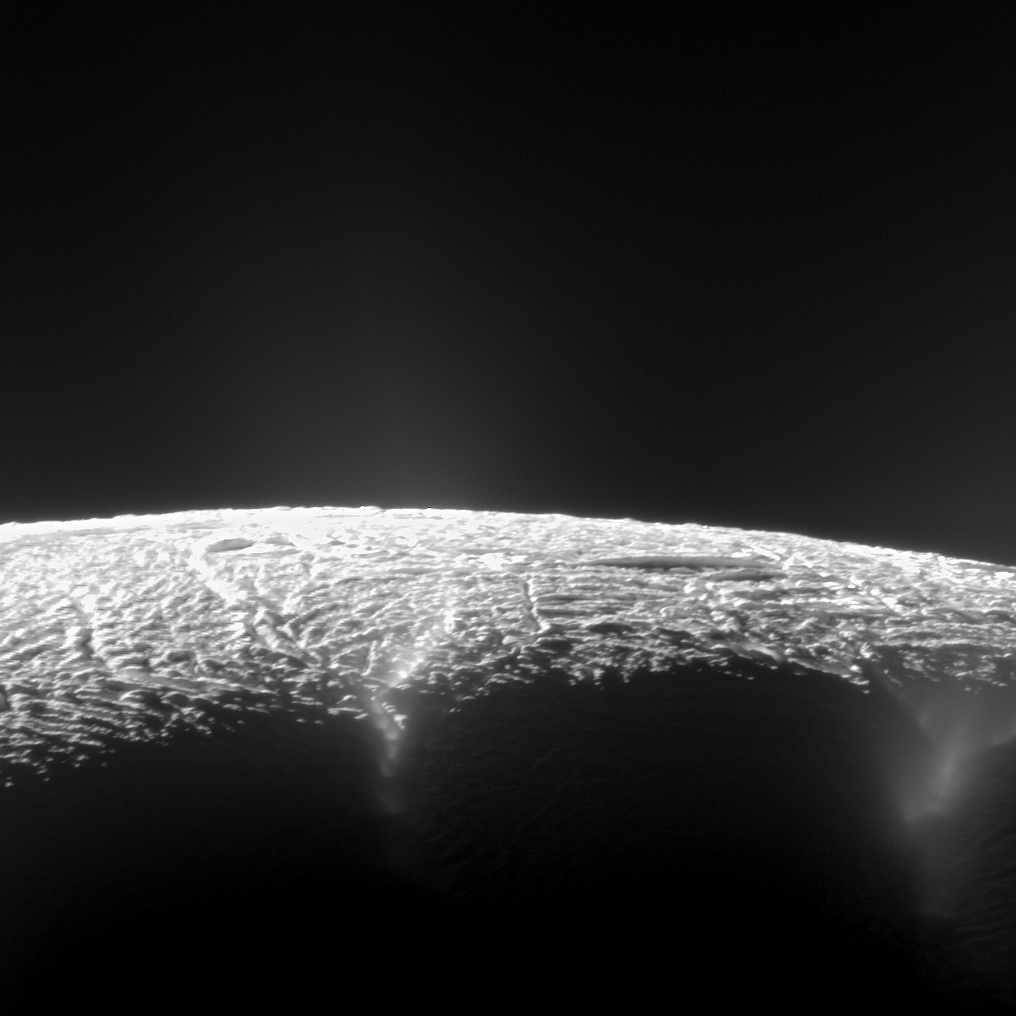
Elevated View of Enceladus’ South Pole

Posted by


NASA dixit:

“August 13, 2010. This dramatic view looks across the region of Enceladus’ geyser basin and down on the ends of the Baghdad and Damascus fractures that face Saturn. The image, which looks approximately in the direction of Saturn, was taken from a more elevated viewpoint than other Cassini survey images of this area of the moon’s south pole. The geysering segments of the fractures seen here are among the most active and warmest in the whole region. As seen from the spacecraft from an elevation angle of 25 degrees south, the jets are projected against the bright surface as opposed to black sky. Consequently, despite the pronounced activity, the jets appear fuzzy, or indistinct, in this image and their tilts are consequently not measurable. Though their source locations are clearly seen, this image was not used in the process of triangulation, but instead it was used to confirm source locations determined from triangulation using other images.

The image was taken with Cassini’s narrow-angle camera through the clear filter, with an image scale about 230 feet (70 meters) per pixel and a sun-Enceladus-spacecraft, or phase, angle of about 151 degrees.”

“After almost 20 years in space, NASA’s Cassini spacecraft begins the final chapter of its remarkable story of exploration: its Grand Finale. Between April and September 2017, Cassini will undertake a daring set of orbits that is, in many ways, like a whole new mission. Following a final close flyby of Saturn’s moon Titan, Cassini will leap over the planet’s icy rings and begin a series of 22 weekly dives between the planet and the rings.

No other mission has ever explored this unique region. What we learn from these final orbits will help to improve our understanding of how giant planets – and planetary systems everywhere – form and evolve.

On the final orbit, Cassini will plunge into Saturn’s atmosphere, sending back new and unique science to the very end. After losing contact with Earth, the spacecraft will burn up like a meteor, becoming part of the planet itself.

Cassini’s Grand Finale is about so much more than the spacecraft’s final dive into Saturn. That dramatic event is the capstone of six months of daring exploration and scientific discovery. And those six months are the thrilling final chapter in a historic 20-year journey.”

Image credit: NASA


  • Facebook
  • Google
  • Slashdot
  • Reddit
  • Live
  • TwitThis
July 30, 2017

Before Saturn’s Limb

Posted by


NASA dixit:

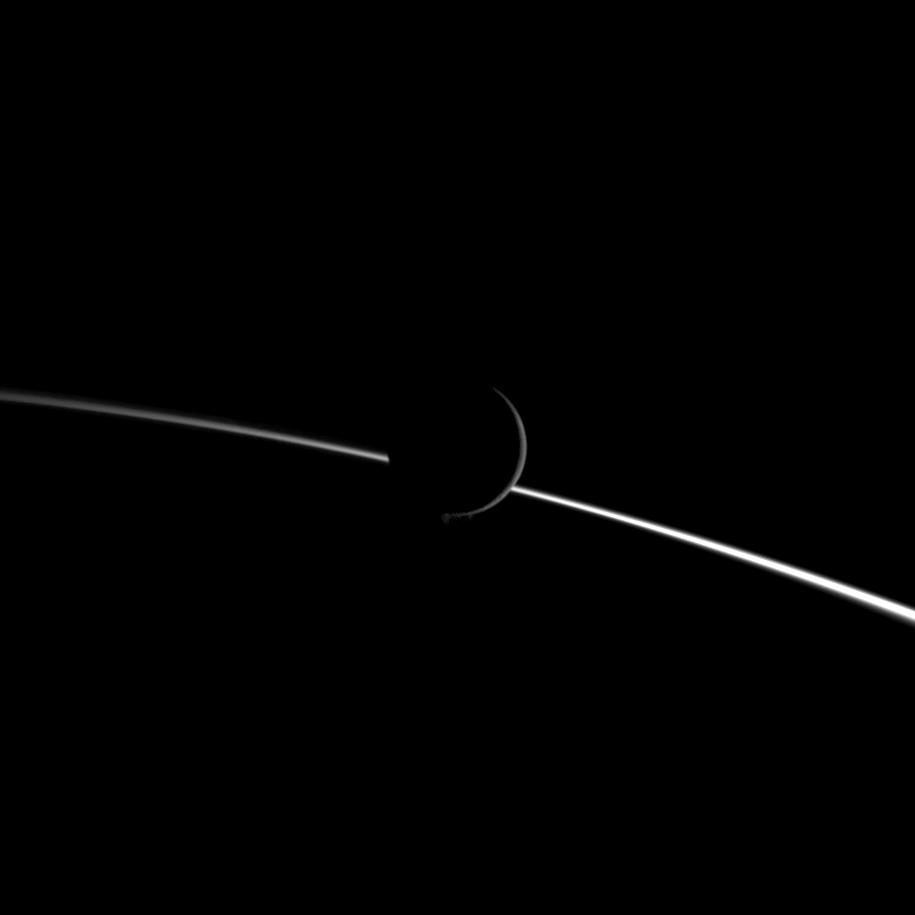
“August 13, 2010. Jets of water ice particles spew from Saturn’s moon Enceladus in this image obtained by NASA’s Cassini spacecraft. A crescent of the moon appears dimly illuminated in front of the bright limb of Saturn. This view looks toward the night side of Saturn, which occupies the lower half of the image. Enceladus, in the center of the image, is closer to the spacecraft than the planet is in this view. Sunlight scatters through the planet’s atmosphere and forms the bright diagonal line running from the left to right of the image. Lit terrain seen on Enceladus (504 kilometers, 313 miles across) is on the leading hemisphere of the moon. North on Enceladus is up. The jets erupting from the south polar region appear faint here, but can be seen at the bottom of the crescent of the moon.

The image was taken in visible light with the Cassini spacecraft wide-angle camera. The view was acquired at a distance of approximately 61,000 kilometers (38,000 miles) from Enceladus and at a sun-Enceladus-spacecraft, or phase, angle of 155 degrees. Image scale is 4 kilometers (2 miles) per pixel.”

“After almost 20 years in space, NASA’s Cassini spacecraft begins the final chapter of its remarkable story of exploration: its Grand Finale. Between April and September 2017, Cassini will undertake a daring set of orbits that is, in many ways, like a whole new mission. Following a final close flyby of Saturn’s moon Titan, Cassini will leap over the planet’s icy rings and begin a series of 22 weekly dives between the planet and the rings.

No other mission has ever explored this unique region. What we learn from these final orbits will help to improve our understanding of how giant planets – and planetary systems everywhere – form and evolve.

On the final orbit, Cassini will plunge into Saturn’s atmosphere, sending back new and unique science to the very end. After losing contact with Earth, the spacecraft will burn up like a meteor, becoming part of the planet itself.

Cassini’s Grand Finale is about so much more than the spacecraft’s final dive into Saturn. That dramatic event is the capstone of six months of daring exploration and scientific discovery. And those six months are the thrilling final chapter in a historic 20-year journey.”

Image credit: NASA


  • Facebook
  • Google
  • Slashdot
  • Reddit
  • Live
  • TwitThis
July 22, 2017

Propeller from Unlit Side

Posted by


NASA dixit:

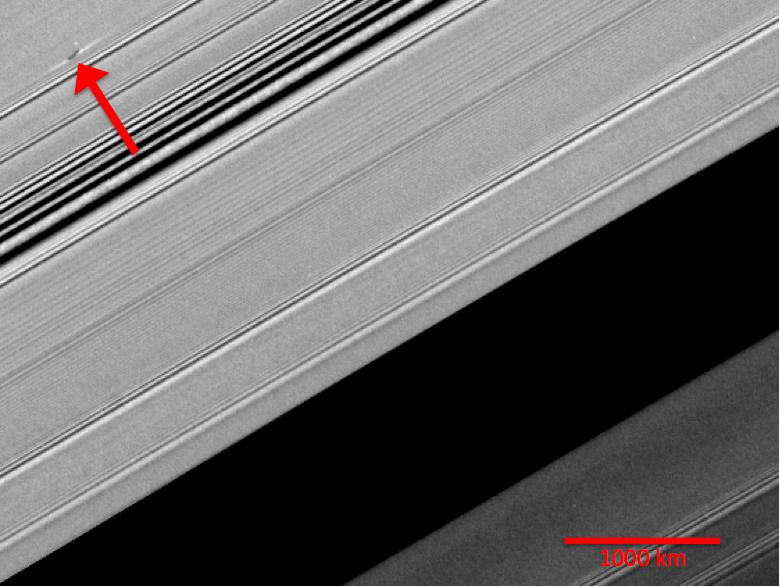
“August 19, 2008. A propeller-shaped structure created by an unseen moon appears dark in this image obtained by NASA’s Cassini spacecraft of the unilluminated side of Saturn’s rings. The propeller is marked with a red arrow in the top left of the annotated version of the image. The Encke Gap of Saturn’s A ring is in the lower right of the image. The A ring is the outermost of Saturn’s main rings. The moon, likely about a kilometer (half a mile) across, can’t be seen at this resolution. However, it is larger than other “propeller” moons and has cleared ring material from the bright (because they are less opaque) wing-like regions to its left and right in this image. Disturbed ring material close to the moon blocks more sunlight and appears like a dark airplane propeller.

Several density waves are visible in the ring, particularly in the upper left. A spiral density wave is a spiral-shaped accumulation of particles that tightly winds many times around the planet. It is the result of gravitational tugs by individual moons whose orbits are in resonance with the particles’ orbits at a specific distance from Saturn. A propeller’s appearance changes with viewing geometry, and this image shows the way a propeller looks when viewed from the unilluminated side of the rings. The dark structure at the center of this propeller corresponds to the bright structure seen in Sunlit Propeller, which was imaged from the sunlit side of the rings.

This image is part of a growing catalogue of “propeller” moons that, despite being too small to be seen, enhance their visibility by creating larger disturbances in the surrounding fabric of Saturn’s rings. Cassini scientists now have tracked several of these individual propeller moons embedded in Saturn’s disk over several years.

These images are important because they represent the first time scientists have been able to track the orbits of objects in space that are embedded in a disk of material. Continued monitoring of these objects may lead to direct observations of the interaction between a disk of material and embedded moons. Such interactions help scientists understand fundamental principles of how solar systems formed from disks of matter. Indeed, Cassini scientists have seen changes in the orbits of these moons, although they don’t yet know exactly what causes these changes.

Imaging scientists nicknamed the propeller shown here “Santos-Dumont” after the early Brazilian-French aviator Alberto Santos-Dumont. The propeller structure is 5 kilometers (3 miles) in the radial dimension (the dimension moving outward from Saturn which is far out of frame to the lower right of this image). It is 65 kilometers (40 miles) in the azimuthal (longitudinal) dimension. Scale in the original image was about 2 kilometers (1 mile) per pixel. The image has been rotated and contrast-enhanced to aid visibility. The cropped inset of the propeller included here was magnified by a factor of four.

This view looks toward the northern, unilluminated side of the rings from about 45 degrees above the ring plane. The image was taken in visible light with the Cassini spacecraft narrow-angle camera. The view was acquired at a distance of approximately 310,000 kilometers (193,000 miles) from Saturn and at a sun-Saturn-spacecraft, or phase, angle of 121 degrees.”

“After almost 20 years in space, NASA’s Cassini spacecraft begins the final chapter of its remarkable story of exploration: its Grand Finale. Between April and September 2017, Cassini will undertake a daring set of orbits that is, in many ways, like a whole new mission. Following a final close flyby of Saturn’s moon Titan, Cassini will leap over the planet’s icy rings and begin a series of 22 weekly dives between the planet and the rings.

No other mission has ever explored this unique region. What we learn from these final orbits will help to improve our understanding of how giant planets – and planetary systems everywhere – form and evolve.

On the final orbit, Cassini will plunge into Saturn’s atmosphere, sending back new and unique science to the very end. After losing contact with Earth, the spacecraft will burn up like a meteor, becoming part of the planet itself.

Cassini’s Grand Finale is about so much more than the spacecraft’s final dive into Saturn. That dramatic event is the capstone of six months of daring exploration and scientific discovery. And those six months are the thrilling final chapter in a historic 20-year journey.”

Image credit: NASA


  • Facebook
  • Google
  • Slashdot
  • Reddit
  • Live
  • TwitThis
July 19, 2017

Epimetheus Revealed

Posted by


NASA dixit:

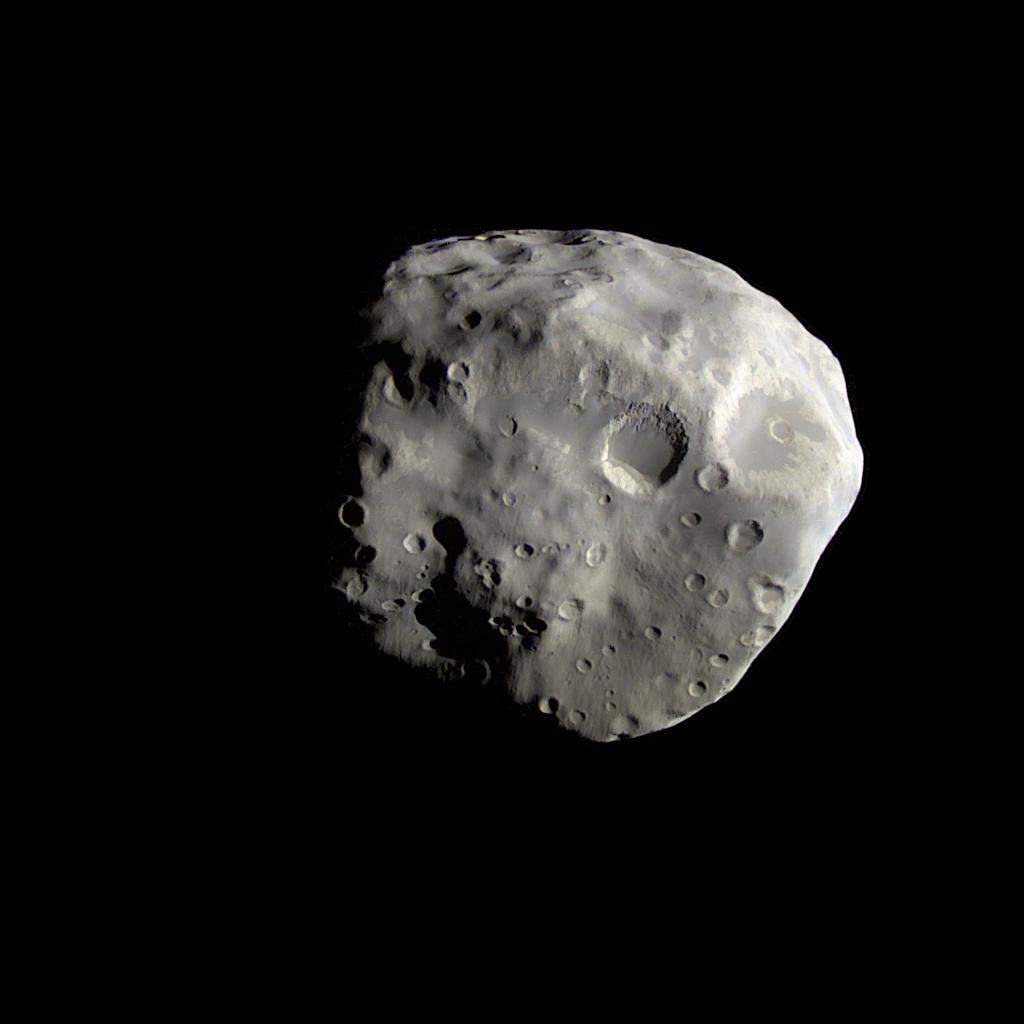
“December 3, 2007. The Cassini spacecraft’s close flyby of Epimetheus in December 2007 returned detailed images of the moon’s south polar region. The view shows what might be the remains of a large impact crater covering most of this face, and which could be responsible for the somewhat flattened shape of the southern part of Epimetheus (116 kilometers, or 72 miles across) seen previously at much lower resolution.

The image also shows two terrain types: darker, smoother areas, and brighter, slightly more yellowish, fractured terrain. One interpretation of this image is that the darker material evidently moves down slopes, and probably has a lower ice content than the brighter material, which appears more like “bedrock.” Nonetheless, materials in both terrains are likely to be rich in water ice.

The images that were used to create this enhanced color view were taken with the Cassini spacecraft narrow-angle camera. The views were obtained at a distance of approximately 37,400 kilometers (23,000 miles) from Epimetheus and at a Sun-Epimetheus-spacecraft, or phase, angle of 65 degrees. Image scale is 224 meters (735 feet) per pixel.”

“After almost 20 years in space, NASA’s Cassini spacecraft begins the final chapter of its remarkable story of exploration: its Grand Finale. Between April and September 2017, Cassini will undertake a daring set of orbits that is, in many ways, like a whole new mission. Following a final close flyby of Saturn’s moon Titan, Cassini will leap over the planet’s icy rings and begin a series of 22 weekly dives between the planet and the rings.

No other mission has ever explored this unique region. What we learn from these final orbits will help to improve our understanding of how giant planets – and planetary systems everywhere – form and evolve.

On the final orbit, Cassini will plunge into Saturn’s atmosphere, sending back new and unique science to the very end. After losing contact with Earth, the spacecraft will burn up like a meteor, becoming part of the planet itself.

Cassini’s Grand Finale is about so much more than the spacecraft’s final dive into Saturn. That dramatic event is the capstone of six months of daring exploration and scientific discovery. And those six months are the thrilling final chapter in a historic 20-year journey.”

Image credit: NASA


  • Facebook
  • Google
  • Slashdot
  • Reddit
  • Live
  • TwitThis
July 16, 2017

Flying by Epimetheus

Posted by


NASA dixit:

“April 7, 2010. Swinging by Saturn’s small moon Epimetheus, Cassini snapped this shot during the spacecraft’s flyby. Lit terrain seen here is on the Saturn-facing side of Epimetheus (113 kilometers, or 70 miles across). North on Epimetheus is up and rotated 27 degrees to the left.

The image was taken in visible light with the Cassini spacecraft narrow-angle camera. The view was acquired at a distance of approximately 87,000 kilometers (54,000 miles) from Epimetheus and at a Sun-Epimetheus-spacecraft, or phase, angle of 69 degrees. Image scale is 519 meters (1,703 feet) per pixel.”

“After almost 20 years in space, NASA’s Cassini spacecraft begins the final chapter of its remarkable story of exploration: its Grand Finale. Between April and September 2017, Cassini will undertake a daring set of orbits that is, in many ways, like a whole new mission. Following a final close flyby of Saturn’s moon Titan, Cassini will leap over the planet’s icy rings and begin a series of 22 weekly dives between the planet and the rings.

No other mission has ever explored this unique region. What we learn from these final orbits will help to improve our understanding of how giant planets – and planetary systems everywhere – form and evolve.

On the final orbit, Cassini will plunge into Saturn’s atmosphere, sending back new and unique science to the very end. After losing contact with Earth, the spacecraft will burn up like a meteor, becoming part of the planet itself.

Cassini’s Grand Finale is about so much more than the spacecraft’s final dive into Saturn. That dramatic event is the capstone of six months of daring exploration and scientific discovery. And those six months are the thrilling final chapter in a historic 20-year journey.”

Image credit: NASA


  • Facebook
  • Google
  • Slashdot
  • Reddit
  • Live
  • TwitThis