OrbitalHub

The place where space exploration, science, and engineering meet

Domain is for sale. $50,000,000.00 USD. Direct any inquiries to contact@orbitalhub.com.

Archive for the Cassini Images category

May 17, 2017

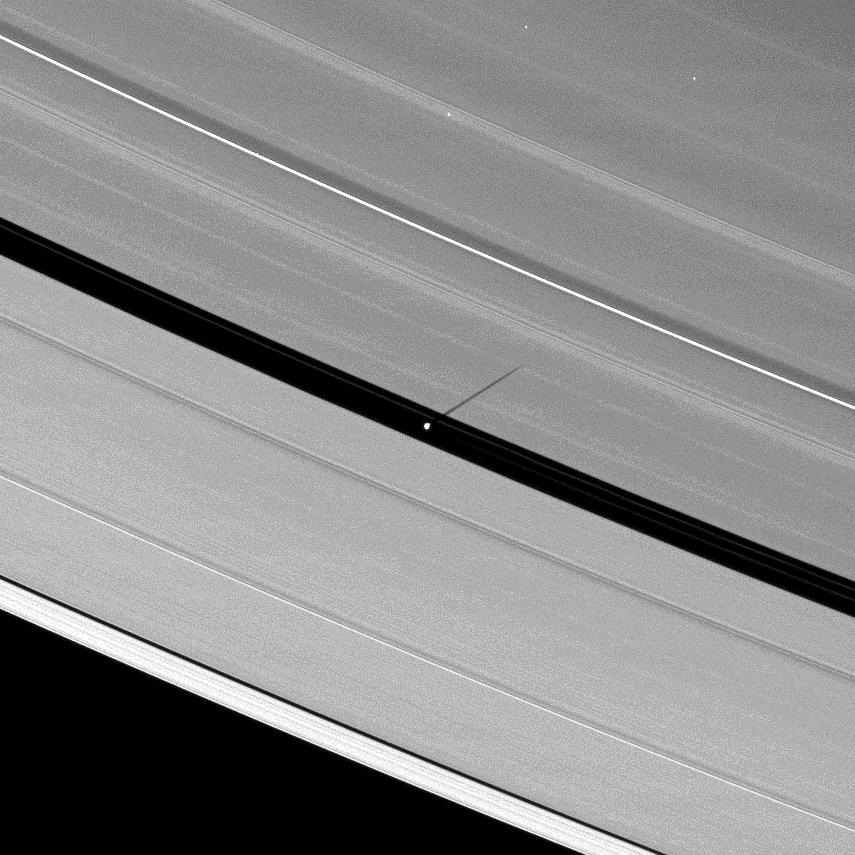
Lengthening Shadows

Posted by


NASA dixit:

“June 28, 2009. As Saturn’s equinox continues to approach, the moon Pan casts a slightly longer shadow on the A ring. The novel illumination geometry created as Saturn approaches its August 2009 equinox allows moons orbiting in or near the plane of Saturn’s equatorial rings to cast shadows onto the rings. These scenes are possible only during the few months before and after Saturn’s equinox, which occurs only once in about 15 Earth years. Three stars are visible through the rings. This view looks toward the unilluminated side of the rings from about 51 degrees above the ringplane. The image was taken in visible light with the Cassini spacecraft narrow-angle camera. The view was acquired at a distance of approximately 1.4 million kilometers (870,000 miles) from Pan and at a Sun-Pan-spacecraft, or phase, angle of 80 degrees. Image scale is 8 kilometers (5 miles) per pixel.”

“After almost 20 years in space, NASA’s Cassini spacecraft begins the final chapter of its remarkable story of exploration: its Grand Finale. Between April and September 2017, Cassini will undertake a daring set of orbits that is, in many ways, like a whole new mission. Following a final close flyby of Saturn’s moon Titan, Cassini will leap over the planet’s icy rings and begin a series of 22 weekly dives between the planet and the rings.

No other mission has ever explored this unique region. What we learn from these final orbits will help to improve our understanding of how giant planets – and planetary systems everywhere – form and evolve.

On the final orbit, Cassini will plunge into Saturn’s atmosphere, sending back new and unique science to the very end. After losing contact with Earth, the spacecraft will burn up like a meteor, becoming part of the planet itself.

Cassini’s Grand Finale is about so much more than the spacecraft’s final dive into Saturn. That dramatic event is the capstone of six months of daring exploration and scientific discovery. And those six months are the thrilling final chapter in a historic 20-year journey.”

Image credit: NASA


  • Facebook
  • Google
  • Slashdot
  • Reddit
  • Live
  • TwitThis
May 14, 2017

Rhea Transits Saturn

Posted by


NASA dixit:

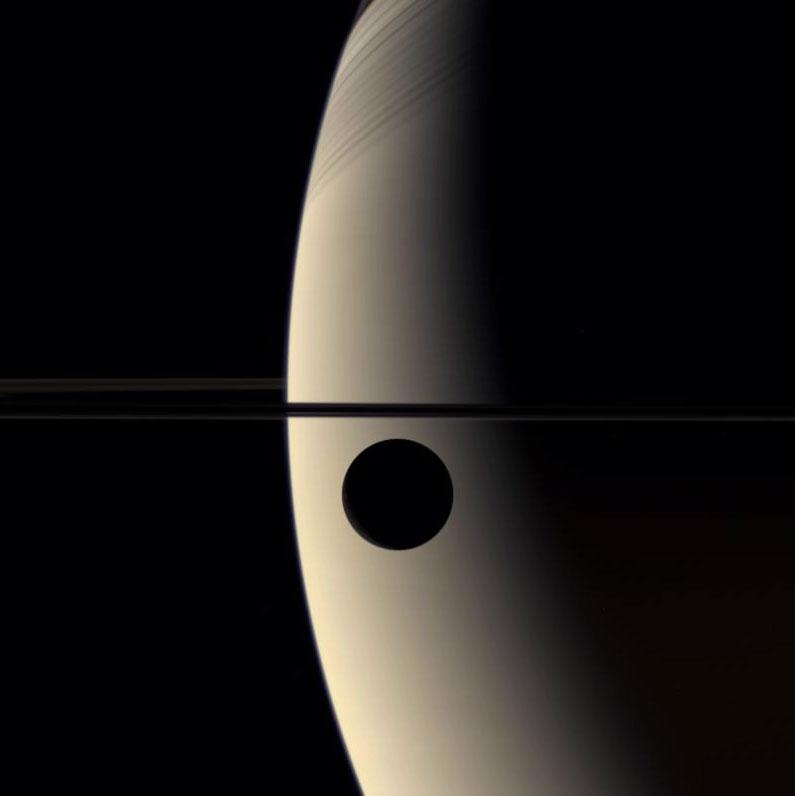
“June 21, 2006. The slim crescent of the moon Rhea glides silently onto the featureless, golden face of Saturn in this mesmerizing color image. In an interplay of contrast and shadow, the moon goes dark against the planet, and then its crescent suddenly brightens as it slips in front of Saturn’s night side. This view looks down onto the unlit side of Saturn’s rings, which cast soft, linear shadows onto the planet’s northern hemisphere. The images were acquired by the Cassini spacecraft wide-angle camera on March 21, 2006, at a distance of approximately 221,000 kilometers (137,000 miles) from Rhea. The image scale is approximately 13 kilometers (8 miles) per pixel.”

“After almost 20 years in space, NASA’s Cassini spacecraft begins the final chapter of its remarkable story of exploration: its Grand Finale. Between April and September 2017, Cassini will undertake a daring set of orbits that is, in many ways, like a whole new mission. Following a final close flyby of Saturn’s moon Titan, Cassini will leap over the planet’s icy rings and begin a series of 22 weekly dives between the planet and the rings.

No other mission has ever explored this unique region. What we learn from these final orbits will help to improve our understanding of how giant planets – and planetary systems everywhere – form and evolve.

On the final orbit, Cassini will plunge into Saturn’s atmosphere, sending back new and unique science to the very end. After losing contact with Earth, the spacecraft will burn up like a meteor, becoming part of the planet itself.

Cassini’s Grand Finale is about so much more than the spacecraft’s final dive into Saturn. That dramatic event is the capstone of six months of daring exploration and scientific discovery. And those six months are the thrilling final chapter in a historic 20-year journey.”

Image credit: NASA


  • Facebook
  • Google
  • Slashdot
  • Reddit
  • Live
  • TwitThis
May 11, 2017

Titan Flyby

Posted by


NASA dixit:

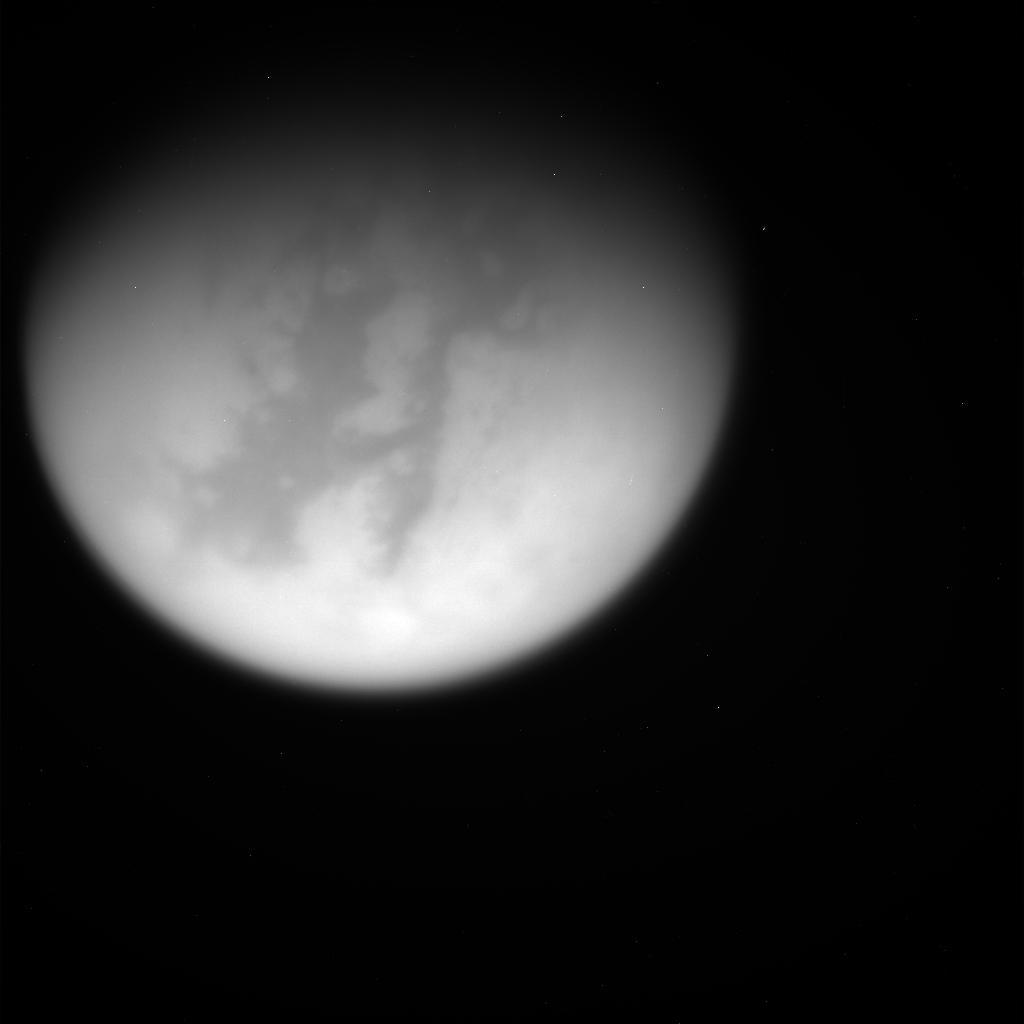
“March 31, 2005. NASA’s Cassini spacecraft successfully flew by Saturn’s largest moon, Titan, at about 2,400 kilometers (1,500 miles) above the surface.”

“After almost 20 years in space, NASA’s Cassini spacecraft begins the final chapter of its remarkable story of exploration: its Grand Finale. Between April and September 2017, Cassini will undertake a daring set of orbits that is, in many ways, like a whole new mission. Following a final close flyby of Saturn’s moon Titan, Cassini will leap over the planet’s icy rings and begin a series of 22 weekly dives between the planet and the rings.

No other mission has ever explored this unique region. What we learn from these final orbits will help to improve our understanding of how giant planets – and planetary systems everywhere – form and evolve.

On the final orbit, Cassini will plunge into Saturn’s atmosphere, sending back new and unique science to the very end. After losing contact with Earth, the spacecraft will burn up like a meteor, becoming part of the planet itself.

Cassini’s Grand Finale is about so much more than the spacecraft’s final dive into Saturn. That dramatic event is the capstone of six months of daring exploration and scientific discovery. And those six months are the thrilling final chapter in a historic 20-year journey.”

Image credit: NASA


  • Facebook
  • Google
  • Slashdot
  • Reddit
  • Live
  • TwitThis
May 8, 2017

Huygens Landing Site

Posted by


NASA dixit:

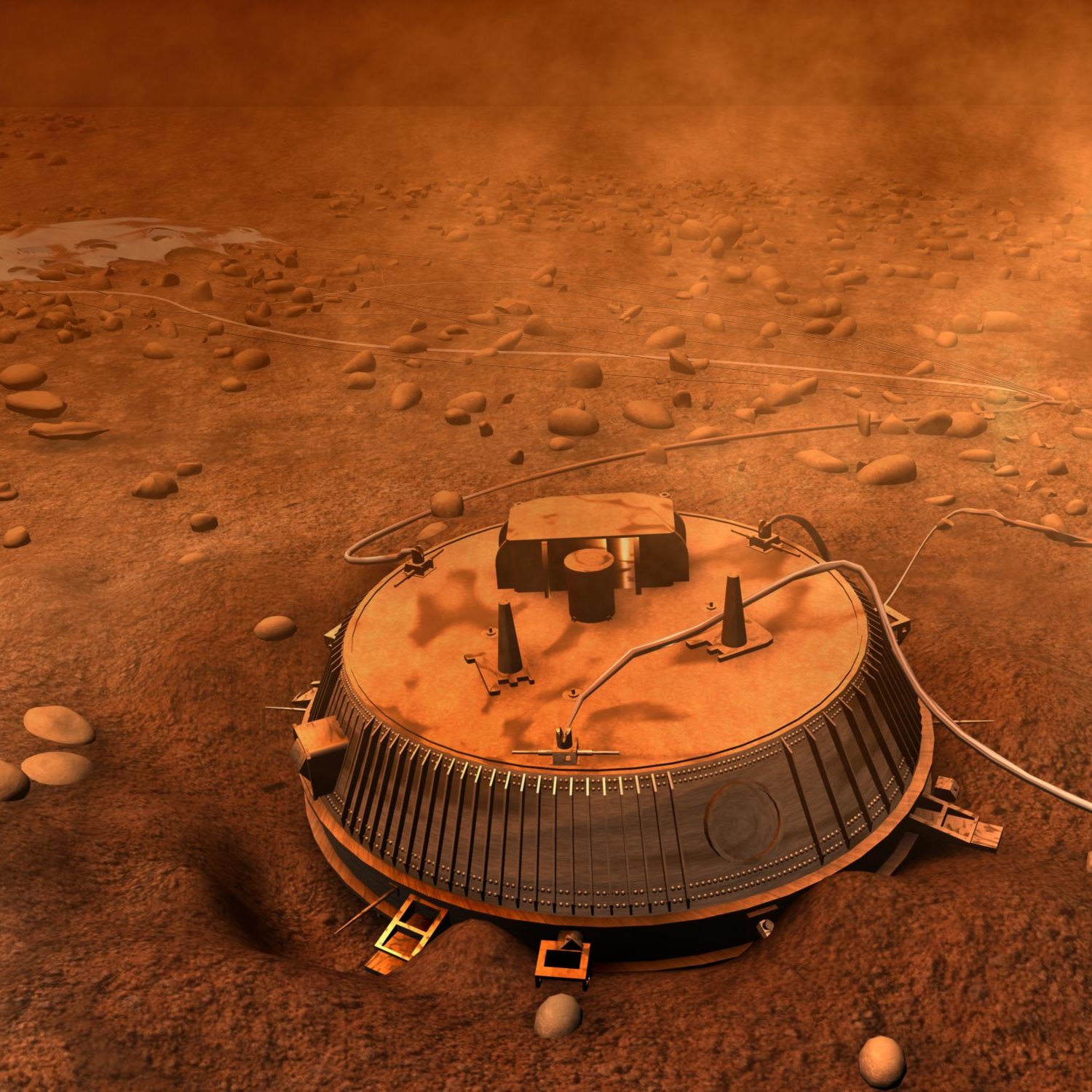
“January 14, 2005. This is an artist’s interpretation of the area surrounding the Huygens landing site, based on images and data returned.”

“After almost 20 years in space, NASA’s Cassini spacecraft begins the final chapter of its remarkable story of exploration: its Grand Finale. Between April and September 2017, Cassini will undertake a daring set of orbits that is, in many ways, like a whole new mission. Following a final close flyby of Saturn’s moon Titan, Cassini will leap over the planet’s icy rings and begin a series of 22 weekly dives between the planet and the rings.

No other mission has ever explored this unique region. What we learn from these final orbits will help to improve our understanding of how giant planets – and planetary systems everywhere – form and evolve.

On the final orbit, Cassini will plunge into Saturn’s atmosphere, sending back new and unique science to the very end. After losing contact with Earth, the spacecraft will burn up like a meteor, becoming part of the planet itself.

Cassini’s Grand Finale is about so much more than the spacecraft’s final dive into Saturn. That dramatic event is the capstone of six months of daring exploration and scientific discovery. (And those six months are the thrilling final chapter in a historic 20-year journey.)”

Image credit: NASA


  • Facebook
  • Google
  • Slashdot
  • Reddit
  • Live
  • TwitThis
May 4, 2017

View from Huygens

Posted by


NASA dixit:

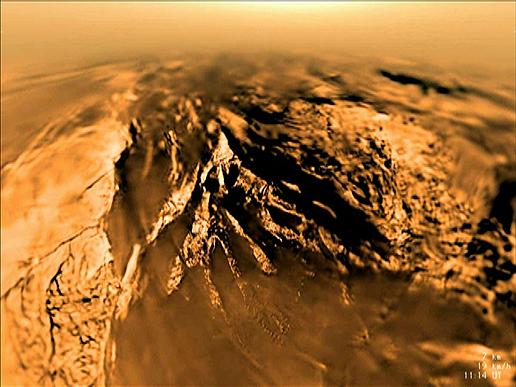
“January 14, 2005. Image collected during the 147-minute plunge through Titan’s thick orange-brown atmosphere to a soft sandy riverbed by the European Space Agency’s Huygens Descent Imager/Spectral Radiometer. In 4 minutes and 40 seconds, the movie shows what the probe ‘saw’ within the few hours of the descent and the landing. On approach, Titan appeared as just a little disk in the sky among the stars, but after landing, the probe’s camera resolved little grains of sand millions of times smaller than Titan.

At first, the Huygens camera just saw fog over the distant surface. The fog started to clear only at about 60 kilometers (37 miles) altitude, making it possible to resolve surface features as large as 100 meters (328 feet). Only after landing could the probe’s camera resolve the little grains of sand. The movie provides a glimpse of such a huge change of scale.”

“After almost 20 years in space, NASA’s Cassini spacecraft begins the final chapter of its remarkable story of exploration: its Grand Finale. Between April and September 2017, Cassini will undertake a daring set of orbits that is, in many ways, like a whole new mission. Following a final close flyby of Saturn’s moon Titan, Cassini will leap over the planet’s icy rings and begin a series of 22 weekly dives between the planet and the rings.

No other mission has ever explored this unique region. What we learn from these final orbits will help to improve our understanding of how giant planets – and planetary systems everywhere – form and evolve.

On the final orbit, Cassini will plunge into Saturn’s atmosphere, sending back new and unique science to the very end. After losing contact with Earth, the spacecraft will burn up like a meteor, becoming part of the planet itself.

Cassini’s Grand Finale is about so much more than the spacecraft’s final dive into Saturn. That dramatic event is the capstone of six months of daring exploration and scientific discovery. (And those six months are the thrilling final chapter in a historic 20-year journey.)”

Image credit: NASA


  • Facebook
  • Google
  • Slashdot
  • Reddit
  • Live
  • TwitThis


NASA dixit:

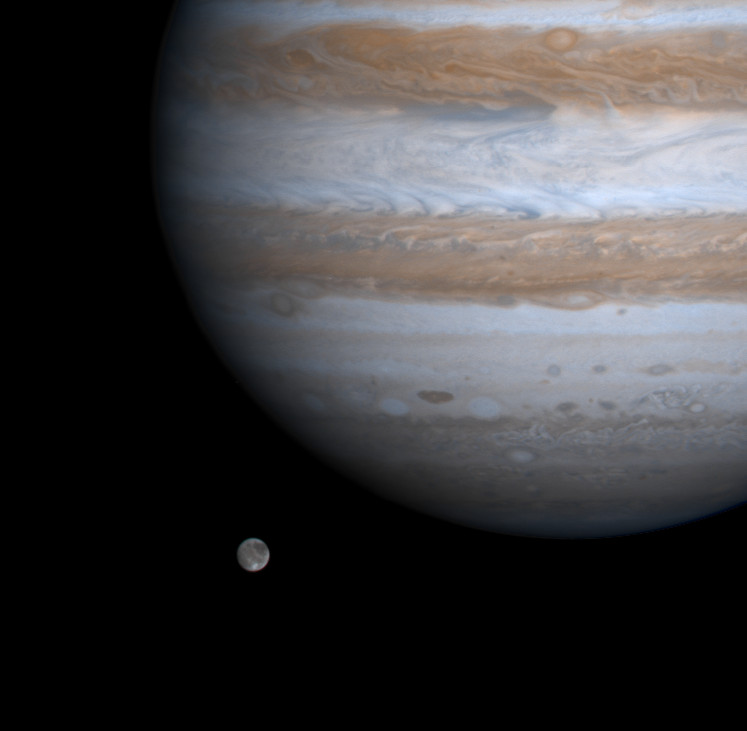
“December 3, 2000. The solar system’s largest moon, Ganymede, is captured here alongside the planet Jupiter in a color picture taken by NASA’s Cassini spacecraft. Ganymede is larger than the planets Mercury and Pluto and Saturn’s largest moon, Titan. Both Ganymede and Titan have greater surface area than the entire Eurasian continent on our planet. Cassini was 26.5 million kilometers (16.5 million miles) from Ganymede when this image was taken. The smallest visible features are about 160 kilometers (about 100 miles) across.

The bright area near the south (bottom) of Ganymede is Osiris, a large, relatively new crater surrounded by bright icy material ejected by the impact, which created it. Elsewhere, Ganymede displays dark terrains that NASA’s Voyager and Galileo spacecraft have shown to be old and heavily cratered. The brighter terrains are younger and laced by grooves. Various kinds of grooved terrains have been seen on many icy moons in the solar system. These are believed to be the surface expressions of warm, pristine, water-rich materials that moved to the surface and froze.

Ganymede has proven to be a fascinating world, the only moon known to have a magnetosphere, or magnetic environment, produced by a convecting metal core. The interaction of Ganymede’s and Jupiter’s magnetospheres may produce dazzling variations in the auroral glows in Ganymede’s tenuous atmosphere of oxygen.”

“After almost 20 years in space, NASA’s Cassini spacecraft begins the final chapter of its remarkable story of exploration: its Grand Finale. Between April and September 2017, Cassini will undertake a daring set of orbits that is, in many ways, like a whole new mission. Following a final close flyby of Saturn’s moon Titan, Cassini will leap over the planet’s icy rings and begin a series of 22 weekly dives between the planet and the rings.

No other mission has ever explored this unique region. What we learn from these final orbits will help to improve our understanding of how giant planets – and planetary systems everywhere – form and evolve.

On the final orbit, Cassini will plunge into Saturn’s atmosphere, sending back new and unique science to the very end. After losing contact with Earth, the spacecraft will burn up like a meteor, becoming part of the planet itself.

Cassini’s Grand Finale is about so much more than the spacecraft’s final dive into Saturn. That dramatic event is the capstone of six months of daring exploration and scientific discovery. (And those six months are the thrilling final chapter in a historic 20-year journey.)”

Image credit: NASA


  • Facebook
  • Google
  • Slashdot
  • Reddit
  • Live
  • TwitThis