OrbitalHub

The place where space exploration, science, and engineering meet

Domain is for sale. $50,000,000.00 USD. Direct any inquiries to contact@orbitalhub.com.

Archive for the Spacecraft Design category

September 8, 2008

The Space Elevator – from Fiction to Fact

Posted by


When I read The Fountains of Paradise a few years ago, I thought the space elevator was an interesting concept but that there was little chance of seeing it materialize like we saw the geostationary satellites become a reality after being depicted in a science fiction story by the same author, Arthur C. Clarke. And not just because some famous scientist said so, but because anchoring to the Earth a geostationary satellite with a cable measuring some 100,000 km is quite a technological challenge.


The first scientist to propose building a structure to reach space was Konstantin Tsiolkovski, who envisioned an orbital tower in 1895. In 1960, another Russian scientist, Yuri Artsutanov, developed this concept into an article called Into Space with the Help of an Electric Locomotive, which was published in Komsomolskaya Pravda. Artsutanov proposed linking of geosynchronous satellites to the ground using cables. It is interesting to mention here that Arthur C. Clarke and Yuri Artsutanov actually met years after the Fountains of Paradise was published.


Ok, so it is just science fiction, you might say. Well, not quite. There was a study ordered by NASA under the NASA Institute for Advanced Concepts (NIAC) program, which had as its object the investigation of all aspects of the construction and operation of a space elevator. The study was funded by NASA for more than two years and it was titled The Space Elevator.


A book was also published by the authors of the study, Bradley C. Edwards and Eric A. Westling. The book has the same title as the study. I found the book easy to read and really entertaining. Even if it becomes very technical in some parts, it is accessible to readers who do not have a technical background.


The book starts by presenting the main components of the design (the ribbon, the spacecraft, the climber, and the anchor), and the challenges that the space and the Earth’s atmosphere pose to the space elevator during the deployment phase and during the normal life of the program: lightings, meteors, and LEO objects, just to mention a few.


Being a feasibility study, the economic considerations had to be part of it. There are budget estimates that would draw the attention of potential investors, and even a realistic schedule for the development of not just one, but up to four ribbons.


While the space elevator is obviously a very cheap solution for deploying payloads in Earth’s orbit, it can also be used for opening Mars to human exploration and colonization. An Earth space elevator uploading materials in orbit working together with a space elevator downloading them on Mars would make possible the continuous flow of materials and colonists.


The later chapters of the book present the possible implications of the space elevator on the development of space travel and on the future of our technological society.


As the authors acknowledge, the book is not an exhaustive study of all aspects to be considered in the designing and building of the space elevator, but a good beginning. The proposed budget of 6 to 10 billion dollars for the project is not excessive considering the potential return of investment and that access to space is essential for the future development of our society.


Published in 2003, the book is a classic. I strongly recommend it.


In a follow up to The Space Elevator, Bradley C. Edwards and Philip Ragan wrote Leaving the Planet by Space Elevator, which was published in 2006.


For more information about the space elevator, including the 2008 Space Elevator Challenge and the Elevator: 2010 challenge, check out The Spaceward Foundation’s site.


  • Facebook
  • Google
  • Slashdot
  • Reddit
  • Live
  • TwitThis


Credits: ESA


In September 2008, the first Automated Transport Vehicle (ATV) mission will come to an end. It is a significant achievement for the European space industry, marking another first in space exploration: the ATV spacecraft is capable of performing rendezvous and docking procedures to the International Space Station (ISS) in a fully autonomous manner. In comparison, the Russian spacecrafts used for carrying supplies and crews to the station (Progress and Soyuz) need the cooperation of the station for docking procedures.


The ATV program started back in 1995 and it has so far cost approximately 1.3 billion euros.


I will start by presenting some of the technical data of the ATV spacecraft. It will not be an exhaustive presentation by far, but I think it is important to have the orders of magnitude at least.


Credits: ESA


ATV has a mass of almost 21 tonnes (20,750 kg) at launch, of which up to 7 tonnes is on-board propellants and payload. The pressurized cabin section used for cargo storage has 48 cubic meters in volume. ATV is the largest spacecraft ever developed in Europe.


In the on orbit configuration, the spacecraft has a length of 9.794 m, maximum diameter of 4.480m, and the solar arrays span of 22.281 m.


The launch vehicle used by ATV missions is Ariane 5. The ATV is deployed by the Ariane 5 rocket on a low Earth orbit (260×260 km, inclination 51.6 degrees).


Credits: ESA


The ATV spacecraft consists of two main modules, the avionics/propulsion module, called the ATV Service Module, and the Integrated Cargo Carrier (ICC), which docks with the International Space Station (ISS).


Credits: ESA


The ICC represents 60% of the total ATV volume. It is used to deliver two types of supplies to the ISS: the dry cargo (like hardware and personal parcels) and the fluid cargo (like propellant for the ISS’s own propulsion system, water, and gas).


Cargo mass can be distributed as follows:
· dry cargo: 1,500 kg – 5,500 kg;
· water: 0 – 840 kg;
· gas (nitrogen, oxygen, air, 2 gases/flight): 0 – 100 kg;
· ISS re-boost and attitude control propellant: 0 – 4,700 kg;
The total cargo upload capacity: 7,667 kg.


Credits: ESA

The waste download capacity is 6,340 kg (5,500 kg dry cargo + 840 kg wet cargo).


The front of the ICC contains the docking system. The docking system is Russian made and it is a state-of-the-art docking mechanism. It has evolved over the years from the original docking system used for the Salyut space station program in the late 1960s. The docking system enables crew access to the ICC pressurized module, but also provides electrical and propellant connections between the ATV and the ISS.


In order to make docking a safe procedure, the ICC is equipped with quite an impressive array of sensors and active components: two telegoniometers (used to calculate the distance and direction from ATV to ISS), two videometers (used to compute distance and orientation of the ISS), two star trackers, and two visual video targets (used by the ISS crew to monitor visually the ATV’s final approach).


Credits: ESA

The ATV Service Module includes the propulsion systems, the electrical power, computers, the communications, and the avionics.


The main propulsion system of the spacecraft is comprised of 4 x 490 N thrusters. The attitude control system relies on 28 x 220 N thrusters. The ATV propulsion system is a pressure fed liquid bi-propellant system using monomethyl hydrazine fuel and nitrogen tetroxide oxidizer. The fuel is pressurized by helium stored in two high pressure tanks.


The four solar panels ATV is equipped with can generate 4,800 W on average during the 6 month mission in space.


The typical ATV mission starts in French Guiana, at the Kourou launch site. An Ariane 5 rocket deploys the ATV spacecraft on a circular Low Earth Orbit (LEO) at an altitude of 260 km. ATV then activates its navigation systems and fires its thrusters to reach the transfer orbit to the ISS.


After two or three days, and raising its orbit to 400 km, ATV will be in sight of ISS. It will start the approaching phase of the mission from about 30 km behind and 5 km below the station.


Even if the approach and the docking procedures are fully automatic, the flight controllers can at any time call on the spacecraft and back away from the station. The ISS crew can also reject the spacecraft in case any anomalies are noticed.


Once the spacecraft is safely docked to the ISS, the station’s crew can access the pressurized cargo section and remove the payload. After the payload is removed, the crew fills the cargo section with used hardware and waste materials.

At intervals of 10 to 14 days, the main thrusters of the ATV will be used to boost the station’s altitude.

Once the mission is accomplished, the ATV separates from the ISS, and performs a controlled and safe destructive re-entry somewhere above the Pacific Ocean.


The first ATV mission is called Jules Verne, after the French author Jules Gabriel Verne (1828 – 1905) who pioneered the science-fiction genre.

The Jules Verne ATV had to pass many tests in order to qualify for the mission. An interesting test was the acoustic testing at the ESA’s test facilities in Noordwijk in the Netherlands.

The spacecraft has to withstand the vibrations caused by the extreme noise levels generated during the launch by the Ariane 5 rocket. The ATV was locked in a closed space with huge speakers that simulate the noise levels recorded during an Ariane 5 launch.


Credits: ESA

Even though the ATV is able to perform the rendezvous and the docking procedures on its own, the ground control experts from ESA and CNES, the French space agency, were involved in the operations. They determined the route the spacecraft must follow in order to dock with the ISS. The two ISS control centers were also involved in ATV operations: the Mission Control Centre in Moscow and the Mission Control Center in Houston, Texas.


The Jules Verne mission is the first in a series to come. There are already five ATV missions scheduled between now and 2015. Under the coordination of ESA and the prime contractor EADS Astrium, European engineers have contributed to this new generation spacecraft. Major sub-contractors are Thales Alenia Space (Italy), Astrium (Germany and France), Oerlikon Space (Switzerland), Dutch Space (The Netherlands), with Russian partners providing the advanced docking system.


The Jules Verne mission liftoff occurred on March 9th, 2008 at 05:03 CET (04:03 UT) at the Kourou Spaceport in French Guiana.


ATV Jules Verne had to perform what the media called orbital rehearsals for ISS docking. The initial test, performed on March 14th, demonstrated the Collision Avoidance Manoeuvre (CAM). During this initial test, an automated system took control of the spacecraft and moved it to a safe distance from the ISS.


The following two tests demonstrated the flying capabilities of the spacecraft in the proximity of the station. On March 29th, ATV manoeuvred around the ISS using relative GPS navigation. Two days later, the ATV tested close proximity manoeuvring and control. The ATV approached first within 20 meters of the station, retreated, then approached even nearer, to only 12 meters from the docking port on the ISS Russian Zvezda module, before again backing off to a safe distance from the station.


On April 3rd, 2008 ATV Jules Verne docked to the ISS.

The ATV will undock from the ISS at the beginning of September 2008 and it will complete its mission at the end of September 2008 above the Pacific Ocean.


Due to its remarkable capabilities, ATV will serve the ISS for many years and it will become a major player after the Space Shuttle retirement in 2010.


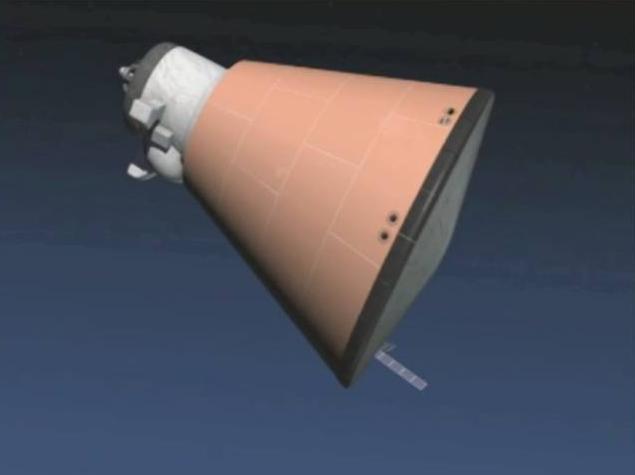
There are quite a few ATV evolution scenarios already considered by ESA in the present. To mention here only two of the configurations: the Large Cargo Return (LCR) and the Crew Transport Vehicle (CTV). The LCR configuration presents a large cargo re-entry capsule able to bring back hundreds of kilograms of cargo and valuable experiment results. In the CTV configuration, the Integrated Cargo Carrier component of the spacecraft would be transformed into a manned re-entry capsule for crew transportation. Because of the re-entry capabilities, the CTV could be used as a crew rescue capsule for the ISS.


  • Facebook
  • Google
  • Slashdot
  • Reddit
  • Live
  • TwitThis
August 23, 2008

Constellation Program

Posted by


Credits: NASA


Constellation Program is NASA’s new generation space transportation system. It is designed to cover a wide range of space missions, such as delivering supplies and human crews to the International Space Station (ISS) and traveling beyond low Earth orbit (LEO). The goal of the program is to establish a permanent human presence on the Moon and then go to Mars and other destinations.


The Constellation Program promotes exploration, science, commerce, and the United States’ presence in space.


Constellation consists of two launching vehicles (Ares I and Ares V), the Orion spacecraft, the Earth Departure Stage, and the Altair, which is the Lunar Surface Access Module.


Credits: NASA


Ares I is the crew launch vehicle that will be used to deliver the Orion spacecraft to LEO. Ares I is a two stage rocket, 94 m long and 5.5 m in diameter that can deliver a 25,000 kg payload to LEO.


The first stage is a solid rocket booster that evolved from the Space Shuttle Solid Rocket Booster (SRB). An additional fifth segment was added to the initial SRB design, which enables the rocket to produce more thrust and burn longer. The second stage uses liquid oxygen and liquid hydrogen as fuel. The J-2X engine used by the second stage evolved from the J-2 engine used on the Saturn V rocket.


In addition to its primary mission, Ares I can also be used to deliver resources and supplies to the ISS or to park payloads in orbit for retrieval by other spacecraft bound for the Moon or other destinations.


Credits: NASA


Ares V is the cargo launch vehicle of the Constellation Program. Ares V is a two stage rocket, 116 m long and 10 m in diameter. It will be able to deliver a staggering 188,000 kg (188 metric tonnes!) payload into a LEO.


The first stage uses both solid and liquid propulsion (two SRB-derived boosters and 6 RS-68 liquid fueled engines) while the second stage (the Earth Departure Stage) uses a single J-2X engine. It is a versatile launch system and it will be used to carry to LEO cargo and the components needed to go to the Moon and later to Mars.


Both launch vehicles are subject to configuration changes. The images reflect the configuration as of September 2006.


Credits: NASA


Orion is able to carry four to six astronauts. It will provide logistic support to ISS in the first stage. After that, Orion will become an important part of NASA’s human missions to the Moon and Mars.


The conceptual design is similar to the Apollo, but has been improved: an updated digital control system, automated pilot for docking procedures, and a nitrogen/oxygen mixed atmosphere.


The conical form is the safest and most reliable design for re-entering the Earth’s atmosphere. The landing procedure has also been modified: instead of a splash in the Ocean, the module will land on solid ground using a combination of parachutes and airbags.


Credits: NASA

Altair is the lander spacecraft component of the Constellation Program. Like its predecessor, the Apollo Lunar Module, Altair has two stages.


Altair will land all crew members of the lunar mission on the surface of the Moon, while Orion will stay in lunar orbit until the mission ends. The ascending stage brings the crew back on Orion for the journey home.


While the ultimate goal of the program is a manned mission to Mars (there are predictions for 2030), the main activities will be providing logistic support to ISS and establishing a permanent human settlement on the Moon.


Credits: NASA


For more information you can visit the Constellation Program page on NASA’s web site.


  • Facebook
  • Google
  • Slashdot
  • Reddit
  • Live
  • TwitThis