OrbitalHub

The place where space exploration, science, and engineering meet

Domain is for sale. $50,000,000.00 USD. Direct any inquiries to contact@orbitalhub.com.

Archive for the Space Exploration category

August 26, 2010

How Big is Small at Orbital Velocities

Posted by


Credits: CNES


Since the launch of Sputnik-1, on October 4, 1957, some 4,600 launches have placed more than 6,000 satellites in orbits around Earth.


All these activities have created a cloud of particles orbiting the Earth, which is referred to as orbital debris.


The majority of these particles are fragments from explosions and collisions (such as the Chinese Fengyun-1 ASAT test in 2007, and the collision between Iridium 33 and Cosmos 2251 in 2009). Some of them are spent rocket stages and defunct satellites. The total mass in orbit has been estimated to 5,800 tons.


As the ejecta generated in explosions and collisions have a wide range of velocities, the evolution of the particle cloud following the event can evolve in ways that are sometimes hard to predict, as some of the particles can disperse into orbits that are dissimilar to the original orbits.


Credits: NASA


To make things more complicated, the particles comprising the orbital debris environment are quite hard to detect. Some of them are impossible to detect due to technological limitations (present equipment is capable of tracking only objects larger than 1 cm in diameter in low Earth orbit and larger than 50 cm in diameter in geosynchronous orbit) or simply because they have orbits that are out of the range of tracking stations (such as highly elliptical and high inclination orbits with the perigee situated deep in the Southern Hemisphere – the Molniya orbits).


Even if most of the particles orbiting the Earth at velocities in the range of 8-10 km/s (or 28,800-36,000 km/h) are less than 1 cm in size, the kinetic energies associated with impacts at orbital velocities make them a source of great concern.


Just to get a sense of the effects that even small particles with velocities in the order of 10 km/s can have on space structures, if we assume a density of 1 g/cm3, a particle as small as 0.1 mm can cause surface erosion, and a particle 1 mm in size can inflict serious damage. A 3 mm particle moving at 10 km/s has the kinetic energy of a bowling ball moving at 100 km/h. A 1 cm fragment has the kinetic energy of a 180 kg safe. It is easy to visualize the effects of an impact with such an object on an operational satellite or a space station parked in low Earth orbit.


To find out more about orbital debris you can visit the NASA Orbital Debris Program office website.


  • Facebook
  • Google
  • Slashdot
  • Reddit
  • Live
  • TwitThis
July 9, 2010

Rosetta and 21 Lutetia

Posted by


Credits: ESA


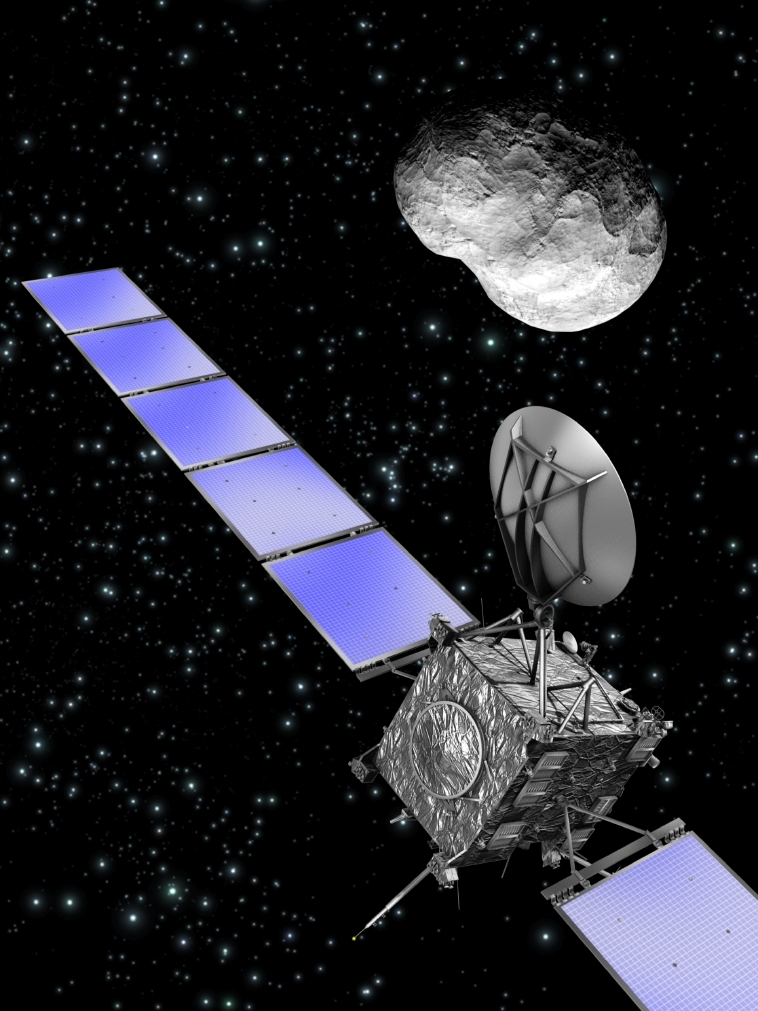
On July 10, 2010, the European comet chaser Rosetta will perform the second asteroid flyby of its mission. The first flyby was performed on September 6, 2008, when Rosetta had a close encounter with the asteroid 2867 Steins. Rosetta will skim by the asteroid 21 Lutetia at approximately 3,000 km. The speed of the spacecraft relative to the asteroid will be around 54,000 km/h.


The asteroid Lutetia was discovered on November 15, 1852, by the German astronomer Hermann Goldschmidt. Besides the characteristics of its trajectory, few things are known about the asteroid. From the preliminary observations made by Rosetta, scientists were able to estimate the diameter of the asteroid to 134 km, but the actual shape and composition still remain to be determined.


During the flyby, the spacecraft will operate in a special Asteroid Flyby Mode. This will allow the spacecraft to control its attitude and keep the asteroid in the field of view of the imaging instruments carried onboard.


Rosetta has to follow a complicated trajectory that includes three Earth gravity assists and one at Mars, in order to accelerate to the speed needed for reaching its final destination. The last gravity assist maneuver occurred on November 13, 2009, when Rosetta swung by Earth.


After 6 years into the mission, the systems on the spacecraft are doing very well, and the best is yet to come: the rendezvous with the comet 67/P Churyumov-Gerasimenko in 2014. Rosetta will deploy a small lander on the surface of the comet, and it will continue to fly alongside the nucleus of the comet for more than one year.


OrbitalHub will re-cast the live webstream from ESOC, ESA’s European Space Operations Center, in Darmstadt, Germany. The program starts July 10, 2010, at 20:00 GMT. The closest approach will occur at 20:10:07 GMT. Come back and watch the events unfold!


  • Facebook
  • Google
  • Slashdot
  • Reddit
  • Live
  • TwitThis
July 2, 2010

OCO 2.0

Posted by


Credits: NASA


The Orbiting Carbon Observatory 2 mission is scheduled to launch in February 2013.


The previous spacecraft failed to reach orbit on February 24, 2009, after being launched on top of a Taurus XL launch vehicle from Vandenberg Air Force Base in California.


The OCO spacecraft will make global CO2 measurements from space, quite useful as scientists are trying to understand the global carbon cycle in order to be able to make predictions of future atmospheric CO2 increases.


NASA awarded the launch services contract to Orbital Sciences Corp. of Dulles, Virginia. OCO-2 will be launched by a Taurus XL 3110 launch vehicle from Vandenberg Air Force Base.


We quote from the NASA press release:

“OCO-2 is a NASA’s first mission dedicated to studying atmospheric carbon dioxide. Carbon dioxide is the leading human-produced greenhouse gas driving changes in the Earth’s climate. OCO-2 will provide the first complete picture of human and natural carbon dioxide sources and sinks, the places where the gas is pulled out of the atmosphere and stored.”


You can find more information about the Orbiting Carbon Observatory on NASA’s website.


  • Facebook
  • Google
  • Slashdot
  • Reddit
  • Live
  • TwitThis


Credits: CSA


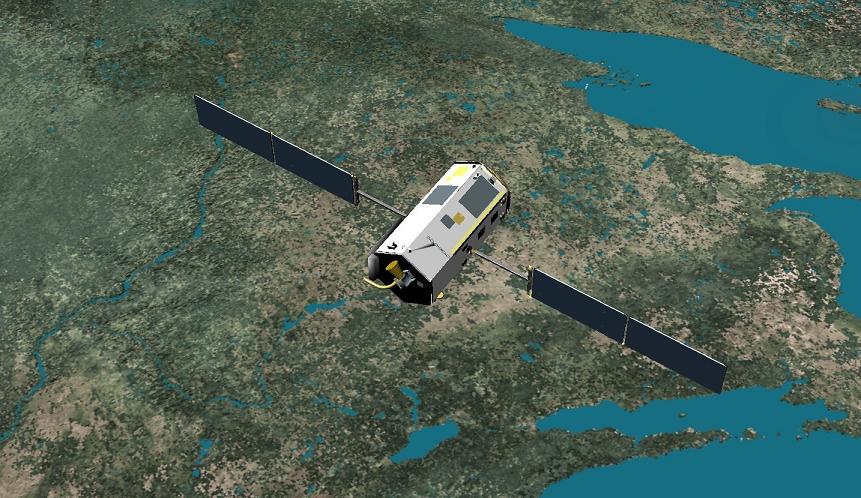
RADARSAT-1 is the first commercial Earth observation satellite developed in Canada, and it is equipped with a powerful synthetic aperture radar (SAR) instrument.


Launched on November 4, 1995, from Vandenberg Air Force Base in California, the satellite is well beyond the planned five-year lifetime, and continues to provide images of the Earth for both scientific and commercial applications.


Canada is involved in space debris mitigation research and development activities. In Canada, these activities are coordinated by the Canadian Space Agency, which formed a group, the Orbital Debris Working Group, in order to address a number of objectives such as to increase the knowledge and awareness of orbital debris in the space community, to encourage research in orbital debris and mitigation measures, and to support development of orbital debris detection and collision avoidance techniques and technologies.


In Canada, the space operators and manufacturers are adopting space debris mitigation measures on a voluntary basis. Existing guidelines are used for monitoring activities to prevent on-orbit collisions and conduct post-mission disposal procedures. Space system manufacturers have to provide, among other things, information regarding the method of disposal for the satellite and the estimated duration of the satellite disposal operation.


Credits: NASA/GSFC Scientific Visualization Studio


The Canadian Space Agency has prepared post-mission disposal plans for its remote sensing satellite RADARSAT-1, plans that comply with the guidelines of the United Nations document entitled Guidelines for Space Debris Mitigation and with the measures required for the space hardware manufacturers in Canada.


The remaining fuel will be used to lower the orbit and orient the satellite so that drag is maximized.


Also, the energy stored in the propellant tanks, the reaction wheels, and the batteries of the satellite will be removed. In this way, the on-orbit retirement period of the satellite is reduced to the lowest possible.


You can find more information about RADARSAT-1 on the Canadian Space Agency’s web site.


  • Facebook
  • Google
  • Slashdot
  • Reddit
  • Live
  • TwitThis
April 2, 2010

IKAROS

Posted by


Credits: JAXA


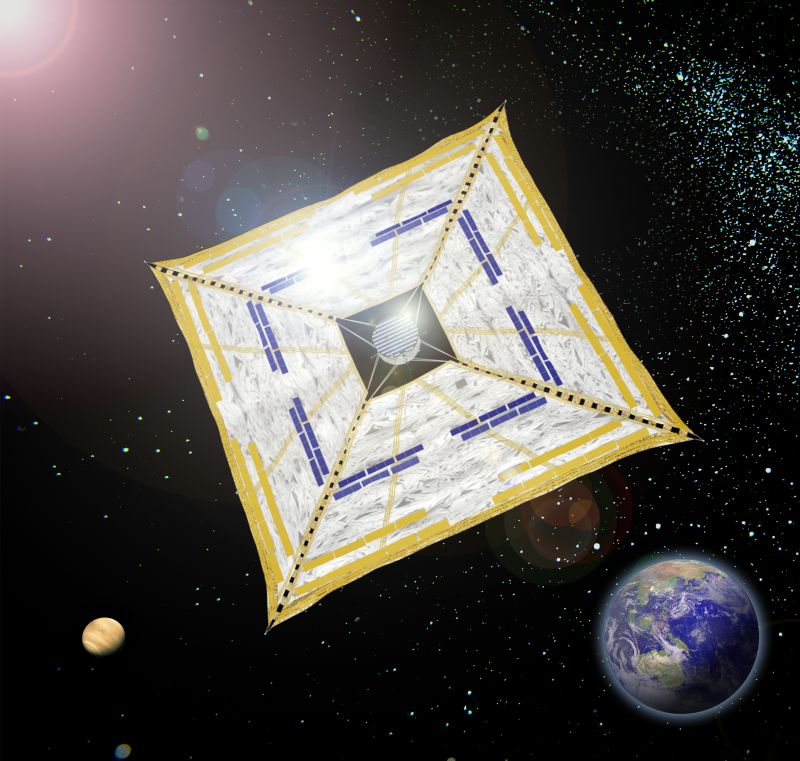
While solar sail projects around the world are starving for funding, in Japan things are different. The Japan Aerospace Exploration Agency (JAXA) is developing a small solar power sail demonstrator, IKAROS (Interplanetary Kite-craft Accelerated by Radiation Of the Sun). IKAROS is equipped with a square sail made of polyimide resin and 0.0075 mm thick. Long-term plans of the agency include a medium-sized solar power sail with a diameter of 50 m and ion-propulsion engines that will explore the Trojan asteroids and Jupiter.


The solar power sail is a slightly different concept than the traditional solar sail. In addition to the solar sail, the solar power sail has a thin film of solar cells deployed on the membrane. The solar cells generate electricity that can be used to power ion-propulsion engines onboard the spacecraft. Fuel-effective mission profiles are made possible by such hybrids.


IKAROS will be launched from the Tanegashima Space Center on top of a H-II launch vehicle. It will share the ride with the Venus Climate Orbiter “AKATSUKI”.


JAXA is committed to leading the research and the development of solar sails:
“JAXA will lead future solar system exploration using solar power sails. Our missions will lead to lower cost in the solar cells market, whose growth is a key factor for global warming prevention. Those low-cost solar cells are also the foundation of future solar power satellite systems.”


Centauri Dreams presents the comments of Osamu Mori, the project leader for the sail mission, on the solar-powered attitude control system of the spacecraft and the deployment method of the sail. You can find more information about IKAROS on JAXA’s web site.


  • Facebook
  • Google
  • Slashdot
  • Reddit
  • Live
  • TwitThis
March 8, 2010

Kepler Anniversary

Posted by


Credits: NASA/Kim Shiflett


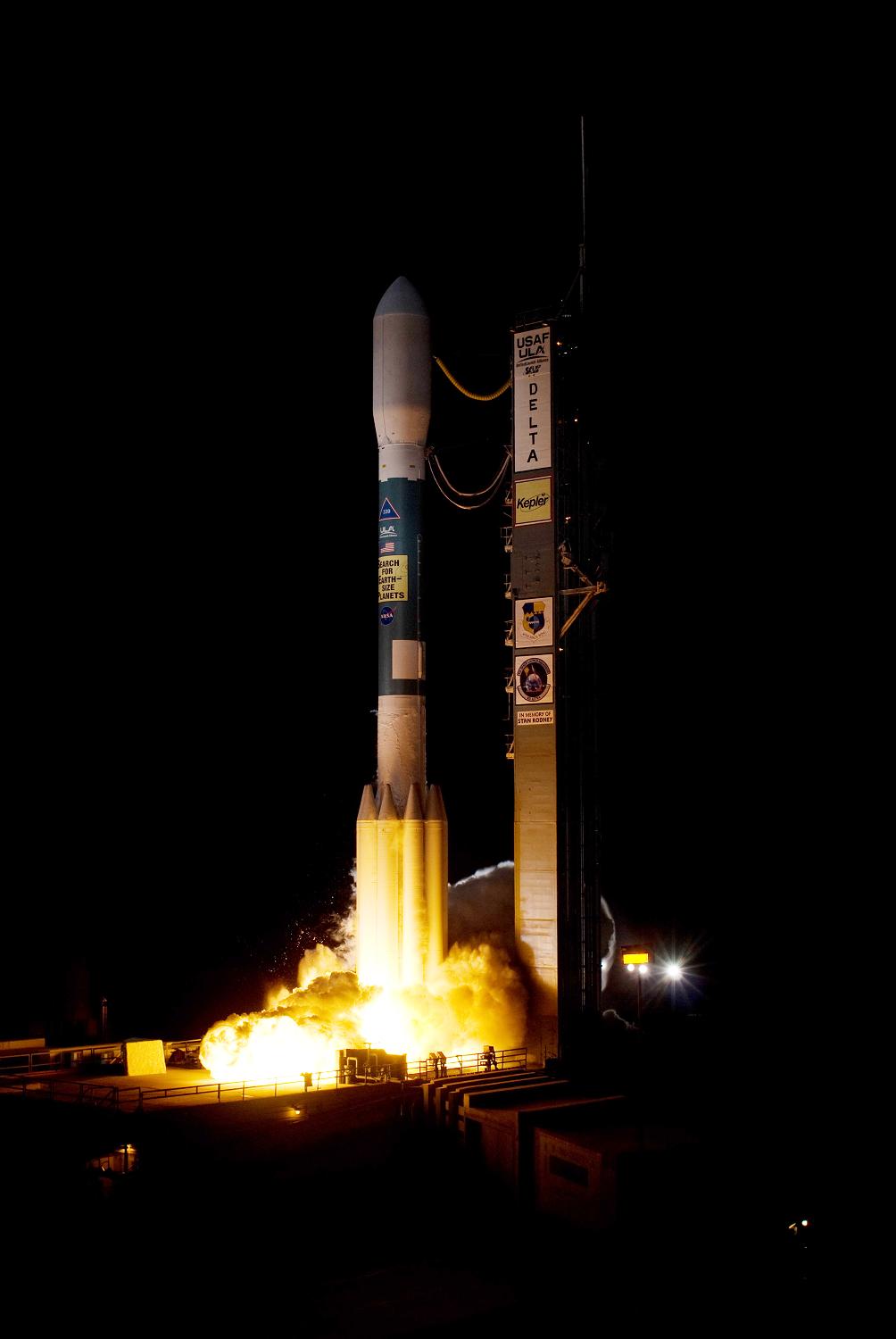
On March 6, 2009, the Delta II launch vehicle carrying the Kepler spacecraft lifted off from Launch Complex 17-B at Cape Canaveral Air Force Station in Florida.


In May 2009, Kepler started to hunt for other Earth-like planets in our galaxy. The technique used by Kepler to discover exo-planets is called transits. The large field of view of the Kepler telescope simultaneously captures the light of a very large number of stars in the Cygnus and Lyra constellations.


Kepler scientists already announced the discovery of five exoplanets named Kepler 4b, 5b, 6b, 7b, and 8b. The data collected by Kepler was also used to detect the atmosphere of the HAT-P-7b giant gas planet.


Kepler is expected to be operational until at least November 2012. Scientists hope to discover exo-planets in the habitable zone of other stars. The habitable zone is a region around a star where water can exist in liquid form on the surface of a planet. You can find more information about Kepler on NASA’s Kepler Mission website.


  • Facebook
  • Google
  • Slashdot
  • Reddit
  • Live
  • TwitThis