OrbitalHub

The place where space exploration, science, and engineering meet

Domain is for sale. $50,000,000.00 USD. Direct any inquiries to contact@orbitalhub.com.


Credits: CSA


RADARSAT-1 is the first commercial Earth observation satellite developed in Canada, and it is equipped with a powerful synthetic aperture radar (SAR) instrument.


Launched on November 4, 1995, from Vandenberg Air Force Base in California, the satellite is well beyond the planned five-year lifetime, and continues to provide images of the Earth for both scientific and commercial applications.


Canada is involved in space debris mitigation research and development activities. In Canada, these activities are coordinated by the Canadian Space Agency, which formed a group, the Orbital Debris Working Group, in order to address a number of objectives such as to increase the knowledge and awareness of orbital debris in the space community, to encourage research in orbital debris and mitigation measures, and to support development of orbital debris detection and collision avoidance techniques and technologies.


In Canada, the space operators and manufacturers are adopting space debris mitigation measures on a voluntary basis. Existing guidelines are used for monitoring activities to prevent on-orbit collisions and conduct post-mission disposal procedures. Space system manufacturers have to provide, among other things, information regarding the method of disposal for the satellite and the estimated duration of the satellite disposal operation.


Credits: NASA/GSFC Scientific Visualization Studio


The Canadian Space Agency has prepared post-mission disposal plans for its remote sensing satellite RADARSAT-1, plans that comply with the guidelines of the United Nations document entitled Guidelines for Space Debris Mitigation and with the measures required for the space hardware manufacturers in Canada.


The remaining fuel will be used to lower the orbit and orient the satellite so that drag is maximized.


Also, the energy stored in the propellant tanks, the reaction wheels, and the batteries of the satellite will be removed. In this way, the on-orbit retirement period of the satellite is reduced to the lowest possible.


You can find more information about RADARSAT-1 on the Canadian Space Agency’s web site.


  • Facebook
  • Google
  • Slashdot
  • Reddit
  • Live
  • TwitThis
02-21-10

CryoSat-2

Posted by


Credits: ESA – P. Carril


In 2007, projections of sea level rise made by the Fourth Assessment Report of the Intergovernmental Panel on Climate Change were in the range of 28–43 cm by 2100, but there are new projections of the sea level rise that are in the order of 1.4 m.


While the trend is quite obvious, it is very important to be able to make accurate predictions.


Cryosat has been designed to measure the ice thickness on land and also at sea, and will provide enough data so that a precise rate of change of the ice thickness can be determined. A better understanding of how the volume of ice on Earth is changing will also be possible.


The declared primary goals of the CryoSat mission are to determine the regional trends in Arctic perennial sea-ice thickness and mass, and to determine the contribution that the Antarctic and Greenland ice sheets are making to mean global rise in sea level. Cryosat will also measure the variations in the thickness of Earth’s polar caps and glaciers. The spacecraft will be operational for a minimum of three years.


Credits: ESA/P. Carril


The spacecraft has a launch mass of 720 kg, of which 23 kg is the fuel required for orbital maneuvers and attitude corrections. The overall size of the spacecraft is 4.6 m x 2.34 m. Two solar panels are attached to the spacecraft’s body and provide a maximum of 800 W of power. As the CryoSat-2 orbit is not Sun-synchronous, providing enough power to the scientific payload has been a considerable challenge.


The operational orbit will be a 717 km non Sun-synchronous orbit with a 92 degree inclination.


The primary payload of the CryoSat-2 spacecraft is the SAR/Interferometric Radar Altimeter (SIRAL). In order to have the position of the spacecraft accurately tracked, a radio receiver called Doppler Orbit and Radio Positioning Integration by Satellite (DORIS) and a laser retro-reflector are part of the payload as well. A global network of laser ranging stations (the International Laser Ranging Service or ILRS for short) will support the mission. Three star-trackers will ensure a proper orientation of the spacecraft.


Using the Synthetic Aperture technique, CryoSat-2 measurements taken by SIRAL will have a 250 m resolution in the along-track direction. The instrument is designed to operate in three measurement modes: Low Resolution Mode (LRM) mostly over the oceans, Synthetic Aperture Radar (SAR) mode over sea-ice areas, and SAR Interferometric (SARIn) mode over steeply sloping ice-sheet margins, small ice caps, and mountain glaciers.


Credits: ESA – AOES Medialab


CryoSat-2 will be placed in orbit by a Dnepr launch vehicle. With a lift-off mass of 211 tons, Dnepr is 34 m long and 3 m in diameter, and has three stages that use hypergolic liquid propellants (N2O4 nitrogen peroxide and UDMH unsymmetrical dimethylhydrazine). In addition, there are Dnepr configurations with a third and a fourth stage for missions that require more energy. The launch vehicle is based on an ICMB designated as SS-18 Satan by NATO. The development and commercial operation of the Dnepr Space Launch System is managed by the International Space Company (ISC) Kosmotras. Dnepr can lift 4,500 kg to low Earth orbit (LEO) or 2,300 kg to a 98 degree Sun-synchronous orbit. Among other satellites launched by Dnepr are Demeter, Genesis I, Genesis II, and THEOS. Dnepr, carrying Cryosat-2, will lift off from Baikonur Cosmodrome in Kazakhstan.


The Rockot launch vehicle that attempted the orbiting of the first CryoSat mission, on October 8, 2005, failed to reach orbit. Due to faults in the onboard software, the second stage engine of the launcher did not shut down. The mission was terminated when the launch vehicle exceeded the flight envelope limit. The Rockot second stage/Breeze-KM/CryoSat stack crashed somewhere in the Arctic Ocean.


You can find more information about Cryosat-2 on ESA’s dedicated website. The Cryosat-2 mission EADS team also has a blog on EADS Astrium website. Check out the latest updates from Baikonur brought to you by Klaus Jäger (Astrium Spacecraft Launch Manager) and Edmund Paul (Astrium Spacecraft Operations Manager). A presentation of the SIRAL-2 instrument is available on Thales Group’s website.


  • Facebook
  • Google
  • Slashdot
  • Reddit
  • Live
  • TwitThis
01-17-10

Sentinel

Posted by


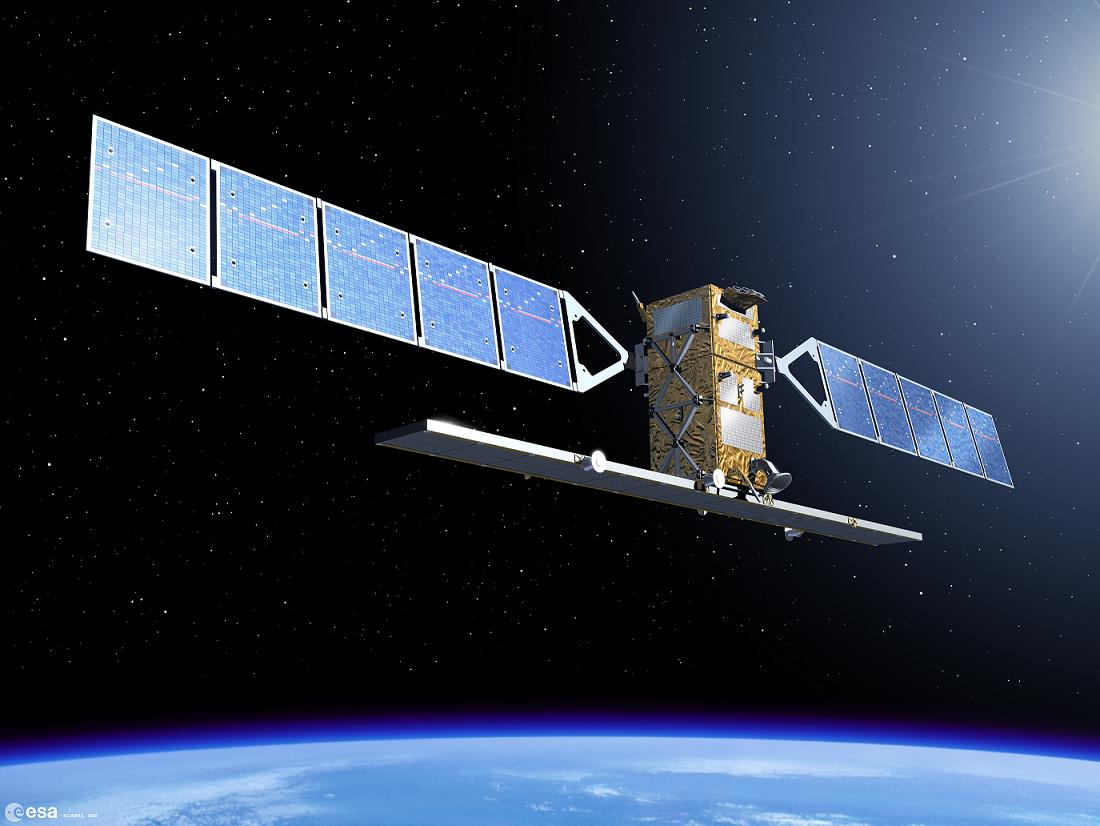
Credits: ESA – P.Carril


The European Union’s Global Monitoring for Environment and Security (GMES) initiative was born as the result of a growing need for accurate and accessible information about the environment, the effects of climate change, and civil security. GMES uses as its main information feed the data collected by satellites developed by ESA. Data is also collected by instruments carried by aircraft, floating in the ocean, or located on the ground.


GMES provides services that can be grouped into five main categories: land management, marine environment, atmosphere, aid emergency response, and security.


There are five Sentinel missions designed as components of the GMES initiative. These missions will complement the national initiatives of the EU members involved. The missions will collect data for land and ocean monitoring, and atmospheric composition monitoring, making use of all-weather radar and optical imaging. Each of the Sentinel missions is based on a constellation of two satellites.


Sentinel-1 is an all-weather radar-imaging mission. The satellites will have polar orbits and collect data for the GMES land and ocean services. The first satellite is scheduled for launch in 2012. Sentinel-1 will ensure the continuity of Synthetic Aperture Radar (SAR) applications, taking over from systems carried by ERS-1, ERS-2, Envisat, and Radarsat. Sentinel-1 satellites will be carried to orbit by Soyuz launch vehicles lifting off from Kourou.


Sentinel-2 will provide high-resolution multi-spectral imagery of vegetation, soil, and water, and will cover inland waterways and coastal areas. Sentinel-2 is designed for the data continuity of missions like Landsat or SPOT (Satellite Pour l’Observation de la Terre). Each satellite will carry a Multi-Spectral Imager (MSI) that can ‘see’ in thirteen spectral bands spanning from the visible and near infrared (VNIR) to the shortwave infrared (SWIR). The first Sentinel-2 is planned to launch in 2013. Vega will provide launch services for Sentinel-2 missions.


Credits: ESA – P.Carril


Sentinel-3 will determine parameters such as sea-surface topography and sea and land surface temperature. It will also determine ocean and land colour with high accuracy. The first Sentinel-3 satellite is expected to reach orbit in 2013. The spacecraft bus has a three-meter accuracy real-time orbit determination capability based on GPS and Kalman filtering.


Sentinel-4 is devoted to atmospheric monitoring and it will consist of payloads carried by Meteosat Third Generation (MTG) satellites that are planned to launch in 2017 and 2024. Sentinel-5 will be used for atmospheric monitoring as well. The payload will be carried by a post-EUMETSAT Polar System (EPS) spacecraft, planned to launch in 2020. A Sentinel-5 precursor will ensure that no data gap will exist between the Envisat missions and Sentinel-5.


You can find out more about the GMES initiative and the Sentinel missions on a dedicated page on ESA’s website.


  • Facebook
  • Google
  • Slashdot
  • Reddit
  • Live
  • TwitThis