OrbitalHub

The place where space exploration, science, and engineering meet

Domain is for sale. $50,000,000.00 USD. Direct any inquiries to contact@orbitalhub.com.

02-16-18

Eta Carinae

Posted by


ESA dixit:

“ESA’s XMM-Newton has spotted surprising changes in the powerful streams of gas from two massive stars, suggesting that colliding stellar winds don’t behave as expected. Massive stars – several times larger than our Sun – lead turbulent lives, burning their nuclear fuel rapidly and pouring large amounts of material into their surroundings throughout their short but sparkling lives.

These fierce stellar winds can carry the equivalent of Earth’s mass in a month and travel at millions of kilometres per hour, so when two such winds collide they unleash enormous amounts of energy. The cosmic clash heats the gas to millions of degrees, making it shine brightly in X-rays.

Normally, colliding winds change little because neither do the stars nor their orbits. However, some massive stars behave dramatically. This is the case with HD 5980, a pairing of two huge stars each 60 times the mass of our Sun and only about 100 million kilometres apart – closer than we are to our star. One had a major outburst in 1994, reminiscent of the eruption that turned Eta Carinae into the second brightest star in the sky for about 18 years in the 19th century. While it is now too late to study Eta Carinae’s historic eruption, astronomers have been observing HD 5980 with X-ray telescopes to study the hot gas.”

Read more…

Video credit: ESA


  • Facebook
  • Google
  • Slashdot
  • Reddit
  • Live
  • TwitThis


NASA dixit:

“Astronomers studying the star RZ Piscium have found evidence suggesting its strange, unpredictable dimming episodes may be caused by vast orbiting clouds of gas and dust, the remains of one or more destroyed planets.

Young stars are often prodigious X-ray sources. Observations using the European Space Agency’s XMM-Newton satellite, show that RZ Piscium is, too. Its total X-ray output is roughly 1,000 times greater than our Sun’s. Ground-based observations show the star’s surface temperature to be about 9,600 degrees Fahrenheit (5,330 degrees Celsius), only slightly cooler than the Sun’s. They also show RZ Piscium is enriched in the tell-tale element lithium, which is slowly destroyed by nuclear reactions inside stars and serves as a clock indicating the elapsed time since a star’s birth.

Ground-based telescopes also reveal large amounts of dust and hydrogen-rich gas in the system, suggesting that large blobs of this material are orbiting the star and causing the brightness dips.

The best explanation that accounts for all of the available data, say the researchers, is that the star is encircled by debris representing the aftermath of a disaster of planetary proportions. It’s possible the star’s tides may be stripping material from a close substellar companion or giant planet, producing intermittent streams of gas and dust, or that the companion is already completely dissolved. Another possibility is that one or more massive gas-rich planets in the system underwent a catastrophic collision in the astronomically recent past.”

Music: “Frozen Wonder” from Killer Tracks

Video credit: NASA’s Goddard Space Flight Center/CI Lab


  • Facebook
  • Google
  • Slashdot
  • Reddit
  • Live
  • TwitThis


NASA dixit:

“This artist’s rendering illustrates new findings about a star shredded by a black hole. When a star wanders too close to a black hole, intense tidal forces rip the star apart. In these events, called “tidal disruptions,” some of the stellar debris is flung outward at high speed while the rest falls toward the black hole. This causes a distinct X-ray flare that can last for a few years. NASA’s Chandra X-ray Observatory, Swift Gamma-ray Burst Explorer, and ESA/NASA’s XMM-Newton collected different pieces of this astronomical puzzle in a tidal disruption event called ASASSN-14li, which was found in an optical search by the All-Sky Automated Survey for Supernovae (ASAS-SN) in November 2014. The event occurred near a super-massive black hole estimated to weigh a few million times the mass of the sun in the center of PGC 043234, a galaxy that lies about 290 million light-years away. Astronomers hope to find more events like ASASSN-14li to test theoretical models about how black holes affect their environments.

During the tidal disruption event, filaments containing much of the star’s mass fall toward the black hole. Eventually these gaseous filaments merge into a smooth, hot disk glowing brightly in X-rays. As the disk forms, its central region heats up tremendously, which drives a flow of material, called a wind, away from the disk.”

Video credit: NASA’s Goddard Space Flight Center


  • Facebook
  • Google
  • Slashdot
  • Reddit
  • Live
  • TwitThis


Credits: NASA/JPL


The Nuclear Spectroscopic Telescope Array (NuSTAR) is a high-energy X-ray space telescope that will expand our understanding of the origins and the development of stars and galaxies.


NuSTAR was proposed to NASA in May 2003. In 2006, while NuSTAR was undergoing an extended feasibility study, NASA cancelled the program due to budgetary constraints. However, in September 2007, the program was restarted.


In 2007, Orbital Sciences Corporation was selected by NASA to design, manufacture, and test the NuSTAR telescope.


The spacecraft is based on a proven design, used by Orbital for other NASA Small Explorer missions: SORGE, GALEX, AIM, and OCO. NuSTAR will have a launch mass of 360 kg, and will be powered by articulated solar arrays providing 600 W.


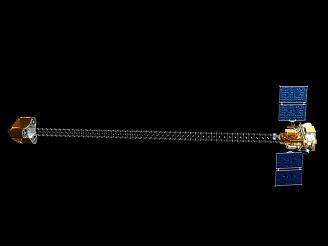
The spacecraft incorporates a ten-meter long extendable mast. The mast allows the telescope to fit into a small launch vehicle.


The technology used to build the telescope is not new. A team of researchers, led by Dr. Fiona Harrison, professor of physics and astronomy at Caltech, has been improving the NuSTAR technology for the last ten years. A previous high energy X-ray telescope (High Energy Focusing Telescope or HEFT) was developed as part of a high altitude balloon payload.


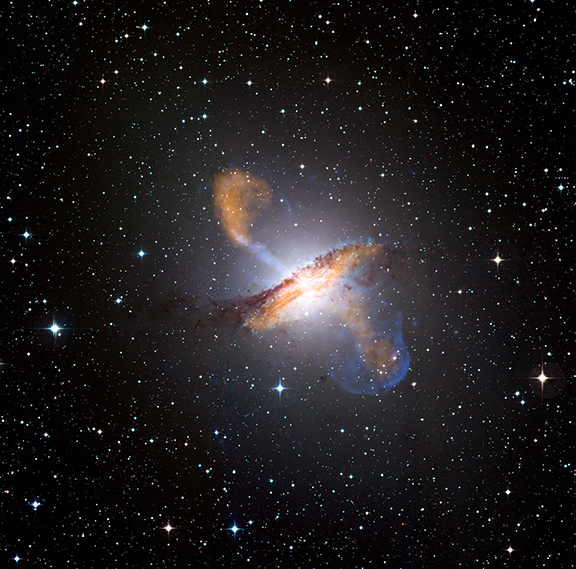
The currently operational X-ray telescopes, Chandra and XMM-Newton, observe the sky in the low energy X-ray spectrum (X-ray energies less than 10 keV). NuSTAR will make observations in a higher range, up to 79 keV. As much of the energy emitted by a black hole is absorbed by the surrounding gas and dust, observations in the high-energy X-ray spectrum can reveal in greater detail what is happening closer to the event horizon.
 

Credit: NASA/CXC/CfA/R.Kraft et al./MPIfR/ESO/APEX/A.Weiss et al./ESO/WFI


The NuSTAR telescope will have a sensitivity two orders of magnitude greater than any other instrument used to detect black holes. NuSTAR will help scientists understand how black holes are distributed throughout the universe, and what powers the most active galaxies.


The NuSTAR instrument consists of two co-aligned hard X-ray telescopes. The ten-meter mast mentioned above separates the mirrors and the imaging detectors. The detectors are Cadmium Zinc Telluride (CdZnTe) detectors and do not require cryogenic operation.


On February 9, 2009, NASA awarded Orbital the launch services contract for the NuSTAR mission. The telescope will be launched in 2011 aboard a Pegasus XL launch vehicle. Pegasus XL will be carried beneath a L-1011 aircraft and released over the Pacific Ocean. The air-launch system is very cost-effective, providing flexibility during operation and requiring minimal ground support.


NuSTAR will be deployed into a 525×525 km low Earth orbit (LEO) with a twenty-seven degree inclination.


For more details about the science of NuSTAR, you can visit the mission’s home page at Caltech. Orbital has also posted a NuSTAR fact sheet on their web site.

 

  • Facebook
  • Google
  • Slashdot
  • Reddit
  • Live
  • TwitThis
10-22-08

Newton Phone Home

Posted by


Credits: ESA


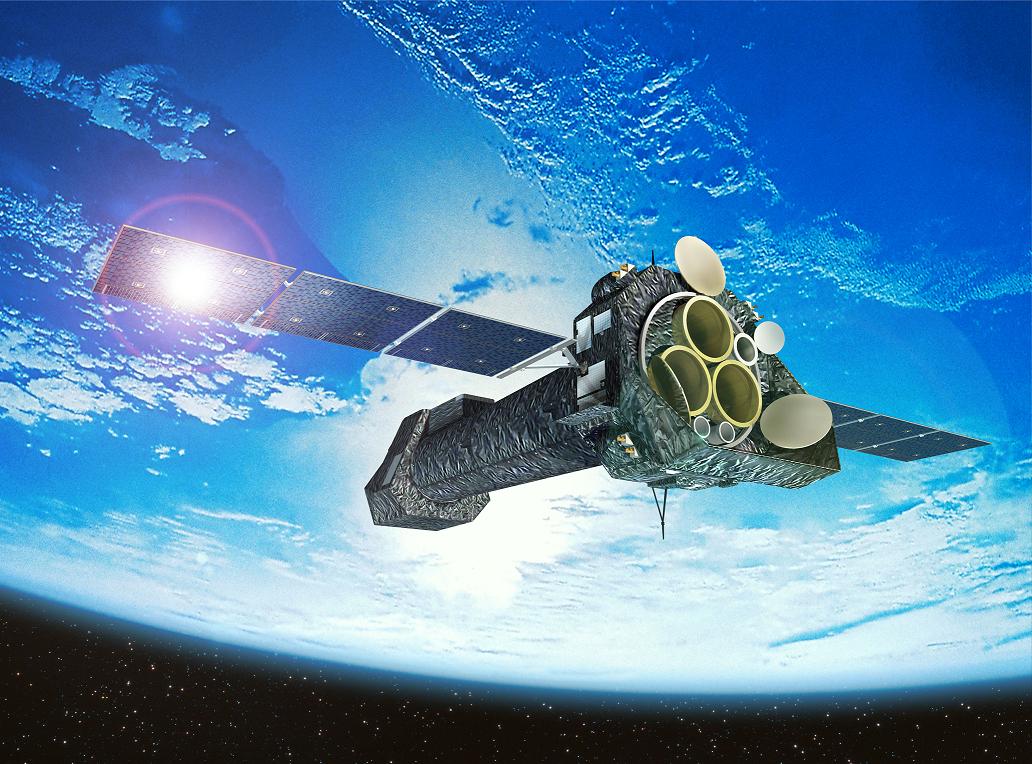
After operating flawlessly in orbit for almost nine years, the XMM-Newton X-ray observatory lost contact with the ESA’s ground stations.


In the case of a space mission, losing contact with a spacecraft can mean anything from a technical problem onboard to a collision with space debris or even a meteorite.


The contact was lost when the satellite switched from one ground station to another. The satellite must perform such operations in orbit in order to maintain radio contact with the ground control center of the mission. The ESA’s ground station in Villafranca, Spain, reported that it was not able to re-establish radio contact with the satellite.


Several astronomic observatories have managed to take images of the satellite in orbit. By now it is clear to the ground investigators that the satellite is intact and it is maintaining a constant altitude on the expected orbit. By using a more powerful ground antenna (the 35m diameter antenna at New Norcia in Australia), a weak radio transmission was received from XMM-Newton, proving that the satellite is still alive. Engineers hope to re-establish nominal radio contact with the satellite.


Credits: NASA/ESA/R. Massey (Caltech)


ESA launched the X-ray Multi-Mirror Mission (XMM-Newton) on December 10th, 1999. The mission has an operational lifetime of ten years. XMM-Newton has a large collecting area due to its three X-ray telescopes. In addition, the high altitude orbit offers the ability to make long uninterrupted exposures.


X-rays are absorbed by the Earth’s atmosphere, so only a space telescope like XMM-Newton can detect and study celestial X-ray sources.


Data collected by the XMM-Newton was used to compile a three-dimensional large-scale map of the dark matter for the first time. The dark matter is an invisible form of matter that accounts for most of the mass of the Universe.


ESA has an entire website dedicated to the XMM-Newton mission. For more details about XMM-Newton you can visit the XMM-Newton Science Operations Center (XMM-Newton SOC) page.


  • Facebook
  • Google
  • Slashdot
  • Reddit
  • Live
  • TwitThis