OrbitalHub

The place where space exploration, science, and engineering meet

Domain is for sale. $50,000,000.00 USD. Direct any inquiries to contact@orbitalhub.com.


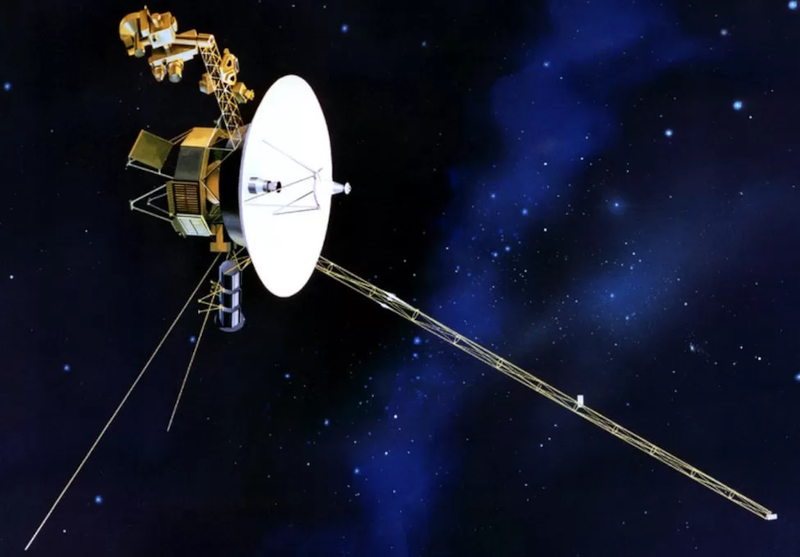
On February 27, 2026, Voyager 1 experienced an unexpected drop in power levels during a routine roll maneuver. The spacecraft, now more than 25 billion kilometers from Earth, relies on a radioisotope thermoelectric generator that produces less electricity each year as its plutonium fuel decays. The February anomaly triggered a response from mission engineers at NASA’s Jet Propulsion Laboratory in Pasadena, who recognized that any further power decline could force the spacecraft’s fault protection system to shut down systems autonomously, a recovery process that would carry significant risk for a spacecraft operating in interstellar space.

The team acted before that became necessary. On April 17, 2026, engineers sent commands to shut down the Low-Energy Charged Particles experiment aboard Voyager 1, an instrument that had operated nearly continuously since the spacecraft launched in September 1977. The LECP measures ions, electrons, and cosmic rays originating from both the solar system and the galaxy beyond, and it played a central role in confirming that Voyager 1 had crossed the heliopause into interstellar space in 2012. Turning it off was not a decision made under pressure. Years earlier, the science and engineering teams had agreed on a sequence for shutting down spacecraft systems while preserving the mission’s ability to continue collecting data. The LECP was simply next on the list.

The command had to travel 23 hours to reach the spacecraft, and the shutdown process itself took another three hours and fifteen minutes. Of the ten instrument sets Voyager 1 carries, seven have now been turned off. Voyager 2 lost its LECP in March 2025. Both spacecraft now retain two science instruments each: the Plasma Wave Subsystem, which detects oscillations in the charged particle environment, and the Magnetometer, which measures the strength and direction of magnetic fields in interstellar space. These two instruments provide the only ongoing measurements of the region beyond the Sun’s protective bubble, and keeping them operating is the mission’s overriding priority.

The shutdown buys approximately one year of additional operation. During that time, engineers are finalizing a more ambitious fix they call the Big Bang, named with characteristic mission humor for the dramatic swap of multiple powered systems at once. The concept involves turning off a group of higher-power devices and simultaneously activating lower-power alternatives that serve the same thermal and operational functions. Keeping the spacecraft warm enough to prevent its fuel lines from freezing is the central challenge. The plutonium generator provides heat as well as electricity, and as output declines, the thermal margin that protects tubing and mechanisms narrows. The Big Bang approach addresses this by shedding power loads that are less critical while maintaining the thermal environment the spacecraft needs to survive.

The team will test the procedure on Voyager 2 first, beginning in May and running through June 2026. Voyager 2 is closer to Earth, making communication more responsive, and it has slightly more power margin than its twin, making it the safer test subject. If the May-June tests succeed, engineers will attempt the same swap on Voyager 1 no earlier than July 2026. There is even a possibility that Voyager 1’s LECP could be switched back on if the power savings materialize as projected.

Both Voyagers lose approximately four watts of power per year. At launch, each generator produced about 470 watts. They now produce roughly 250 watts, and the decline continues. The spacecraft were built to last five years. They have now operated for nearly 49. The Big Bang represents the latest in a series of engineering compromises that have kept the probes functional far beyond anyone’s expectation, trading instrument capabilities for survival, and survival for the chance to keep returning data from a region of space that no other human-made object will reach for generations, if ever again.

The one-light-day milestone, when Voyager 1 reaches exactly the distance that light travels in one day, approximately 25.9 billion kilometers, is expected in November 2026. It will be a symbolic moment. The real story is quieter: a team of engineers, some of them not yet born when the spacecraft launched, making decisions about power allocation and instrument status for two probes that crossed the boundary between solar system and galaxy before most people reading this were born.

Radioisotope thermoelectric generators convert heat from radioactive decay into electricity through the Seebeck effect, where temperature differences between semiconductor materials generate a voltage. The Voyager RTGs contain plutonium-238, which decays with a half-life of 87.7 years, meaning the fuel supply shrinks by roughly 0.8 percent each year. The generator’s electrical output follows roughly the same curve, which is why the four-watts-per-year decline is predictable and planned for.

The thermal output of the RTG, currently around 2,400 watts, exceeds its electrical output by an order of magnitude. This heat is not waste; it is the primary thermal management mechanism for the spacecraft. The electronics and propulsion systems are designed to operate within a specific temperature range, and the RTG’s warmth keeps them there. As the generator cools, the thermal margin decreases, requiring engineers to balance electrical load against thermal load in ways that were not anticipated during the 1970s design phase.

The fault protection system that nearly triggered in February operates on voltage thresholds. If power drops below a certain level, the spacecraft automatically shuts down non-essential systems to preserve core functions. The shutdown is designed to be recoverable, but recovery requires the spacecraft to orient its high-gain antenna toward Earth and receive commands, a process that takes time and is complicated by the 23-hour communication delay. More importantly, an uncontrolled shutdown could leave the spacecraft in a state where instruments needed for science are offline. Preventing that scenario drove the decision to shut down LECP deliberately rather than wait for the fault system to act.

The Big Bang, if successful, will further reduce power consumption by switching to redundant systems that draw less current while performing the same thermal maintenance functions. The switch must be simultaneous because the spacecraft’s thermal control depends on continuous heat input. Any gap in heating could allow components to cool below their minimum operating temperature, causing damage that would be irreversible at 25 billion kilometers.


  • Facebook
  • Google
  • Slashdot
  • Reddit
  • Live
  • TwitThis
07-27-18

Voyager Images

Posted by


Wikipedia dixit:

“The Voyager program is an American scientific program that employs two robotic probes, Voyager 1 and Voyager 2, to study the outer Solar System. The probes were launched in 1977 to take advantage of a favorable alignment of Jupiter, Saturn, Uranus and Neptune. Although their original mission was to study only the planetary systems of Jupiter and Saturn, Voyager 2 continued on to Uranus and Neptune. The Voyagers now explore the outer boundary of the heliosphere in interstellar space; their mission has been extended three times and they continue to transmit useful scientific data. Neither Uranus nor Neptune has been visited by a probe other than Voyager 2.

On 25 August 2012, data from Voyager 1 indicated that it had become the first human-made object to enter interstellar space, traveling “further than anyone, or anything, in history”. As of 2013, Voyager 1 was moving with a velocity of 17 kilometers per second (11 mi/s) relative to the Sun.

Data and photographs collected by the Voyagers’ cameras, magnetometers and other instruments, revealed unknown details about each of the four giant planets and their moons. Close-up images from the spacecraft charted Jupiter’s complex cloud forms, winds and storm systems and discovered volcanic activity on its moon Io. Saturn’s rings were found to have enigmatic braids, kinks and spokes and to be accompanied by myriad “ringlets”. At Uranus, Voyager 2 discovered a substantial magnetic field around the planet and ten more moons. Its flyby of Neptune uncovered three rings and six hitherto unknown moons, a planetary magnetic field and complex, widely distributed auroras. Voyager 2 is the only spacecraft to have visited the two ice giants.”

Credits Video: NASA


  • Facebook
  • Google
  • Slashdot
  • Reddit
  • Live
  • TwitThis
05-29-18

Voyager Images

Posted by


Wikipedia dixit:

“The two Voyager space probes were originally conceived as part of the Mariner program, and they were thus initially named Mariner 11 and Mariner 12. They were then moved into a separate program named “Mariner Jupiter-Saturn”, later renamed the Voyager Program because it was thought that the design of the two space probes had progressed sufficiently beyond that of the Mariner family to merit a separate name.

The Voyager Program was similar to the Planetary Grand Tour planned during the late 1960s and early 70s. The Grand Tour would take advantage of an alignment of the outer planets discovered by Gary Flandro, an aerospace engineer at the Jet Propulsion Laboratory. This alignment, which occurs once every 175 years, would occur in the late 1970s and make it possible to use gravitational assists to explore Jupiter, Saturn, Uranus, Neptune, and Pluto. The Planetary Grand Tour was to send several pairs of probes to fly by all the outer planets (including Pluto, then still considered a planet) along various trajectories, including Jupiter-Saturn-Pluto and Jupiter-Uranus-Neptune. Limited funding ended the Grand Tour program, but elements were incorporated into the Voyager Program, which fulfilled many of the flyby objectives of the Grand Tour except a visit to Pluto.

Voyager 2 was the first to launch. Its trajectory was designed to allow flybys of Jupiter, Saturn, Uranus, and Neptune. Voyager 1 was launched after Voyager 2, but along a shorter and faster trajectory that was designed to provide an optimal flyby of Saturn’s moon Titan, which was known to be quite large and to possess a dense atmosphere. This encounter sent Voyager 1 out of the plane of the ecliptic, ending its planetary science mission. Had Voyager 1 been unable to perform the Titan flyby, the trajectory of Voyager 2 could have been altered to explore Titan, forgoing any visit to Uranus and Neptune. Voyager 1 was not launched on a trajectory that would have allowed it to continue to Uranus and Neptune, but could have continued from Saturn to Pluto without exploring Titan.

During the 1990s, Voyager 1 overtook the slower deep-space probes Pioneer 10 and Pioneer 11 to become the most distant human made object from Earth, a record that it will keep for the foreseeable future. The New Horizons probe, which had a higher launch velocity than Voyager 1, is traveling more slowly due to the extra speed Voyager 1 gained from its flybys of Jupiter and Saturn. Voyager 1 and Pioneer 10 are the most widely separated human made objects anywhere, since they are traveling in roughly opposite directions from the Solar System.

In December 2004, Voyager 1 crossed the termination shock, where the solar wind is slowed to subsonic speed, and entered the heliosheath, where the solar wind is compressed and made turbulent due to interactions with the interstellar medium. On December 10, 2007, Voyager 2 also reached the termination shock, about 1 billion miles closer to the Sun than from where Voyager 1 first crossed it, indicating that the Solar System is asymmetrical.

In 2010 Voyager 1 reported that the outward velocity of the solar wind had dropped to zero, and scientists predicted it was nearing interstellar space. In 2011, data from the Voyagers determined that the heliosheath is not smooth, but filled with giant magnetic bubbles, theorized to form when the magnetic field of the Sun becomes warped at the edge of the Solar System.

On 15 June 2012, scientists at NASA reported that Voyager 1 was very close to entering interstellar space, indicated by a sharp rise in high-energy particles from outside the Solar System. In September 2013, NASA announced that Voyager 1 had crossed the heliopause on August 25, 2012, making it the first spacecraft to enter interstellar space.

As of 2017 Voyager 1 and Voyager 2 continue to monitor conditions in the outer expanses of the Solar System. The Voyager spacecraft are expected to be able to operate science instruments through 2020, when limited power will require instruments to be deactivated one by one. Sometime around 2025, there will no longer be sufficient power to operate any science instruments.”

Credits Video: NASA Jet Propulsion Laboratory


  • Facebook
  • Google
  • Slashdot
  • Reddit
  • Live
  • TwitThis
09-24-17

Voyager 2 Trajectory

Posted by


Wikipedia dixit:

“Voyager 2 is a space probe launched by NASA on August 20, 1977, to study the outer planets. Part of the Voyager program, it was launched 16 days before its twin, Voyager 1, on a trajectory that took longer to reach Jupiter and Saturn but enabled further encounters with Uranus and Neptune. It is the only spacecraft to have visited either of the ice giants.

Its primary mission ended with the exploration of the Neptunian system on October 2, 1989, after having visited the Uranian system in 1986, the Saturnian system in 1981, and the Jovian system in 1979. Voyager 2 is now in its extended mission to study the outer reaches of the Solar System and has been operating for 40 years and 29 days as of September 18, 2017. It remains in contact through the Deep Space Network.

At a distance of 115 AU (1.72×10¹⁰ km) from the Sun as of July 30, 2017, Voyager 2 is the fourth of five artificial objects to achieve the escape velocity that will allow them to leave the Solar System. The probe was moving at a velocity of 15.4 km/s (55,000 km/h) relative to the Sun as of December 2014 and is traveling through the heliosheath. Upon reaching interstellar space, Voyager 2 is expected to provide the first direct measurements of the density and temperature of the interstellar plasma.”

Video credit: NASA


  • Facebook
  • Google
  • Slashdot
  • Reddit
  • Live
  • TwitThis
09-23-17

Voyager 1 Trajectory

Posted by


Wikipedia dixit:

“Voyager 1 is a space probe launched by NASA on September 5, 1977. Part of the Voyager program to study the outer Solar System, Voyager 1 launched 16 days after its twin, Voyager 2. Having operated for 40 years and 13 days as of September 18, 2017, the spacecraft still communicates with the Deep Space Network to receive routine commands and return data. At a distance of 139 AU (2.08×10¹⁰ km) from the Sun as of July 1, 2017, it is the farthest spacecraft from Earth as well as the farthest man-made object. It is also the most distant object in the solar system whose location is known, even farther than Eris (96 AU) and V774104 (~103 AU).

The probe’s objectives included flybys of Jupiter, Saturn and Saturn’s large moon, Titan. While the spacecraft’s course could have been altered to include a Pluto encounter by forgoing the Titan flyby, exploration of the moon, which was known to have a substantial atmosphere, took priority. It studied the weather, magnetic fields and rings of the two planets and was the first probe to provide detailed images of their moons.

After completing its primary mission with the flyby of Saturn on November 20, 1980, Voyager 1 became the third of five artificial objects to achieve the escape velocity that will allow them to leave the Solar System. It is pursuing an extended mission to explore the regions and boundaries of the outer heliosphere. On August 25, 2012, Voyager 1 crossed the heliopause to become the first spacecraft to enter interstellar space and study the interstellar medium.

Voyager 1’s extended mission is expected to continue until around 2025 when its radioisotope thermoelectric generators will no longer supply enough electric power to operate its scientific instruments.”

Video credit: NASA


  • Facebook
  • Google
  • Slashdot
  • Reddit
  • Live
  • TwitThis