OrbitalHub

The place where space exploration, science, and engineering meet

Domain is for sale. $50,000,000.00 USD. Direct any inquiries to contact@orbitalhub.com.

10-23-18

Dawn

Posted by


Wikipedia dixit:

“The Dawn mission was designed to study two large bodies in the asteroid belt in order to answer questions about the formation of the Solar System, as well as to test the performance of its ion drive in deep space. Ceres and Vesta were chosen as two contrasting protoplanets, the first one apparently “wet” (i.e. icy and cold) and the other “dry” (i.e. rocky), whose accretion was terminated by the formation of Jupiter. The two bodies provide a bridge in scientific understanding between the formation of rocky planets and the icy bodies of the Solar System, and under what conditions a rocky planet can hold water.

The International Astronomical Union (IAU) adopted a new definition of planet on August 24, 2006, which introduced the term “dwarf planet” for ellipsoidal worlds that were too small to qualify for planetary status by “clearing their orbital neighborhood” of other orbiting matter. Dawn is the first mission to study a dwarf planet, arriving at Ceres a few months before the arrival of the New Horizons probe at Pluto in July 2015.

Ceres comprises a third of the total mass of the asteroid belt. Its spectral characteristics suggest a composition similar to that of a water-rich carbonaceous chondrite. Vesta, a smaller, water-poor achondritic asteroid comprising a tenth of the mass of the asteroid belt, has experienced significant heating and differentiation. It shows signs of a metallic core, a Mars-like density and lunar-like basaltic flows.

Available evidence indicates that both bodies formed very early in the history of the Solar System, thereby retaining a record of events and processes from the time of the formation of the terrestrial planets. Radionuclide dating of pieces of meteorites thought to come from Vesta suggests that Vesta differentiated quickly, in three million years or less. Thermal evolution studies suggest that Ceres must have formed some time later, more than three million years after the formation of CAIs (the oldest known objects of Solar System origin).

Moreover, Vesta appears to be the source of many smaller objects in the Solar System. Most (but not all) V-type near-Earth asteroids, and some outer main-belt asteroids, have spectra similar to Vesta, and are thus known as vestoids. Five percent of the meteoritic samples found on Earth, the howardite–eucrite–diogenite (HED) meteorites, are thought to be the result of a collision or collisions with Vesta.

It is thought that Ceres may have a differentiated interior; its oblateness appears too small for an undifferentiated body, which indicates that it consists of a rocky core overlain with an icy mantle. There is a large collection of potential samples from Vesta accessible to scientists, in the form of over 1,400 HED meteorites, giving insight into Vesta geologic history and structure. Vesta is thought to consist of a metallic iron–nickel core, an overlying rocky olivine mantle and crust.”

Video Credit: NASA


  • Facebook
  • Google
  • Slashdot
  • Reddit
  • Live
  • TwitThis


NASA JPL dixit:

“Dawn delves into the unknown and achieves what’s never been attempted before. A mission in NASA’s Discovery Program, Dawn orbited and explored the giant protoplanet Vesta in 2011-2012, and now it is in orbit and exploring a second new world, dwarf planet Ceres.

Dawn’s goal is to characterize the conditions and processes of its earliest history by investigating in detail two of the largest protoplanets remaining intact since their formation. Ceres and Vesta reside in the main asteroid belt, the extensive region between Mars and Jupiter, along with many other smaller bodies. Each followed a very different evolutionary path, constrained by the diversity of processes that operated during the first few million years of solar system evolution. When Dawn visits Ceres and Vesta, the spacecraft steps us back in solar system time.”

Video credit: NASA/JPL-Caltech/UCLA/MPS/DLR/IDA


  • Facebook
  • Google
  • Slashdot
  • Reddit
  • Live
  • TwitThis


Credits: NASA/MSFC


Solar sails have emerged as a revolutionary propulsion system for space travel. Due to increased interest in both theoretical and experimental research, the benefits of solar sailing have become clear and compelling.


Two leading experts in solar sail propulsion, Gregory Matloff and Les Johnson, have agreed to share their knowledge about this exciting topic with OrbitalHub readers.


Gregory Matloff teaches physics at the New York City College of Technology and consults for NASA’s Marshall Space Flight Center. Les Johnson is a physicist at NASA’s Marshall Space Flight Center, where he serves as the Deputy Manager of the Advanced Concepts Office.


DJ: From the whole range of space technology-related fields of research, why was it that solar sails attracted your attention?
Gregory Matloff: I was attracted to solar sailing because it is an example of space propulsion that requires no fuel. As such, it has the potential to achieve higher velocities at less cost.
Les Johnson: They are simple, elegant and very practical in that they do not require any fuel. We are extremely limited in our exploration of space because of our lack of efficient propulsion. Sails, which require no fuel, will enable some science and exploration missions that are currently impossible (using only chemical rockets).


DJ: In the Solar Sails book, you have presented the problems and limitations of chemical, nuclear, and ion rocket propulsion. Why do you think that, despite these limitations, the solar sail has not yet been adopted as a means of propulsion for interplanetary robotic missions?
G.M.: Solar sails have been slower to achieve operational readiness for a number of reasons. First, space agencies have developed vast rocket-based infrastructures. We simply have more experience with rockets. Second, rockets work on Earth as well as in space. We needed a lot of in-space experience before sail testing in space could begin. Third, space-mission planners are a conservative lot. They (correctly) will not risk their payloads to a sail until the technological readiness of solar sailing is sufficiently advanced.
L.J.: The reasons are simple. 1) Any mission conducted in space is expensive. When you are the owner of a multi-million dollar spacecraft, you tend to become very conservative and risk averse. Even though there are many benefits to be gained from using a solar sail, it is new and therefore risky. We’ve flown hundreds, if not thousands, of rocket engines and not a single solar sail. Would you risk your investment on a new (risky) propulsion system? 2) Anytime you use a new technology, the first flight will be more expensive. If you are paying for a space mission and your budget is limited, you must often choose between what is best (like a solar sail) and what is good enough (like the tried and true rocket engine). Tried and true seems to be the choice right now.
Let me be clear. This may be penny wise but it is pound foolish. If solar sails become an “off the shelf” option like some rocket engines, then we will be going new places and learning things that we simply cannot otherwise accomplish with “tried and true” technologies.


DJ: How many solar sail designs have been considered to date, and which one do you think will prove to be the most successful in the future?
G.M.: There are six or seven different sail designs. These include rectangular (or square), spinning-disc, heliogyro, parachute, hollow-body, parabolic and hoop sails. All these and various other configurations may find application to different missions.
L.J.: There is no clear answer here. NASA and DLR selected the square, 3-axis stabilized approach. The Russians, with their Znamya, appear to prefer a spinning solar sail. Others prefer the heliogyro. All appear to be feasible.


DJ: How well suited is the solar sail for manned space missions?
G.M.: Unfurled near Earth, solar-sails are slow to accelerate but can reach high velocities. Current Earth-launched sail designs could be uprated and enlarged to carry freight to support manned interplanetary expeditions. Future thinner, heat-tolerant and radiation resistant solar sails manufactured in space could result in faster interplanetary transfers and even slow interstellar travel.
L.J.: Any solar sail that we can foresee building in the near term will be useful only for robotic missions. These sails will be big enough — some nearly half a mile on a side! To get the materials and sizes required for a human mission will require advances in materials technology that are difficult to imagine happening anytime soon. Though I am optimistic that they will eventually occur, we prefer the incremental approach. We should begin with using sails to propel robots and move toward a capability for humans.


DJ: How do you think space propulsion systems will evolve in the near future? To what extent will they include solar sails?
G.M.: Future solar-sail evolution requires advances in space infrastructure — notably in-space manufacturing, and materials science. More theoretical work on space environment effects and theories of devices such as the perforated solar sail is also required. Also, space-based solar-pumped lasers could be developed to allow sail acceleration farther from the Sun.
L.J.: I believe we won’t be giving up chemical rockets anytime soon. We will see more and more flights of solar electric propulsion after the (assumed) success of the DAWN mission, which is currently enroute to asteroids Ceres and Vesta. THEN we might see the use of solar sails begin.


Les Johnson and Gregory L. Matloff are two of the co-authors of the book Solar Sails: A Novel Approach To Interplanetary Travel. A good review of the book was written by Paul A. Gilster of Centauri Dreams. I invite everyone to read it.


  • Facebook
  • Google
  • Slashdot
  • Reddit
  • Live
  • TwitThis
02-17-09

Dawn and the Flyby of Mars

Posted by


Credits: NASA/JPL


The Dawn spacecraft is currently performing the Mars flyby phase of its mission. The purpose of the Mars flyby is to alter the trajectory of the spacecraft in order to rendezvous with its first scientific target in the main asteroid belt.


The spacecraft will come within 549 km of the surface of Mars on February 17, 2009, at 4:28 PST.


The flyby is a gravity assist maneuver used in orbital mechanics to alter the trajectory of a spacecraft. The gravity assist is also known as a gravitational slingshot. The first ever gravity assist maneuver was performed by Mariner 10 in February 1974, and most of the interplanetary missions have made use of it since then.


The scientific objective of the Dawn mission is to answer important questions about the origin and the evolution of our solar system. The currently accepted theory about the formation of our solar system states that Jupiter’s gravity interfered with the accretion process, thereby preventing a planet from forming in the region between Jupiter and Mars. This led to the formation of the asteroid belt.


The asteroids chosen as scientific targets for the Dawn mission are Vesta and Ceres. Due to their size, they have survived the collisional phase, and it is believed that they have preserved the physical and chemical conditions of the early solar system. The asteroids have followed different evolutionary paths and have dissimilar characteristics, which makes them perfect research subjects.


Credits: NASA/JPL


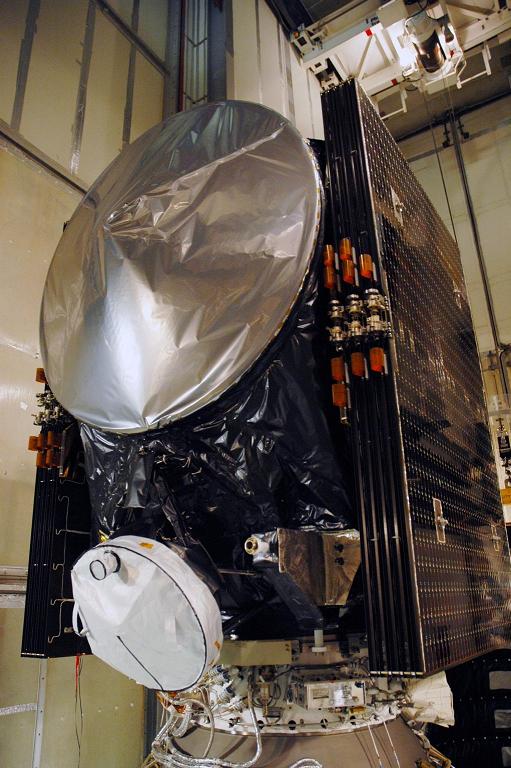
The design of the Dawn spacecraft is based on Orbital’s STAR-2 series, and uses flight-proven components from other Orbital and JPL spacecraft: the propulsion system is based on the design used on Deep Space 1, the attitude control system used on Orbview, a hydrazine-based reaction control system used on the Indostar spacecraft, and command and data handling, as well as flight software, from the Orbview program.


The core structure of the spacecraft is a graphite composite cylinder, while the panels are aluminum core with aluminum/composite face sheets.


The central cylinder hosts the hydrazine and xenon tanks. The hydrazine tank can store 45 kg of fuel, while the xenon tank has a capacity of 450 kg.


The attitude control system (ACS) uses star trackers to estimate attitudes in cruise mode. A coarse Sun sensor (CSS) allows ACS to keep the solar panels normal to the Sun-spacecraft line. ACS also uses the hydrazine-based reaction control system for the control of attitude and for desaturation of the reaction wheels.


Credits: NASA/George Shelton


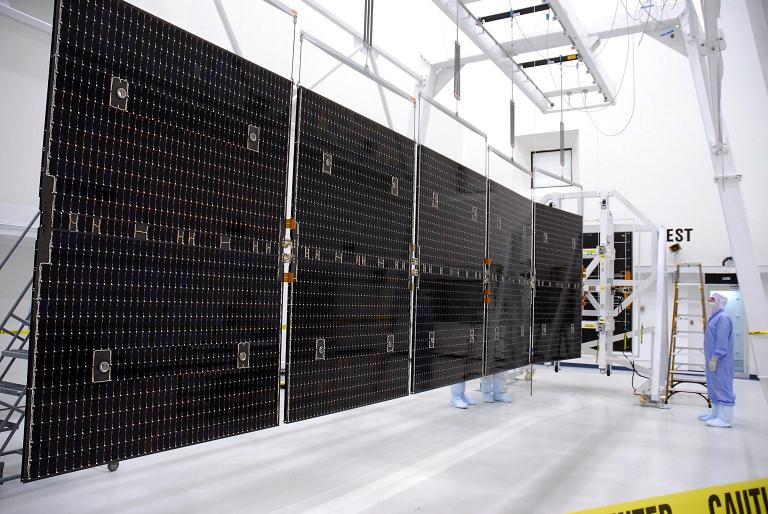
The solar panels are capable of producing more than 10 kW at 1 AU and 1 kW at 3 AU (on Ceres’ orbit).


The command and data handling system (CDHS) is based on a RAD6000 board running VxWorks. The software is written in C. There are 8GB available on the board as storage for engineering and scientific data.


The scientific payload consists of the Framing Camera (FC), the Gamma Ray and Neutron Detector (GRaND), and the visible and infrared (VIR) mapping spectrometer.


The FC will be used for determining the bulk density, the gravity field, for obtaining images of the surface, and for compiling topographic maps of Vesta and Ceres. In addition, the FC will capture images for optical navigation in the proximity of the asteroids. For reliability purposes, the payload includes two identical cameras that can run independently.


GRaND will serve for the determination of the elemental composition of the asteroids. GRaND is the result of the expertise accumulated during the Lunar Prospector and Mars Odyssey programs.


Credits: NASA/Jack Pfaller


VIR will help map the surface mineralogy of the asteroids. The instrument is a modified version of the visible and infrared spectrometer flying on the Rosetta mission.


The Dawn spacecraft uses ion propulsion to make its journey to Vesta and Ceres. Ion propulsion will also be used by Dawn during the low altitude flights over the asteroids.


While the fact that Dawn’s engines have a thrust of only 90 mN can hardly impress a reader, the important detail to mention when discussing propulsion systems is the specific impulse. Dawn’s engines have a specific impulse of 3100 s. For a chemical rocket, the specific impulse ranges from 250 s for solid rockets to 450 s for bipropellant liquid rockets. The only drawback (if this can be regarded as a drawback) is that the ion engines must be fired for much longer in order to achieve an equivalent trajectory.


With such high specific impulse engines, Dawn makes use of the fuel onboard in a very efficient way. The fuel used is xenon, a heavy noble gas placed in group 8A of the periodic table. The power produced by the large solar panels is used to ionize the fuel and then accelerate it with an electric field between two grids. In order to maintain a neutral plasma, electrons are injected into the beam after acceleration.


Credits: NASA/Amanda Diller


Dawn was launched from Cape Canaveral Air Force Station and injected on an interplanetary trajectory by a Delta II launch vehicle.


The main contributors to the Dawn mission are the University of California in Los Angeles (science lead, science operations, data products, archiving, and analysis), the Jet Propulsion Laboratory (project management, systems engineering, mission assurance, payload, navigation, mission operations, level zero data), and the Orbital Sciences Corporation (spacecraft design and fabrication, quality assurance, and payload integration).


The scientific payload was provided by the Los Alamos National Laboratory, the German Aerospace Center, the Max Planck Institute, and the Italian Aerospace Center. The Deep Space Network is responsible for data return from the spacecraft.


For more information about Dawn, you can visit the Dawn Mission Home Page on the JPL web site.


  • Facebook
  • Google
  • Slashdot
  • Reddit
  • Live
  • TwitThis