OrbitalHub

The place where space exploration, science, and engineering meet

Domain is for sale. $50,000,000.00 USD. Direct any inquiries to contact@orbitalhub.com.

06-29-20

Sunsets on Other Worlds

Posted by


NASA dicit:

Geronimo Villanueva, a planetary scientist from NASA’s Goddard Space Flight Center in Greenbelt, Maryland, created the sunset simulations while building a computer modeling tool for a possible future mission to Uranus, an icy-cold planet in the outer solar system. The animations show all-sky views as if you were looking up at the sky through a super wide camera lens from Earth, Venus, Mars, Uranus, and Titan.

Video credit: Geronimo Villanueva/James Tralie/NASA’s Goddard Space Flight Center


  • Facebook
  • Google
  • Slashdot
  • Reddit
  • Live
  • TwitThis


Wikipedia dicit:

Venus is the second planet from the Sun. It is named after the Roman goddess of love and beauty. As the second-brightest natural object in the night sky after the Moon, Venus can cast shadows and, rarely, is visible to the naked eye in broad daylight. Venus lies within Earth’s orbit, and so never appears to venture far from the Sun, setting in the west just after dusk and rising in the east a bit before dawn. Venus orbits the Sun every 224.7 Earth days. With a rotation period of 243 Earth days, it takes longer to rotate about its axis than any planet in the Solar System and goes in the opposite direction to all but Uranus (meaning the Sun rises in the west and sets in the east). Venus does not have any natural satellites, a distinction it shares only with Mercury among planets in the Solar System.

Venus is a terrestrial planet and is sometimes called Earth’s “sister planet” because of their similar size, mass, proximity to the Sun, and bulk composition. It is radically different from Earth in other respects. It has the densest atmosphere of the four terrestrial planets, consisting of more than 96% carbon dioxide. The atmospheric pressure at the planet’s surface is 92 times that of Earth, or roughly the pressure found 900 m (3,000 ft) underwater on Earth. Venus is by far the hottest planet in the Solar System, with a mean surface temperature of 735 K (462 °C; 863 °F), even though Mercury is closer to the Sun. Venus is shrouded by an opaque layer of highly reflective clouds of sulfuric acid, preventing its surface from being seen from space in visible light. It may have had water oceans in the past, but these would have vaporized as the temperature rose due to a runaway greenhouse effect. The water has probably photodissociated, and the free hydrogen has been swept into interplanetary space by the solar wind because of the lack of a planetary magnetic field. Venus’s surface is a dry desertscape interspersed with slab-like rocks and is periodically resurfaced by volcanism.

Video Credit: NASA Goddard


  • Facebook
  • Google
  • Slashdot
  • Reddit
  • Live
  • TwitThis
03-21-19

Venus Dust Ring

Posted by


NASA dicit:

This visualization displays a simulation of the dust ring at Venus’s orbit around the Sun. Scientists hypothesize a group of never-before-detected asteroids orbiting the Sun with Venus are responsible for supplying Venus’s dust ring.

Video Credit: NASA’s Scientific Visualization Studio/Tom Bridgman


  • Facebook
  • Google
  • Slashdot
  • Reddit
  • Live
  • TwitThis


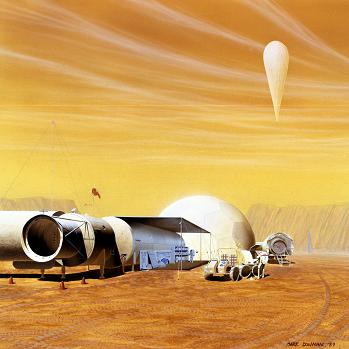
Credits: Mark Dowman


Airships are making a big comeback now as the energy consumption for all modes of transportation is being re-analyzed. Missions with special requirements like surveillance and reconnaissance missions and transportation of heavy payloads to remote outposts are the main driver for the reinvention of the airship.


But Earth is not the only place where airships can be deployed. There are a number of destinations in the solar system that would make a perfect environment for deployment and operation of airships, like Mars, Venus, and Titan – Saturn’s largest moon.


The presence of an atmosphere makes possible the use of vehicles that can fly within atmosphere for planetary exploration. Also, planetary exploration with low-powered vehicles like airships really makes sense considering the fact that energy is always at a premium.


So far, the only extraterrestrial deployment of an airship was performed during the Vega mission to Venus, in 1984. Two balloons were released and they floated 54 km above the planet’s surface for nearly two days.


Lighter-Than-Air (LTA) AERial ROBOTS (AEROBOTS) would present some advantages over their Heavier-Than-Air (HTA) siblings and the traditional planetary scouts, the exploration rovers: they would have long-duration mission and long-distance capabilities, they would not have to deal with obstacle avoidance problems, and they have low-power consumption. However, the environment in which the airship will operate will impose some restrictions on the capabilities of the airship (consider things like atmospheric composition and density, temperature, and the amount of solar radiation available). More on the planetary environments in the solar system and airship evaluations for each one of them can be found here.


NASA has funded a number of projects for solar system exploration that make use of aerobots. The Jet Propulsion Laboratory’s Planetary Aerobot Program is developing balloons to support scientific payloads in the atmosphere of other planets in our solar system. You can find more details about JPL’s Planetary Aerobot Program here.

 

  • Facebook
  • Google
  • Slashdot
  • Reddit
  • Live
  • TwitThis