OrbitalHub

The place where space exploration, science, and engineering meet

Domain is for sale. $50,000,000.00 USD. Direct any inquiries to contact@orbitalhub.com.


Credits: NASA/JPL


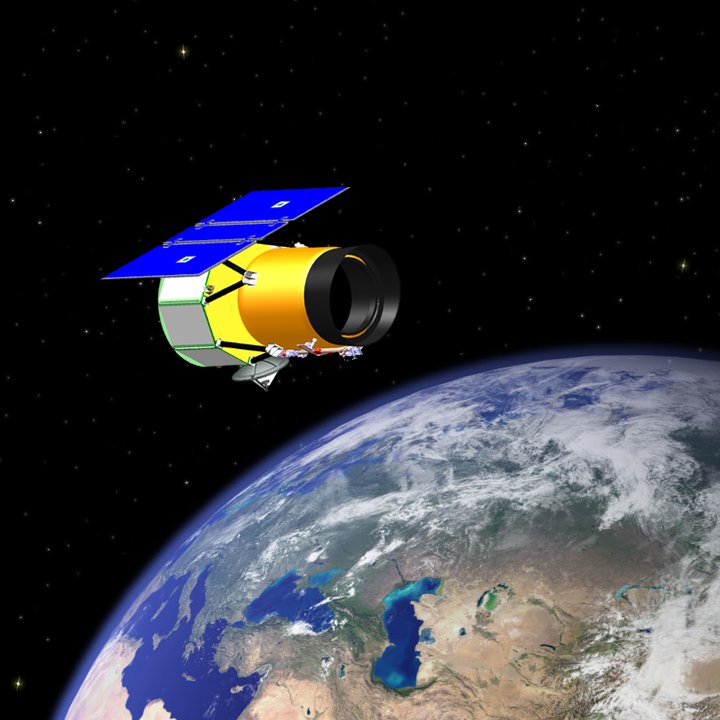
Wide-field Infrared Survey Explorer or WISE is a NASA-funded scientific research project that will provide an all-sky survey in the mid-infrared wavelength range.


WISE will collect data that will allow scientists to compile an all-sky infrared image atlas and catalogue of over 300 million infrared sources. WISE will be able to measure the diameters of more than 100,000 asteroids that glow in the mid-infrared, and make observations of the coldest and nearest stars, regions of new star and planet formation, and the structure of our own galaxy.


WISE will only operate for seven to thirteen months. WISE will explore the entire Universe from a 523×523 km, 97.4-inclined orbit above the ground. The spacecraft will orbit in a Sun-synchronous orbit, so the solar panel will always be pointed at the Sun.


The cryostat will run for thirteen months. After a one-month in-orbit checkout period, the telescope will operate for six months. An additional pass of the sky (that would take another six months) is possible, if funded to do so by NASA.
 

Credits: UCLA/JPL


The spacecraft is 2.85 m long, 2.0 m wide, and 1.73 m deep. The spacecraft does not carry propellant. The telescope will make all pointing adjustments using reaction wheels and torque rods. Star trackers, sun sensors, a magnetometer, and gyroscopes will be the sensors used by the attitude control subsystem. The TDRSS (Tracking and Data Relay Satellite System) satellites will relay commands and data with ground stations.


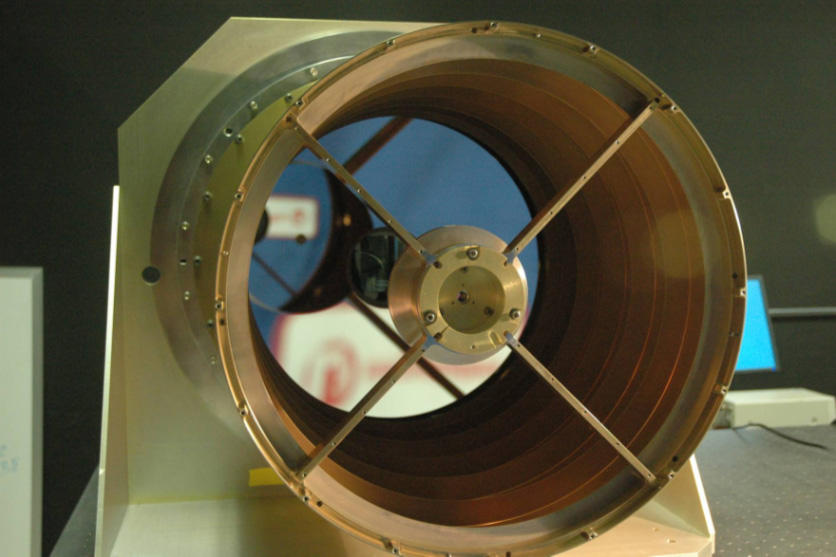
The field of view is 47 arc minutes and it comes from a small telescope diameter (only 40 cm) and large detector arrays. The telescope has four infrared sensitive detector arrays, 1024×1024 pixels each. For the near-infrared bands, there are Mercury-Cadmium-Telluride (MCT) detectors, while for the mid-infrared bands, Arsenic-doped Silicon (Si:As) detectors are used.
 

Credits: UCLA/JPL


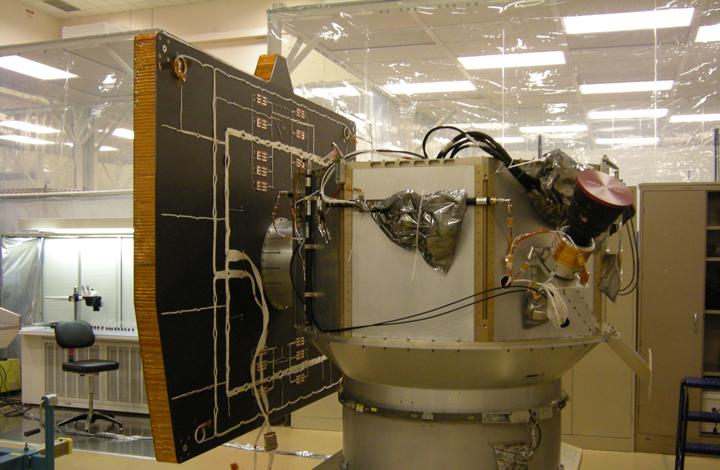
The optics instruments have to be cooled to very low temperatures in order to lower noise detection. The MCT detectors operate at 32 K, while the Si:As detectors will be cooled to less than 8 K.


The WISE launch is scheduled for November 2009. WISE will launch aboard a Delta II launch vehicle from Vandenberg Air Force Base, in California.


The WISE team consists of UCLA (University of California at Los Angeles), JPL (Jet Propulsion Laboratory), SDL (Space Dynamics Labs in Utah), BATC (Ball Aerospace & Technology Corporation), IPAC (Infrared Processing and Analysis Center), and UCB (University of California at Berkeley).


For more information about the WISE mission, you can visit the WISE mission homepage at the Space Science Laboratory, University of California, Berkeley, website.


  • Facebook
  • Google
  • Slashdot
  • Reddit
  • Live
  • TwitThis
03-5-09

HTV

Posted by


Credits: JAXA


HTV stands for H-II Transfer Vehicle. HTV is an unmanned spacecraft designed and built in Japan. HTV is designed to deliver supplies to the International Space Station (ISS).


The typical mission for HTV starts at the Tanegashima Space Center (TKSC) near Tsukuba, in Japan.


A H-IIB launch vehicle will inject the HTV on a low Earth orbit (LEO). After the separation from the H-IIB second stage, the transfer vehicle is able to navigate independently.


It will take approximately three days for HTV to reach the proximity of the ISS. During this time, it will maintain contact with the Control Center at TKSC (designated as HTV-CC) through the Tracking and Data Relay Satellite System (TDRSS). TDRSS is a network of satellites that allow a spacecraft in LEO to maintain permanent contact with the control center on the ground. HTV will use GPS to position itself at 7 km behind the ISS.


At this point, the berthing phase of the mission starts. HTV will approach the ISS within 500 m and use the Rendezvous Sensor (RVS) to move closer to the ISS. Reflectors that are installed on Kibo will allow HTV to maintain a distance of 10 m below the ISS.


Credits: JAXA


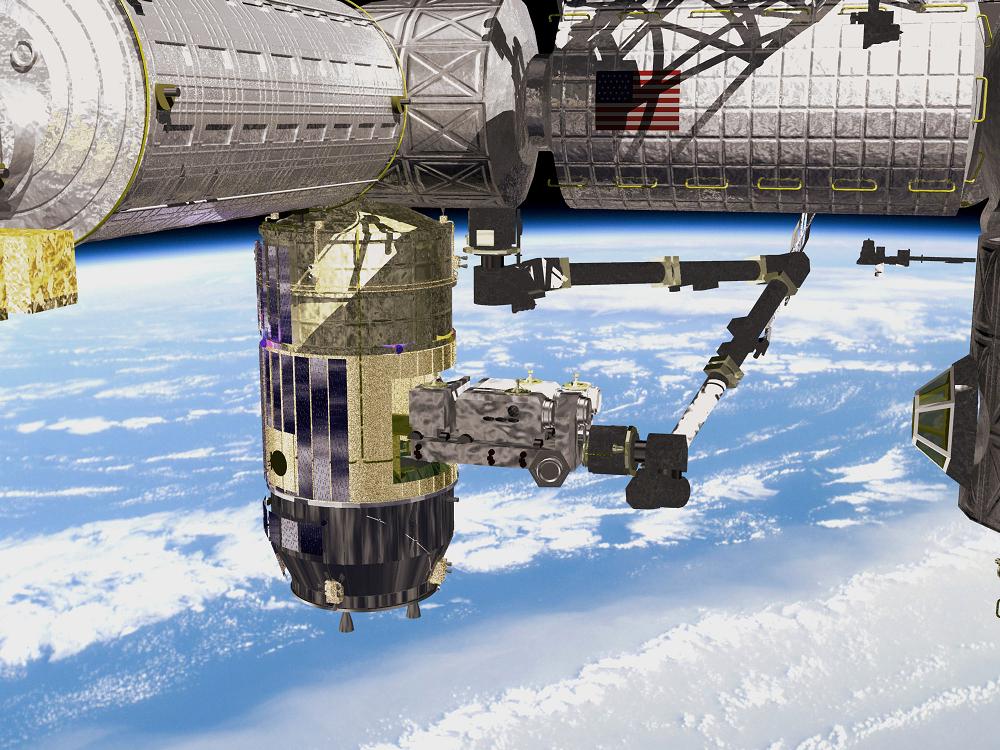
HTV does not have the capability to dock on its own to the ISS (as opposed to the European ATV), so the Canadarm2 robotic arm will be used to grab the transfer vehicle and berth it to the nadir side of the Node 2 module.


While the HTV is berthed to the ISS, supplies from the HTV’s pressurized section are transferred to the space station by the crew, and waste will be loaded from the ISS.


The cargo from the un-pressurized section will be unloaded using the robotic arm and attached either to the Exposed Facility of the Japanese Experiment Module (JEM) or the ISS Mobile Base System.


The HTV mission will end in a similar way to the European ATV: a destructive re-entry above the Pacific Ocean.


Here is some more background information about the HTV. The spacecraft is a cylinder-shaped structure 10 m long and 4.4 m in diameter. It has a total mass of 10,500 kg, of which 6,000 kg is cargo (divided into 4,500 kg pressurized cargo and 1,500 kg un-pressurized cargo). HTV can carry 6,000 kg of waste during the re-entry.


HTV consists of four modules: the Pressurized Logistics Carrier (PLC), the Unpressurized Logistics Carrier (UPLC), the Avionics Module, and the Propulsion Module. The UPLC carries the Exposed Pallet (EP), which can accommodate unpressurized payloads.


Credits: JAXA


The PLC is equipped with a Common Berthing Mechanism (CBM). This will allow the crew present on the station to enter the module in order to unload the supplies and load waste material.


The EP carried by the UPLC can be either Type I or Type III Exposed Pallets. The Type I EPs will carry payloads for the Kibo’s Exposed Facility (EF), while the Type III EPs will be used to deliver the Orbital Replacement Units (ORUs) to the ISS.


The systems in the avionics module enable HTV to execute the autonomous flight to the space station. The module also contains communication and power systems. The thirty-two thrusters installed on the propulsion module provide HTV with the capability to execute orbital adjustments and control the attitude during the mission.


HTV will add to the existing fleet of transfer vehicles that includes the Russian Soyuz and Progress spacecraft, as well as the European ATV. The first HTV mission is scheduled for late 2009.


For more information about HTV, you can visit the H-II Transfer Vehicle page on the JAXA web site.


  • Facebook
  • Google
  • Slashdot
  • Reddit
  • Live
  • TwitThis