


 |
| Credits: JAXA |
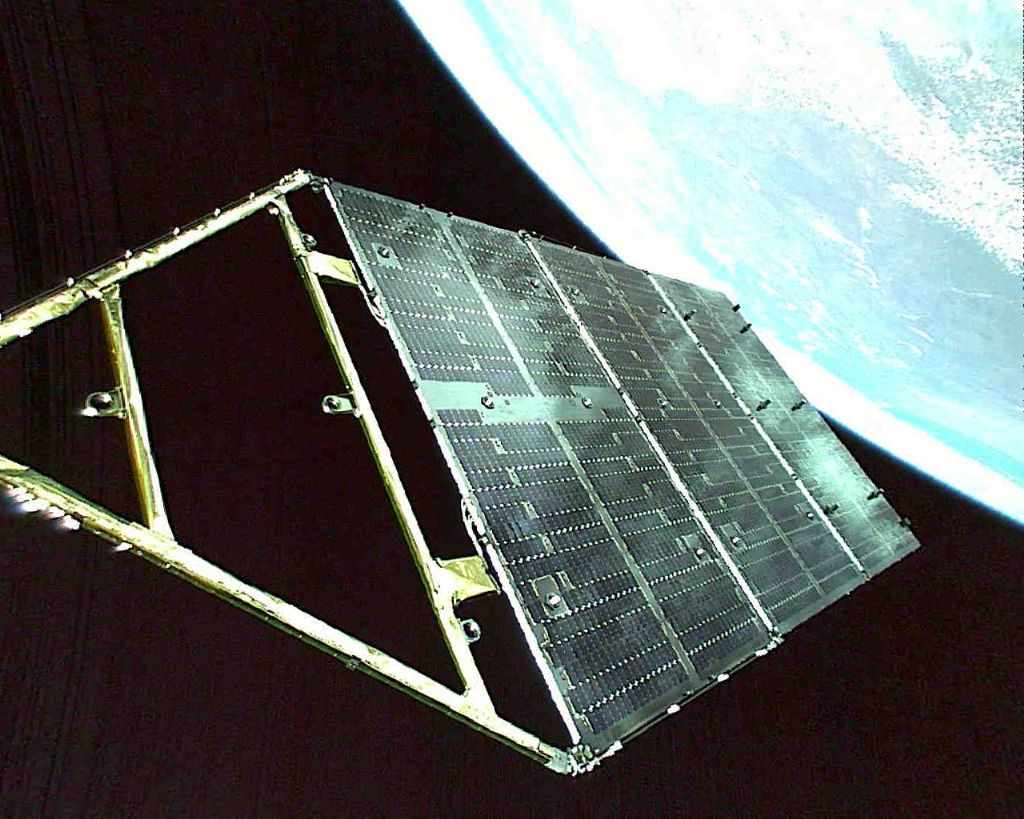
After a launch postponement due to a bad weather forecast, IBUKI was finally launched on January 23, 2009.
IBUKI was launched aboard H-IIA Launch Vehicle No. 15 from the Tanegashima Space Center. Sixteen minutes after liftoff, the separation of IBUKI was confirmed. The satellite was injected into the scheduled orbit: 684.8 km x 667.4 km, with an orbit inclination of 98 degrees.
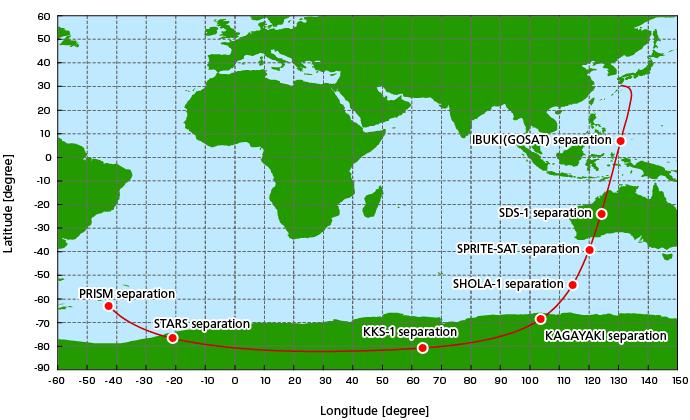
IBUKI was not the only satellite launched by flight 15. The payload included several piggyback payloads. It is common practice to include small satellites in the payload that are made by private companies or universities, in the case of an excessive launch capability.
Seven micro-satellites, six selected through public tender and one JAXA satellite, were launched by the H-IIA launch vehicle with IBUKI: KAGAYAKI / SORUN CORPORATION (debris detection and Aurora electric current observation mission), STARS / Kagawa University (tether space robot demonstration), KKS-1 / Tokyo Metropolitan College of Industrial Technology (demonstration of the micro cluster and three axis attitude control functions), PRISM / The University of Tokyo (earth image acquisition by using an expandable refracting telescope), SOHLA-1 / ASTRO TECHNOLOGY SOHLA (measurements of thunder and lightning), SPRITE-SAT / Tohoku University (observations of the sprite phenomenon and gamma radiation of the Earth’s origin), and Small Demonstration Satellite-1 (SDS-1) / JAXA (on-orbit verification of the space wire demonstration).
 |
| Credits: JAXA |
For more details on the additional payloads of H-IIA F15, you can check out the piggyback payload web page on the JAXA web site. Some of the links on the page require knowledge of Japanese or hands-on experience with the Google translation tool.
IBUKI will undergo a check of the onboard equipment function for about three months before becoming operational.


 Subscribe to blog posts using RSS












