 |
| Credits: ESA/AOES Medialab |
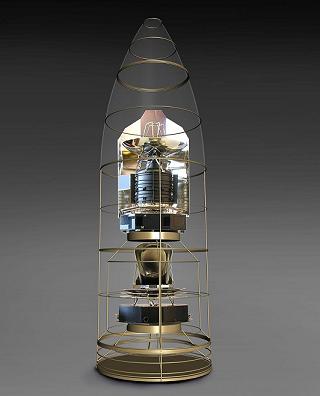
In a previous post, we presented the Planck spacecraft. We would like to dedicate this post to Planck’s big brother, Herschel. Why b(r)other? Because Planck and Herschel will be launched into space by the same Ariane 5 launcher and they will share the fairing section during the launch phase of the mission. Why big? Well, because Herschel is a larger spacecraft than Planck… actually Herschel is the largest space telescope ever built.
Just to have an idea about the size of the infrared telescope onboard the Herschel spacecraft, the primary mirror has a diameter of 3.5 m and a mass of only 350 kg. In comparison, the mirror of the Hubble space telescope has a diameter of 2.4 m and a mass of 1.5 tons. Obviously, a great deal of effort has been put into minimizing the mass of the telescope, an advance made possible by present-day technology.
The infrared telescope will become operational four months after its launch and will have a nominal mission lifetime of three years. The objectives that ESA set for the Herschel Space Observatory are ambitious: the study of the galaxies in the early universe, the investigation of the creation of stars, the observation of the chemical composition of the atmosphere and surfaces of comets, planets and satellites, as well as examining the molecular chemistry of the universe.
Like Planck, Herschel will observe the sky from the second Lagrangean Point (L2) of the Sun-Earth system. The instruments onboard Herschel will collect long-wavelength infrared radiation. Herschel will be the only space observatory to cover the spectral range from the far infrared to sub-millimeter, which is the reason why the initial name of the space observatory was Far Infrared and Sub-millimeter Telescope (FIRST).
 |
| Credits: ESA |
The Herschel spacecraft will have 3.3 tons at launch, with a length of 7.5 m and a cross section of 4×4 m. The spacecraft comprises of two modules: the service module and the payload module. While the service module contains the systems for power conditioning, attitude control, data handling and communications, and the warm parts of the scientific instruments, the payload module contains the telescope, the optical bench, the cold parts of the scientific instruments and the cooling system. A sunshield protects the telescope and the cryostat from solar radiation. The sunshield also carries solar cells for power generation.
In order to make accurate observations of the infrared spectrum, parts of the scientific instruments onboard have to be cooled to temperatures close to absolute zero. Two thousand liters of liquid helium will be used for primary cooling during the mission. In addition, each detector onboard is equipped with additional cooling systems.
 |
| Credits: ESA/Guarniero |
Herschel will not be the first infrared telescope launched into space. There are three predecessors that we would like to mention here: IRAS, the US-Dutch-British satellite launched in 1983, ISO – launched by ESA in 1995, and the NASA’s Spitzer Space Telescope – launched in 2003. However, these three infrared space telescopes were operated on Earth orbits. As we mentioned, Herschel will operate in the L2 point, away from any interference that would affect the scientific instruments onboard. Operating in the L2 point will also help with regard to thermal stability because the spacecraft will not move in and out of eclipse regions.
The launch date is set for early 2009. The journey to the final operational position will take around four months. The European Space Operations Control Center (ESOC) in Darmstadt will coordinate the mission.



 Subscribe to blog posts using RSS












