OrbitalHub

The place where space exploration, science, and engineering meet

Domain is for sale. $50,000,000.00 USD. Direct any inquiries to contact@orbitalhub.com.

05-20-20

Comet Counter

Posted by


Wikipedia dicit:

The Solar and Heliospheric Observatory (SOHO) is a spacecraft built by a European industrial consortium led by Matra Marconi Space (now Airbus Defence and Space) that was launched on a Lockheed Martin Atlas II AS launch vehicle on December 2, 1995 to study the Sun. SOHO has also discovered over 3,000 comets. It began normal operations in May 1996. It is a joint project of international cooperation between the European Space Agency (ESA) and NASA. Originally planned as a two-year mission, SOHO continues to operate after over 25 years in space: the mission is extended until the end of 2020 with a likely extension until 2022.

In addition to its scientific mission, it is a main source of near-real-time solar data for space weather prediction. Along with Wind, ACE and DSCOVR, SOHO is one of four spacecraft in the vicinity of the Earth–Sun L1 point, a point of gravitational balance located approximately 0.99 astronomical unit (AU)s from the Sun and 0.01 AU from the Earth. In addition to its scientific contributions, SOHO is distinguished by being the first three-axis-stabilized spacecraft to use its reaction wheels as a kind of virtual gyroscope; the technique was adopted after an on-board emergency in 1998 that nearly resulted in the loss of the spacecraft.

Video credit: NASA Goddard


  • Facebook
  • Google
  • Slashdot
  • Reddit
  • Live
  • TwitThis
09-25-17

September Solar Flares

Posted by


ESA dixit:

“The Sun unleashed powerful solar flares on September 6, one of which was the strongest in over a decade. An X2.2-class flare was launched at 09:10 GMT and an X9.3 flare was observed at 12:02 GMT. An M-class flare was also observed two days earlier on September 4.

The images were captured by the ESA/NASA Solar and Heliospheric Observatory, SOHO. The flares were launched from a group of sunspots classified as active region 2673. The shaded disc at the centre of the image is a mask in SOHO’s LASCO instrument that blocks out direct sunlight to allow study of the faint details in the Sun’s corona. The white circle added within the disc shows the size and position of the visible Sun.”

Video credit: ESA


  • Facebook
  • Google
  • Slashdot
  • Reddit
  • Live
  • TwitThis
12-2-15

SOHO’s 20 Years in Space

Posted by


NASA dixit:

“Dr. Joe Gurman of NASA’s Goddard Space Flight Center provides commentary on selected shots from SOHO’s 20 years in space.

After 20 years in space, ESA and NASA’s Solar and Heliospheric Observatory, or SOHO, is still going strong. Originally launched in 1995 to study the sun and its influence out to the very edges of the solar system, SOHO revolutionized this field of science, known as heliophysics, providing the basis for nearly 5,000 scientific papers. SOHO also found an unexpected role as the greatest comet hunter of all time—reaching 3,000 comet discoveries in September 2015.

When SOHO was launched on Dec. 2, 1995, the field of heliophysics looked very different than it does today. Questions about the interior of the sun, the origin of the constant outflow of material from the sun known as the solar wind, and the mysterious heating of the solar atmosphere were still unanswered. Twenty years later, not only do we have a much better idea about what powers the sun, but our entire understanding of how the sun behaves has changed.”

Video credit: NASA Goddard


  • Facebook
  • Google
  • Slashdot
  • Reddit
  • Live
  • TwitThis
09-23-15

SOHO and Comets

Posted by


NASA dixit:

“In this video, Karl Battams of the Naval Research Lab talks us through a visualization of the comets that SOHO has witnessed. Since its launch nearly 20 years ago, NASA and the European Space Agency’s Solar and Heliospheric Observatory has spotted 3000 comets. The mission’s The Large Angle and Spectrometric Coronagraph (LASCO) instrument blocks out the bright solar disk, making it easier to see the corona of plasma and dust around the Sun, normally only visible during solar eclipses. This instrument also provides a very large field of view of the region around the Sun.

This visualization utilizes SOHO data from 1998 – 2010 and shows over 2000 comets. Comets that were first observed by SOHO carry no labels, and comets witnessed but not discovered by the spacecraft are represented with their labels. Trails on the comets are color coded based on family: yellow – unaffiliated comets, red – Kreutz group, green – Meyer group, blue – Marsden, cyan – Kracht, and magenta – Kracht 2.”

Video credit: NASA


  • Facebook
  • Google
  • Slashdot
  • Reddit
  • Live
  • TwitThis
02-7-10

Solar Dynamics Observatory

Posted by


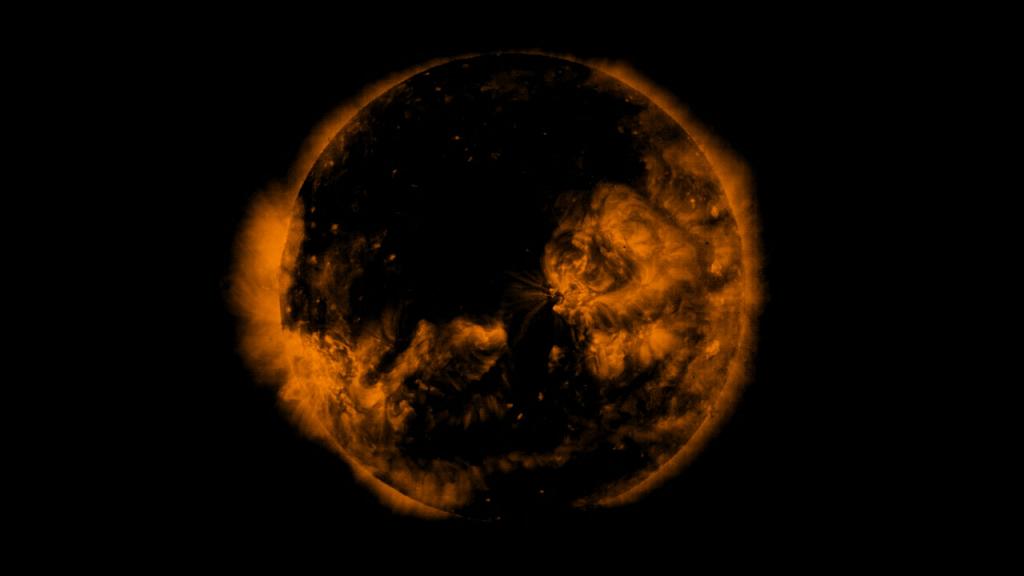
Credits: NASA/Goddard Space Flight Center Scientific Visualization Studio


Predictions of space weather are important as the effects of magnetic storms can be very significant: disruptions in radio communications, radiation hazards to astronauts in LEO, and power lines surges, just to name a few. The goal of NASA’s Living With a Star (LWS) Program is to understand the changing Sun and its effects on the Solar System. The Solar Dynamics Observatory (SDO) is one of NASA’s LWS missions.


SDO will take measurements of the solar activity. There are seven science questions SDO will try to answer. Among them, what is the mechanism that drives the cycles of solar activity? How do the EUV variations relate to the magnetic activity of the Sun? Is it possible to make predictions regarding the space weather and climate? The last question, if answered, will make choosing the launch windows for future interplanetary manned missions an easier task.


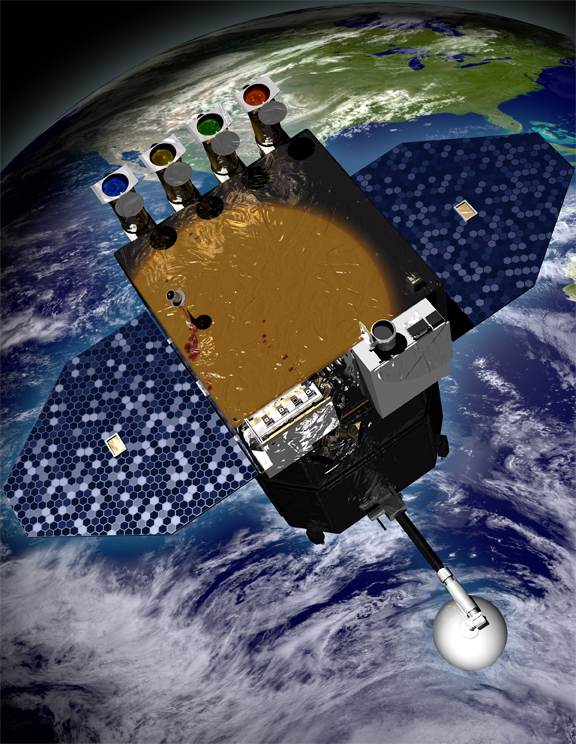
The spacecraft is 2.2 x 2.2 x 4.5 m and 3-axis stabilized. At launch, it has a mass of 3200 kg (270 kg the payload and 1400 kg the fuel). The solar panels are 6.5 m across, cover 6.6 m2, and produce up to 1540 W of power.


Credits: NASA


SDO carries three instruments: the Atmospheric Imaging Assembly (AIA), EUV Variability Experiment (EVE), and the Helioseismic and Magnetic Imager (HMI). The instruments will take measurements that will reveal at a very high rate the variations of the Sun.


The HMI was developed at Stanford University and it will extend the SOHO/MDI instrument. The HMI will help to study the origin of variability and the various components of the magnetic activity of the Sun. The measurements aim at understanding the origin and evolution of sunspots, sources and drivers of solar activity and disturbances, connections between the internal processes and the dynamics of the corona and the heliosphere.


You can find more information about the instrument on the HMI page on Stanford University’s web site.


The AIA will capture images of the solar atmosphere in ten wavelengths every ten seconds. The data collected by the instrument will improve the understanding of the activity in the solar atmosphere. The instrument was developed by Lockheed Martin.


EVE was developed at University of Colorado at Boulder. EVE will measure the solar extreme ultraviolet irradiance.


The SDO will launch aboard an Atlas V launch vehicle from SLC 41 at Cape Canaveral. SDO will operate on a geosynchronous orbit, which will allow continuous observations of the Sun. The orbit will also allow a continuous contact with a single dedicated ground station. The high data acquisition rate required such a mission profile, as a large on-board storage system would add to the overall complexity of the system.


You can find more information about SDO on NASA’s website.


  • Facebook
  • Google
  • Slashdot
  • Reddit
  • Live
  • TwitThis