OrbitalHub

The place where space exploration, science, and engineering meet

Domain is for sale. $50,000,000.00 USD. Direct any inquiries to contact@orbitalhub.com.

10-19-17

Propeller in Saturn’s A Ring

Posted by


NASA dixit:

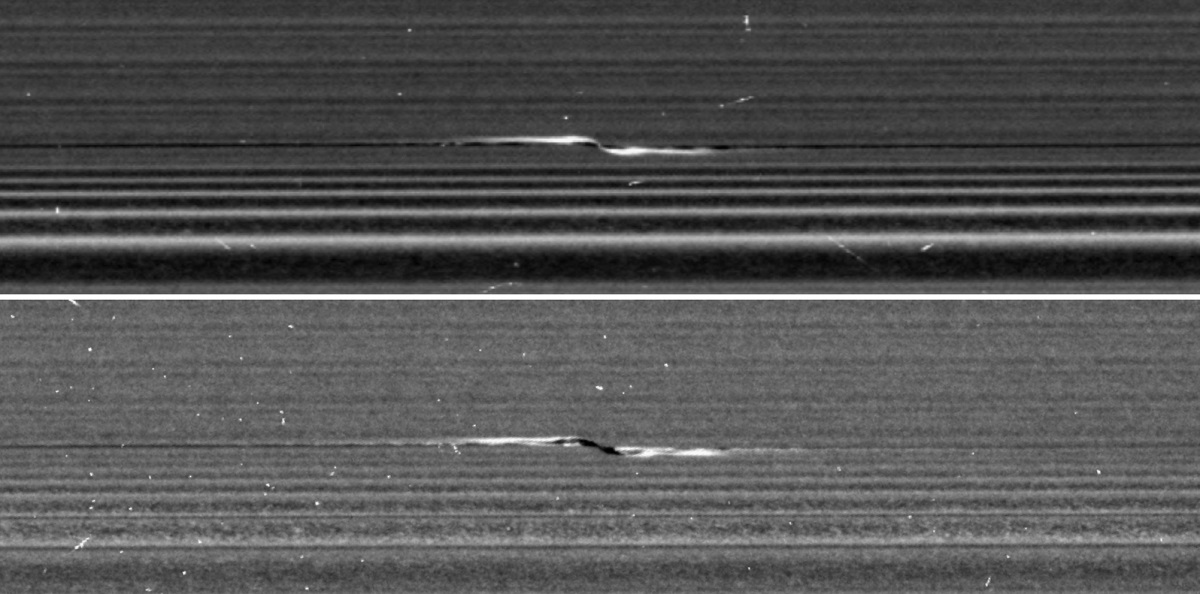
“February 21, 2017. NASA’s Cassini spacecraft captured these remarkable views of a propeller feature in Saturn’s A ring. These are the sharpest images taken of a propeller so far, and show an unprecedented level of detail. The propeller is nicknamed “Santos-Dumont,” after the pioneering Brazilian-French aviator. This observation was Cassini’s first targeted flyby of a propeller. The views show the object from vantage points on opposite sides of the rings. The top image looks toward the rings’ sunlit side, while the bottom image shows the unilluminated side, where sunlight filters through the backlit ring.

The two images are reprojected at the same scale (0.13 mile or 207 meters per pixel) in order to facilitate comparison. Cassini scientists have been tracking the orbit of this object for the past decade, tracing the effect that the ring has upon it. Now, as Cassini has moved in close to the ring as part of its ring-grazing orbits, it was able to obtain this extreme close-up view of the propeller, enabling researchers to examine its effects on the ring. These views, and others like them, will inform models and studies in new ways going forward.

Like a frosted window, Saturn’s rings look different depending on whether they are seen fully sunlit or backlit. On the lit side, the rings look darker where there is less material to reflect sunlight. On the unlit side, some regions look darker because there is less material, but other regions look dark because there is so much material that the ring becomes opaque. Observing the same propeller on both the lit and unlit sides allows scientists to gather richer information about how the moonlet affects the ring. For example, in the unlit-side view, the broad, dark band through the middle of the propeller seems to be a combination of both empty and opaque regions. The propeller’s central moonlet would only be a couple of pixels across in these images, and may not actually be resolved here. The lit-side image shows that a bright, narrow band of material connects the moonlet directly to the larger ring, in agreement with dynamical models. That same thin band of material may also be obscuring the moonlet from view. Lengthwise along the propeller is a gap in the ring that the moonlet has pried open. The gap appears dark on both the lit and unlit sides. Flanking the gap near the moonlet are regions of enhanced density, which appear bright on the lit side and more mottled on the unlit side.

One benefit of the high resolution of these images is that, for the first time, wavy edges are clearly visible in the gap. These waves are also expected from dynamical models, and they emphasize that the gap must be sharp-edged. Furthermore, the distance between the wave crests tells scientists the width of the gap (1.2 miles or 2 kilometers), which in turn reveals the mass of the central moonlet. From these measurements, Cassini imaging scientists deduce that the moonlet’s mass is comparable to that of a snowball about 0.6 mile (1 kilometer) wide.”

Image credit: NASA/JPL-Caltech/Space Science Institute


  • Facebook
  • Google
  • Slashdot
  • Reddit
  • Live
  • TwitThis
07-22-17

Propeller from Unlit Side

Posted by


NASA dixit:

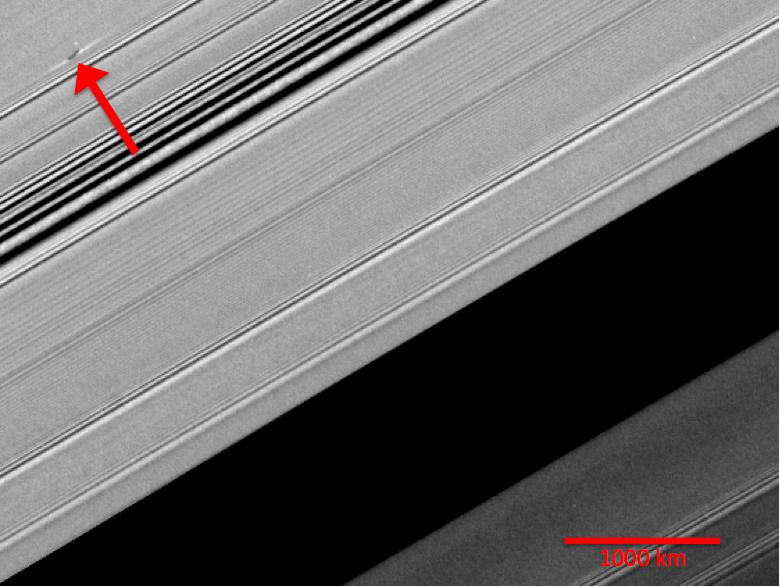
“August 19, 2008. A propeller-shaped structure created by an unseen moon appears dark in this image obtained by NASA’s Cassini spacecraft of the unilluminated side of Saturn’s rings. The propeller is marked with a red arrow in the top left of the annotated version of the image. The Encke Gap of Saturn’s A ring is in the lower right of the image. The A ring is the outermost of Saturn’s main rings. The moon, likely about a kilometer (half a mile) across, can’t be seen at this resolution. However, it is larger than other “propeller” moons and has cleared ring material from the bright (because they are less opaque) wing-like regions to its left and right in this image. Disturbed ring material close to the moon blocks more sunlight and appears like a dark airplane propeller.

Several density waves are visible in the ring, particularly in the upper left. A spiral density wave is a spiral-shaped accumulation of particles that tightly winds many times around the planet. It is the result of gravitational tugs by individual moons whose orbits are in resonance with the particles’ orbits at a specific distance from Saturn. A propeller’s appearance changes with viewing geometry, and this image shows the way a propeller looks when viewed from the unilluminated side of the rings. The dark structure at the center of this propeller corresponds to the bright structure seen in Sunlit Propeller, which was imaged from the sunlit side of the rings.

This image is part of a growing catalogue of “propeller” moons that, despite being too small to be seen, enhance their visibility by creating larger disturbances in the surrounding fabric of Saturn’s rings. Cassini scientists now have tracked several of these individual propeller moons embedded in Saturn’s disk over several years.

These images are important because they represent the first time scientists have been able to track the orbits of objects in space that are embedded in a disk of material. Continued monitoring of these objects may lead to direct observations of the interaction between a disk of material and embedded moons. Such interactions help scientists understand fundamental principles of how solar systems formed from disks of matter. Indeed, Cassini scientists have seen changes in the orbits of these moons, although they don’t yet know exactly what causes these changes.

Imaging scientists nicknamed the propeller shown here “Santos-Dumont” after the early Brazilian-French aviator Alberto Santos-Dumont. The propeller structure is 5 kilometers (3 miles) in the radial dimension (the dimension moving outward from Saturn which is far out of frame to the lower right of this image). It is 65 kilometers (40 miles) in the azimuthal (longitudinal) dimension. Scale in the original image was about 2 kilometers (1 mile) per pixel. The image has been rotated and contrast-enhanced to aid visibility. The cropped inset of the propeller included here was magnified by a factor of four.

This view looks toward the northern, unilluminated side of the rings from about 45 degrees above the ring plane. The image was taken in visible light with the Cassini spacecraft narrow-angle camera. The view was acquired at a distance of approximately 310,000 kilometers (193,000 miles) from Saturn and at a sun-Saturn-spacecraft, or phase, angle of 121 degrees.”

“After almost 20 years in space, NASA’s Cassini spacecraft begins the final chapter of its remarkable story of exploration: its Grand Finale. Between April and September 2017, Cassini will undertake a daring set of orbits that is, in many ways, like a whole new mission. Following a final close flyby of Saturn’s moon Titan, Cassini will leap over the planet’s icy rings and begin a series of 22 weekly dives between the planet and the rings.

No other mission has ever explored this unique region. What we learn from these final orbits will help to improve our understanding of how giant planets – and planetary systems everywhere – form and evolve.

On the final orbit, Cassini will plunge into Saturn’s atmosphere, sending back new and unique science to the very end. After losing contact with Earth, the spacecraft will burn up like a meteor, becoming part of the planet itself.

Cassini’s Grand Finale is about so much more than the spacecraft’s final dive into Saturn. That dramatic event is the capstone of six months of daring exploration and scientific discovery. And those six months are the thrilling final chapter in a historic 20-year journey.”

Image credit: NASA


  • Facebook
  • Google
  • Slashdot
  • Reddit
  • Live
  • TwitThis