OrbitalHub

The place where space exploration, science, and engineering meet

Domain is for sale. $50,000,000.00 USD. Direct any inquiries to contact@orbitalhub.com.

09-24-08

Scouting the Moon

Posted by


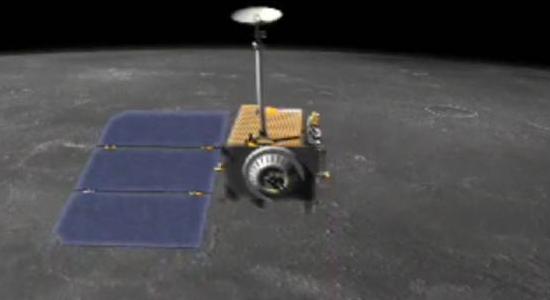
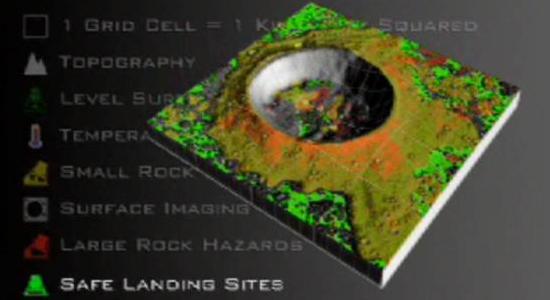
NASA’s return to the Moon requires careful preparation. Finding safe landing sites, locating potential resources, and taking measurements of the radiation environment are some of the tasks the Lunar Reconnaissance Orbiter (LRO) spacecraft will perform while in lunar orbit. LRO is an unmanned mission that will create a comprehensive atlas of the moon’s surface and resources.


The data gathered by LRO will be crucial in designing and building a permanent lunar outpost. The data will also be used to reduce the risk and increase the productivity of the future manned missions to the Moon.


The launch of LRO is scheduled for February 2009. An Atlas V rocket launched from the Kennedy Space Center will place the LRO on a transfer trajectory. After 4 days, the spacecraft will reach the Moon and after performing additional orbital maneuvers, it will move into its final orbit. The LRO’s final orbit will be a circular polar orbit 50 kilometers above the lunar surface.
 

Credits: NASA


The mission is designed to last for one year, with a possible extension. The total mass of the spacecraft is around 1,000 kilograms, of which 500 to 700 kilograms will be the fuel. The power is supplied by articulated solar arrays, and for the peak and eclipse periods a Li-Ion battery is used. The bandwidth of the communication link will be approximately 100-300 Mbps.


The LRO payload is comprised of six scientific instruments and one technology demonstration.


The Cosmic Ray Telescope for the Effects of Radiation (CRaTER) was built and developed by Boston University and the Massachusetts Institute of Technology in Boston. CRaTER will help explore the lunar radiation environment. The data gathered by measurements will help in the development of protective technologies that will keep future lunar crews safe.


The Diviner Lunar Radiometer Experiment (DLRE) was built and developed by the University of California, Los Angeles and the Jet Propulsion Laboratory in Pasadena, California. DLRE is capable of measuring surface and subsurface temperatures from orbit.


The Lyman-Alpha Mapping Project (LAMP) was built and developed at the Southwest Research Institute in San Antonio. LAMP will be used to map the entire lunar surface in the far ultraviolet spectrum.
 

Credits: NASA


The Lunar Exploration Neutron Detector (LEND) was developed at the Institute for Space Research in Moscow. This detector will create high-resolution maps of the hydrogen distribution and gather data about the neutron component of the lunar radiation.


The Lunar Orbiter Laser Altimeter (LOLA) was conceived and built at NASA’s Goddard Space Flight Center. LOLA will generate high-resolution three-dimensional maps of the moon’s surface.


The Lunar Reconnaissance Orbiter Camera (LROC), developed at Arizona State University at Tempe, will image the lunar surface in color and ultraviolet. LROC will be able to capture 1 m resolution images of the lunar poles.


The technology demonstration is called Mini-RF Technology Demonstration. The primary goal of this demonstration is to locate subsurface water ice deposits. The advanced single aperture radar (SAR) that will be used is capable of taking high-resolution imagery of the permanently shadowed regions on the lunar surface.


The data gathered by LRO will help us develop a better understanding of the lunar environment. This understanding is essential for a safe human return to the Moon and for the future exploration of our solar system.


  • Facebook
  • Google
  • Slashdot
  • Reddit
  • Live
  • TwitThis


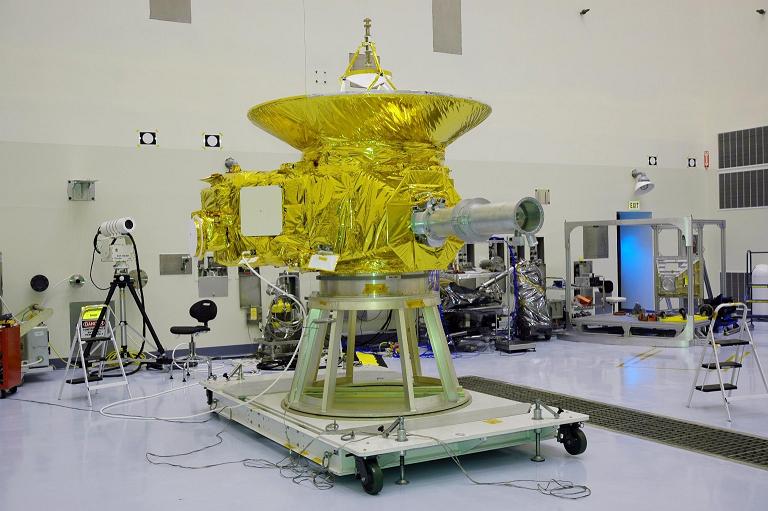
Yes, they do. They really do! One of NASA’s deep space mission probes, New Horizons, is undergoing a check. The mission operators wake the spacecraft out of hibernation once a year. A number of checks are performed: the antennas must be pointed toward Earth, the trajectory must be corrected if needed, and instruments must be calibrated. These checks last more than a usual visit to a doctor… about 50 days. The operators verify the health of the spacecraft, perform maintenance on subsystems and instruments, and gather navigation data.


Credits: NASA


The highlight of the current check was the upload of a new version of the software that runs the spacecraft’s Command and Data Handling system. The brain transplant, as it was called, was a success. The mission team at the Johns Hopkins Applied Physics Laboratory (APL) in Laurel, Maryland, sent the updates through NASA’s Deep Space Network (DSN) to the spacecraft. Two more updates are to be sent for both the Autonomy and Guidance and Control systems.


All commands that are sent to the spacecraft must pass a rigorous development and review process. After the command sequences are tested on the ground, the mission operations team will send them from the New Horizons Mission Operations Center at APL using the DSN, which is operated and managed by NASA’s Jet Propulsion Laboratory.


Credits: NASA


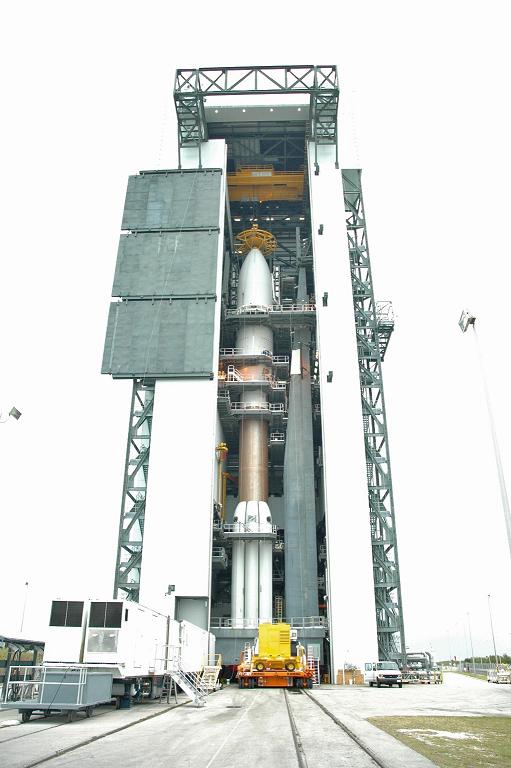
The New Horizons spacecraft was launched on January 19th, 2006 on top of an Atlas V rocket from Cape Canaveral Air Force Station, Florida.


The trajectory chosen for the probe is not complicated, as the probe is flying to Pluto using just one gravity boost from Jupiter. The journey consists of 5 segments: the early cruise, the Jupiter encounter, the interplanetary cruise, the Pluto-Charon encounter, and the Kuiper Belt.


During the early cruise segment of the voyage, spacecraft and instrument checkouts, instrument calibrations, and trajectory corrections were performed. Rehearsals for the Jupiter encounter were also conducted.


During the second segment of the voyage, the closest approach to Jupiter occurred on February 28th, 2007.


Credits: JHUAPL / SwRI


The third segment of the voyage consists mainly of spacecraft and instrument checkouts, trajectory corrections, instrument calibrations, and Pluto encounter rehearsals. This part of the voyage lasts for 8 years and is the current segment of the mission.


The Pluto-Charon encounter is planned for July 14th, 2015.


In the Kuiper Belt, plans are for one or two encounters with Kuiper Belt Objects (KBOs). These objects would be in the 40 to 90 kilometer size range and New Horizons would acquire the same data it collected during the Pluto-Charon encounter and send it back to Earth for analysis.


Credits: JHUAPL / SwRI


New Horizons is a small spacecraft. It weighs 478 kilograms in total, of which 77 kilograms is the hydrazine fuel, and 30 kilograms the scientific instruments. It measures 0.7×2.1×2.7 meters.


For communication with Earth, the spacecraft is using a 2.1 meter high-gain antenna. The data transfer rate is 38 kilobits per second at Jupiter, and 0.6 to 1.2 kilobits per second at Pluto. The data gathered during the encounter with Pluto will take 9 months to transmit back to Earth.


The scientific payload of the spacecraft draws less than 28 Watts of power. The mission uses a radioisotope thermoelectric generator (RTG) for power generation. The RTG contains 11 kilograms of plutonium dioxide. At the start of the mission, the RTG provided 240 Watts of energy at 30 Volts. Due to the decay of the plutonium, the power output decreases during the mission, and by the time of the Pluto encounter the RTG will only produce about 200 Watts.


The scientific instruments that were selected meet the mission’s goals. NASA set out a list of things it wanted to know about Pluto: the composition and behavior of the atmosphere, the appearance of the surface, the geological structures on the surface of Pluto, etc. The scientific payload contains seven instruments.


Credits: NASA


Ralph is a visible and infrared imager/spectrometer. It will obtain high-resolution color maps and surface composition maps of the surfaces of Pluto and Charon.


Alice is an ultraviolet imaging spectrometer. It will be used to analyze the composition and the structure of Pluto’s atmosphere and to look for atmospheres around Charon and Kuiper Belt Objects (KBOs).


REX is the Radio Science Experiment. It is a passive radiometer that measures atmospheric composition and temperature by using what is called an occultation technique: after passing Pluto, the spacecraft will point its antenna back to Earth and record the transmissions sent by the NASA’s DSN. The alterations of the transmissions caused by Pluto’s atmosphere will be recorded and sent back to Earth for analysis. REX will also be used to measure weak radio emissions from Pluto itself.


LORRI stands for Long Range Reconnaissance Imager. It is a telescopic camera and it will be used to obtain encounter data at long distances, to map Pluto’s far side and to provide high-resolution geologic data. LORRI will take images having 100-meter resolution.


SWAP, the solar wind and plasma spectrometer, stands for Solar Wind Around Pluto. It will measure the atmospheric escape rate and it will observe Pluto’s interaction with solar wind, determining whether Pluto has a magnetosphere or not.


Credits: NASA / JHUAPL

PEPSSI, Pluto Energetic Particle Spectrometer Science Investigation, is an energetic particle spectrometer used to measure the composition and density of plasma (ions) escaping from Pluto’s atmosphere.


SDC is the Student Dust Counter. It is the first scientific instrument built by students mounted on a space probe. It measures the space dust impacting the spacecraft during the voyage across the solar system, recording the count and the size of dust particles. It was built primarily by students from the University of Colorado in Boulder, with supervision from scientists.


If you want to know the present location of the spacecraft, there is a dedicated page on APL that you can visit.


For more information on the New Horizons Mission you can read the New Horizons Missions Guides document on the APL website.


The New Horizons Mission also has a page on Twitter.


  • Facebook
  • Google
  • Slashdot
  • Reddit
  • Live
  • TwitThis


Credits: ESA MPS for OSIRIS Team MPS/UPM/
LAM/IAA/RSSD/INTA/UPM/DASP/IDA


On September 6th, 2008, the ESA’s space probe Rosetta performed the first highlight on its 11 year mission: a close flyby the asteroid 2867 Steins. There are two more important events to occur during the mission, which are another flyby the asteroid 21 Lutetia in 2010 and the actual rendezvous with the comet 67/P Churyumov-Gerasimenko in 2014.


The Rosetta mission is special in many ways. It is the first mission to deploy a lander to the surface of a comet. It will also be the first to orbit the nucleus of a comet and to fly alongside a comet as it heads towards the inner Solar System.


Credits: ESA


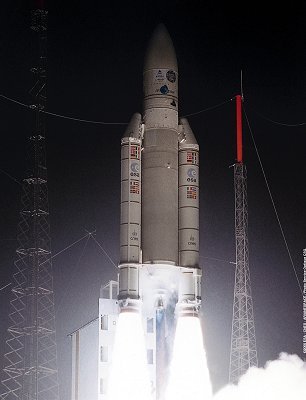
Rosetta’s mission began on March 2nd, 2004, when the spacecraft lifted off from Kourou, French Guiana. In order to optimize the use of fuel, the probe has a very complicated trajectory to reach its final target, the comet 67/P Churyumov-Gerasimenko. The long trajectory includes three Earth-gravity assists (2004, 2007, and 2009) and one at Mars (2007). The probe uses the gravity wells of Earth and Mars to accelerate to the speed needed for the rendezvous with the comet. Most of the time, the probe is hibernating with the majority of its systems shut down in order to optimize the power consumption. At the time of the rendezvous, the remaining fuel will be used to slow down the probe to match the speed of the comet.


Credits: ESA/AOES Medialab


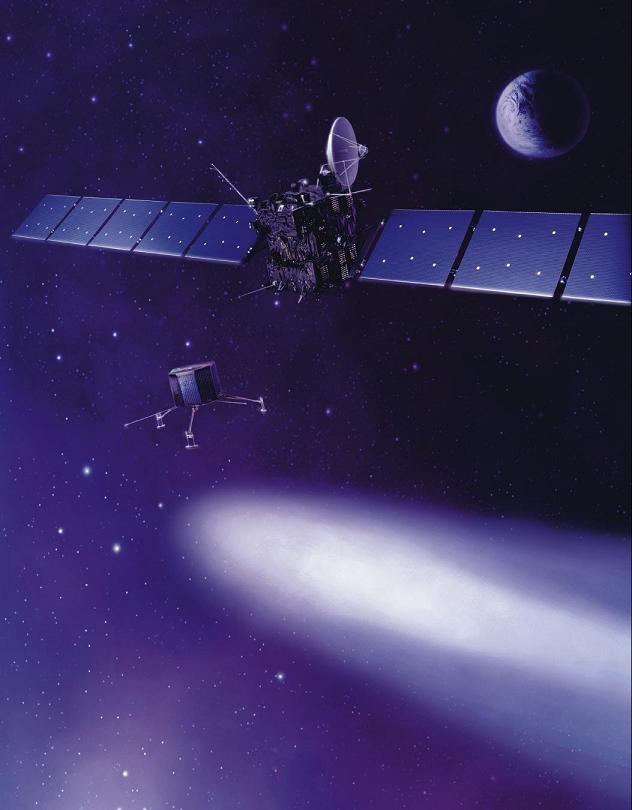
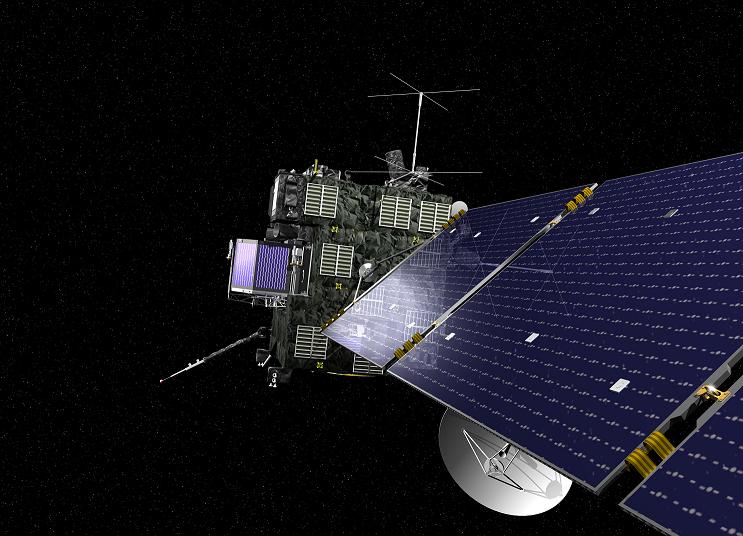
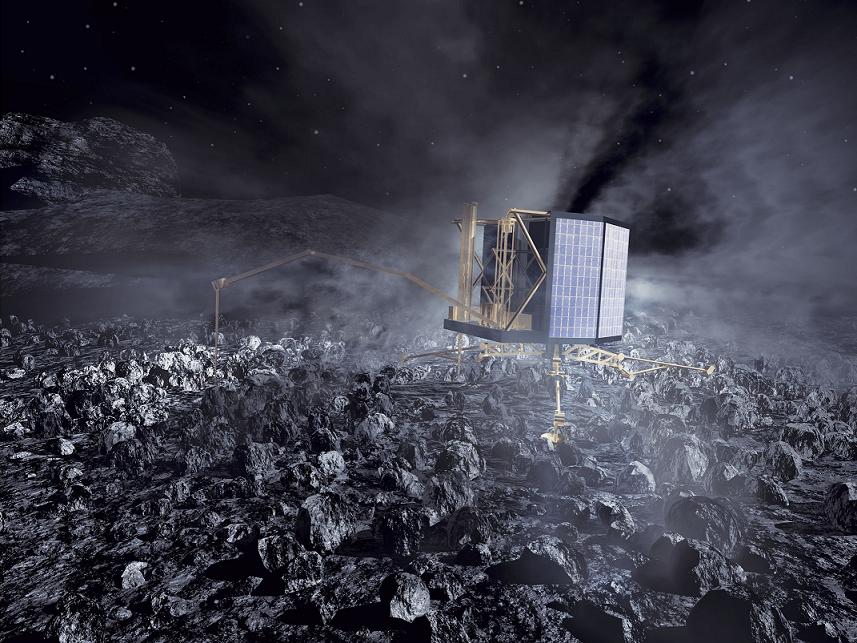
After reaching the comet, Rosetta will deploy a lander, called Philae, to the surface. While the probe will study the comet’s nucleus from a close orbit, the lander will take measurements from the comet’s surface. Because the gravity of the comet is very weak, the lander will use a harpoon to anchor itself to the surface.


Rosetta will stay with the comet more than one year, and during this time it will study one of the most primitive materials in the solar system. Scientists hope to discover the secrets of the physical and chemical processes that marked the beginning of the solar system some 5 billion years ago.


Credits: ESA/AOES Medialab


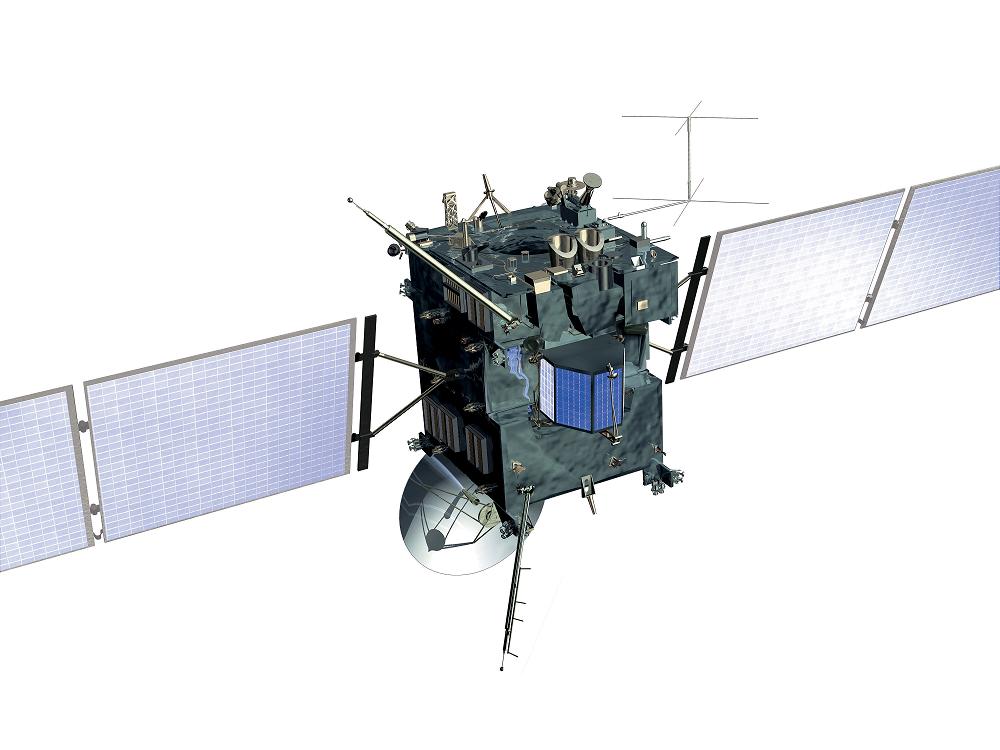
Traditionally, probes sent beyond the main asteroid belt employ radioisotope thermal generators (RTGs) as power generators. RTGs convert the heat from a radioactive source into electricity using an array of thermocouples. Instead, Rosetta is using solar cells for power generation. The probe deploys two impressive solar panels (a total area of 64 square meters). Even when close to the comet, the panels will be able to generate around 400 Watts of power. The panels can be rotated through +/- 180 degrees to track the Sun in every attitude assumed by the probe.


The probe is cube-shaped and measures 2.8×2.1×2.0 meters. At launch, it weighs 3,000 kg, including 1,670 kg of fuel, 165 kg of scientific payload for the orbiter, and 100 kg for the lander. The scientific instruments are accommodated on the lower side of the probe, which will be directed towards the comet during the last phase of the mission. Meanwhile, the probe will orbit the nucleus of the comet. A communication antenna 2.2 meters in diameter will be mounted on one side of the probe and on the opposite side the lander is attached. The other two lateral sides are used for anchoring the solar panels.


Credits: ESA/AOES Medialab


I was able to dig up more information about the probe and the lander in the mission launch kit on the EADS Astrium website.


The prime contractor for the spacecraft is Astrium Germany. The main sub-contractors are Astrium UK, Astrium France, and Alenia Spazio.


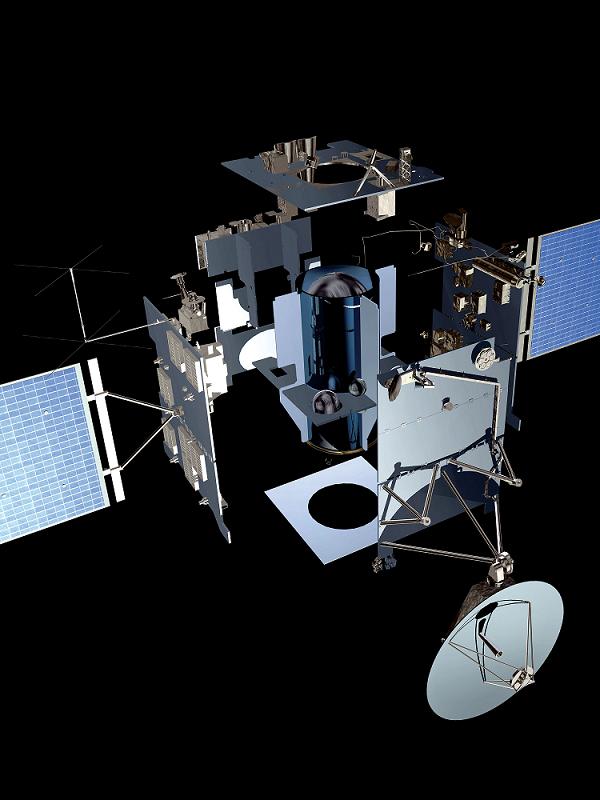
For propulsion and attitude control, the probe is using 24x10N bipropellant jets. The propulsion system is at the centre of the probe, where the tanks of propellant are located in the centre of a vertical tube.


I could not find an explanation as to why this design was chosen. Since the ability of the spacecraft to maneuver by using the onboard propulsion system is critical, I am assuming that the fuel tanks have to be protected from possible hits by micro meteorites.


Credits: ESA/AOES Medialab


The scientific instruments onboard Rosetta are: OSIRIS (Optical Spectroscopic and Infrared Remote Imaging System), ALICE (Ultraviolet Imaging Spectrometer), VIRTIS (Visible and Infrared Thermal Imaging System), MIRO (Microwave Instrument for Rosetta Orbiter), ROSINA (Rosetta Orbiter Spectrometer for Ion and Neutral Analysis), COSIMA (Cometary Secondary Ion Mass Analyser), MIDAS (Micro-Imaging Dust Analysis System), CONSERT (Comet Nucleus Sounding Experiment by Radiowave Transmission), GIADA (Grain Impact Analyser and Dust Accumulator), RPC (Rosetta Plasma Consortium), and RSI (Radio Science Investigation).


The lander is provided by a European consortium lead by the DLR (German Aeronautic Research Institute). Members of this consortium include ESA and the Austrian, Finnish, French, Hungarian, Irish, Italian, and British institutes.


Credits: ESA/AOES Medialab


The lander has a polygonal carbon fibre sandwich structure which is covered in solar cells. The antenna transmits data from the lander via the probe orbiting the comet.


There is an impressive collection of scientific instruments mounted on the lander as well: COSAC (Cometary Sampling and Composition experiment), MODULUS PTOMELY (Gas analyser), MUPUS (Multi-Purpose Sensors for Surface and Subsurface Science), ROMAP (Rosetta Lander Magnetometer and Plasma Monitor), SESAME (Surface Electrical Seismic and Acoustic Monitoring Experiments), APXS (Alpha X-ray Spectrometer), CONSERT (Comet Nucleus Sounding Experiment by Microwave Transmission), CIVA (Imager system using panoramic cameras), ROLIS (Rosetta Lander Imaging System used during the descend phase), and SD2 (Sample and Distribution Device, a sample acquisition system).


Credits: ESA


The scientific data collected by the instruments is transmitted to the Rosetta Mission Operations Centre (MOC) through a 8bps link. Due to the narrow bandwidth, the data cannot be sent back to Earth in real-time and has to be stored on the probe before being relayed.


The MOC at the European Space Operations Centre (ESOC) in Darmstadt has been controlling this long term mission since launch using ESA’s DSA 1 deep-space ground station at New Norcia.


It may seem like a long journey, but as in The Days of the Comet, the Rosetta mission could open up a whole new world of possibilities.


  • Facebook
  • Google
  • Slashdot
  • Reddit
  • Live
  • TwitThis