 |
| Credits: SpaceX |
SpaceX recently reached two major milestones towards the goal of servicing the International Space Station (ISS) after the retirement of the Space Shuttle in September 2010.
The milestones are the successful testing of the heat shield material used for the thermal protective system of the Dragon spacecraft, and a mission-length firing of the Merlin Vacuum engine that powers the second stage of the Falcon 9 launch vehicle.
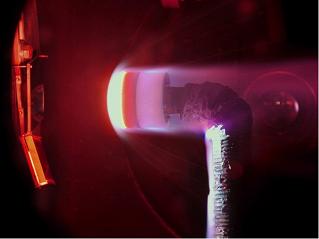
On February 23, 2009, SpaceX announced that the PICA-X high performance heat shield material passed an arc jet testing. During the test that recreates the conditions experienced during an atmospheric reentry, the material was subjected to temperatures as high as 1850 degrees Celsius.
PICA is short for Phenolic Impregnated Carbon Ablator. It is a material used for thermal protection, which was initially developed by NASA. PICA-X is an improved variation of the original PICA and was developed by SpaceX with the assistance of NASA. SpaceX becomes the second commercial source for this high-performance carbon-based material.
“We tested three different variants developed by SpaceX,” said Tom Mueller, VP of Propulsion, SpaceX. “Compared to the PICA heat shield flown successfully on NASA’s Stardust sample return capsule, our SpaceX versions equaled or improved the performance of the heritage material in all cases.”
 |
| Credits: SpaceX |
The arc jet tests were performed at the Arc Jet Complex at NASA Ames Research Center, as the test center is capable of creating the reentry conditions. The Arc Jet Complex has a long history in the development of thermal protective systems.
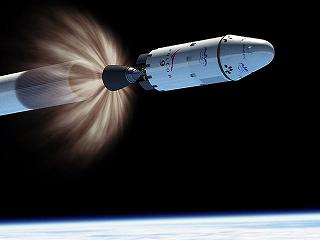
PICA-X will protect the Dragon spacecraft and the crew during the reentry in the atmosphere from low Earth orbit (LEO).
One remarkable detail that I discovered when reading the press release is that PICA-X will also be used to coat the second stage of the Falcon 9 launch vehicle, as SpaceX plans to reuse the second stage of the launch vehicle as well.
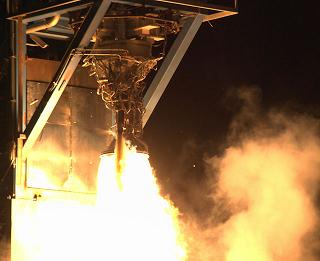
On March 7, 2009, the Merlin Vacuum engine completed a full mission duration firing at the SpaceX Test Facility in McGregor, Texas. During the test that lasted 6 minutes, the engine consumed more than 100,000 pounds of liquid oxygen and rocket grade kerosene.
The Merlin Vacuum engine is a variation of the Merlin 1C engine that powers the Falcon 1 launch vehicle, and it accommodates changes that make it more efficient to fire in the vacuum of space (most notably the shape of the nozzle).
 |
| Credits: SpaceX |
“Specific impulse, or Isp, indicates how efficiently a rocket engine converts propellant into thrust,” said Tom Mueller. “With a vacuum Isp of 342 seconds, the new Merlin Vacuum engine has exceeded our requirements, setting a new standard for American hydrocarbon engine performance in space.”
The engine uses a regeneratively cooled combustion chamber, which means that the propellant is injected into the walls of the combustion chamber and prevents them from melting.
The nozzle is radiatively cooled and much larger, and also has a larger exhaust section than the Merlin 1C. This results in an improved performance of the engine. The engine is capable of multiple restarts and can operate at reduced thrust, which will enable the upper stage to deliver payloads matching a broad range of orbital profiles.
“Falcon 9 was designed from the ground up to provide our customers with breakthrough advances in reliability,” said Elon Musk, CEO and CTO of SpaceX. “In successfully adapting our flight tested first stage engine for use on the second stage, this recent test further validates the architecture of Falcon 9, designed to provide customers with high reliability at a fraction of traditional costs.”
The first flight of the Falcon 9 /Dragon launch system is scheduled for late 2009 from Launch Pad SLC-40 at Cape Canaveral, Florida. For more information about SpaceX and the Falcon 9 /Dragon launch system, you can visit the SpaceX website.



 Subscribe to blog posts using RSS












