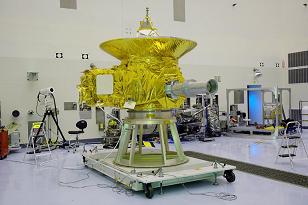
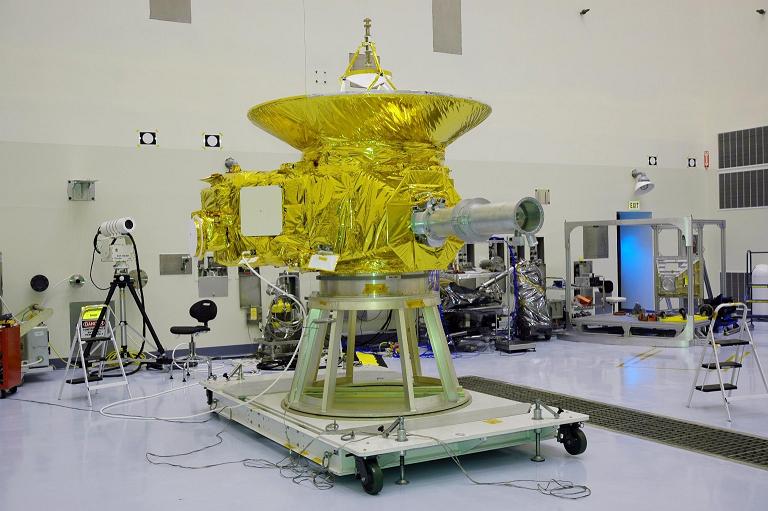
Yes, they do. They really do! One of NASA’s deep space mission probes, New Horizons, is undergoing a check. The mission operators wake the spacecraft out of hibernation once a year. A number of checks are performed: the antennas must be pointed toward Earth, the trajectory must be corrected if needed, and instruments must be calibrated. These checks last more than a usual visit to a doctor… about 50 days. The operators verify the health of the spacecraft, perform maintenance on subsystems and instruments, and gather navigation data.
 |
| Credits: NASA |
The highlight of the current check was the upload of a new version of the software that runs the spacecraft’s Command and Data Handling system. The brain transplant, as it was called, was a success. The mission team at the Johns Hopkins Applied Physics Laboratory (APL) in Laurel, Maryland, sent the updates through NASA’s Deep Space Network (DSN) to the spacecraft. Two more updates are to be sent for both the Autonomy and Guidance and Control systems.
All commands that are sent to the spacecraft must pass a rigorous development and review process. After the command sequences are tested on the ground, the mission operations team will send them from the New Horizons Mission Operations Center at APL using the DSN, which is operated and managed by NASA’s Jet Propulsion Laboratory.
 |
| Credits: NASA |
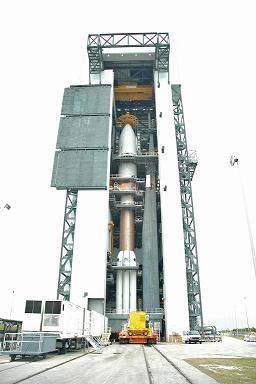
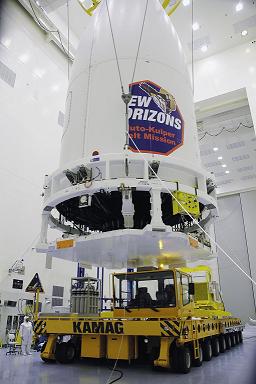
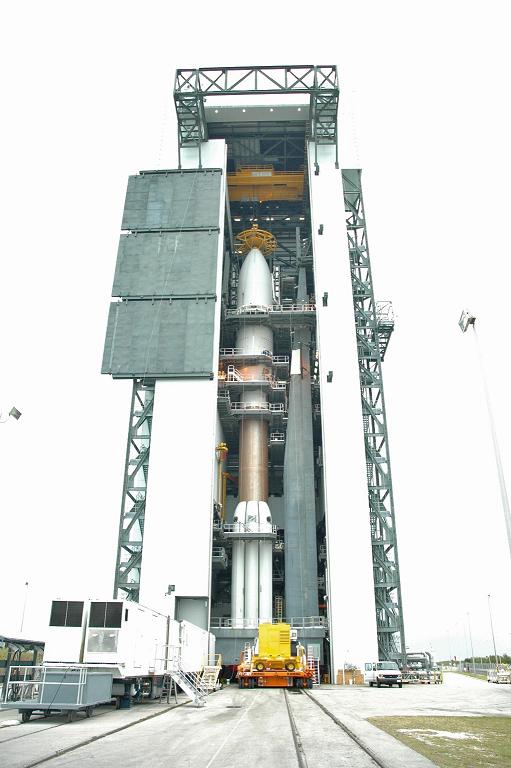
The New Horizons spacecraft was launched on January 19th, 2006 on top of an Atlas V rocket from Cape Canaveral Air Force Station, Florida.
The trajectory chosen for the probe is not complicated, as the probe is flying to Pluto using just one gravity boost from Jupiter. The journey consists of 5 segments: the early cruise, the Jupiter encounter, the interplanetary cruise, the Pluto-Charon encounter, and the Kuiper Belt.
During the early cruise segment of the voyage, spacecraft and instrument checkouts, instrument calibrations, and trajectory corrections were performed. Rehearsals for the Jupiter encounter were also conducted.
During the second segment of the voyage, the closest approach to Jupiter occurred on February 28th, 2007.
 |
| Credits: JHUAPL / SwRI |
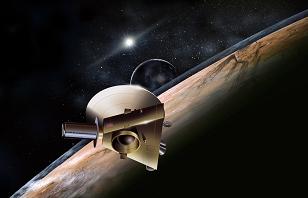
The third segment of the voyage consists mainly of spacecraft and instrument checkouts, trajectory corrections, instrument calibrations, and Pluto encounter rehearsals. This part of the voyage lasts for 8 years and is the current segment of the mission.
The Pluto-Charon encounter is planned for July 14th, 2015.
In the Kuiper Belt, plans are for one or two encounters with Kuiper Belt Objects (KBOs). These objects would be in the 40 to 90 kilometer size range and New Horizons would acquire the same data it collected during the Pluto-Charon encounter and send it back to Earth for analysis.
 |
| Credits: JHUAPL / SwRI |
New Horizons is a small spacecraft. It weighs 478 kilograms in total, of which 77 kilograms is the hydrazine fuel, and 30 kilograms the scientific instruments. It measures 0.7×2.1×2.7 meters.
For communication with Earth, the spacecraft is using a 2.1 meter high-gain antenna. The data transfer rate is 38 kilobits per second at Jupiter, and 0.6 to 1.2 kilobits per second at Pluto. The data gathered during the encounter with Pluto will take 9 months to transmit back to Earth.
The scientific payload of the spacecraft draws less than 28 Watts of power. The mission uses a radioisotope thermoelectric generator (RTG) for power generation. The RTG contains 11 kilograms of plutonium dioxide. At the start of the mission, the RTG provided 240 Watts of energy at 30 Volts. Due to the decay of the plutonium, the power output decreases during the mission, and by the time of the Pluto encounter the RTG will only produce about 200 Watts.
The scientific instruments that were selected meet the mission’s goals. NASA set out a list of things it wanted to know about Pluto: the composition and behavior of the atmosphere, the appearance of the surface, the geological structures on the surface of Pluto, etc. The scientific payload contains seven instruments.
 |
| Credits: NASA |
Ralph is a visible and infrared imager/spectrometer. It will obtain high-resolution color maps and surface composition maps of the surfaces of Pluto and Charon.
Alice is an ultraviolet imaging spectrometer. It will be used to analyze the composition and the structure of Pluto’s atmosphere and to look for atmospheres around Charon and Kuiper Belt Objects (KBOs).
REX is the Radio Science Experiment. It is a passive radiometer that measures atmospheric composition and temperature by using what is called an occultation technique: after passing Pluto, the spacecraft will point its antenna back to Earth and record the transmissions sent by the NASA’s DSN. The alterations of the transmissions caused by Pluto’s atmosphere will be recorded and sent back to Earth for analysis. REX will also be used to measure weak radio emissions from Pluto itself.
LORRI stands for Long Range Reconnaissance Imager. It is a telescopic camera and it will be used to obtain encounter data at long distances, to map Pluto’s far side and to provide high-resolution geologic data. LORRI will take images having 100-meter resolution.
SWAP, the solar wind and plasma spectrometer, stands for Solar Wind Around Pluto. It will measure the atmospheric escape rate and it will observe Pluto’s interaction with solar wind, determining whether Pluto has a magnetosphere or not.
 |
| Credits: NASA / JHUAPL |
PEPSSI, Pluto Energetic Particle Spectrometer Science Investigation, is an energetic particle spectrometer used to measure the composition and density of plasma (ions) escaping from Pluto’s atmosphere.
SDC is the Student Dust Counter. It is the first scientific instrument built by students mounted on a space probe. It measures the space dust impacting the spacecraft during the voyage across the solar system, recording the count and the size of dust particles. It was built primarily by students from the University of Colorado in Boulder, with supervision from scientists.





 Subscribe to blog posts using RSS












