


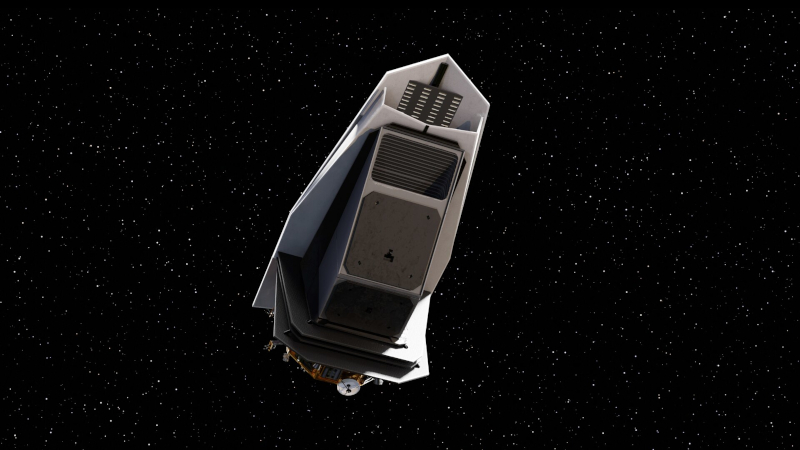
At a facility in Logan, Utah, engineers and scientists are assembling a spacecraft designed for a specific and increasingly important purpose: finding potentially hazardous objects before they find Earth. NEO Surveyor, NASA’s first space telescope built specifically for planetary defense, has now entered integration and testing at Utah State University’s Space Dynamics Laboratory. With a launch targeted no earlier than September 2027, the mission is transitioning from design and subsystem development into full spacecraft assembly and operational validation.
The mission addresses a well-defined problem in planetary science and risk management. Near-Earth objects, or NEOs, are asteroids and comets whose orbits bring them close to Earth’s orbital path around the Sun. Most are harmless, but some are large enough that an impact could produce severe regional or global consequences. The challenge is not only detecting these objects, but accurately determining their size, composition, trajectory, and long-term orbital evolution.
Traditional asteroid surveys rely heavily on visible-light telescopes. These systems detect sunlight reflected from an object’s surface. While effective, visible-light observations introduce ambiguity because brightness depends on both size and reflectivity. A small, highly reflective asteroid can appear similar to a much larger, darker one. This uncertainty complicates risk assessment.
NEO Surveyor approaches the problem differently by observing in the infrared. Instead of measuring reflected sunlight, the telescope measures thermal radiation emitted by objects themselves. Every object with a temperature above absolute zero emits infrared energy, and the intensity of that radiation depends strongly on the object’s size and temperature. By observing thermal emission directly, astronomers can estimate asteroid size with much greater accuracy than visible-light observations alone allow.
The spacecraft uses two heat-sensitive infrared imaging channels optimized for detecting and characterizing NEOs. These detectors operate at wavelengths where asteroids emit strongly after being heated by sunlight. The engineering challenge is substantial because infrared instruments are extremely sensitive to heat generated by the spacecraft itself. Any excess thermal emission from onboard systems can overwhelm faint asteroid signals.
To address this, NEO Surveyor incorporates a carefully designed thermal architecture. Passive cooling systems, including sunshields and radiative surfaces, help maintain the telescope and detectors at low temperatures. The observatory’s orientation relative to the Sun is tightly controlled to minimize thermal loading. This thermal stability is critical for detector sensitivity and calibration consistency over the mission lifetime.
The mission’s observing location also plays an important role. NEO Surveyor is expected to operate near the Sun-Earth L1 Lagrange point, a gravitationally stable region approximately 1.5 million kilometers from Earth toward the Sun. From this location, the telescope can maintain a continuous view of space near Earth’s orbit while operating in a thermally stable environment. The vantage point also allows the observatory to detect objects approaching from directions difficult to observe from Earth-based telescopes, particularly those coming from the daytime side of the sky.
The science objectives are directly tied to NASA’s planetary defense strategy. During its five-year baseline mission, NEO Surveyor aims to detect at least two-thirds of near-Earth objects larger than approximately 460 feet, or 140 meters, in diameter. Objects of this scale are considered capable of causing major regional damage in the event of an impact. Identifying and tracking them significantly improves Earth’s preparedness and response options.
Detection alone, however, is only part of the mission. The infrared data collected by NEO Surveyor will also help characterize asteroid composition and physical properties. By measuring thermal behavior over time, scientists can infer surface characteristics such as roughness and thermal inertia. Combined with rotational observations, these measurements provide insight into shape, spin state, and internal structure.
This information is scientifically valuable beyond planetary defense. Asteroids are remnants of the early Solar System, preserving material from the era of planetary formation. Their compositions reveal details about the distribution of minerals, volatiles, and organic compounds billions of years ago. Understanding asteroid populations also improves models of Solar System dynamics and long-term orbital evolution.
The engineering effort behind NEO Surveyor extends beyond the spacecraft itself. The mission will generate extremely large volumes of observational data, requiring advanced processing systems capable of identifying moving objects against dense stellar backgrounds. Software pipelines are being developed to automatically detect candidate NEOs, correlate repeated observations, and calculate preliminary orbits.
This data-processing challenge is significant because asteroids move relative to background stars, often appearing as faint, shifting points of light. Algorithms must distinguish genuine moving objects from detector noise, cosmic ray events, and background artifacts. Once detections are confirmed, orbital determination software calculates trajectories and predicts future positions. These calculations must account for gravitational interactions with planets and subtle non-gravitational effects such as the Yarkovsky effect, where uneven thermal emission gradually alters an asteroid’s orbit over time.
Integration and testing at the Space Dynamics Laboratory represent the stage where these systems begin operating together as a unified observatory. Spacecraft structure, avionics, thermal systems, detectors, and software must all function as an integrated system under simulated launch and space conditions. Environmental testing will expose the observatory to vibration, acoustic loads, vacuum conditions, and thermal extremes to verify readiness for launch and long-duration operation.
Reliability is especially important for a planetary defense mission. NEO Surveyor is intended to operate continuously for years with minimal intervention. Detector calibration, pointing accuracy, onboard data handling, and communication systems must remain stable over extended periods. Even small degradations in sensitivity or pointing precision can affect detection performance for faint objects.
The broader significance of NEO Surveyor lies in its role as infrastructure for planetary defense. Previous asteroid discoveries have largely come from general-purpose astronomical surveys. NEO Surveyor is different because it is purpose-built. Every aspect of the observatory—from wavelength selection to orbital placement—is optimized for detecting hazardous objects efficiently and systematically.
This represents a maturation of planetary defense from a research activity into an operational capability. Instead of relying on incidental discoveries, the mission establishes a dedicated system for identifying and tracking threats. The earlier a hazardous object is detected, the more response options become available, ranging from evacuation planning to potential deflection missions.
As assembly and testing continue toward launch readiness, NEO Surveyor is moving closer to becoming a permanent observational asset for Earth. Its task is straightforward in concept but demanding in execution: continuously scan the Solar System for objects that could one day intersect our planet’s path.
In practical terms, the mission is about measurement and detection. In strategic terms, it is about reducing uncertainty. By expanding humanity’s ability to identify and characterize near-Earth objects, NEO Surveyor strengthens the scientific and technical foundation of planetary defense while also deepening our understanding of the Solar System’s small-body population.


 Subscribe to blog posts using RSS












