OrbitalHub

The place where space exploration, science, and engineering meet

Domain is for sale. $50,000,000.00 USD. Direct any inquiries to contact@orbitalhub.com.

10-17-17

Farewell to Mimas

Posted by


NASA dixit:

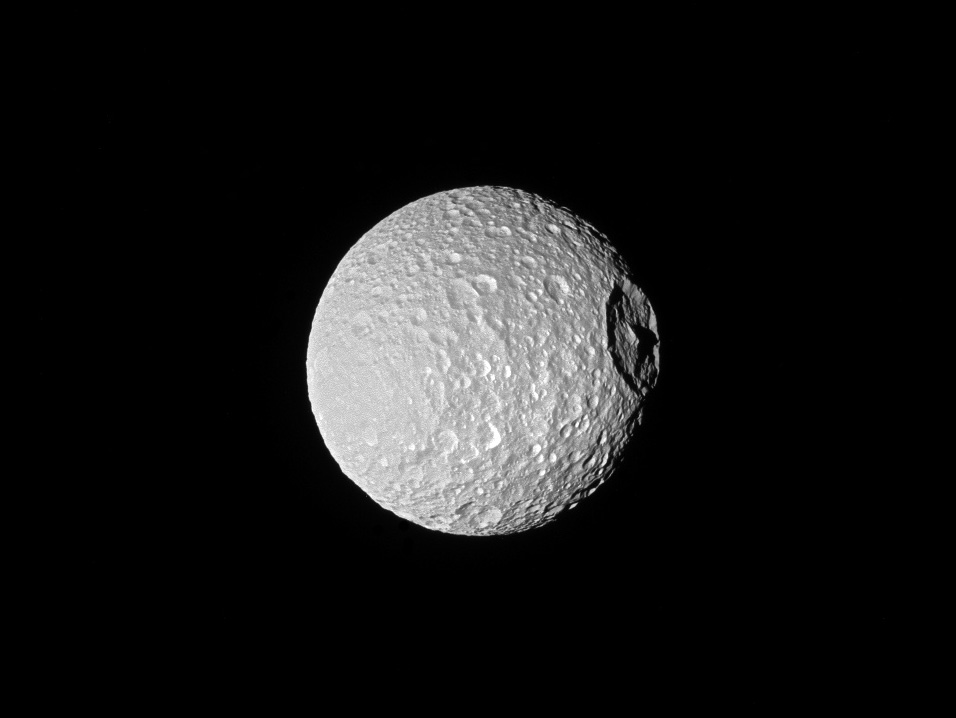
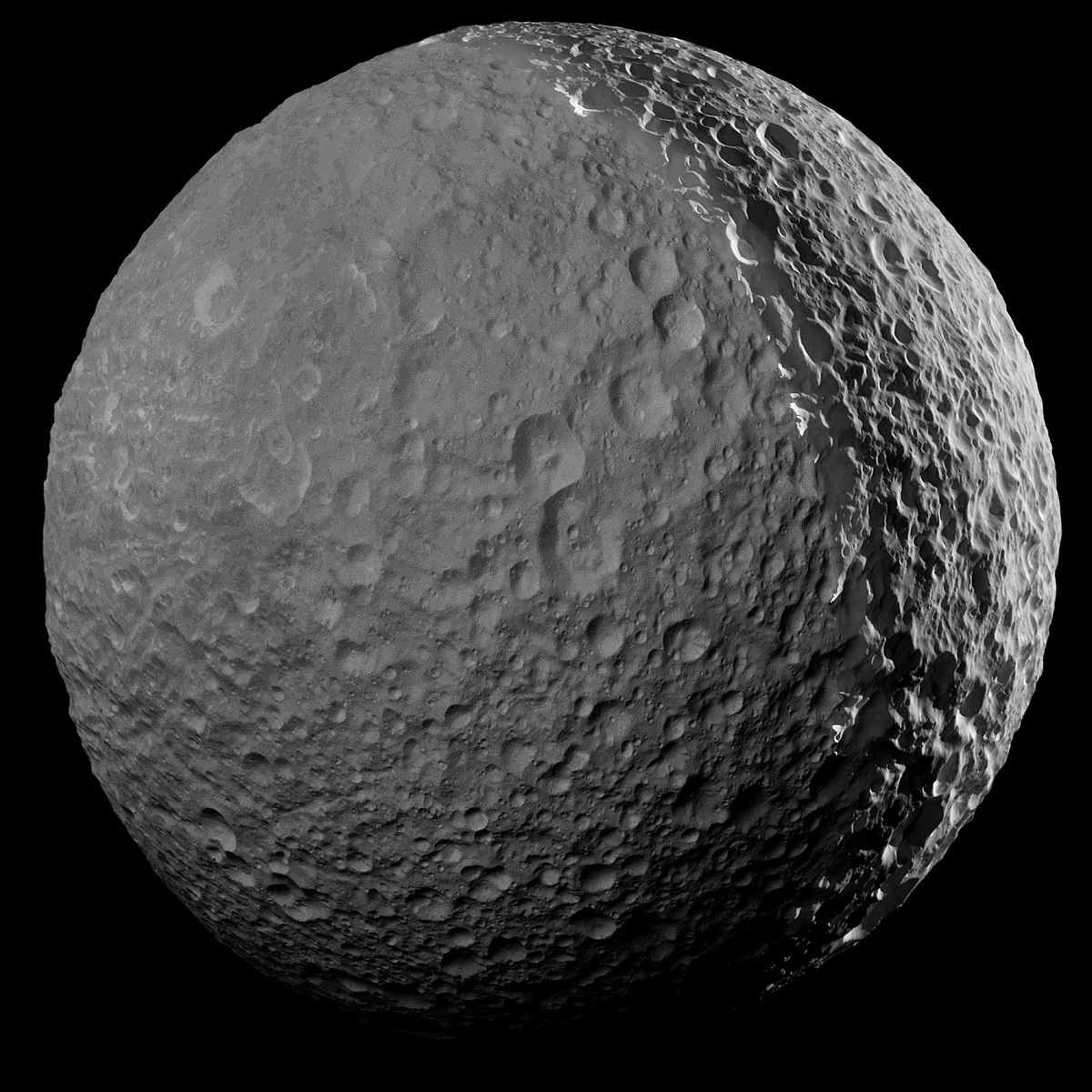
“January 30, 2017. In its season of “lasts,” NASA’s Cassini spacecraft made its final close approach to Saturn’s moon Mimas. At closest approach, Cassini passed 25,620 miles (41,230 kilometers) from Mimas. This mosaic is one of the highest resolution views ever captured of the icy moon. Close approaches to Mimas have been somewhat rare during Cassini’s mission, with only seven flybys at distances of less than 31,000 miles (50,000 kilometers).

Mimas’ surface is pockmarked with countless craters, the largest of which gives the icy moon its distinctive appearance. The left side, which is lit by reflected light from Saturn, has been enhanced in brightness in order to show the full surface. Imaging scientists combined ten narrow-angle camera images to create this mosaic view. The scene is an orthographic projection centered on terrain at 17.5 degrees south latitude, 325.4 degrees west longitude on Mimas. An orthographic view is most like the view seen by a distant observer looking through a telescope.

This mosaic was acquired at a distance of approximately 28,000 miles (45,000 kilometers) from Mimas. Image scale is approximately 820 feet (250 meters) per pixel. The images were taken in visible light with the Cassini spacecraft narrow-angle camera.”

Image credit: NASA/JPL-Caltech/Space Science Institute


  • Facebook
  • Google
  • Slashdot
  • Reddit
  • Live
  • TwitThis
10-10-17

Mimas’ Mountain

Posted by


NASA dixit:

“October 22, 2016. Shadows cast across Mimas’ defining feature, Herschel Crater, provide an indication of the size of the crater’s towering walls and central peak. Named after the icy moon’s discoverer, astronomer William Herschel, the crater stretches 86 miles (139 kilometers) wide, almost one-third of the diameter of Mimas (246 miles or 396 kilometers) itself. Large impact craters often have peaks in their center. Herschel’s peak stands nearly as tall as Mount Everest on Earth.

This view looks toward the anti-Saturn hemisphere of Mimas. North on Mimas is up and rotated 21 degrees to the left. The image was taken with the Cassini spacecraft narrow-angle camera using a combination of spectral filters which preferentially admits wavelengths of ultraviolet light centered at 338 nanometers. The view was acquired at a distance of approximately 115,000 miles (185,000 kilometers) from Mimas and at a Sun-Mimas-spacecraft, or phase, angle of 20 degrees. Image scale is 3,300 feet (1 kilometer) per pixel.”

Image credit: NASA/JPL-Caltech/Space Science Institute


  • Facebook
  • Google
  • Slashdot
  • Reddit
  • Live
  • TwitThis
10-3-17

Three Times the Fun

Posted by


NASA dixit:

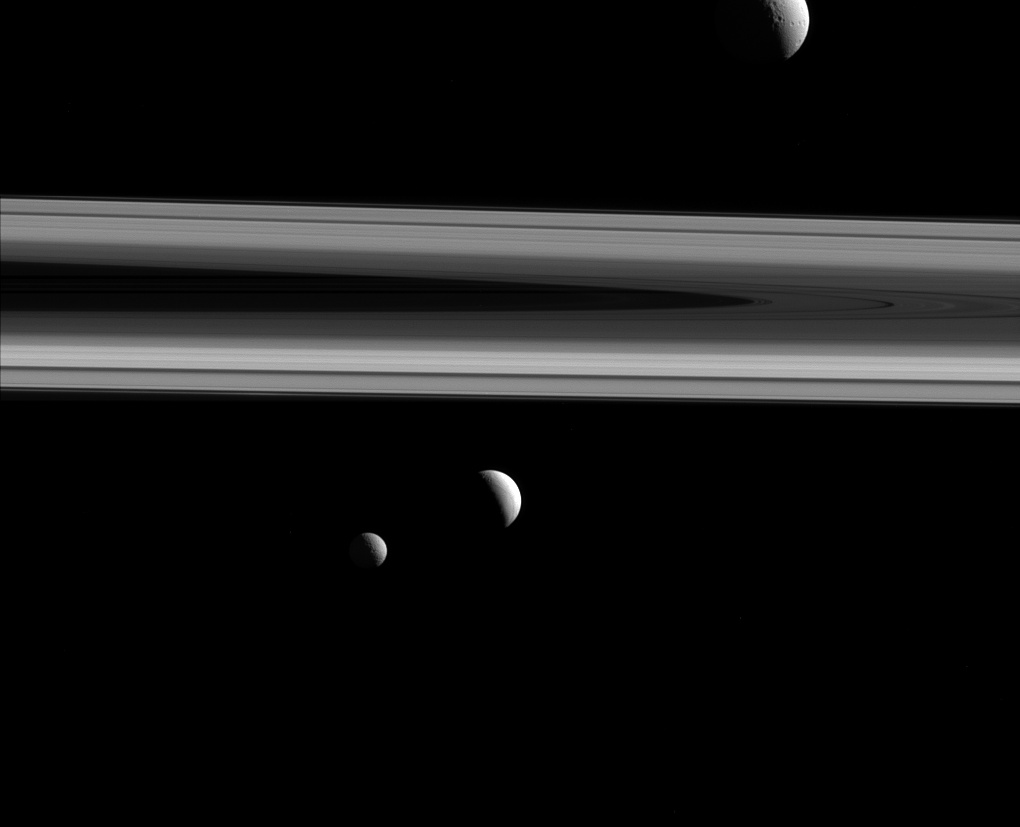
“December 3, 2015. Three of Saturn’s moons, Tethys, Enceladus, and Mimas, are captured in this group photo from NASA’s Cassini spacecraft. Tethys (660 miles or 1062 kilometers across) appears above the rings, while Enceladus (313 miles or 504 kilometers across) sits just below center. Mimas (246 miles or 396 kilometers across) hangs below and to the left of Enceladus.

This view looks toward the sunlit side of the rings from about 0.4 degrees above the ring plane. The image was taken in visible light with the Cassini spacecraft narrow-angle camera. The view was acquired at a distance of approximately 837,000 miles (1.35 million kilometers) from Enceladus, with an image scale of 5 miles (8 kilometers) per pixel. Tethys was approximately 1.2 million miles (1.9 million kilometers) away with an image scale of 7 miles (11 kilometers) per pixel. Mimas was approximately 1.1 million miles (1.7 million kilometers) away with an image scale of 6 miles (10 kilometers) per pixel.”

Image credit: NASA/JPL-Caltech/Space Science Institute


  • Facebook
  • Google
  • Slashdot
  • Reddit
  • Live
  • TwitThis
09-14-17

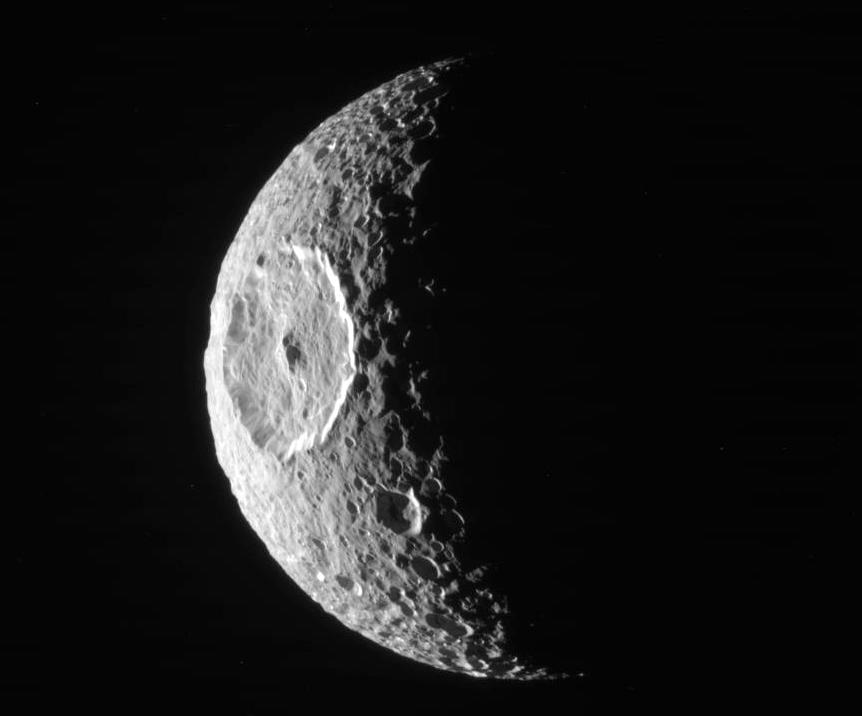
Crescent Mimas

Posted by


NASA dixit:

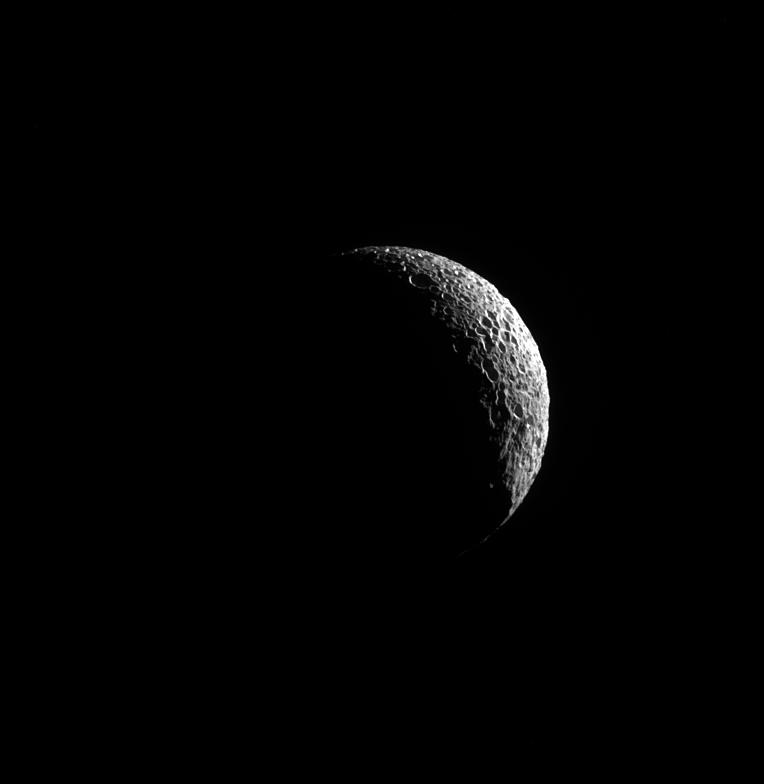
“May 20, 2013. A thin sliver of Mimas is illuminated, the long shadows showing off its many craters, indicators of the moon’s violent history. The most famous evidence of a collision on Mimas (246 miles, or 396 kilometers across) is the crater Herschel that gives Mimas its Death Star-like appearance. This view looks toward the anti-Saturn hemisphere of Mimas. North on Mimas is up and rotated 40 degrees to the right. The image was taken in visible light with the Cassini spacecraft narrow-angle camera.

The view was acquired at a distance of approximately 100,000 miles (200,000 kilometers) from Mimas and at a Sun-Mimas-spacecraft, or phase, angle of 130 degrees. Image scale is 4,000 feet (1 kilometer) per pixel.”

“After almost 20 years in space, NASA’s Cassini spacecraft begins the final chapter of its remarkable story of exploration: its Grand Finale. Between April and September 2017, Cassini will undertake a daring set of orbits that is, in many ways, like a whole new mission. Following a final close flyby of Saturn’s moon Titan, Cassini will leap over the planet’s icy rings and begin a series of 22 weekly dives between the planet and the rings.

No other mission has ever explored this unique region. What we learn from these final orbits will help to improve our understanding of how giant planets – and planetary systems everywhere – form and evolve.

On the final orbit, Cassini will plunge into Saturn’s atmosphere, sending back new and unique science to the very end. After losing contact with Earth, the spacecraft will burn up like a meteor, becoming part of the planet itself.

Cassini’s Grand Finale is about so much more than the spacecraft’s final dive into Saturn. That dramatic event is the capstone of six months of daring exploration and scientific discovery. And those six months are the thrilling final chapter in a historic 20-year journey.”

Image credit: NASA


  • Facebook
  • Google
  • Slashdot
  • Reddit
  • Live
  • TwitThis
08-29-17

Rings In Between

Posted by


NASA dixit:

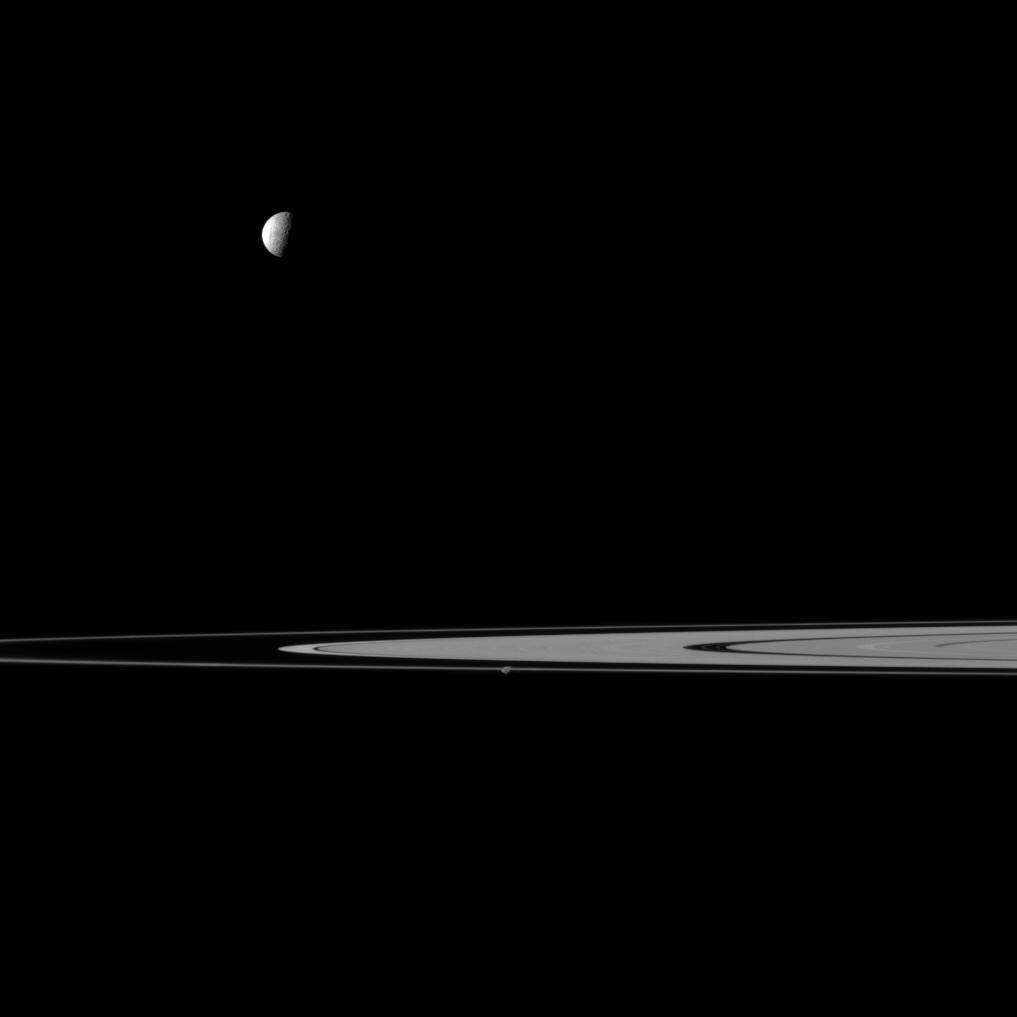
“November 4, 2011. Saturn’s rings lie between a pair of moons in this Cassini spacecraft view that features Mimas and Prometheus. Mimas (246 miles or 396 kilometers across) is the more noticeable of the two moons and is in the top left of the view. The smaller moon Prometheus (53 miles, or 86 kilometers across) is near the center of the image and is closest to Cassini. Mimas is beyond the rings and farthest from the spacecraft. Lit terrain seen on Mimas is on the leading hemisphere of the moon. This view looks toward the northern, sunlit side of the rings from just above the ringplane.

The image was taken in visible light with the Cassini spacecraft narrow-angle camera. The view was acquired at a distance of approximately 746,000 miles (1.2 million kilometers) from Prometheus and 870,000 miles (1.4 million kilometers) from Mimas. Image scale is 4 miles (7 kilometers) per pixel on Prometheus and 5 miles (8 kilometers) per pixel on Mimas.”

“After almost 20 years in space, NASA’s Cassini spacecraft begins the final chapter of its remarkable story of exploration: its Grand Finale. Between April and September 2017, Cassini will undertake a daring set of orbits that is, in many ways, like a whole new mission. Following a final close flyby of Saturn’s moon Titan, Cassini will leap over the planet’s icy rings and begin a series of 22 weekly dives between the planet and the rings.

No other mission has ever explored this unique region. What we learn from these final orbits will help to improve our understanding of how giant planets – and planetary systems everywhere – form and evolve.

On the final orbit, Cassini will plunge into Saturn’s atmosphere, sending back new and unique science to the very end. After losing contact with Earth, the spacecraft will burn up like a meteor, becoming part of the planet itself.

Cassini’s Grand Finale is about so much more than the spacecraft’s final dive into Saturn. That dramatic event is the capstone of six months of daring exploration and scientific discovery. And those six months are the thrilling final chapter in a historic 20-year journey.”

Image credit: NASA


  • Facebook
  • Google
  • Slashdot
  • Reddit
  • Live
  • TwitThis
08-11-17

Mimas

Posted by


NASA dixit:

“October 16, 2010. NASA’s Cassini spacecraft obtained this raw image of the moon Mimas just before Mimas went into shadow behind Saturn. The camera was approximately 101,552 kilometers (63,1010 miles) away.”

“After almost 20 years in space, NASA’s Cassini spacecraft begins the final chapter of its remarkable story of exploration: its Grand Finale. Between April and September 2017, Cassini will undertake a daring set of orbits that is, in many ways, like a whole new mission. Following a final close flyby of Saturn’s moon Titan, Cassini will leap over the planet’s icy rings and begin a series of 22 weekly dives between the planet and the rings.

No other mission has ever explored this unique region. What we learn from these final orbits will help to improve our understanding of how giant planets – and planetary systems everywhere – form and evolve.

On the final orbit, Cassini will plunge into Saturn’s atmosphere, sending back new and unique science to the very end. After losing contact with Earth, the spacecraft will burn up like a meteor, becoming part of the planet itself.

Cassini’s Grand Finale is about so much more than the spacecraft’s final dive into Saturn. That dramatic event is the capstone of six months of daring exploration and scientific discovery. And those six months are the thrilling final chapter in a historic 20-year journey.”

Image credit: NASA


  • Facebook
  • Google
  • Slashdot
  • Reddit
  • Live
  • TwitThis