OrbitalHub

The place where space exploration, science, and engineering meet

Domain is for sale. $50,000,000.00 USD. Direct any inquiries to contact@orbitalhub.com.


Wikipedia dixit:

“The John F. Kennedy Space Center (KSC) is one of ten National Aeronautics and Space Administration field centers. Since December 1968, Kennedy Space Center has been NASA’s primary launch center of human spaceflight. Launch operations for the Apollo, Skylab and Space Shuttle programs were carried out from Kennedy Space Center Launch Complex 39 and managed by KSC. Located on the east coast of Florida, KSC is adjacent to Cape Canaveral Air Force Station (CCAFS). The management of the two entities work very closely together, share resources, and even own facilities on each other’s property.

Though the first Apollo flights, and all Project Mercury and Project Gemini flights took off from CCAFS, the launches were managed by KSC and its previous organization, the Launch Operations Directorate. Starting with the fourth Gemini mission, the NASA launch control center in Florida (Mercury Control Center, later the Launch Control Center) began handing off control of the vehicle to the Mission Control Center shortly after liftoff; in prior missions it held control throughout the entire mission.

Additionally, the center manages launch of robotic and commercial crew missions and researches food production and In-Situ Resource Utilization for off-Earth exploration. Since 2010, the center has worked to become a multi-user spaceport through industry partnerships, even adding a new launch pad (LC-39C) in 2015.

There are about 700 facilities grouped across the center’s 144,000 acres. Among the unique facilities at KSC are the 525 ft tall Vehicle Assembly Building for stacking NASA’s largest rockets, the Operations and Checkout Building, which houses the astronaut crew quarters, and 3-mile-long Shuttle Landing Facility. There is also a Visitor Complex open to the public on site.”

Video credit: NASA


  • Facebook
  • Google
  • Slashdot
  • Reddit
  • Live
  • TwitThis


NASA dixit:

“NASA’s Cassini spacecraft arrived at Kennedy Space Center 20 years ago to begin processing for launch on a mission that would see it deliver spectacular images and data from the ringed planet Saturn. As the massive spacecraft begins its final chapter, engineers at Kennedy took a look back to how their contributions to the mission began.”

Video credit: NASA


  • Facebook
  • Google
  • Slashdot
  • Reddit
  • Live
  • TwitThis


NASA dixit:

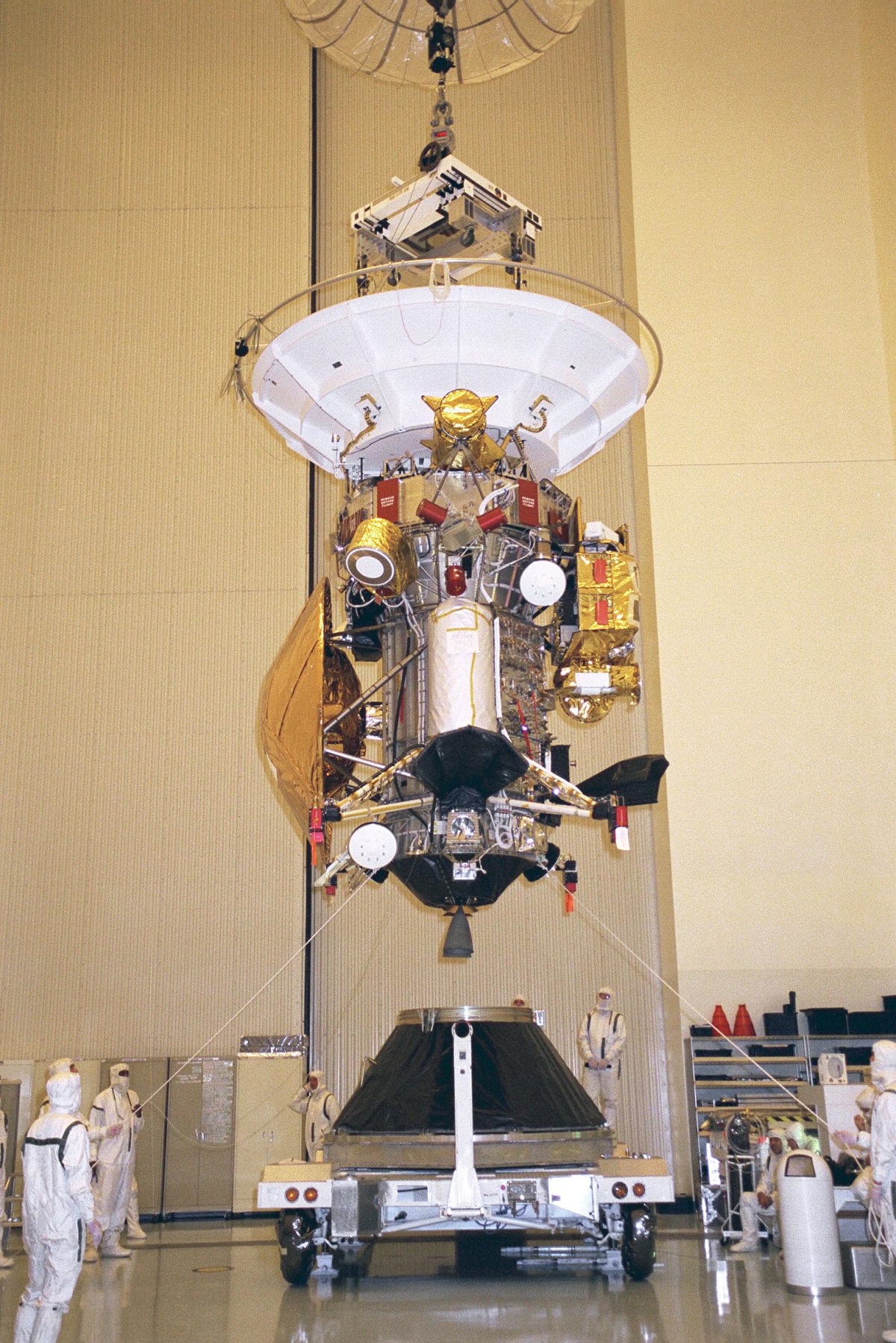
“July 22, 1997. Flight mechanics from NASA’s Jet Propulsion Laboratory (JPL) in Pasadena, Calif., lower the Cassini spacecraft onto its launch vehicle adapter in KSC’s Payload Hazardous Servicing Facility. The adapter will later be mated to a Titan IV/Centaur expendable launch vehicle that will lift Cassini into space. Scheduled for launch in October, the Cassini mission, a joint US-European four-year orbital surveillance of Saturn’s atmosphere and magnetosphere, its rings, and its moons, seeks insight into the origins and evolution of the early solar system. It will take seven years for the spacecraft to reach Saturn. JPL is managing the Cassini project for NASA.”

“After almost 20 years in space, NASA’s Cassini spacecraft begins the final chapter of its remarkable story of exploration: its Grand Finale. Between April and September 2017, Cassini will undertake a daring set of orbits that is, in many ways, like a whole new mission. Following a final close flyby of Saturn’s moon Titan, Cassini will leap over the planet’s icy rings and begin a series of 22 weekly dives between the planet and the rings.

No other mission has ever explored this unique region. What we learn from these final orbits will help to improve our understanding of how giant planets – and planetary systems everywhere – form and evolve.

On the final orbit, Cassini will plunge into Saturn’s atmosphere, sending back new and unique science to the very end. After losing contact with Earth, the spacecraft will burn up like a meteor, becoming part of the planet itself.

Cassini’s Grand Finale is about so much more than the spacecraft’s final dive into Saturn. That dramatic event is the capstone of six months of daring exploration and scientific discovery. (And those six months are the thrilling final chapter in a historic 20-year journey.)”

Image credit: NASA


  • Facebook
  • Google
  • Slashdot
  • Reddit
  • Live
  • TwitThis
06-14-09

Node 3 Welcomed At KSC

Posted by


Credits: ESA


The Kennedy Space Center has officially welcomed Node 3. Node 3 is a European-built module for the International Space Station (ISS). The prime contractor chosen for the job was Thales Alenia Space, in Turin, Italy.


Node 3 was transported from Italy by an Airbus Beluga aircraft. The aircraft left Turin on May 17, and arrived in Florida on May 20.


Node 3 is now being prepared for the journey to the ISS in the Space Station Processing Facility (SSPF) at KSC.


Node 3 is a connecting module. With a length of 6.7 m and 4.4 m in diameter, Node 3 will have a total mass of 19,000 kg once berthed to the ISS. Node 3 will eventually house the life support system necessary for the permanent crew of six on the space station. On one of its berthing ports, Node 3 will accommodate the Cupola. Node 3 also provides room for eight refrigerator-size racks. Two of these racks will be used by avionics systems controlling the node.


Credits: ESA


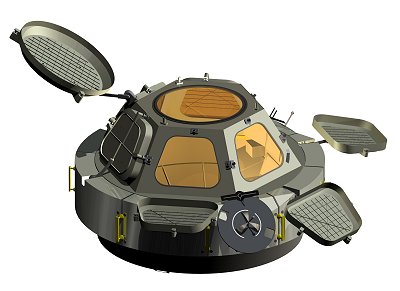
Cupola is an observation module. Once attached to Node 3, it will provide a pressurized observation and work area for two ISS crew members. Cupola will allow the crew to control the space station remote manipulator system through the robotic workstation. Cupola has a mass of 1,880 kg, a height of 1.5 m, and it has a maximum diameter of 2.9 m. The windows are protected by a Micro-meteorid and orbital Debris Protection System (MDPS), which consists of shutters made out of aluminum coated with Kevlar.


Node 3 will be launched inside the Orbiter cargo bay, mounted on a pallet via a Manual Berthing Mechanism, and transferred to the Node location using the Shuttle Remote Manipulator System.


“Node 3 represents a turning point for the International Space Station,” said Simonetta Di Pippo, ESA Director of Human Spaceflight. “By having accomplished the development of the ISS modules and by completing its assembly in the months to come we open a new avenue of cooperation and exploration that will take humankind back to the Moon and beyond to other destinations while continuing to exploit the enormous possibilities in low Earth orbit.”


Credits: ESA


NASA has chosen the name Tranquility for Node 3, after the Sea of Tranquility, landing site of Apollo 11 in 1969. Colbert had to settle for having one of the treadmills onboard ISS named after him.


Node 3 and Cupola are scheduled to be delivered to the ISS by STS-130 Space Shuttle Endeavour in early 2010.


You can find out more about Node 3 and Cupola on the page dedicated to the ISS on ESA’s web site.


  • Facebook
  • Google
  • Slashdot
  • Reddit
  • Live
  • TwitThis